
Business
New SL Sovereign Bonds win foreign investor confidence

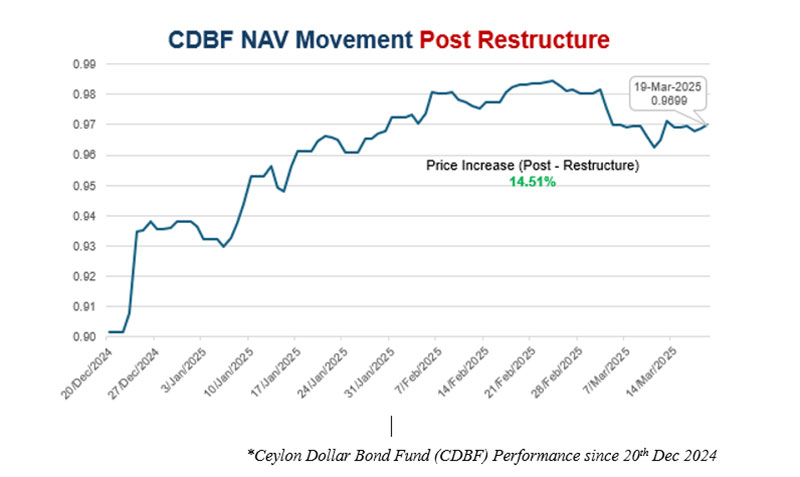
Sri Lanka’s country rating was upgraded from ‘Restricted Default’ to ‘CCC’ following the successful exchange for the new International Sovreign Bonds (SL ISBs) during December 2024. The three types (03) of exciting new sovereign bonds have restored foreign investor confidence.
The Central Bank of Sri Lanka (CBSL) has performed a remarkable role in guiding the economy out of default status and restored economic stability, and gained Sri Lanka a non-default Country Rating of ‘CCC’. Among the key achievements of CBSL, have been to reduce treasury interest rates under 9% and stabilize the currency while rebuilding foreign reserves to $ 6Bn.
SL offers four Macro Linked Bonds (MLBs) linked to GDP growth, a Governance Linked Bond (GLB) and a short term, Fixed Coupon Bond for unpaid Past Due Interest (PDI). The MLBs offer variable returns depending on SL’s GDP growth from 2024 to 2027, (e.g. haircuts can vary between 16% to 39%). The GLB interest can vary depending on meeting 15.3% and 15.4% of Total Revenue/ GDP thresholds in 2026 and 2027 respectively. The PDI bond offers a fixed coupon of 4% until 2028 and trades at around $94.
This combination of unique, variable returns offers global investors an exciting opportunity to capitalize on SL’s economic revival and US interest rate movements. Sri Lanka’s economic resurgence in 2024 was promising, with a 5% GDP growth rate. With improving investor confidence, SL ISB daily turnover now exceeds $10mn.
The Ceylon Dollar Bond Fund (CDBF) is the only USD Sovereign Bond Fund that is exclusively invested in SL ISBs with Deutsche Bank acting as the Trustee and Custodian Bank. The Fund reported returns of 53% in 2023 and 39% in 2024.
We invite foreign investors to enter CDBF while Sri Lanka is rated at ‘CCC’ and consider realizing their investment upon SL reaching a Country Rating of ‘B- ‘. Other advantages of CDBF are, the ability to withdraw anytime and being tax exempted.
Ceylon Asset Management (CAM), the Fund Manager, has commenced an advertising campaign to promote the CDBF to the Sri Lankan Diaspora, South Asian, Middle Eastern and Australian Investors. CAM is an Associate Company of Sri Lanka Insurance Corporation (SLIC) and licensed under the Securities and Exchange Commission of Sri Lanka Act, No. 19 of 2021.
Meanwhile, the Ceylon Financial Sector Fund managed by CAM emerged as the top performing rupee fund in Sri Lanka during 2024, with a return of 64%. Investors can find out more on www.ceylonassetmanagement.com or write to us on info@ceylonam.com.
Past performance is not an indicator of the future performance. Investors are advised to read and understand the contents of the KIID on www.ceylonam.com before investing. Among others investors shall consider the fees and charges involved.(CAM)

HNB Life PLC has delivered a robust performance in the first quarter of 2026, recording a 54% year-on-year increase in Gross Written Premium (GWP) to Rs. 7.01 billion, up from Rs. 4.55 billion in Q1 2025. Net Written Premium rose by a matching 54% to Rs. 6.69 billion, reflecting strong new business generation and policy persistency.
Total net income grew 39% to Rs. 8.69 billion, supported by solid underwriting and steady investment income, including Rs. 2.05 billion from interest and dividends. The company’s balance sheet remains resilient, with total assets reaching Rs. 71.38 billion and the Life Insurance Fund expanding to Rs. 52.55 billion.
Profit after tax stood at Rs. 0.21 billion, though profitability was tempered by a low-interest rate environment and fair value fluctuations in the equity portfolio. No surplus transfer from the Life Insurance Fund has been made yet, as this typically follows year-end valuation.
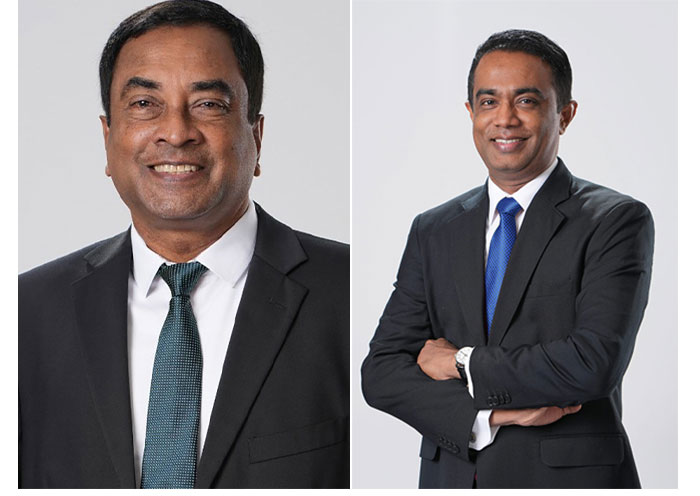
Chairman Stuart Chapman attributed the momentum to the company’s recent rebranding and its strategic alignment with the Hatton National Bank Group. CEO Lasitha Wimalaratne emphasized disciplined execution, digital enablement, and enhanced distribution as key drivers.
HNB Life, rated ‘A’ (lka) by Fitch, marks 25 years as one of Sri Lanka’s fastest-growing life insurers, operating 79 branches nationwide. The company remains well-positioned for sustainable long-term growth.
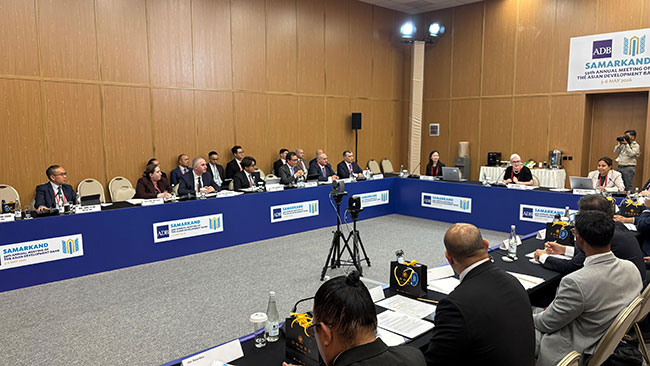
The atmosphere in Samarkand, Uzbekistan, during the 59th Annual Meeting of the Asian Development Bank (ADB) was nothing short of electric. Walking through the Silk Road Samarkand complex – a venue steeped in the history of ancient global trade – one could easily feel the weight of past legacies. “More pressing, however, was the palpable urgency of the future, as the halls of the Congress Center resonated with strategic discussions on ‘Asia’s Second Growth Leap.'” The global narrative was unmistakable: the talk of post-crisis recovery was no longer relevant. For Sri Lanka, the echoing message from Samarkand was both a warning and an invitation: the transition from an aid-recipient mindset to a competitive global partner is no longer a choice. It is our only survival mechanism.
While delegates from across the region shared aggressive blueprints for economic acceleration, the absence of Sri Lankan policymakers was a stark reality. Other Asian nations did not speak of mere “potential”; they spoke of velocity.
In Samarkand, the ancient gateway of the Silk Road, the irony was impossible to ignore. As regional leaders debated the deployment of an Interconnected Pan-Asia Grid to revolutionise energy integration, discussed how deep capital markets must drive development, and outlined strategies to scale up investments from critical minerals to advanced manufacturing value chains, a troubling realisation set in. The world is moving at lightning speed on digital highways for inclusive growth, yet Sri Lanka remains haunted by the ghost of political and bureaucratic “dilly-dallying.”
The true “Samarkand Spirit” demands an immediate, radical shift in our national mindset. Sri Lanka must aggressively shed its “crisis” label. The high-level discourse in Uzbekistan focused entirely on how emerging economies can stop begging for economic concessions and start delivering regional solutions.
Whether the focus was on maximising opportunities within the Regional Comprehensive Economic Partnership (RCEP) or financing large-scale offshore wind projects, the core directive for our nation remained constant: Sri Lanka must stop looking for a hand-out and start building an economic bridge.
The ADB has laid out the catalytic pathway for the Asia-Pacific’s second growth phase. The infrastructure, the capital, and the frameworks are ready. The burning question for Sri Lanka’s policymakers is simple: Are we ready to execute, or are we content with stagnation?
Leaving Uzbekistan, the takeaway for our leadership is vivid and uncompromising. Decisive action is the sole currency of the new Asian century.
To bridge the gap between the historic Silk Road and the strategic Indian Ocean, Sri Lanka must:
Accelerate Digitisation: Swiftly overhaul bureaucratic frameworks to create a seamless, trusted digital economy.
Integrate Energy Grid Connectivity: Boldly plug into the regional grid networks discussed at the summit to resolve long-term energy insecurity.
Plug into Global Supply Chains: Pivot aggressively toward high-value manufacturing and regional trade agreements.
The 59th ADB Annual Meeting proved that the international community is ready to partner with a competitive, forward-thinking Sri Lanka. We possess the geographic location and the inherent talent. Now, post-Samarkand, we have the definitive roadmap.
The “Second Leap” of the Asia-Pacific region is already in motion. The ultimate test for Sri Lanka’s policymakers is whether they will lead the country into this dynamic new era or leave us observing fruitlessly from the sidelines.
By Sanath Nanayakkare

Here is the point that carries more weight than the headline PMI figures released by the Central Bank of Sri Lanka. While much of April’s contraction in manufacturing (42.6) and services (46.7) was dismissed as seasonal — the Sinhala and Tamil New Year holidays, fewer working days, fading festive demand — the rupture in new business flows tells a different, more troubling tale.
April 2026 marked the first month since April 2023 that services sector new business contracted. Not a slowdown. Not a plateau. An outright decline. Nor was it narrow in scope. The deterioration cut across transportation of goods, insurance, wholesale and retail trade, and accommodation, food and beverage service activities.
The Island Financial Review asked an independent analyst for his take. Here is what he said.
“These are not fringe sub-sectors; they are the arteries of Sri Lanka’s domestic economy. Why does this matter beyond the seasonal logic? Because new business is a leading indicator. What falls today in new orders will show up tomorrow in production, employment and stock purchases. April’s drop in new business — the first in three full years — suggests that May’s anticipated recovery may be shallower than hoped, and that a return above the neutral 50 PMI threshold before June is unlikely unless geopolitical tensions ease sharply.”
“Compounding the concern, the decline in new business was not an isolated Sri Lankan phenomenon. It arrived alongside two external shocks: rising energy prices, which hammered transport and personal services, and the ongoing Middle East conflict, which lengthened supplier delivery times and added logistical friction.”
“To be sure, expectations over the next three months remain positive. Firms hope for a stabilisation following the end of the war. But the first decline in new business in three years is a quiet alarm. Seasonal patterns explain April’s production dip. They do not explain why customers stopped placing new orders. For Sri Lanka’s policymakers and business leaders, that is the story to watch in May,” he said.
By Sanath Nanayakkare

President meets senior officials of the Urban Development Authority

CEAT Kelani Branch Inter-Company Employees’ Union makes donation to the ‘Rebuilding Sri Lanka’ Fund

Escaped tiger shot by German police after attacking man

Prime Minister off to the United Kingdom to participate in the 22nd Annual Commonwealth Education Forum

Steps initiated to safeguard Sri Lanka’s Maritime Heritage

Fighter jet crews parachute safely after collision at US air show

‘Dates have the highest sugar content to fight Coronavirus’

Sunday Island 27 December – Headlines

#SundayIsland 17th December – Headlines

Sunday Island – 28th March

Sunday Island Headlines – 21 March

Sunday Island – 21st February – Headlines
-
 News6 days ago
Ex-SriLankan CEO’s death: Controversy surrounds execution of bail bond
-

 Features2 days ago
Sri Lankan Airlines Airbus Scandal and the Death of Kapila Chandrasena and my Brother Rajeewa
-
Features7 days ago
High Stakes in Pursuing corruption cases
-
 News3 days ago
Lanka’s eligibility to draw next IMF tranche of USD 700 mn hinges on ‘restoration of cost-recovery pricing for electricity and fuel’
-

 Features7 days ago
When University systems fail:Supreme Court’s landmark intervention in sexual harassment case
-
 Midweek Review6 days ago
A victory that can never be forgotten
-

 News2 days ago
Kapila Chandrasena case: GN phone records under court scrutiny
-

 Features4 days ago
Mysterious Death of United Nations Secretary General Hammarskjöld