Connect with us

Latest News

Taskin, Mehidy, Taijul, Mahmudul put Bangladesh well in front

Published

on

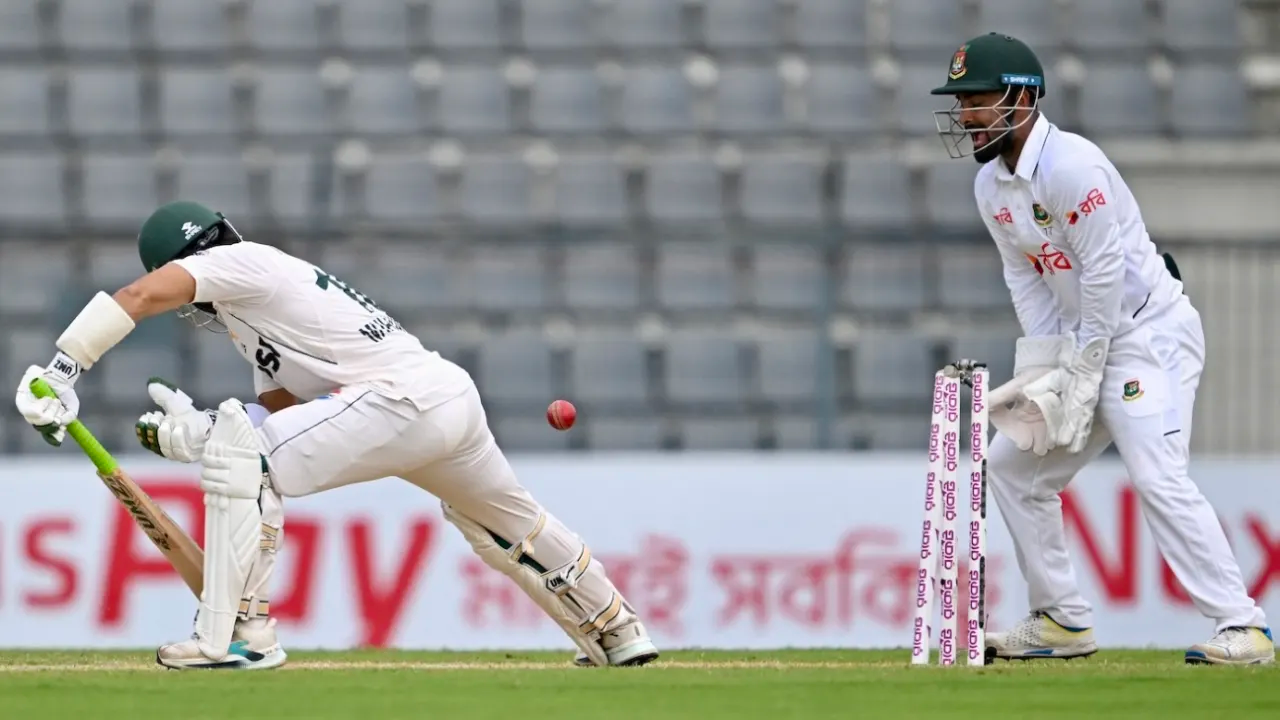
Mohammad Rizwan was among the three wickets taken by Taijul Islam [Cricinfo]

Bangladesh ruled the second day of the Sylhet Test, going to stumps with a healthy 156-run lead and only three wickets down in their second innings. The home side were 110 for 3, losing Mominul Haque on what turned out to be the last ball of the day. Before that, it was a strong showing from their bowlers who combined to restrict Pakistan to 232 for a lead of 46 runs in the first innings, before Mahmudul Hasan Joy led the second innings with a half-century to follow his duck in the first innings.

Babar Azam top-scored for Pakistan with 68 on his return to the playing XI following an injury. Bangladesh’s bowling attack once again combined wonderfully, with Nahid Rana and Taijul Islam taking three wickets each. This, after Taskin Ahmed and Mehidy Hasan Miraz shared the first four wickets in the morning session.

Captain Najmul Hossain Shanto was unbeaten on 13 at stumps after Mominul fell for 30. Mahmudul reached a quick half-century off 58 balls, as Bangladesh sped out of the blocks on the second evening despite an early setback. Khurram Shahzad removed the debutant Tanzid Hasan for 4 with a delivery that squared up the left-hand batter, who edged the ball to Saud Shakeel at gully.

Brief scores:
Bangladesh 278 and 110 for 3 in 26.4 overs  (Mahmudul Hasan Joy 52, Mominul Haque 30;Khurram  Shahzad 2-19) lead  Pakistan 232 in 57.4 overs (Babar Azam 68, Saijd Khan 38; Taskin Ahmed 2-37, Mehidy Hasan Miraz 2-21, Nahid  Rana 3-60, Taijul Islam 3-67) by 156 runs

[Cricinfo]



Continue Reading
Advertisement
Click to comment

Leave a Reply

Your email address will not be published. Required fields are marked *

Latest News

Iran and Israel say they will pause strikes but warn of retaliation if ceasefire breached again

Published

on

By

Iran and Israel say they have halted attacks on each other, after the two countries exchanged fire for the first time since April’s truce.

Israel’s Prime Minister Benjamin Netanyahu said on Monday that his country was holding fire “at the moment”. But he stressed that the struggle against Iran and Hezbollah was “not finished”.

It came hours after Iran’s armed forces said it had stopped operations following the delivery of a “painful response” to Israel.

It promised “more severe and crushing measures” if Israel carried out more strikes, including in Lebanon, where Israeli forces are fighting the Iran-backed group Hezbollah.

Tehran launched missiles at Israel on Sunday in retaliation for a strike on Beirut.

Israel responded in the early hours of Monday morning by targeting what it said were military sites in the Islamic Republic.

In a call with the BBC, US President Donald Trump denied that Netanyahu had defied his wishes by launching strikes.

“No, no. They had already gone. They had already gone. They were already on their way,” he said.

The White House confirmed that Trump had called Netanyahu to discuss the crisis. An Israeli official said Israel had halted its strikes at his request.

Asked how he had persuaded Netanyahu to stop attacking Iran, Trump responded: “All I did is say, ‘We have to use sense’. We’re very close to signing a very powerful deal, a very good deal.

“No nuclear weapons, no nothing. You know, we have to use a lot of common sense. It was fine.”

Trump also said of Netanyahu: “If I tell him to do something, he does it.”

The president told US news outlet Axios he had told Israel’s prime minister he might find himself fighting alone if he went back to war with Iran.

“I said, ‘Bibi, you better be careful, or you will be on your own very soon,'” Axios quoted him as saying.

In his televised statement on Monday, Netanyahu said he had told Trump that “Israel has a full right to self-defence, and we are exercising it as required”.

Sunday’s exchange of fire had continued on Monday morning, with Iran launching more missiles towards Jerusalem and central and southern Israel, according to Israeli authorities.

The Israel Defence Forces (IDF) said a second wave of air strikes had targeted a petrochemical complex in the south-western Iranian city of Mahshahr, where an Israeli military official said chemicals used for ballistic missiles were produced.

Iran’s Emergency Organisation chief, Jafar Miadfar, told Tasnim news agency that the strikes injured 14 people in Mahshahr and one in Tehran.

Casualties were also reported in Lebanon, where the health ministry said five people had been killed and eight wounded in an Israeli strike on Tyre in southern Lebanon on Monday. The Red Cross said four of its rescuers were among the injured.

Hezbollah, meanwhile, said it had fired a rocket barrage at a group of Israeli army vehicles and soldiers in southern Lebanon on Monday morning.

Trump publicly told both countries to “immediately stop ‘shooting'” because they were jeopardising negotiations between Washington and Tehran on a deal to end the regional war.

“Israel and Iran… are looking to do an immediate CEASEFIRE! Final negotiations on ‘Peace’ are proceeding, subject to ignorance or stupidity getting in its way,” he wrote on Truth Social.

The war began on 28 February, when Israel and the US launched a joint attack on Iran, killing Supreme Leader Ayatollah Ali Khamenei and several other top officials.

The hostilities spread quickly across the Middle East, as Iran retaliated by launching missiles and drones at Israel and Gulf Arab states hosting US military facilities. Iran also effectively blocked the crucial Strait of Hormuz waterway, causing a surge in the price of oil.

Lebanon was drawn into the conflict on 2 March, when Hezbollah launched rockets into Israel in retaliation for Khamenei’s assassination. Israel responded with air strikes across Lebanon and a ground invasion of a significant part of the country’s south.

Reuters Israeli settlers stand next to part of an Iranian ballistic missile protruding from the ground in the Israeli-occupied West Bank (8 June 2026)
Israeli settlers inspect part of an Iranian ballistic missile that fell in the occupied West Bank [BBC]

A US-brokered ceasefire deal between the Israeli and Lebanese governments has failed to end hostilities. Hezbollah has rejected the agreement, demanding a full Israeli withdrawal.

In recent weeks, the US has been pressing Israel to scale back its campaign to allow room for a wider deal with Iran, which has demanded that it also cover the conflict in Lebanon.

According to the US news outlet Axios, the Israeli strikes were carried out despite Prime Minster Netanyahu being told not to retaliate by President Trump, who was already angry that his warnings not to attack Beirut had been ignored.

Earlier, he reportedly told the Financial Times that the Israeli prime minister would have to accept any deal that the US secures with Iran because he “won’t have any choice”. “I call all the shots. He doesn’t call the shots,” he was quoted as saying.

The Israeli ambassador to the US, Yechiel Leiter, wrote on X: “No self-respecting country in the world would tolerate such an attack, and neither will Israel.”

Iran’s top negotiator Mohammad Baqer Qalibaf said in a Telegram post on Monday evening that “ceasefire violations and naval blockades” – in reference to the US’s blockade of Iranian ports – had “been the cause of recent tensions”.

He added that: “We are not going to fight or negotiate, but we are going to fight on our own time and negotiate on our own time.”

IDF handout via Reuters A screengrab taken from an Israel Defense Forces (IDF) handout video said to show an Israeli air strike on an aerial defence system in Iran (8 June 2026)
The Israeli military released video footage that it said showed a strike on an Iranian aerial defence system [BBC]

At least 3,468 people have been killed in Iran during the war, according to the country’s Martyrs Foundation. Iran’s Human Rights Activists News Agency (HRANA) has put the death toll from US and Israeli attacks at 3,636, including 1,701 civilians.

Another 3,613 people have been killed in Israeli attacks on Lebanon, the country’s health ministry says. Its figures do not differentiate between combatants and civilians.

Israeli authorities say 20 civilians have been killed in Iranian missile attacks in Israel, while four Palestinians have been killed in the occupied West Bank. Thirty Israeli soldiers and four civilians have been killed on both sides of the Israel-Lebanon border during the fighting with Hezbollah.

Another 29 people have been killed in Iranian attacks on Bahrain, Kuwait, Qatar, Saudi Arabia and the United Arab Emirates, according to local authorities.

Thirteen US service members have been killed, seven of them in Iranian attacks in the Gulf.

[BBC]

Continue Reading

Latest News

Suthar’s debut six-for powers India to their biggest Test win

Published

on

By

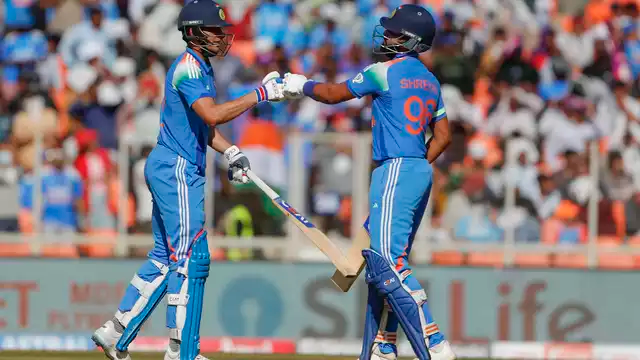
India pose with the trophy after beating Afghanistan [Cricinfo]

In the end, the Afghanistan batters did not die wondering. Their lower order swung away, time and again. Their patience was worn down in the sweltering New Chandigarh heat and India sealed a win by an innings and 300 runs, their biggest in Test cricket.

Afghanistan were up against it right away on the morning of day three of this one-off Test, only their second against India in the format. Debutant Manay Suthar resumed overnight on a three-for, and bowled with turn and guile on a pitch that had flattened out for everyone else. He ended with figures of 6 for 33 – the third best figures for an Indian bowler on a Test debut – and bundled out Afghanistan for 152.

India enforced the follow on. In their second effort, trailing by 412 runs, Afghanistan pushed Suthar back from his attacking lines by stepping down the pitch to him. Sediqullah Atal, who scored 42, led the charge by smashing him for a six and a four right before tea. In many ways, however, Suthar had already won the match for India by then.

Consistently bowling around the 90 kph mark, Suthar plucked out Sharafuddin Ashraf in Afghanistan’s first innings, spinning one past him. Then, he accounted for Rahmat Shah’s crucial wicket – the middle-order batter had brought up a stoic fifty off 100 balls, resisting India through the first hour and a half. Suthar bowled him around the legs, an expansive sweep was his undoing.

Rahmat was the eighth wicket to fall and it sealed Suthar’s five-for. A while later, he pinned Mohammad Saleem on the pads for his sixth. This last dismissal was the latest in a line of bad reviews (or lack thereof) from either side throughout the day. Suthar had pitched the delivery outside leg. For some reason, Saleem did not review and he was animated at the dugout as he walked back.

The tall Prasidh Krishna had begun the day from the other end, along with Suthar. Prasidh stuck to back-of-a-length deliveries, utilising the angles off the pitch to create jeopardy for the batters. He also struck the first blow for India, when he got the ball to jag back in, catch the inside edge onto the stumps, and send back Azmatullah Omarzai.

Mohammed Siraj came on for a spell of three overs, for five runs, the highlight of which was when he comically reviewed a clear inside-edge into the pads for an lbw. Soon, Washington Sundar came on from his end, and Kuldeep from the other, bowling in tandem. Kuldeep hesitated to put revs on the ball and for a period, both bowlers looked innocuous in comparison to Suthar.

However, Ashraf visibly struggled to bat with a groin injury. Kuldeep began lobbing up balls that Ashraf needed to step out to deadbat. Suthar returned to take advantage of his limited reach, and had him edging behind.

Washington also picked up the final wicket of Afghanistan’s first innings, when he had Ziaur Rahman going for a huge swipe across the line. Pant ran in to complete a catch. This would be his sole wicket in the first innings, but Suthar’s prodigious spin – and six-for – ensured that Sundar, the wily offspinner, would get his own turn in the spotlight next.

After lunch, Atal continued walking down the pitch, once in a while, to negate Suthar’s more threatening options. But India’s other two spinners, Washington and Kuldeep – who just could not get it to spin as much on a flat track – showed their versatility instead.

Washington was the star spinner in the second innings, using his drift through the air instead of big turn off the pitch. He picked up 4 for 36, bowling with smarts against an Afghanistan line-up that tried to follow Atal’s lead by attacking the spinners. Kuldeep struggled to hit consistent lines, but kept lobbing the balls up and waited for the Afghanistan batters to hit him across the line.

After lunch, Atal receded into a shell. On the other hand, his partners chose rash shots to force the issue for Afghanistan. Siraj had already prised out Atal’s opening partner, Abdul Malik, after a patient 40-ball eight by getting a delivery to jag into his pads. Then, Rahmanullah Gurbaz swiped Kuldeep across the line in a rush of blood, mistiming the ball straight to long-on. The wicket came against the run of play, with him already on 24 off 23, bossing a tiring India spin attack in the blistering heat of New Chandigarh.

Next, Rahmat – Afghanistan’s best batter from their first innings – danced down the pitch to Washington and holed out at wide mid-off. Fifteen minutes before tea, captain Hashmatullah Shahidi edged a tentative prod to Shubman Gill at first slip and Washington got his second wicket of the innings. Both these wickets were a result of a consistent line, attacking batters in the outside-off channel.

Afghanistan’s resistance broke down completely on the last ball before tea. Atal, who had batted patiently thus far, leaned into an ill-judged lofted drive, off Washington, hitting it straight to point.

When they returned to bat after tea, Afghanistan’s lower-order batters were in no mood to stick around. Suthar plucked out one last wicket, pinning Afsar Zazai on the pads off a front-foot defense. On the other hand, Azmatullah Omarzai, Nangeyalia Kharote, and Mohammad Saleem all fell while miscuing lofted shots. Saleem’s edge to B Sai Sudharsan at covers sealed an innings-win for India.

Scores:
India 564 for 8 dec in 127 overs (KL Rahul 100, Sai Sudarshan 81, Shubman Gill 126,  Rishbah Pant 81, Washington Sundar 52*; Mohammed Saleem 6-140) beat Afghanistan 152 in 58.4 overs (Rahmat Shah 60; Prasidh Krishna 3-37, Manav Suthar 6-33 ) and 112 in 35.5 overs  (Sediqullah Atal 42; Manav Suthar 1-29, Washington  Sundar 4-36, Kuldeep Yadav 3-30) by an innings and 300 runs

[Cricinfo]

Continue Reading

Latest News

Sri Lanka claim ODI series 1-0 after another washout in Kingston

Published

on

By

The Sabina Park staff clear the water on the ground [Cricinfo]

For the second game running in Kingston, persistent rain forced an ODI between West Indies and Sri Lanka to be abandoned without a ball being bowled. This one – the third and final ODI in this series at Sabina Park – meant Sri Lanka secured the trophy with a 1-0 margin, courtesy the 41-run victory they enjoyed in the series opener.

The umpires had several inspections, but after discussing with curators they decided that getting play started by the cut off of 8.02pm for a 20-over-shootout was almost impossible.

While the mood around both camps might be damp, both literally and metaphorically following two straight washouts, the outcome is still a landmark one for the visiting Lions. It is their first ODI-series victory in the Caribbean in 23 years – the last coming in 2003. A positive start for their newly appointed head coach Gary Kirsten and their new ODI captain Kusal Mendis, although they would’ve liked to have seen more in-game action from the players.

“Very happy to win the series, we did really well in that one game – in all three departments,” Mendis said. “There are not a lot of matches ahead of next year’s World Cup, happy with my first series victory as captain. Got support of the staff too.” He also praised the bowling unit.

For West Indies, the weather and the subsequent series result is undoubtedly a frustrating blow. Denied a chance to avenge their opening game defeat, it’s not only a first series loss at home in three years but, more critically, it’s a result that hinders their pursuit of vital ICC ranking points required for automatic, direct qualification for the 2027 ODI World Cup.

West Indies, for now, remain in tenth place in the ODI rankings, just outside of the top eight qualifying spots. They have ODI series campaigns against New Zealand (World No. 2) and India (No. 1) coming up next.

“You can’t control mother nature,” Shai Hope said. “Credit must be given to the Sri Lankan team for the way they played in the first game. [T20I series next] We need to look ahead, understand conditions. Adaptability will be key in Jamaica. We’ve got some experience, hope to bounce back there.”

Both sides will rapidly shift focus to the shortest format as a three-match T20I series is scheduled to kick off on Thursday, June 11, with subsequent matches on June 13 and June 14.

However, the teams will not be changing hotels just yet; all three T20Is are slated to take place at the exact same venue in Kingston. With rain expected to be a presence across Jamaica over the coming week, ground staff will have their work cut out for them to ensure the upcoming matches escape a similar watery fate. Those matches will all start at 7.30pm local time.

[Cricinfo]

Continue Reading

Trending