
News
Toxic coconut oil scare trigger public wave of fear over aflatoxins in foodstuffs

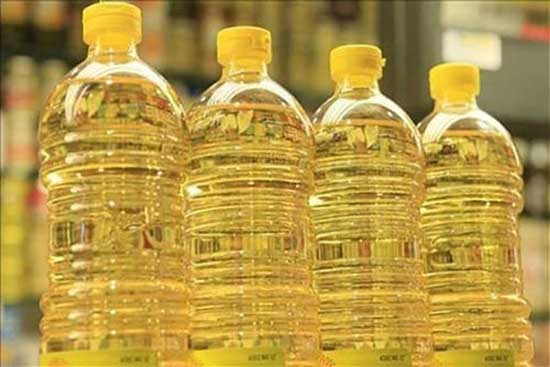
People now wary of buying certain products
By Suresh Perera
In the backdrop of a top official of Sri Lanka’s key standards body coming under heavy flak over her controversial claim that several other consumer commodities also contain toxic substances, public apprehension has shifted to many other products in the market following a wave of fear triggered over cancer-causing free radicals in foodstuffs, industry players said.
The Trade Ministry has already initiated a disciplinary inquiry into the assertion by Dr. Siddhika Senaratne, the Director-General of the Sri Lanka Standards Institution (SLSI), that aflatoxins are also found in certain other food items sold to the public.
Aflatoxins are a family of toxins produced by certain fungi found on agricultural crops.
As the SLSI scientist’s remarks during a television talk show ignited an uproar following the seizure of imported stocks of contaminated coconut oil, industry officials said that customers are now wary of purchasing certain food products as the social media, rightly or wrongly, painted a frightening picture, they said.
A committee will be appointed to examine Dr. Senaratne’s statement to ascertain the validity or otherwise of her claim of the presence of aflatoxins in some food products in the marketplace, authoritative sources said.
Though the Director-General didn’t identify any of the “toxic products” she claimed were being sold to consumers, her statement unleashed a cycle of fear and uncertainty as consumers, influenced largely by social media reports and hearsay, viewed many brands with suspicion, the sources noted.
However, there has been no credible scientific evidence so far to prove that products identified on social media contain carcinogenic properties, they said.
Dr. Senaratne’s contention was that identifying products with toxic substances could lead to the collapse of some local industries. The Consumer Affairs Authority (CAA) has been informed to take up the issue with the relevant manufacturers for remedial action, she said.
It is no secret that many mills use copra with fungus to extract coconut oil. The perishable copra is dried outdoors but there is no proper cleaning of the fungi, which are common under tropical and sub-tropical conditions, before the oil is extracted, industry officials said.
Has it been established whether the shiny wax coating used on apples as an oxygen barrier to preserve freshness, particularly in consignments imported from China, belong to the safe food grade material?, they asked.
In the case of apples imported to Sri Lanka from the USA, the whole process of orchard to point of landing take many weeks. It is true that fruits are stored in cold rooms to preserve quality and slow the aging process by regulating oxygen and carbon dioxide levels. However, the question arises whether there are accredited processes to monitor the agro chemical and other toxic levels in imported apples and other varieties of fruits before permitting the stocks to be released to the local market, they noted.
Hoppers are a staple of Sri Lankan cuisine, but it’s common knowledge that many wayside eateries introduce plaster of paris (a quick-setting gypsum plaster consisting of a fine white powder known as calcium sulfate hemihydrate) to the batter to keep them fresh and crispy, the officials asserted.
“This is because customers insist on freshly baked hoppers and as a result, those that have gone flat cannot be sold”, they said.
Cleanliness of eateries is being monitored to some extent, but are there any quality checks for toxicity on the food served to customers?, they queried.
After the contaminated coconut oil scandal surfaced, people are reluctant to even buy traditional oil-based sweetmeats from the marketplace, they further said.
Unlike earlier years, there is a slump in sweetmeat sales, a supermarket official said. “Customers are wary about toxic coconut oil in the market”.






Bus fares have been increased by 12.19% with effect from midnight today [23rd March 2026].
The minimum fare will be increased from Rs 27 to Rs 30 while the maximum fare of Rs2159/- will be increased to 2422/-
Latest News
Public will not be served as Computer system failure at Department of Registration of Persons

The Acting Commissioner General of Registration of Persons has announced that due to an unexpected failure of the computer system of the Department of Registration of Persons, all services, including the one day service will not be held on Tuesday (24th March) at the Head Office and all Provincial offices.

Latest News
Heat Index at Caution Level in the Western, Sabaragamuwa, Southern and North-western provinces and in Anuradhapura, Mannar and Vavuniya districts
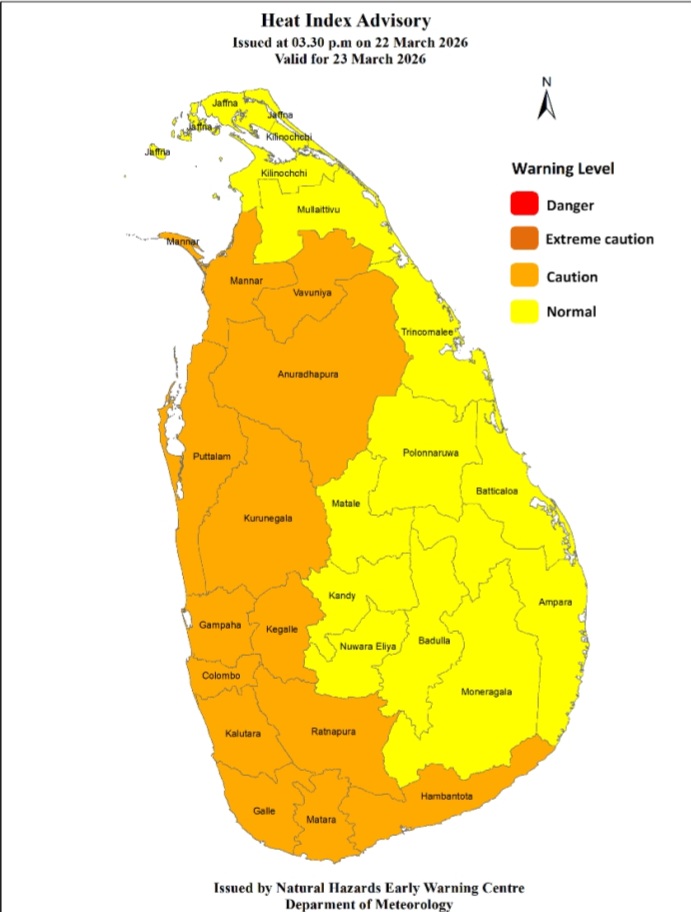
Warm Weather Advisory
Issued by the Natural Hazards Early Warning Centre of the Department of Meteorology
at 3.30 p.m. on 22 March 2026, valid for 23 March 2026.
The Heat index, the temperature felt on human body is likely to increase up to ‘Caution level’ at some places in the Western, Sabaragamuwa, Southern and North-western provinces and in
Anuradhapura, Mannar and Vavuniya districts.
The Heat Index Forecast is calculated by using relative humidity and maximum temperature and this is the condition that is felt on your body. This is not the forecast of maximum temperature. It is generated by the Department of Meteorology for the next day period and prepared by using global numerical weather prediction model data.

Effect of the heat index on human body is mentioned in the above table and it is prepared on the advice of the Ministry of Health and Indigenous Medical Services.
ACTION REQUIRED
Job sites: Stay hydrated and takes breaks in the shade as often as possible.
Indoors: Check up on the elderly and the sick.
Vehicles: Never leave children unattended.
Outdoors: Limit strenuous outdoor activities, find shade and stay hydrated.
Dress: Wear lightweight and white or light-colored clothing.
Note:
In addition, please refer to advisories issued by the Disaster Preparedness & Response Division, Ministry of Health in this regard as well. For further clarifications please contact 011-7446491.

Two killed when Air Canada jet hits fire truck at NYC’s LaGuardia Airport

Bus fares increased by 12.19% from midnight today [23]
Public will not be served as Computer system failure at Department of Registration of Persons

Trump says he is postponing strikes on Iran power plants after ‘productive’ talks on ending war

Asia stocks slide as US and Iran threaten to escalate war

Heat Index at Caution Level in the Western, Sabaragamuwa, Southern and North-western provinces and in Anuradhapura, Mannar and Vavuniya districts

‘Dates have the highest sugar content to fight Coronavirus’

Sunday Island 27 December – Headlines

#SundayIsland 17th December – Headlines

Sunday Island – 28th March

Sunday Island Headlines – 21 March

Sunday Island – 21st February – Headlines
-

 News6 days ago
CIABOC questions Ex-President GR on house for CJ’s maid
-

 News7 days ago
Sri Lankan marine scientist Asha de Vos honoured at UNGA opening
-

 News7 days ago
Australian HC debunks misleading travel risk claims for Sri Lanka
-

 News5 days ago
Bailey Bridge inaugurated at Chilaw
-

 News5 days ago
Pay hike demand: CEB workers climb down from 40 % to 15–20%
-

 News4 days ago
CIABOC tells court Kapila gave Rs 60 mn to MR and Rs. 20 mn to Priyankara
-

 Editorial6 days ago
Couple QR-based quota with odd-even rationing
-

 News3 days ago
Colombo, Oslo steps up efforts to strengthen bilateral cooperation in key environmental priority areas