
Latest News
US and Iran hold talks seen as crucial to prevent conflict

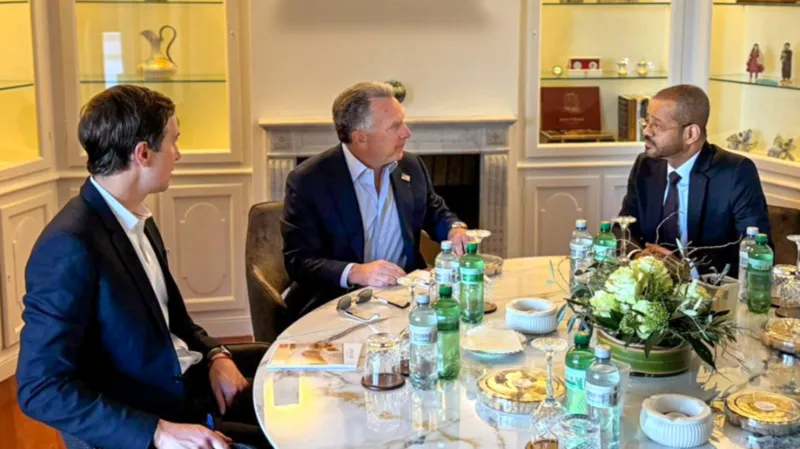
US and Iranian officials have met in Geneva for a third round of indirect talks seen as crucial to averting conflict, with President Donald Trump threatening to strike Iran if a nuclear deal is not reached.
The discussions come amid the largest US military build-up in the Middle East since the US-led invasion of Iraq in 2003, and with Iran vowing to respond to an attack with force.
Thursday’s talks were adjourned after three hours. Oman’s Foreign Minister Badr Albusaidi, who is acting as the mediator, said negotiators had exchanged “creative and positive ideas” and would return after taking a break. “We hope to make more progress,” he added.
But the chances of an agreement remain unclear.
While Trump has said he prefers to solve the crisis through diplomacy, he has also said he is considering a limited strike on Iran to pressure its leaders to accept a deal.
The president, however, has done little to explain what he is demanding in the negotiations and why there could be the need to take military action now, eight months after the US bombed Iranian nuclear facilities during a war between Israel and Iran.
Iran has rejected the US demand to stop the enrichment of uranium in its territory, but there have been indications that it is prepared to offer some concessions about its nuclear programme.
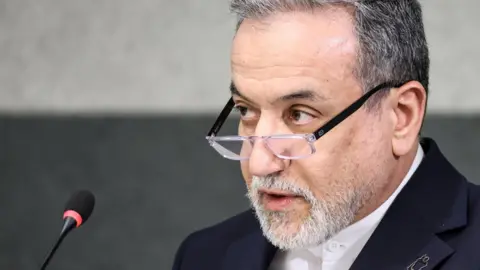
As in the previous two rounds of discussions earlier this month, the Iranian delegation is being led by Foreign Minister Abbas Araghchi, while the US is represented by special envoy Steve Witkoff and Trump’s son-in-law, Jared Kushner.
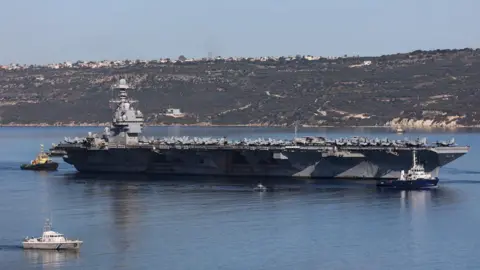
In recent weeks, the US has sent thousands of troops and what Trump has described as an “armada” to the region, including two aircraft carriers along with other warships, as well as fighter jets and refuelling aircraft.
Trump first threatened to bomb Iran last month as security forces brutally repressed anti-government protests, killing thousands of people. But since then, his focus has turned to Iran’s nuclear programme, which has been at the centre of a long-running dispute with the West.
For decades, the US and Israel have accused Iran of trying to secretly develop a nuclear weapon. Iran insists its programme is only for peaceful purposes, though the country is the only non-nuclear-armed state to have enriched uranium at near weapons-grade level.

In his State of the Union speech to Congress on Tuesday, Trump briefly and vaguely talked about the tensions with Iran, without clearly laying out the case for strikes.
He said Iran was working to build missiles that would “soon” be capable of reaching the US, without giving details. He also accused the country of trying to “start all over again” with a nuclear weapons programme following last year’s strikes, and said he could not allow the “world’s number one sponsor of terror… to have a nuclear weapon”.
The US struck three nuclear sites in Iran last June, as it joined Israel in its bombing campaign. At the time, Trump said the facilities had been “obliterated”.
Iran says its enrichment activity stopped after the attacks, although it has not allowed the International Atomic Energy Agency’s inspectors to access the damaged sites.
“They want to make a deal,” Trump said, “but we haven’t heard those secret words: ‘We will never have a nuclear weapon’.”
Hours before the speech, however, the Iranian foreign minister posted on social media that Iran would “under no circumstances ever develop a nuclear weapon”. Araghchi also said there was an “historic opportunity to strike an unprecedented agreement that addresses mutual concerns and achieves mutual interests”.
Reacting to Trump’s address, an Iranian foreign ministry spokesman accused the US of repeating “big lies” regarding its nuclear programme, ballistic missiles and the number of protesters killed in the crackdown.
Iran’s proposals have not been made public, but the discussions in Geneva could include the creation of a regional consortium for uranium enrichment, which has been raised in previous negotiations, as well as ideas about what to do with Iran’s roughly 400kg (880lb) stockpile of highly enriched uranium and verification and monitoring mechanisms.
In return, Iran expects the lifting of sanctions that have crippled its economy. Opponents of the regime say any relief would give the clerical rulers a lifeline.
But it remains unclear which conditions Trump could find acceptable for a deal. Iran has already rejected discussing limits to the country’s ballistic missile programme and ending its support for proxies in the region – an alliance Tehran calls the “Axis of Resistance” that includes Hamas in Gaza, Hezbollah in Lebanon, militias in Iraq, and the Houthis in Yemen.
Reports in US media, quoting unnamed administration officials, have suggested that Trump was considering an initial strike in the coming days on Iran’s Revolutionary Guards or nuclear sites to pressure the country’s leaders. If negotiations failed, according to the reports, the president might go as far as ordering a campaign with the aim of toppling the Iranian Supreme Leader, Ayatollah Ali Khamenei.
The Chairman of the Joint Chiefs of Staff is also said to have warned that strikes against Iran could be risky, potentially drawing the US into a prolonged conflict, although Trump has insisted that Gen Dan Caine believes it would be “easily won”.
Iran, meanwhile, has threatened to respond to any attack by striking American military assets in the Middle East and Israel.
US-allied countries in the region are concerned that an attack on Iran could lead to a wider conflict, and have warned that air power alone will not be able to change the country’s leadership.
Israeli Prime Minister Benjamin Netanyahu, however, has warned against a deal that does not include Iran’s ballistic missiles and its proxies. Netanyahu has long described Iran as a key threat for Israel, and a source of instability in the region.
Analysts believe that the prime minister, who visited the White House earlier this month, may be pushing for a campaign with the goal of toppling the Iranian regime.
The US has the world’s second-largest nuclear arsenal. Israel is also believed to have nuclear weapons, although it neither confirms nor denies this.
Ahead of the State of the Union, Secretary of State Marco Rubio delivered a classified briefing to the so-called “gang of eight”, composed of the leaders of both parties in the Senate and House of Representatives and the chairs and ranking members of the intelligence committees of both chambers.
Following the briefing, Chuck Schumer, the Senate minority leader, gave a brief statement, saying: “This is serious, and the administration has to make its case to the American people.”
[BBC]

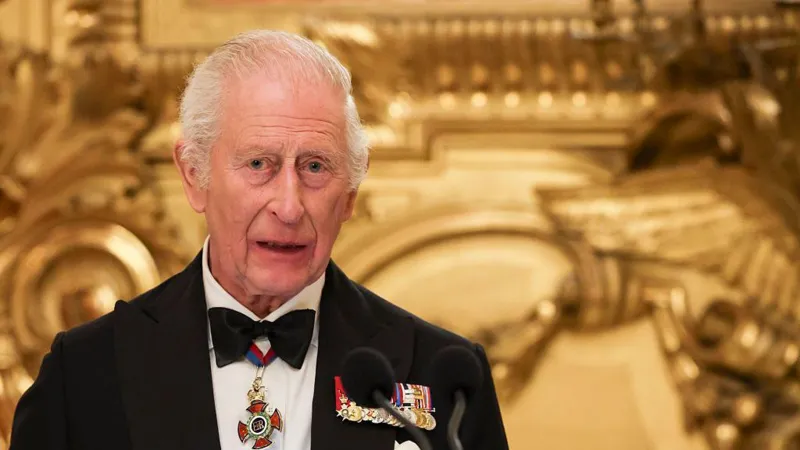
The United States declared independence from the British crown 250 years ago – but this week, it could not get enough of it.
From the minute King Charles and Queen Camilla stepped onto the White House South Lawn, US networks dumped their standard diet of political warfare and breaking news for something rare: pure pageantry.
In a country that seems to agree on almost nothing, the British royals managed something close to a clean sweep – drawing warm receptions from both sides of a political spectrum where neutral ground is rare.
The visit came at a fraught time in US-British relations, with the White House and Downing Street at odds over the war in Iran, straining a relationship both governments insist remains unshakeable.
The reviews following the King’s appearances at the White House, in Congress and in New York were warm across the political divide.
A commentator in the conservative Washington Examiner wrote that the UK needed more than conventional diplomacy – and that King Charles delivered.
“His Majesty’s Government under scandal-plagued Labour Prime Minister Keir Starmer needed the monarchy to do what only the king could do,” the editorial said.
The King’s comments in Congress and at the White House’s lavish banquet on Tuesday – mixing humour with history and a call for unity – also were widely praised.
Some saw them as a subtle rebuke of President Trump.
“Sometimes it takes an outside perspective to see what’s really going on,” an opinion writer wrote in the Arizona Republic. “It’s striking to have a king remind us of what democracy is all about.”
For months, Donald Trump – a committed Anglophile and avid fan of the Royals – repeatedly told reporters that he was excited for the King’s visit. That excitement was on full display throughout the King’s visit to Washington, in which the world saw a warmer version of a president not shy to make his feelings known.
Uncharacteristically, Trump largely stuck to a script, making no mention of policy disagreements with Downing Street and lauding the long ties between the US and Britain.
“Before we ever proclaimed our independence, Americans carried within us the rare gifts of moral courage,” he said. “And it came from a small but mighty kingdom from across the sea.”
On Capitol Hill, where the King became only the second British monarch to address a joint session of Congress, Charles received a standing ovation – though some in the room heard something more pointed in his words.
“As opposed to Keir Starmer, who is looked at…as a leftist weenie, we saw in King Charles – someone who is proud of Britain,” Washington Republican Representative Michael Baumgartner told the BBC. “I think that was good.”
The warm welcome on Capitol Hill was not lost on President Trump.
“He got the Democrats to stand, I’ve never been able to do that. I couldn’t believe it,” Trump said at the banquet a few hours later. “They liked him more than they’ve ever liked any Republican or Democrat, actually.”
Elizabeth Holmes, an expert on the Royal Family and author, told the BBC that many members of the American public are broadly interested in the family, even as that interest has ebbed and flowed over the years.
“I think the fascination is rooted in a combination of novelty and distance,” she said. “It’s not something we have here.”
The King and Queen traveled to New York City on Wednesday where they made a few stops, including one at the 9/11 Memorial. Jacob Knutton, who manages a British-themed restaurant and store in New York, says business has been “a lot busier” around the King’s visit.
“There’s definitely been a lot of people talking about it,” said Knutton, who grew up in London and Australia. “Americans are talking about it and trying to get our opinions on it.”
But not every American is as enthused.
While recent statistics are hard to come by, a YouGov poll conducted in 2024 found that only 42% of Americans held a favourable view of King Charles.
In comparison, his mother, Queen Elizabeth, garnered a 67% approval rating. Over three quarters of those polled – 76% – held a favourable view of the King’s ex-wife, Princess Diana, who died in 1997.
According to Holmes, in the eyes of some Americans, Charles had a “far less compelling” narrative than his mother, who became Queen at a young age.
US feelings about King Charles are further complicated by his complex relationship with son Prince Harry, Holmes added.
Data from Google Trends suggests that US-based searches for the King during the visit spiked by 20 to 25 times over normal, and by 50 times during his speech to Congress.
Others who haven’t followed the royal visit closely, still are excited. “I think it’s cool that he’s here,” said Harry James, 21, who works in a fish and chips shop in New York. “It’s cool we can keep these traditions going.”
Holmes believes the visit already has improved US perceptions of the King. “Trump is such a polarising figure, and I think people were very eager to see their interactions,” she said.
His dinner comments, in particular, have “really taken off”.
“I think people are delighted to see British wit on display,” she added.
Near the White House on Tuesday, some of those who turned out to watch the King’s motorcade pass said they felt hopeful.
“It’s natural for human beings to disagree,” said Maribeth Massie, of Maine, who watched the King’s motorcade near the White House on Monday. “Hopefully they’ll lay some common ground together and move forward.”
Knutton also hopes the visit helps – in part for his business’ sake. His store imports nearly all of its goods from the UK, and feels the pinch of Trump’s tariffs, he said.
“I’m sure it will have an effect,” he said. “But I’m not expecting magical wand-waving.”
[BBC]

Oil prices have soared following reports that the US is preparing for an “extended” blockade of Iran.
The global benchmark oil price, Brent crude, briefly hit $120 (£89) a barrel on Wednesday evening, its highest price since 2022.
The BBC understands that energy executives including Chevron chief executive Mike Wirth met US President Donald Trump at the White House on Tuesday to discuss how to limit the fallout from the conflict on American consumers.
Oil traders appear to have taken the meeting as a sign the effective closure of the Strait of Hormuz will continue for a long time.
The executives discussed topics including domestic energy production, progress in Venezuela, oil futures, natural gas, and shipping, according to a White House official.
They described the meeting as being part of the President’s regular meetings with energy executives to discuss their industry.
The meeting follows separate reports from the Wall Street Journal that US President Donald Trump has instructed aides to prepare to extend the ongoing blockade of Iran’s ports, in an effort to squeeze the country’s economy.
Iran has said it will continue to disrupt traffic travelling through the Strait of Hormuz in response to the US blockade.
[BBC]
Latest News
Heat Index at Caution Level in the North-central, Eastern, and Sabaragamuwa provinces and in Kurunegala, Monaragala, Vavuniya, Mullaittivu and Kilinochchi districts during the day time
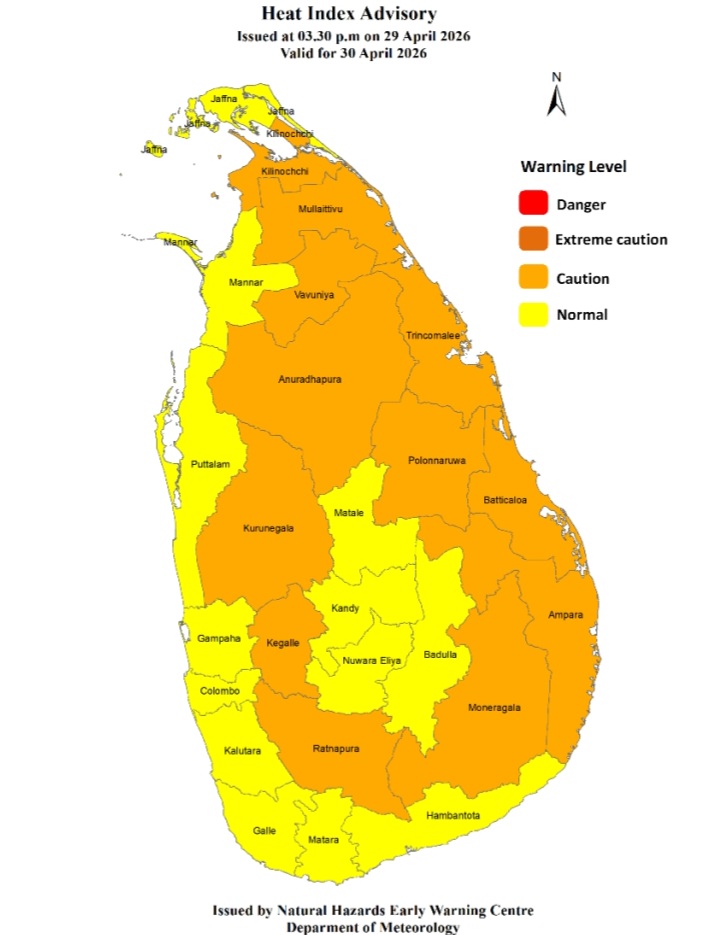
Warm Weather Advisory
Issued by the Natural Hazards Early Warning Centre
Issued at 3.30 p.m. on 29 April 2026, valid for 30 April 2026.
The Heat index, the temperature felt on the human body is likely to increase up to ‘Caution level’ at some places in the North-central, Eastern, and Sabaragamuwa provinces and in Kurunegala, Monaragala, Vavuniya, Mullaittivu and Kilinochchi districts during the day time.
The Heat Index Forecast is calculated by using relative humidity and maximum temperature and this is the condition that is felt on your body. This is not the forecast of maximum temperature. It is generated by the Department of Meteorology for the next day period and prepared by using global numerical weather prediction model data.

Effect of the heat index on the human body is mentioned in the above table and it is prepared on the advice of the Ministry of Health and Indigenous Medical Services.
ACTION REQUIRED
Job sites: Stay hydrated and takes breaks in the shade as often as possible.
Indoors: Check up on the elderly and the sick.
Vehicles: Never leave children unattended.
Outdoors: Limit strenuous outdoor activities, find shade and stay hydrated.
Dress: Wear lightweight and white or light-colored clothing.
Note:
In addition, please refer to advisories issued by the Disaster Preparedness & Response Division, Ministry of Health in this regard as well. For further clarifications please contact 011-7446491

Explanation sought from AKD on ‘Russian energy supplies’

US reiterates its commitment to enhancing relations with Northern Sri Lanka

Rooftop Solar at Crossroads as Sri Lanka Shifts to Distributed Energy Future

Indonesia-SL agreement on Visa Exemption for Diplomatic and Official passports soon

Six-year prison term for Rs 15,000 bribe

The pointer who showed the moon: Professor Y. Karunadasa (1934–2026)

‘Dates have the highest sugar content to fight Coronavirus’

Sunday Island 27 December – Headlines

#SundayIsland 17th December – Headlines

Sunday Island – 28th March

Sunday Island Headlines – 21 March

Sunday Island – 21st February – Headlines
-
 News6 days ago
Whistleblowers ask Treasury Chief to resign over theft of USD 2.5 mn
-

 News6 days ago
No cyber hack: Fintech expert exposes shocking legacy flaws that led to $2.5 million theft
-

 News3 days ago
BIA drug bust: 25 monks including three masterminds arrested
-

 Business4 days ago
Nestlé Lanka Announces Change in Leadership
-

 News3 days ago
Banks alert customers to phishing attacks
-
 News4 days ago
Hackers steal $3.2 Mn from Finance Ministry
-

 News1 day ago
Treasury chief’s citizenship details sought from Australia
-

 Business6 days ago
Dialog Enterprise partners Star Garments: Pioneering 5G innovation in Sri Lanka’s apparel industry