
Latest News
Top UN court says countries can sue each other over climate change

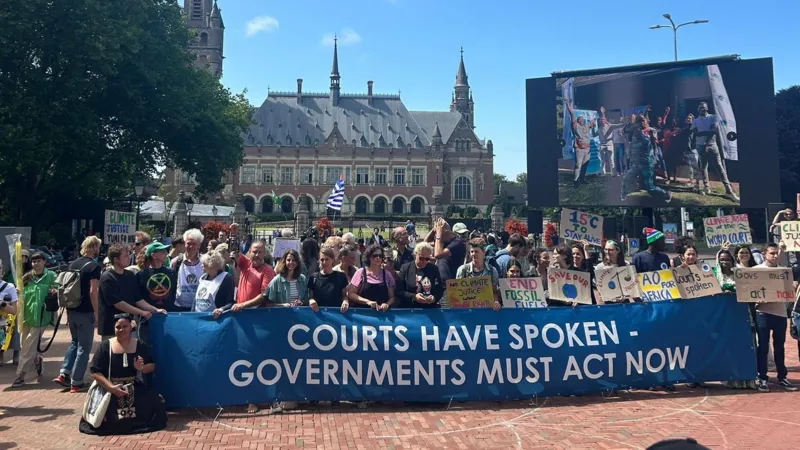
A landmark decision by a top UN court has cleared the way for countries to sue each other over climate change, including over historic emissions of planet-warming gases.
But the judge at the International Court of Justice in the Hague, Netherlands on Wednesday said that untangling who caused which part of climate change could be difficult.
The ruling is non-binding but legal experts say it could have wide-ranging consequences.
It will be seen as a victory for countries that are very vulnerable to climate change, who came to court after feeling frustrated about lack of global progress in tackling the problem.
The unprecedented case at the International Court of Justice (ICJ) was the brainchild of a group of young law students from low-lying Pacific islands on the frontlines of climate change, who came up with the idea in 2019.
One of those students, Siosiua Veikune from Tonga, was in the Hague to hear the decision.
“I’m lost for words. This is so exciting. There’s a ton of emotions rushing through us. This is a win we take proudly back home to our communities,” he told BBC News.
“Tonight I’ll sleep easier. The ICJ has recognised what we have lived through – our suffering, our resilience and our right to our future,” said Flora Vano, from the Pacific Island Vanuatu, which is considered the country most vulnerable to extreme weather globally.
“This is a victory not just for us but for every frontline community fighting to be heard.”
The ICJ is considered the world’s highest court and it has global jurisdiction. Lawyers have told BBC News that the opinion could be used as early as next week, including in national courts outside of the ICJ.
Campaigners and climate lawyers hope the landmark decision will now pave the way for compensation from countries that have historically burned the most fossil fuels and are therefore the most responsible for global warming.
Many poorer countries had backed the case out of frustration, claiming that developed nations are failing to keep existing promises to tackle the growing problem.
But developed countries, including the UK, argued that existing climate agreements, including the landmark UN Paris deal of 2015, are sufficient and no further legal obligations should be imposed.
On Wednesday the court rejected that argument.
Judge Iwasawa Yuji also said that if countries do not develop the most ambitious possible plans to tackle climate change this would constitute a breach of their promises in the Paris Agreement.
He added that broader international law applies, which means that countries which are not signed up to the Paris Agreement – or want to leave, like the US – are still required to protect the environment, including the climate system.
The court’s opinion is advisory, but previous ICJ decisions have been implemented by governments, including when the UK agreed to hand back the Chagos Islands to Mauritius last year.
“The ruling is a watershed legal moment,” said Joie Chowdhury, Senior Attorney at the Centre for International Environmental Law (CIEL).
“With today’s authoritative historic ruling, the International Court of Justice has broken with business-as-usual and delivered a historic affirmation: those suffering the impacts of climate devastation have a right to remedy for climate harm, including through compensation,” she added.
A spokesperson for the UK’s Foreign, Commonwealth and Development Office said it was “taking time” to look at the opinion before commenting in detail, but added:
“Tackling climate change is and will remain an urgent UK and global priority. Our position remains that this is best achieved through international commitment to the UN’s existing climate treaties and mechanisms.”
The court ruled that developing nations have a right to seek damages for the impacts of climate change such as destroyed buildings and infrastructure.
It added that where it is not possible to restore part of a country then its government may want to seek compensation.
This could be for a specific extreme weather event if it can be proved that climate change caused it, but the Judge said this would need to be determined on a case by case basis.
“This is a huge win for climate vulnerable states. It’s a huge win for Vanuatu, which led this case and is going to change the face of climate advocacy,” said barrister Jennifer Robinson at Doughty Street Chambers, who represented Vanuatu and the Marshall Islands.
It is not clear how much an individual country could have to pay in damages if any claim was successful.
But previous analysis published in Nature, estimated that between 2000 and 2019 there were $2.8 trillion losses from climate change – or $16 million per hour.
During the evidence sessions in December, the court heard from dozens of Pacific Islanders who have been displaced as a result of rising sea level, caused by climate change.
The Marshall Islands highlighted that the costs for their island to adapt to climate change are $9 billion.
“That is $9 billion the Marshall Islands does not have. Climate change is a problem they have not caused, but they are forced to consider relocating their capital,” said Ms Robinson.
As well as compensation, the court also ruled that governments were responsible for the climate impact of companies operating in their countries.
It said specifically that subsidising the fossil fuel industry or approving new oil and gas licenses could be in breach of a country’s obligations.
Developing countries are already exploring bringing new cases seeking compensation for historic contributions to climate change against richer, high emitting nations citing the ICJ opinion, according to lawyers the BBC spoke to.
If a country wants to bring a case back to the ICJ to make a ruling on compensation then it can only do so against countries which have agreed to its jurisdiction, which includes the likes of the UK, but not US or China.
But a case can be brought in any court globally, whether that be domestic or international, citing the ICJ opinion, explained Joie Chowdhury from CIEL.
So instead a country may choose to take their case not to the ICJ but a court where those countries are bound e.g. federal courts in the US.
But the question remains whether the ICJ opinion will be respected.
“[The ICJ] is an institution that is subject to geopolitics – and it relies on states adhering to its judgements, it doesn’t have a police force,” said Harj Narulla, a climate barrister at Doughty Street Chambers, which also represented the Solomon Islands.
When asked about the decision, a White House spokesperson told BBC News:
“As always, President Trump and the entire Administration is committed to putting America first and prioritising the interests of everyday Americans.”
(BBC)


Palestine was the deadliest place to work as a journalist in 2025, with the Middle East as a whole the most dangerous region for media professionals, according to a global journalist union.
The International Federation of Journalists (IFJ) said the region accounted for 74 deaths last year – more than half of the 128 journalists and media workers killed – in a new report released on Wednesday.
The Middle East was followed by Africa with 18 deaths, Asia Pacific (15), the Americas (11) and Europe (10), according to the report. The vast majority of those killed were men, but the list included 10 women.
“128 journalists killed in a single year is not just a statistic; it is a global crisis. These deaths are a brutal reminder that journalists are being targeted with impunity, simply for doing their job,” IFJ General Secretary Anthony Bellanger said.
Palestinian journalists were the biggest cohort of victims: 56 Palestinian media professionals were killed in 2025. Yemen followed, with 13 deaths, Ukraine, with eight, and Sudan, with six, according to the IFJ.
The Paris-based media union cited Israel’s killing of Al Jazeera journalist Anas al-Sharif as the most “emblematic” of the 56 journalists murdered in Palestine last year covering Israel’s genocidal war on Gaza. Al-Sharif, 28, was killed on August 10 alongside several colleagues when Israeli forces struck a media tent outside Gaza City’s al-Shifa Hospital.
The attack also killed Al Jazeera correspondent Mohammed Qreiqeh, Al Jazeera camera operators Ibrahim Zaher and Mohammed Noufal, freelance camera operator Momen Aliwa and freelance journalist Mohammed al-Khalidi.
IFJ also cited an Israeli strike in early September on a Yemeni newspaper office as “one of the worst-ever attacks on a media office”. Thirteen journalists and media workers at the Houthi-affiliated “26 September” newspaper were killed, along with more than 20 other people.
Another nine deaths were ruled as accidents, while others – including two journalists in Syria and two in Iran – were “targeted and killed” because of their work, IFJ said.
While the Middle East was the deadliest region for the third year in a row in 2025, the Asia Pacific accounted for the largest number of journalists and media workers behind bars. Most cases in 2025 were in China and Hong Kong, which together accounted for 143 journalists, followed by 49 in Myanmar and 37 in Vietnam.
Europe was another detention hotspot last year, accounting for 149 imprisoned journalists. IFJ attributed the figure, up 40 percent from a year earlier, to “intensified repression in Azerbaijan and Russia”.
[Aljazeera]

United States President Donald Trump has said that he will delay the implementation of tariffs on upholstered furniture, kitchen cabinets and vanities for one year, amid growing concerns over cost-of-living issues.
Trump signed an order on Wednesday night, during the New Year’s Eve holiday, pausing a planned 50 percent tariff on cabinets and vanities and a 30 percent tariff on upholstered furniture.
But the order maintained the 25 percent tariff he put in place for those products in September.
The US president had previously described the furniture tariffs as a step to “bolster American industry and protect national security”.
Polls indicate that rising prices and the cost of living are major concerns for people in the US as the country approaches its 2026 midterm elections, scheduled for November.
Voters hold President Trump’s policies, and tariffs in particular, at least partly responsible for their economic woes. A Politico poll released in December found that 30 percent of respondents cited tariffs as the primary reason prices were high, and 32 percent said that Trump bears “full responsibility” for the state of the economy.
A majority of respondents cited the cost of living as a top issue facing the country, while 32 percent cited the state of the economy. Democratic politicians have sought to hammer Trump and his Republican Party on affordability concerns, which Trump has waved away as a “hoax” perpetuated by his political rivals.
The Italian foreign ministry said on Thursday that the US had also agreed to slash proposed import duties on pasta products from 13 companies.
Previously, the Trump administration had threatened the pasta companies with additional tariffs of 92 percent, in addition to import taxes on European Union products.
Italy’s foreign ministry said that the US Commerce Department had agreed to bring that rate down to 2.26 percent for La Molisana and 13.98 percent for Garofalo, two Italian food companies the administration had accused of undercutting other pasta producers through unfairly low prices.
The other companies will face a rate of 9.09 percent.
“The recalculation of the duties is a sign that US authorities recognise our companies’ constructive willingness to cooperate,” the foreign ministry said.
[Aljazeera]

Australia batter Usman Khawaja will retire from international cricket following the fifth Ashes Test against England in Sydney this week.
The 39-year-old will play his 88th and final Test on the ground where he made his debut against the same opponents in January 2011.
Khawaja was born in Pakistan and became the first Muslim to play for Australia when he took the place of Ricky Ponting at the end of England’s 3-1 series win 15 years ago.
The left-hander has made 6,206 Test runs at an average of 43.39, with 16 hundreds.
He has played in six Ashes series – winning two, losing two and drawing two.
He was also part of the Australia team that won the World Test Championship in 2023.
The final Test at the SCG starts on Sunday (23:30 GMT, Saturday).
Alongside Steve Smith, Khawaja is one of two remaining members of the Australia team beaten by England in their most recent series win in this country in 2010-11.
He needs 30 runs in his final Test to go above Mike Hussey and into 14th on Australia’s all-time run-scorers list, behind the great Donald Bradman in 13th.
Khawaja played the last of his 40 one-day internationals in 2019, having scored 1,554 runs at 42. He played in nine T20 internationals, scoring 241 runs at 26.77.
Now playing domestically for Queensland, Khawaja will end his career on the ground that was his home when he first played professional cricket for New South Wales in 2008.
Often in and out of the Australia team during his Test career, he found a home at the top of the order during the previous home Ashes in 2021-22.
However, his place has come under scrutiny during this series after he suffered back spasms in the first Test that prevented him from opening.
Travis Head took Khawaja’s place in the second innings and made a swashbuckling century to lead Australia to an eight-wicket win.
Khawaja subsequently missed the second Test with the back problem and was due to be left out of the third, only to receive a late call-up when Steve Smith fell ill.
He made 82 and 40 in Adelaide to retain his place for the fourth Test. Australia lead the series 3-1.
After the Ashes Australia will not play another Test until August, by which time Khawaja will be almost 40.
[BBC]

Showery condition is expected to enhance in the Eastern, Northern and Uva provinces during the coming days, due to the development of a low-level atmospheric disturbance to the East of Sri Lanka

GMOA warns of trade union action unless govt. urgently resolves critical issues in health sector

Elephant census urged as death toll nears 400

CTU raises questions about education reforms

Navy lauds foreign warships that came to assist in disaster relief ops here

It’s PC polls, stupid

‘Dates have the highest sugar content to fight Coronavirus’

Sunday Island 27 December – Headlines

#SundayIsland 17th December – Headlines

Sunday Island – 28th March

Sunday Island Headlines – 21 March

Sunday Island – 21st February – Headlines
-

 Sports4 days ago
Gurusinha’s Boxing Day hundred celebrated in Melbourne
-
 News2 days ago
Leading the Nation’s Connectivity Recovery Amid Unprecedented Challenges
-

 Sports5 days ago
Time to close the Dickwella chapter
-

 Features3 days ago
It’s all over for Maxi Rozairo
-

 News5 days ago
Environmentalists warn Sri Lanka’s ecological safeguards are failing
-

 News3 days ago
Dr. Bellana: “I was removed as NHSL Deputy Director for exposing Rs. 900 mn fraud”
-
 Features5 days ago
Digambaram draws a broad brush canvas of SL’s existing political situation
-

 News2 days ago
Dons on warpath over alleged undue interference in university governance