
Latest News
Top UN court says countries can sue each other over climate change

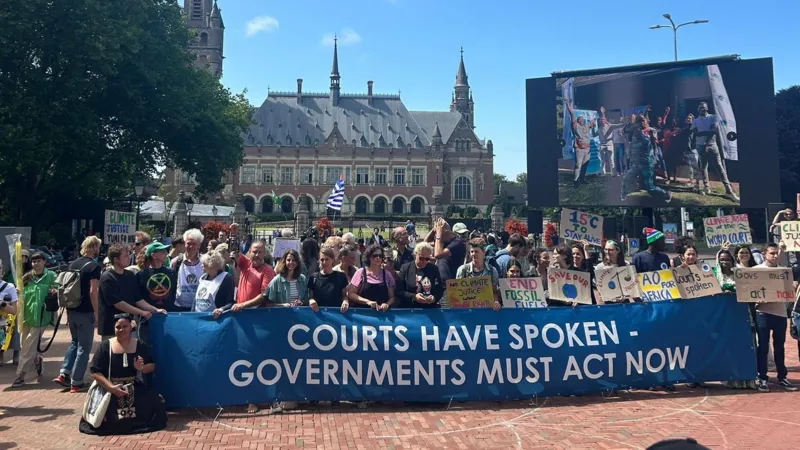
A landmark decision by a top UN court has cleared the way for countries to sue each other over climate change, including over historic emissions of planet-warming gases.
But the judge at the International Court of Justice in the Hague, Netherlands on Wednesday said that untangling who caused which part of climate change could be difficult.
The ruling is non-binding but legal experts say it could have wide-ranging consequences.
It will be seen as a victory for countries that are very vulnerable to climate change, who came to court after feeling frustrated about lack of global progress in tackling the problem.
The unprecedented case at the International Court of Justice (ICJ) was the brainchild of a group of young law students from low-lying Pacific islands on the frontlines of climate change, who came up with the idea in 2019.
One of those students, Siosiua Veikune from Tonga, was in the Hague to hear the decision.
“I’m lost for words. This is so exciting. There’s a ton of emotions rushing through us. This is a win we take proudly back home to our communities,” he told BBC News.
“Tonight I’ll sleep easier. The ICJ has recognised what we have lived through – our suffering, our resilience and our right to our future,” said Flora Vano, from the Pacific Island Vanuatu, which is considered the country most vulnerable to extreme weather globally.
“This is a victory not just for us but for every frontline community fighting to be heard.”
The ICJ is considered the world’s highest court and it has global jurisdiction. Lawyers have told BBC News that the opinion could be used as early as next week, including in national courts outside of the ICJ.
Campaigners and climate lawyers hope the landmark decision will now pave the way for compensation from countries that have historically burned the most fossil fuels and are therefore the most responsible for global warming.
Many poorer countries had backed the case out of frustration, claiming that developed nations are failing to keep existing promises to tackle the growing problem.
But developed countries, including the UK, argued that existing climate agreements, including the landmark UN Paris deal of 2015, are sufficient and no further legal obligations should be imposed.
On Wednesday the court rejected that argument.
Judge Iwasawa Yuji also said that if countries do not develop the most ambitious possible plans to tackle climate change this would constitute a breach of their promises in the Paris Agreement.
He added that broader international law applies, which means that countries which are not signed up to the Paris Agreement – or want to leave, like the US – are still required to protect the environment, including the climate system.
The court’s opinion is advisory, but previous ICJ decisions have been implemented by governments, including when the UK agreed to hand back the Chagos Islands to Mauritius last year.
“The ruling is a watershed legal moment,” said Joie Chowdhury, Senior Attorney at the Centre for International Environmental Law (CIEL).
“With today’s authoritative historic ruling, the International Court of Justice has broken with business-as-usual and delivered a historic affirmation: those suffering the impacts of climate devastation have a right to remedy for climate harm, including through compensation,” she added.
A spokesperson for the UK’s Foreign, Commonwealth and Development Office said it was “taking time” to look at the opinion before commenting in detail, but added:
“Tackling climate change is and will remain an urgent UK and global priority. Our position remains that this is best achieved through international commitment to the UN’s existing climate treaties and mechanisms.”
The court ruled that developing nations have a right to seek damages for the impacts of climate change such as destroyed buildings and infrastructure.
It added that where it is not possible to restore part of a country then its government may want to seek compensation.
This could be for a specific extreme weather event if it can be proved that climate change caused it, but the Judge said this would need to be determined on a case by case basis.
“This is a huge win for climate vulnerable states. It’s a huge win for Vanuatu, which led this case and is going to change the face of climate advocacy,” said barrister Jennifer Robinson at Doughty Street Chambers, who represented Vanuatu and the Marshall Islands.
It is not clear how much an individual country could have to pay in damages if any claim was successful.
But previous analysis published in Nature, estimated that between 2000 and 2019 there were $2.8 trillion losses from climate change – or $16 million per hour.
During the evidence sessions in December, the court heard from dozens of Pacific Islanders who have been displaced as a result of rising sea level, caused by climate change.
The Marshall Islands highlighted that the costs for their island to adapt to climate change are $9 billion.
“That is $9 billion the Marshall Islands does not have. Climate change is a problem they have not caused, but they are forced to consider relocating their capital,” said Ms Robinson.
As well as compensation, the court also ruled that governments were responsible for the climate impact of companies operating in their countries.
It said specifically that subsidising the fossil fuel industry or approving new oil and gas licenses could be in breach of a country’s obligations.
Developing countries are already exploring bringing new cases seeking compensation for historic contributions to climate change against richer, high emitting nations citing the ICJ opinion, according to lawyers the BBC spoke to.
If a country wants to bring a case back to the ICJ to make a ruling on compensation then it can only do so against countries which have agreed to its jurisdiction, which includes the likes of the UK, but not US or China.
But a case can be brought in any court globally, whether that be domestic or international, citing the ICJ opinion, explained Joie Chowdhury from CIEL.
So instead a country may choose to take their case not to the ICJ but a court where those countries are bound e.g. federal courts in the US.
But the question remains whether the ICJ opinion will be respected.
“[The ICJ] is an institution that is subject to geopolitics – and it relies on states adhering to its judgements, it doesn’t have a police force,” said Harj Narulla, a climate barrister at Doughty Street Chambers, which also represented the Solomon Islands.
When asked about the decision, a White House spokesperson told BBC News:
“As always, President Trump and the entire Administration is committed to putting America first and prioritising the interests of everyday Americans.”
(BBC)


Typhoon Noul has hit southern China, including Hong Kong, bringing strong winds and heavy rain to the region and prompting the evacuation of hundreds of thousands of people in Guangdong province.
China’s national weather centre said Noul made landfall on the coast of Huidong county in Huizhou, southern Guangdong province, at approximately 3:50am local time on Sunday (19:50 GMT on Saturday).
China’s official Xinhua News Agency said Noul was the strongest typhoon to make landfall in China so far this year.
Hong Kong’s Observatory said Noul, with maximum sustained winds of 110 kilometres per hour (68 miles per hour) near its centre, was moving Sunday into inland Guangdong and weakening progressively, bringing strong winds and heavy rain to parts of the region.
More than 715,000 people had been relocated for safety by early Sunday in Guangdong province, according to state-owned China National Radio. On Saturday, authorities said some 340,000 people were evacuated.
China’s National Meteorological Centre expected parts of southern Guangdong and southeastern Fujian provinces to experience heavy rain and strong winds over the weekend.
Many trees were seen uprooted in Huilai county, located on the coast of Guangdong province, state broadcaster CCTV reported.
Hong Kong’s airport authority said about 350 flights were cancelled on Sunday. At least nine people were injured across the city during the typhoon period, according to Hong Kong authorities.
As Noul approached Hong Kong, parts of a large scaffolding on a high-rise building collapsed on Saturday afternoon, local police said, although initial reports indicated there were no injuries.
[Aljazeera]

Colombo Kaps defended 197 runs to win the 12th match of the Lanka Premier League by restricting Dambulla Sixers to 176/8 at the Dambulla International Cricket Stadium on Saturday [25] night.
SCORES:
Colombo Kaps 197/5 in 20 overs [Rubin Hermann 39, Sadeera Samarawickrema 16, Sharujan Shanmuganathan 12, Kamindu Mendis 88*, Ben McDermott 14, Janith Liyanage 17; Fazalhaq Farooki 1-41, Dushmantha Chameera 1-41, Ramesh Mendis 1-05, Gulabdin Naib 1-15]
Dambulla Sixers 176/8 in 20 overs [Pavan Rathnayake 50, Marques Ackerman 40, Gulabdin Naib 28, Maheesh Thhekshana 13; Shahnawaz Dahani 2-20, Wanuja Sahan 1-34, Mujeeb Ur Rahman 2-33, Malsha Tharupathi 1-26, Milan Rathnayake 1-26]

Kandy Royals’ bowlers led by Nuwan Thushara were able to defend their score of 165 to win the 11th match of the Lanka Premier League by defeating Galle Gallants by 11 runs at Dambulla on Saturday.
SCORES:
Kandy Royals 165/6 in 20 overs [Lahiru Udara 16, Dale Phillips 34, Wanidu Hasaranga 16, Moeen Ali 41, Angelo Mathews 28, Vijay Shankar 15; Pramod Madushan 2-41, Akif Javed 2-26, Vijayakanth Viyaskanth 2-36]
Galle Gallants 154/8 in 20 overs [Sam Harper 14, Charith Asalanka 14, Chamika Karunarathne 52, Dasun Shanaka 57*; Nuwan Thushara 3-33, Asitha Fernando 2-33, Moeen Ali 1-11, Wanidu Hasaranga 1-26]

Typhoon Noul makes landfall in China, with hundreds of thousands evacuated

Colombo Kaps down Dambulla Sixers by 21 runs

Kandy Royals win by 11 runs
Showers will occur in the Western, Sabaragamuwa and North-western provinces and in Galle, Matara, Kandy and Nuwara-Eliya districts

Govt. launches EPF, ETF shake-up

SLPI concerned over the proposed Chartered Institute of Media Professionals of Sri Lanka

‘Dates have the highest sugar content to fight Coronavirus’

Sunday Island 27 December – Headlines

#SundayIsland 17th December – Headlines

Sunday Island – 28th March

Sunday Island Headlines – 21 March

Sunday Island – 21st February – Headlines
-

 Midweek Review5 days ago
Three high-profile alleged suicides shaping key investigations
-

 News2 days ago
Fort Magistrate orders arrest of MP Archchuna
-

 Editorial2 days ago
An indictment of all parties
-

 News5 days ago
Customs asked to resume probe or face legal action
-
Editorial6 days ago
Welcome bid to tackle rolling death traps
-

 Opinion3 days ago
Ukraine’s power struggle spills on to the streets
-

 News2 days ago
National-level cybersecurity facility Lab established
-

 News7 days ago
Merchant Shipping Secretariat probes bribery scandal