
Latest News
They made America’s clothing. Now they are getting punished for it


Already living from hand to mouth, millions of garment workers across Asia fear for their jobs as a deadline to strike a trade deal with the US – or face punishing tariffs – looms closer.
On 9 July, following a 90-day pause on tariffs for countries to negotiate deals, the US president notified several countries in the region of new levies set to begin on 1 August. The new rates, while lower than those proposed in April, have done little to allay anxieties.
Among nations that received letters from Donald Trump were apparel hubs like Cambodia and Sri Lanka, which are heavily dependent on the US as an export market. The letters said that the two nations would face tariffs of 36% and 30% respectively.
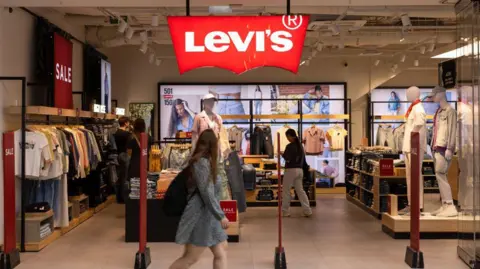
Nike, Levi’s and Lululemon are among big-name US brands that have the bulk of their clothing made in these countries.
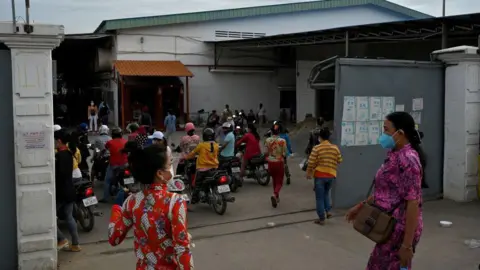
“Can you imagine what will happen if we lose our jobs? I’m so worried, especially for my kids. They need food,” says Nao Soklin, who works in a garment factory in southeastern Cambodia.
Ms Soklin and her husband Kok Taok make a living sewing bags for 10 hours a day. Together, they earn about $570 a month – barely enough to cover rent and provide for their two young sons and aged parents.
“I want to send a message to President Trump, to tell him to please lift the tariff on Cambodia… We need our jobs to support our families,” she told the BBC.
Cambodia, which has become a popular alternative to Chinese retailers because of its ready supply of low-wage labour, exported more than $3bn worth of apparel to the US last year, according to the Asean Statistics Division. The sector, which employs more than 900,000 people, makes up more than a tenth of the country’s overall exports.
For Sri Lanka, exports to the US helped the garment industry – which directly employs some 350,000 people – earn $1.9bn last year, making it the country’s third-largest foreign exchange earner.
“If 30% is the end number, Sri Lanka is in trouble because our competitors, such as Vietnam, have received lower tariffs,” Yohan Lawrence, secretary general of Sri Lanka’s Joint Apparel Association Forum, told the Reuters news agency.
Sri Lankan authorities are hopeful of negotiating a further reduction to the tariffs but have not disclosed what they would consider as an acceptable rate.
Some of its leaders have noted that the country has received the highest concession – of 14 percentage points – so far as a result of earlier negotiations. “We see this as the beginning of a very good situation,” secretary to the Finance Minister Harshana Suriyapperuma said last week.
Cambodia, which got a 13 percentage point concession, is also seeking further talks. “We are doing everything we can to protect the interests of investors and workers,” said Deputy Prime Minister Sun Chanthol, who leads the negotiating team.
“We want the tariff to be zero… But we respect their decision and will continue trying to negotiate a lower rate,” he said.
Trump says the tariffs are needed to reduce the gap between the value of goods the US buys from other countries and those it sells to them.
“Our relationship has been, unfortunately, far from Reciprocal,” the US leader wrote in letters to various countries last week, which he also posted on his Truth Social platform.
But analysts disagree.
Trump’s tariffs overlook the benefits that the US enjoys from existing trade agreements, including lower-priced clothing and higher profits for US companies sourcing from countries like Sri Lanka or Cambodia, says Mark Anner, dean at Rutgers’ School of Management and Labor Relations.
For decades, the US, European Union and Canada had in place a quota system that reserved a certain share of their markets for developing countries like Sri Lanka. The system, which was phased out in 2005, helped Sri Lanka’s garment sector flourish despite stiff competition.
“For the US to now impose prohibitive tariffs that effectively shut these countries out of the market goes against the very development path it once prescribed,” Prof Anner said.
It is unrealistic to expect small, developing economies to not run a trade deficit with the US, says Sheng Lu, a professor at the University of Delaware’s Department of Fashion and Apparel Studies. “How many Boeing airplanes does Cambodia or Sri Lanka need and can afford to purchase each year?” he asked.
Asst Prof Lu believes the strategic rivalry between the US and China is also a factor in trade talks, given how these garment-exporting countries are integrated into supply chains that rely heavily on Chinese inputs.
They now have to “strike a delicate balance” between maintaining economic ties with China while also meeting new US demands, which may include cutting the use of Chinese inputs in production, he says.
Washington’s tariffs add new pressures to familiar challenges in the industry: poverty and weak labour rights in Cambodia, and an ongoing economic crisis in Sri Lanka.
Women, who make up seven in 10 of garment workers in the region, are set to bear the brunt of the tariffs. More downward pressure on their already chronically low wages mean their children could go hungry, while potential layoffs would be even more devastating.
Surangi Sandya, who works in a factory in the Sri Lankan town of Nawalapitiya, says she feels an axe hanging over her.
“Companies don’t work at a loss… If orders decrease, if there is a loss, there may be a possibility that the company will shut down,” she says. Ms Sandya started out as a rank-and-file seamstress in 2011, then worked her way up to become the supervisor of a 70-women team.
If push comes to shove, some Cambodian workers say they will consider moving to Thailand to find jobs – even if they must do it illegally.
“Our livelihoods depend on the garment factory. We won’t survive if our boss shuts it down,” An Sopheak tells the BBC from her tiny 16 sq m room in Cambodia’s capital Phnom Penh.
“We have little education. We can’t find other jobs. We pray every day that President Trump will lift the tariff. Please think about us and our poor country.”
[BBC]


The second T20I between Sri Lanka and Pakistan which was to be played at Dambulla was abandoned without a ball being bowled due to rain.

Colombia’s President Gustavo Petro has told the BBC that he believes there is now a “real threat” of US military action against Colombia.
Petro said the United States is treating other nations as part of a US “empire”. It comes after Trump threatened Colombia with military action. He said that the US risks transforming from “dominating the world” to becoming “isolated from the world.”
He also accused US Immigration and Customs Enforcement (ICE) agents of acting like “Nazi brigades”. Trump has significantly expanded ICE operations as part of what the administration says is a crackdown on crime and immigrants who illegally entered the US.
The BBC has approached the White House for comment.t
Following US strikes on Venezuela and the seizure of Nicolás Maduro, US President Donald Trump said a military operation targeting Colombia “sounds good”.
Trump has also repeatedly told Petro to “watch his ass”, remarks Petro strongly condemned.
Trump and Petro spoke by phone on Wednesday evening, after which Trump said he would meet hisColombian counterpart at the White House in the near future. Writing on his Truth Social platform late on Wednesday after the call, Trump described his conversation with Petro as a “Great Honour”. A Colombian official said at the time that the conversation had reflected a 180-degree shift in rhetoric “from both sides.”
But on Thursday, Petro’s tone suggested relations had not significantly improved.
He told the BBC the call lasted just under an hour, “most of it occupied by me,” and covered “drug trafficking Colombia” and Colombia’s view on Venezuela and “what is happening around Latin America regarding the United States.”
Petro strongly criticised recent US immigration enforcement, accusing ICE agents of operating like “Nazi brigades”.
President Trump has often blamed immigration for crime and trafficking in the US, using it to justify large-scale enforcement operations, and has accused countries like Colombia and Venezuela of not doing enough to tackle drug-trafficking.
Since returning to the White House, the US president has sent ICE agents to cities across the country. The agency enforces immigration laws and conducts investigations into undocumented immigration. It also plays a role in removing undocumented immigrants from the US.
The administration says it deported 605,000 people between 20 January and 10 December 2025. It also said 1.9 million immigrants had “voluntarily self-deported”, following an aggressive public awareness campaign encouraging people to leave the country on their own to avoid arrest or detention.
About 65,000 people were in ICE detention as of 30 November 2025, according to data obtained by the Transactional Records Access Clearinghouse’s immigration project, a compendium of government data from Syracuse University.
This week a US immigration agent shot dead a 37-year-old US citizen in the city of Minneapolis, sparking protests overnight.
Federal officials said the woman, Renee Nicole Good , had tried to run over immigration agents with her car but the city mayor, Democrat Jacob Frey, said the agent who shot her had acted recklessly and demanded agents leave the city.
Petro said ICE had “reached the point where it no longer only persecutes Latin Americans in the streets, which for us is an affront, but it also kills United States citizens.”
He added that if this continued, “instead of a United States dominating the world – an imperial dream – it is a United States isolated from the world. An empire was not built by being isolated from the world.”
Petro said the US has for “decades” treated other governments, particularly in Latin America, as an “empire” regardless of the law.
The two leaders have long been adversaries, frequently trading insults and tariff threats on social media.
Following the US’s military action in Venezuela, Petro accused Washington of seeking wars over “oil and coal,” adding that if the US had not pulled out of the Paris Agreement, where countries agreed to limit global temperature rising by reducing fossil fuel use, “there would be no wars, there would be a much more democratic and peaceful relationship with the world. And South America.”
“The Venezuelan issue is about this,” he said.
After Trump’s comments threatening military action in Colombia, demonstrations were held across the country in the name of sovereignty and democracy.
Petro told the BBC that Trump’s remarks amounted to a “real threat”, citing Colombia’s loss of territory such as Panama in the 20th century, and said “the prospect of removing [the threat] depends on the ongoing conversations.”
Asked how Colombia would defend itself in the event of a US attack, Petro said he would “prefer it to be about dialogue.” He said that “work is being done” on this.
But he added: “Colombia’s history shows how it has responded to large armies.”
“It’s not about confronting a large army with weapons we don’t have. We don’t even have anti-aircraft defenses. Instead, we rely on the masses, our mountains, and our jungles, as we always have.”
Petro confirmed he had also spoken to Delcy Rodríguez, Venezuela’s acting president and former vice president and oil minister, and invited her to Colombia.
He said Venezuela had “long been subject to interference by various intelligence agencies,” adding that while such agencies had permission to operate in Colombia, it was solely to combat drug trafficking. He denounced attempts at what he said were other “covert operations” in Colombia.
He did not directly comment when asked whether he feared the CIA could carry out covert operations similar to their actions in Venezuela in Colombia, or whether he feared his own government or inner circles may have informants.
Maduro was captured by the US army’s Delta Force, the military’s top counter-terrorism unit, after a CIA source in Venezuelan government helped the US track his location.
As the world’s largest producer of cocaine, Colombia is a major hub for the global drug trade. It also has significant oil reserves, as well as gold, silver, emeralds, platinum and coal.
The US has said it will control sales of Venezuelan oil “indefinitely” as it prepares to roll back restrictions on the country’s crude in global markets.
Speaking aboard Air Force One after the Venezuela operation, Trump described Petro as a “sick man who likes making cocaine and selling it to the United States,” adding: “He’s not going to be doing it for very long.”
Petro denied the claims, saying it has “always been proven that I’m not involved in that.”
“For 20 years I have been fighting against the drug cartels, at the cost of my family having to go into exile,” he said.
A former guerrilla, Petro has pursued a “total peace” strategy since taking office, prioritising dialogue with armed groups. Critics say the approach has been too soft, with cocaine production reaching record levels.
Asked what failed and whether he accepted responsibility, Petro said coca cultivation growth was slowing and described “two simultaneous approaches.”
“One, talking about peace with groups that are bandits. And the other, developing a military offensive against those who don’t want peace.”
He said negotiations were ongoing in southern Colombia, “where the greatest reduction in coca leaf cultivation has occurred” and “where the homicide rate in Colombia has fallen the most.” Cocaine is made from the leaves of the coca plant.
The policy of dialogue, he said, was intended to “de-escalate violence”, adding: “we’re not fools, we know who we’re negotiating with.”
(BBC)
Latest News
Landslide RED warnings issued to the Divisional Secretaries Divisions of Ududumbara, Nildadndahinna and Walapane
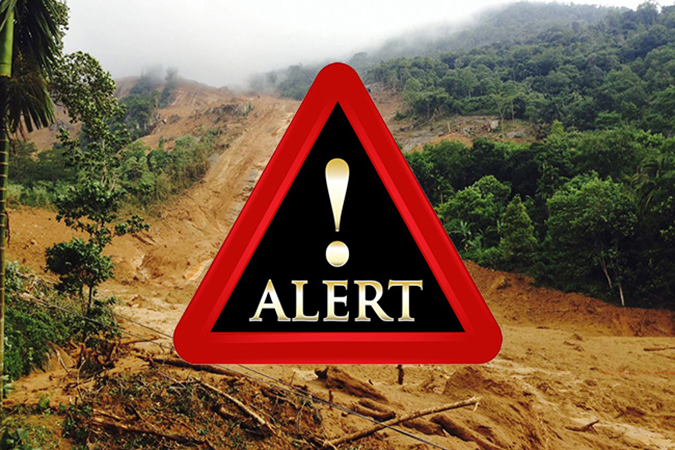
The landslide early warning center of the National Building Research Organisation [NBRO] has issued RED warnings to the districts of Kandy and Nuwara Eliya for the next 24 hours effective from 0900 hrs today [09th January].
Accordingly,
LEVEL III RED landslide early warnings have been issued to the Divisional Secretaries Divisions and surrounding areas of Ududumbara in the Kandy district, and Nildandahinna and Walapane in the Nuwara Eliya district.
LEVEL II AMBER landslide early warnings have been issued to the Divisional Secretaries Divisions and surrounding areas of Wilgamuwa in the Matale district, and Mathurata and Hanguranketha in the Nuwara Eliya district.
LEVEL I YELLOW landslide early warnings have been issued to the Divisional Secretaries Divisions and surrounding areas of Uva Paranagama, Welimada, Kandaketiya, Badulla, Meegahakiwula, Hali_Ela, Passara and Lunugala in the Badulla district, Minipe in the Kandy district, Ambanganga Korale, Ukuwela, Rattota, Naula and Laggala_Pallegama in the Matale district, and Nuwara Eliya in the Nuwara Eliya district.

Rain washes out 2nd T20I in Dambulla

Colombia sees ‘real threat’ of US military action, president tells BBC

Landslide RED warnings issued to the Divisional Secretaries Divisions of Ududumbara, Nildadndahinna and Walapane

Harmanpreet, Mandhana return to DY Patil, on opposite sides this time

Huge anti-government protests in Tehran and other Iranian cities, videos show

Clinical Pakistan look to keep momentum going and wrap up series

‘Dates have the highest sugar content to fight Coronavirus’

Sunday Island 27 December – Headlines

#SundayIsland 17th December – Headlines

Sunday Island – 28th March

Sunday Island Headlines – 21 March

Sunday Island – 21st February – Headlines
-

 News4 days ago
Interception of SL fishing craft by Seychelles: Trawler owners demand international investigation
-
 News4 days ago
Broad support emerges for Faiszer’s sweeping proposals on long- delayed divorce and personal law reforms
-

 Opinion20 hours ago
The minstrel monk and Rafiki, the old mandrill in The Lion King – II
-

 Features20 hours ago
The Venezuela Model:The new ugly and dangerous world order
-

 News3 days ago
Prez seeks Harsha’s help to address CC’s concerns over appointment of AG
-

 News5 days ago
Private airline crew member nabbed with contraband gold
-

 Latest News2 days ago
Warning for deep depression over South-east Bay of Bengal Sea area
-

 News3 days ago
Govt. exploring possibility of converting EPF benefits into private sector pensions