
Latest News
They made America’s clothing. Now they are getting punished for it


Already living from hand to mouth, millions of garment workers across Asia fear for their jobs as a deadline to strike a trade deal with the US – or face punishing tariffs – looms closer.
On 9 July, following a 90-day pause on tariffs for countries to negotiate deals, the US president notified several countries in the region of new levies set to begin on 1 August. The new rates, while lower than those proposed in April, have done little to allay anxieties.
Among nations that received letters from Donald Trump were apparel hubs like Cambodia and Sri Lanka, which are heavily dependent on the US as an export market. The letters said that the two nations would face tariffs of 36% and 30% respectively.
Nike, Levi’s and Lululemon are among big-name US brands that have the bulk of their clothing made in these countries.
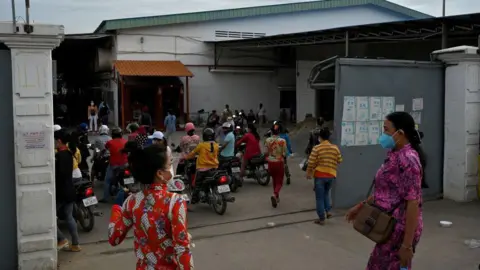
“Can you imagine what will happen if we lose our jobs? I’m so worried, especially for my kids. They need food,” says Nao Soklin, who works in a garment factory in southeastern Cambodia.
Ms Soklin and her husband Kok Taok make a living sewing bags for 10 hours a day. Together, they earn about $570 a month – barely enough to cover rent and provide for their two young sons and aged parents.
“I want to send a message to President Trump, to tell him to please lift the tariff on Cambodia… We need our jobs to support our families,” she told the BBC.
Cambodia, which has become a popular alternative to Chinese retailers because of its ready supply of low-wage labour, exported more than $3bn worth of apparel to the US last year, according to the Asean Statistics Division. The sector, which employs more than 900,000 people, makes up more than a tenth of the country’s overall exports.
For Sri Lanka, exports to the US helped the garment industry – which directly employs some 350,000 people – earn $1.9bn last year, making it the country’s third-largest foreign exchange earner.
“If 30% is the end number, Sri Lanka is in trouble because our competitors, such as Vietnam, have received lower tariffs,” Yohan Lawrence, secretary general of Sri Lanka’s Joint Apparel Association Forum, told the Reuters news agency.
Sri Lankan authorities are hopeful of negotiating a further reduction to the tariffs but have not disclosed what they would consider as an acceptable rate.
Some of its leaders have noted that the country has received the highest concession – of 14 percentage points – so far as a result of earlier negotiations. “We see this as the beginning of a very good situation,” secretary to the Finance Minister Harshana Suriyapperuma said last week.
Cambodia, which got a 13 percentage point concession, is also seeking further talks. “We are doing everything we can to protect the interests of investors and workers,” said Deputy Prime Minister Sun Chanthol, who leads the negotiating team.
“We want the tariff to be zero… But we respect their decision and will continue trying to negotiate a lower rate,” he said.

Trump says the tariffs are needed to reduce the gap between the value of goods the US buys from other countries and those it sells to them.
“Our relationship has been, unfortunately, far from Reciprocal,” the US leader wrote in letters to various countries last week, which he also posted on his Truth Social platform.
But analysts disagree.
Trump’s tariffs overlook the benefits that the US enjoys from existing trade agreements, including lower-priced clothing and higher profits for US companies sourcing from countries like Sri Lanka or Cambodia, says Mark Anner, dean at Rutgers’ School of Management and Labor Relations.
For decades, the US, European Union and Canada had in place a quota system that reserved a certain share of their markets for developing countries like Sri Lanka. The system, which was phased out in 2005, helped Sri Lanka’s garment sector flourish despite stiff competition.
“For the US to now impose prohibitive tariffs that effectively shut these countries out of the market goes against the very development path it once prescribed,” Prof Anner said.
It is unrealistic to expect small, developing economies to not run a trade deficit with the US, says Sheng Lu, a professor at the University of Delaware’s Department of Fashion and Apparel Studies. “How many Boeing airplanes does Cambodia or Sri Lanka need and can afford to purchase each year?” he asked.
Asst Prof Lu believes the strategic rivalry between the US and China is also a factor in trade talks, given how these garment-exporting countries are integrated into supply chains that rely heavily on Chinese inputs.
They now have to “strike a delicate balance” between maintaining economic ties with China while also meeting new US demands, which may include cutting the use of Chinese inputs in production, he says.
Washington’s tariffs add new pressures to familiar challenges in the industry: poverty and weak labour rights in Cambodia, and an ongoing economic crisis in Sri Lanka.
Women, who make up seven in 10 of garment workers in the region, are set to bear the brunt of the tariffs. More downward pressure on their already chronically low wages mean their children could go hungry, while potential layoffs would be even more devastating.
Surangi Sandya, who works in a factory in the Sri Lankan town of Nawalapitiya, says she feels an axe hanging over her.
“Companies don’t work at a loss… If orders decrease, if there is a loss, there may be a possibility that the company will shut down,” she says. Ms Sandya started out as a rank-and-file seamstress in 2011, then worked her way up to become the supervisor of a 70-women team.
If push comes to shove, some Cambodian workers say they will consider moving to Thailand to find jobs – even if they must do it illegally.
“Our livelihoods depend on the garment factory. We won’t survive if our boss shuts it down,” An Sopheak tells the BBC from her tiny 16 sq m room in Cambodia’s capital Phnom Penh.
“We have little education. We can’t find other jobs. We pray every day that President Trump will lift the tariff. Please think about us and our poor country.”
[BBC]


Punjab Kings 165 for 7 in 19.1 overs (Cooper Connolly 72*, Prabhsimran Singh 37, Shreyas Iyer 18, Xavier Bartlett 11*; Kagsio Rabada 1-13, Ashok Sharma 1-31, Rashid Khan 1-29, Washington Sundar 1-27, Prasidh Krishna 3-29) beat Gujarat Titans 162 for 6 in 20 overs (Sai Sudarshan 13, Shubman Gill 39, Joss Buttler 38, Glenn Phillips 25, Washington Sundar 18, Rahul Tewatia 11*; Marco Jansen 1-20, Vijayakumar Vyshak 3-34, Yuzvendra Chahal 2-28) by three wickets
Gujarat Titans (GT) stopped Punjab Kings (PBKS) in their tracks but could not stop them from going over the finish line in New Chandigarh. Cooper Connolly steered the hosts home in a chase that began authoritatively before taking nervy turns.
Prabhsimran Singh led the initial charge alongside Connolly before Prasidh Krishna initiated a collapse that derailed the chase. But with help from Marco Jansen and Xavier Bartlett, Connolly took PBKS home with five balls to spare.
GT had a sub-par outing with the bat, with three of their top four getting off to good starts but none of them capitalising. Yuzvendra Chahal was back to his best, taking out Shubman Gill and Jos Buttler, who top-scored with 39 and 38 respectively.
PBKS’ bowlers conceded 14 extras, 11 of which were wides, four of them coming in the final over by Arshdeep Singh. Perhaps the more relevant stat separating the teams was that GT hit three sixes in their innings and PBKS as many as 14.
Chahal came on with GT well set on 65 for 1 off 7 overs. He bowled slow, and varied his lines against Gill to dismiss him fourth time in the IPL. This time, it was a slog sweep that carried to deep midwicket.
There were a couple of near-chances in the 11th over, one a caught-and-bowled chance off Buttler and then one off Glenn Phillips, who hit an airy four that went just wide of Shreyas Iyer at cover. Chahal returned in the 16th, after a three-over break, with Buttler batting on 38 off 30 and itching for runs. Two dots later, Buttler looked to clear long-on but Bartlett used his height and reach to take an excellent high catch.
Vijaykumar Vyshak bowled across phases and found success later in the innings. Buttler and Gill took him on initially, hitting two fours and a six in his first two overs, the sixth and eighth of the GT innings. He came back and got Glenn Phillips to hole out to long-off in the 14th.
He saved the best for the death, bowling slower balls, either into the pitch or pitched right up. The first variant got Washington Sundar caught, cutting to deep point, and the latter had Shahrukh Khan slogging to deep square leg.
The pitch seemed flat early on as Gill, Sai Sudharsan and Buttler started with a flurry of fours. Nine in the first six overs, in fact. There were drives, pulls and flicks, and a gorgeous back-foot punch by Buttler off Vyshak.
The slowdown came in the middle overs, which saw GT make 77 for 3. Buttler faced 14 dots in his 33-ball 38, Gill, having rocketed to 27 off 15, made just 12 off his last 12 balls.
Phillips got off to a promising start on GT debut, hitting Chahal for a six and a four within his first eight balls at the crease. He missed out on a couple of boundaries because of Marco Jansen’s fielding at long-off. In the end, three of the top-four batters got to 25 but none went past 39.
After Kagiso Rabada dismissed Priyansh Arya cheaply, Connolly and Prabhsimran took him on: they hit three sixes in the fourth over, the same as GT’s innings tally.
Connolly then used Ashok Sharma’s pace to carve a length ball over cover point. He then hit two sixes off successive Rashid overs while Prabhsimran did the same off Washington Sundar.
However, Prabhsimran couldn’t get going against Rashid. He faced eight balls and scored just two before charging the legspinner and finding Prasidh at long-on. PBKS were 83 for 1 in the tenth over.
The momentum didn’t flag with that wicket, as Shreyas hit sixes off back-to-back short balls from Ashok. But out of nowhere, Prasidh dismissed the PBKS captain, who chipped a half-volley straight to deep midwicket.
This brought about a burst of T20-style wickets where the field mattered more than the quality of the ball. Nehal Wadhera cut a shortish slower ball straight to cover. Shashank Singh, looking to run the ball to deep third, nicked to the keeper off Prasidh. Marcus Stoinis, off Prasidh again, carved a shortish ball to deep third. PBKS had lost four wickets in the space of 16 balls for eight runs.
At 121 for 6, with PBKS needing 42 off 30, the game was flipping. But Connolly was ice-cool against Rabada. He punished two short balls to bookend the 16th over, the first cut over backward point for four to bring up his fifty and the last one pulled over square leg for six.
The pressure was eased at the other end as Jansen and Bartlett pulled Prasidh for sixes in the 17th and 19th overs respectively. That was where PBKS effectively sealed the game.
Brief scores:
Punjab Kings 165 for 7 in 19.1 overs (Cooper Connolly 72*, Prabhsimran Singh 37, Shreyas Iyer 18, Xavier Bartlett 11*; Kagsio Rabada 1-13, Ashok Sharma 1-31, Rashid Khan 1-29, Washington Sundar 1-27, Prasidh Krishna 3-29) beat Gujarat Titans 162 for 6 in 20 overs (Sai Sudarshan 13, Shubman Gill 39, Joss Buttler 38, Glenn Phillips 25, Washington Sundar 18, Rahul Tewatia 11*; Marco Jansen 1-20, Vijayakumar Vyshak 3-34, Yuzvendra Chahal 2-28) by three wickets
[Cricinfo]
Latest News
Heat Index at Caution Level in the Western, Sabaragamuwa, Southern, Eastern, North-western, Northern and North-central provinces and in Monaragala district

Warm Weather Advisory
Issued by the Natural Hazards Early Warning Centre
Issued at 3.30 p.m. on 31 March 2026, valid for 01 April 2026.
The Heat index, the temperature felt on human body is likely to increase up to ‘Caution level’ at some places in the Western, Sabaragamuwa, Southern, Eastern, North-western, Northern and North-central provinces and in Monaragala district.
The Heat Index Forecast is calculated by using relative humidity and maximum temperature and this is the condition that is felt on your body. This is not the forecast of maximum temperature. It is generated by the Department of Meteorology for the next day period and prepared by using global numerical weather prediction model data.

Effect of the heat index on human body is mentioned in the above table and it is prepared on the advice of the Ministry of Health and Indigenous Medical Services.
ACTION REQUIRED
Job sites: Stay hydrated and takes breaks in the shade as often as possible.
Indoors: Check up on the elderly and the sick.
Vehicles: Never leave children unattended.
Outdoors: Limit strenuous outdoor activities, find shade and stay hydrated.
Dress: Wear lightweight and white or light-colored clothing.
Note:
In addition, please refer to advisories issued by the Disaster Preparedness & Response Division, Ministry of Health in this regard as well. For further clarifications please contact 011-7446491.
Latest News
Payment of Compensation to the people who have lost their cultivable lands in implementing the Uma Oya Multipurpose Development Project

Approval has been granted at the Cabinet meeting held on 27-06-2012 to provide cultivable agricultural lands from the lower Uma Oya valley to 276 farming families in Hali-Ela, Walimada, and Uva Paranagama Divisional Secretariat Divisions who have lost their cultivable lands due to the acquisition of lands for the
Uma Oya Multipurpose Development Project.
However, the aforementioned proposal could not be implemented due to the encroachment of a large portion of the identified lands by unauthorized persons, heavy forest cover, the threats posed by wild elephants, remoteness from their original settlements, and difficulties in adapting to other environmental conditions and social anomalies.
Accordingly, the Cabinet of Ministers has approved the resolution furnished by the Minister of Agriculture, Livestock, Land, and Irrigation to pay an estimated compensation of Rs. 12 lakhs for each of these 276 farming families, based on the
recommendations submitted by the Cabinet Sub-Committee appointed to provide solutions for the issues arising in the implementation of the Uma Oya Multipurpose Development Project.

Punjab Kings fined for slow over-rate

Ice-cool Connolly leads nervy Punjab Kings home on IPL debut

Showers expected in the Western, Sabaragamuwa and Southern provinces in the evening or night

Heat Index at Caution Level in the Western, Sabaragamuwa, Southern, Eastern, North-western, Northern and North-central provinces and in Monaragala district

Urea shortage threatens Yala harvest: Experts

2025 property grab: Court orders JVP to hand back Yakkala office to FSP

‘Dates have the highest sugar content to fight Coronavirus’

Sunday Island 27 December – Headlines

#SundayIsland 17th December – Headlines

Sunday Island – 28th March

Sunday Island Headlines – 21 March

Sunday Island – 21st February – Headlines
-

 Features4 days ago
A World Order in Crisis: War, Power, and Resistance
-

 News5 days ago
Energy Minister indicted on corruption charges ahead of no-faith motion against him
-

 News6 days ago
US dodges question on AKD’s claim SL denied permission for military aircraft to land
-

 Business6 days ago
Dialog Unveils Dialog Play Mini with Netflix and Apple TV
-

 Sports5 days ago
SLC to hold EGM in April
-

 Latest News6 days ago
A strong Technical and Vocational Education and Training (TVET) system equips individuals with practical, relevant, and future-oriented skills helping to innovate responsibly towards a greener and sustainable future – PM
-

 Opinion5 days ago
When elephants fight, it is the grass that suffers
-
 Features5 days ago
Lest we forget