
Latest News
They made America’s clothing. Now they are getting punished for it


Already living from hand to mouth, millions of garment workers across Asia fear for their jobs as a deadline to strike a trade deal with the US – or face punishing tariffs – looms closer.
On 9 July, following a 90-day pause on tariffs for countries to negotiate deals, the US president notified several countries in the region of new levies set to begin on 1 August. The new rates, while lower than those proposed in April, have done little to allay anxieties.
Among nations that received letters from Donald Trump were apparel hubs like Cambodia and Sri Lanka, which are heavily dependent on the US as an export market. The letters said that the two nations would face tariffs of 36% and 30% respectively.
Nike, Levi’s and Lululemon are among big-name US brands that have the bulk of their clothing made in these countries.
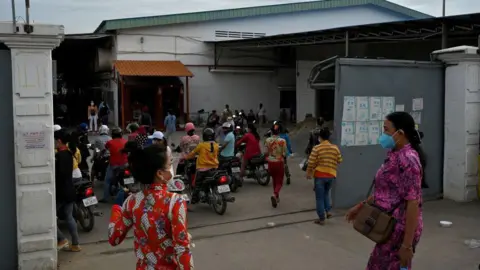
“Can you imagine what will happen if we lose our jobs? I’m so worried, especially for my kids. They need food,” says Nao Soklin, who works in a garment factory in southeastern Cambodia.
Ms Soklin and her husband Kok Taok make a living sewing bags for 10 hours a day. Together, they earn about $570 a month – barely enough to cover rent and provide for their two young sons and aged parents.
“I want to send a message to President Trump, to tell him to please lift the tariff on Cambodia… We need our jobs to support our families,” she told the BBC.
Cambodia, which has become a popular alternative to Chinese retailers because of its ready supply of low-wage labour, exported more than $3bn worth of apparel to the US last year, according to the Asean Statistics Division. The sector, which employs more than 900,000 people, makes up more than a tenth of the country’s overall exports.
For Sri Lanka, exports to the US helped the garment industry – which directly employs some 350,000 people – earn $1.9bn last year, making it the country’s third-largest foreign exchange earner.
“If 30% is the end number, Sri Lanka is in trouble because our competitors, such as Vietnam, have received lower tariffs,” Yohan Lawrence, secretary general of Sri Lanka’s Joint Apparel Association Forum, told the Reuters news agency.
Sri Lankan authorities are hopeful of negotiating a further reduction to the tariffs but have not disclosed what they would consider as an acceptable rate.
Some of its leaders have noted that the country has received the highest concession – of 14 percentage points – so far as a result of earlier negotiations. “We see this as the beginning of a very good situation,” secretary to the Finance Minister Harshana Suriyapperuma said last week.
Cambodia, which got a 13 percentage point concession, is also seeking further talks. “We are doing everything we can to protect the interests of investors and workers,” said Deputy Prime Minister Sun Chanthol, who leads the negotiating team.
“We want the tariff to be zero… But we respect their decision and will continue trying to negotiate a lower rate,” he said.

Trump says the tariffs are needed to reduce the gap between the value of goods the US buys from other countries and those it sells to them.
“Our relationship has been, unfortunately, far from Reciprocal,” the US leader wrote in letters to various countries last week, which he also posted on his Truth Social platform.
But analysts disagree.
Trump’s tariffs overlook the benefits that the US enjoys from existing trade agreements, including lower-priced clothing and higher profits for US companies sourcing from countries like Sri Lanka or Cambodia, says Mark Anner, dean at Rutgers’ School of Management and Labor Relations.
For decades, the US, European Union and Canada had in place a quota system that reserved a certain share of their markets for developing countries like Sri Lanka. The system, which was phased out in 2005, helped Sri Lanka’s garment sector flourish despite stiff competition.
“For the US to now impose prohibitive tariffs that effectively shut these countries out of the market goes against the very development path it once prescribed,” Prof Anner said.
It is unrealistic to expect small, developing economies to not run a trade deficit with the US, says Sheng Lu, a professor at the University of Delaware’s Department of Fashion and Apparel Studies. “How many Boeing airplanes does Cambodia or Sri Lanka need and can afford to purchase each year?” he asked.
Asst Prof Lu believes the strategic rivalry between the US and China is also a factor in trade talks, given how these garment-exporting countries are integrated into supply chains that rely heavily on Chinese inputs.
They now have to “strike a delicate balance” between maintaining economic ties with China while also meeting new US demands, which may include cutting the use of Chinese inputs in production, he says.
Washington’s tariffs add new pressures to familiar challenges in the industry: poverty and weak labour rights in Cambodia, and an ongoing economic crisis in Sri Lanka.
Women, who make up seven in 10 of garment workers in the region, are set to bear the brunt of the tariffs. More downward pressure on their already chronically low wages mean their children could go hungry, while potential layoffs would be even more devastating.
Surangi Sandya, who works in a factory in the Sri Lankan town of Nawalapitiya, says she feels an axe hanging over her.
“Companies don’t work at a loss… If orders decrease, if there is a loss, there may be a possibility that the company will shut down,” she says. Ms Sandya started out as a rank-and-file seamstress in 2011, then worked her way up to become the supervisor of a 70-women team.
If push comes to shove, some Cambodian workers say they will consider moving to Thailand to find jobs – even if they must do it illegally.
“Our livelihoods depend on the garment factory. We won’t survive if our boss shuts it down,” An Sopheak tells the BBC from her tiny 16 sq m room in Cambodia’s capital Phnom Penh.
“We have little education. We can’t find other jobs. We pray every day that President Trump will lift the tariff. Please think about us and our poor country.”
[BBC]


Kenya’s Agnes Ngetich took a second off the women-only half-marathon world record on Sunday when she won the World Athletics Road Running Championships in Copenhagen, stopping the clock at one hour, five minutes, and 15 seconds.
Ngetich, who also broke the women-only 10km (6.2-mile) world record last year, pushed to the front from the outset on a sunny morning in the Danish capital and led until the end, finishing 50 seconds ahead of compatriot Veronica Loleo, who came in second.
The previous record was set by Peres Jepchirchir, another Kenyan, when she won the World Half Marathon title in Poland in 2020.
The overall women’s half-marathon world record is held by Ethiopia’s Letesenbet Gidey, who clocked 1:02:52 in 2021 at the mixed-gender Valencia Half Marathon in Spain.
Sunday’s win was the latest major title this year for the 25-year-old Ngetich, who also won the team half marathon in Copenhagen and the World Cross Country Championships in Florida in the US in January.
(Aljazeera)
Latest News
Flood warning issued to the Divisional Secretariat Divisions of Ganga Ihala Korale, Udapalatha, Doluwa, Udunuwara, Yatinuwara, Gangawata Korale, Harispattuwa, and Pathadumbara

Due to heavy rainfall received in the upper catchment areas of the Mahaweli River over the past few hours, there is a risk of minor flooding in the low-lying areas surrounding the Mahaweli River within the Divisional Secretariat Divisions of Ganga Ihala Korale, Udapalatha, Doluwa, Udunuwara, Yatinuwara, Gangawata Korale, Harispattuwa, and Pathadumbara.Residents living in the above mentioned areas and motorists using roads passing through these areas are urged to exercise extreme caution and remain highly vigilant regarding the prevailing situation.
Furthermore, residents living in close proximity to the Mahaweli River in these areas are advised to remain highly alert to the situation and take all necessary precautions to protect themselves from any potential flooding.The relevant disaster management authorities are requested to take all necessary measures in response to this situation.
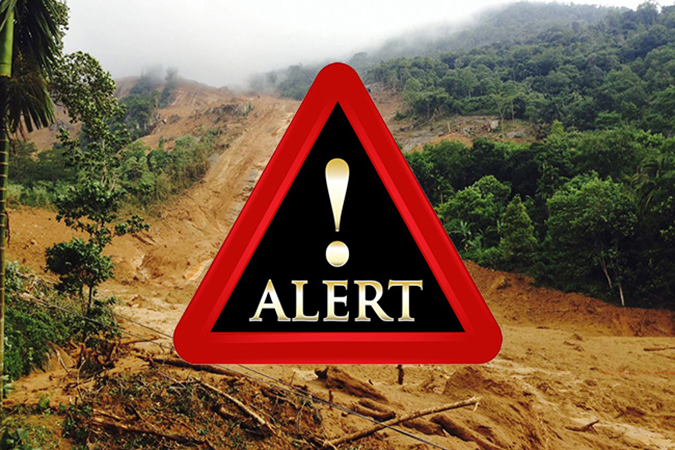
The National Building Research Organisation [NBRO] has issued landslide Red Alerts to the districts of Kandy, Kegalle and Nuwara Eliya effective from 14:00 hrs on 20.09.2026 To 14:00 hrs on 21.09.2026
Accordingly,
LEVEL III [RED] Land Slide early warnings have been issued to the Divisional Secretaries Divisions and surrounding areas of Pasbage Korale in the Kandy district, Dehiowita, Aranayake, Deraniyagala, Mawanella and Yatiyanthota in the Kegalle district and Kothmale West, Kotmale East, Ambagamuwa and Norwood in the Nuwara Eliya district
LEVEL II [AMBER] Land Slide early warnings have been issued to the Divisional Secretaries Divisions and surrounding areas of Padukka in the Colombo district, Nagoda, Thawalama and Neluwa in the Galle district, Bulathsinhala, Palindanuwara, Walallawita and Agalawatta in the Kalutara district, Ganga Ihala Korale in the Kandy district, Bulathkohupitiya and Kegalle in the Kegalle district, Akuressa and Pitabeddara in the Matara district, Thalawakele in the Nuwara Eliya district and Pelmadulla, Ratnapura, Ayagama, Kuruwita and Ratnapura in the Ratnapura district.
LEVEL I [YELLOW] Land Slide early warnings have been issued to the Divisional Secretaries Divisions and surrounding areas of Seethawaka in the Colombo district, Niyagama and Baddegama in the Galle district, Mirigama in the Gampaha district, Ingiriya in the Kalutara district, Udapalatha and Yatinuwara in the Kandy district, Galigamuwa, Warakapola and Ruwanwella in the Kegalle district, Kotapola, Pasgoda and Athuraliya in the Matara district, and Eheliyagoda, Kalawana and Elapatha in the Ratnapura district.

Kenya’s Ngetich breaks women-only half-marathon world record by a second

Showers about 100 mm are likely at times in the Western, Sabaragamuwa and North-western provinces and in Galle, Matara, Kandy and Nuwara-Eliya Districts

New Constitution to decide fate of executive presidency, PCs: NPP

NBRI issues landslide warning for three districts

Mahaweli rises as heavy rain triggers flood, landslide fears

SC determination on 22A to be conveyed to Speaker shortly

‘Dates have the highest sugar content to fight Coronavirus’

Sunday Island 27 December – Headlines

#SundayIsland 17th December – Headlines

Sunday Island – 28th March

Sunday Island Headlines – 21 March

Sunday Island – 21st February – Headlines
-

 News4 days ago
US embassy won’t comment on IGP’s probe into joint drug raid
-

 News3 days ago
Bid for Basil’s extradition nears final stage: Police
-

 Features6 days ago
The emptying university: why are academics leaving?
-

 Business4 days ago
All-new Bolero MaXX unveiled in Sri Lanka
-

 News2 days ago
Shanakiyan urges urgent action over reported death sentence for Lankan in Saudi Arabia
-
 Opinion6 days ago
Who committed genocide and created mass graves in Sri Lanka?
-

 Opinion4 days ago
A journalist who wrote across the divide
-

 Weather6 days ago
Showers above 100 mm expected at times in the Western, Sabaragamuwa, Central, Uva and Southern provinces, and in Ampara and Batticaloa districts