
Features
The transitional 1990s and beyond (JVP-III)

by Rajan Philips
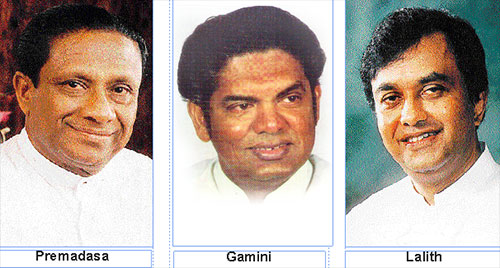
If the 1980s were tumultuous, the 1990s were more transitional, even if not less tumultuous. In this ‘potted’ history, it is not necessary to recount all the details of the 1990s and the first decade of the new 21st century. Suffice it to focus on developments that have had a continuing influence on current events and the farce of 2021. The UNP and the JVP, which more or less came together in 1977, were gone by 1994, after seventeen years of assorted achievements. The UNP would never return to the same pinnacle of power that it seized in 1977. The JVP with a new generation of leaders transformed itself into a democratic political party with mixed results. The first half the decade saw the disintegration of the UNP under the weight of the presidential ambitions of three rival contenders – President Premadasa and his two younger challengers, Lalith Athulathmudali and Gamini Dissanayake. The LTTE took out every one of them in 1993 and 1994.
LTTE violence took off in the 1990s after the JVP had been finished off in the late 1980s. In a telling commentary on that period, Wikipedia lists the names of political leaders, parliamentarians, professionals and political activists who were killed by the JVP, the LTTE, other Tamil groups and the armed forces over three decades of violence. The 1990s began with the assassination of Prime Minister Rajiv Gandhi in 1991 and ended with the killing of TULF MP and Legal Academic Neelan Tiruchelvam in 1999. The old leadership of the TULF, with the exception of M. Sivasithamparam, had been wiped out in the late 1980s. That included TULF leader A. Amirthalingam, a consummate politician and parliamentarian, who started off as a fiery federalist and turned himself into a mellowed separatist.
As the 90s wore on, the LTTE asserted itself as the sole representative of the Tamils. It waged war against the state and its forces but not to capture the state of Sri Lanka but to establish a new state of Tamil Eelam. The JVP’s mission was different, but its ultimate objectives were never clear. Lacking the LTTE’s military prowess, it never seemed plausible that the JVP was serious about capturing state power through violent means. Politically, the JVP swung from its ultra-left attacks on a manifestly leftist government in 1971, to undertaking ultra-right attacks against the most rightwing government in Sri Lanka’s modern history. The left-right cleavage was not part of the LTTE vocabulary.
On the other hand, although it railed against the Indo-Sri Lanka Accord and the presence of Indian armed forces in Sri Lanka, the JVP scrupulously avoided taking potshots at the Indian Army. The LTTE, in contrast, cut its military teeth fighting the Indian army and found common cause with the Sri Lankan government under President Premadasa to fight a common enemy. There was even grudging admiration among sections of the Sinhalese for the LTTE’s choosing to take on the Indian Army. For the record, the Indian Army came to Sri Lanka on the invitation of one Sri Lankan President and left Sri Lanka at the request of the succeeding Sri Lankan President. Hardly the modality for an occupying force. War or peace, Sri Lanka was again left to its own devices.
Illusions of Peace
The second half of the 1990s and the first half of the next belonged to Chandrika Kumaratunga. Her presidency began with a bang of charismatic inspiration but petered through for want of a clear focus and purposeful efforts. Perhaps her singular failure was not single-mindedly moving to abolish the executive presidency as she was universally expected to do. She was also the first and, until Gotabaya Rajapaksa arrived on the scene 25 years later out of nowhere, the only person to become President without previously being a Member of Parliament. Her parliamentary inexperience, untrammeled access to presidential power, not to mention her political ego, all combined to vitiate the promise with which she had led the People’s Alliance to power.
With the benefit of hindsight, we might say that parliament started becoming inexorably poorer from thereon. It is far worse now, in 2021, and for many new reasons. And it has taken a JVP MP, in Dr. Harini Amarasuriya, to take a spirited stand in defense of parliament and parliamentary democracy in Sri Lanka – against presidential authority and media hypocrisy. The ironies of history, you might say, but more on it later.
Chandrika Bandaranaike Kumaratunga (CBK) deserves full marks for starting the peace process during her presidency, but she showed inexplicable naivete in choosing to rely on people from her social circles to take the lead in serious peace mediation. The LTTE was going to be a difficult peace-dance partner anyway, and it required much more than social brokering to make any headway. In the end, the LTTE almost succeeded in assassinating her during her election campaign for a second term in office in 1999.
The main irony of that period was the nasty competition between Chandrika Kumaratunga (leading the SLFP) and Ranil Wickremesinghe (leading the UNP) for leadership in the peace process. It was a total about-turn from previous decades when the two main Sinhalese parties fought one another over who was giving more concessions to the Tamil Federal Party, even though what was on offer was way less than what would be included much later in the 13th Amendment. In any event, the CBK-RW competition over peace turned out to be counter productive both to the peace process and to their respective political calculations.
It may not be wholly accurate to say that presidential politics was the main driver of the peace rivalry, but it is impossible to view the rivalry in isolation from presidential ambitions. All the constitutional changes proposed by the CBK government included provisions to protect her powers, which made it even easier for RW and the UNP to reject the proposals out of hand and even, in one instance, make a bonfire of them right in the well of parliament. As for Ranil Wickremesinghe, his obsession with becoming a President, or at least a presidential candidate one more time (after two attempts in 1999 and 2005), became quite obvious when he deliberately subordinated every initiative of the yahapalanaya government (2015-2019) to that single obsession.
Back during his rivalry with CBK over peace initiatives, Ranil Wickremesinghe stunningly turned to the LTTE to strike a counter peace partnership to CBK’s peace partnership with the TULF. I am not aware of any public recounting of the mediation that brought RW and the LTTE together in a peace initiative. But objectively, it fair to surmise that Ranil Wickremesinghe reached out to the LTTE as a counter to CBK’s peace alliance with the TULF. What was fairly well known throughout the JRJ presidency was that President Jayewardene cunningly kept not only the TULF but also the JVP from joining forces with the SLFP/Left opposition at that time. In the end, there was no ultimate benefit to anyone from JRJ’s Machiavellian politics. The presidential house he built so adroitly would be eventually lost to the UNP. Now it seems it is lost forever. And it will be for other more upstart aspirants as well.
As JRJ’s successor, President Premadasa took a different tack, reaching out to the LTTE to get the Indians out. We know how that tack or track ended. The TULF that was left hanging, or what was left of its depleted leadership, broke with the UNP and turned to Chandrika Kumaratunga and the People’s Alliance for a new kick at what had become the proverbial viable solution, while Ranil Wickremesinghe modified the Premadasa approach to re-engage the LTTE with Norwegian insurance. To their credit, Chandrika Kumaratunga and Ranil Wickremesinghe ‘fought’ over how to make better peace with Tamils, rather than about waging a more brutal war with the LTTE. They both admitted that the Sri Lankan state had failed in the building of its nation and were committed to creating a plural and inclusive polity. While their political spirits were willing their presidential flesh led them astray.
And their peace-fight was nasty. They could not work together even when they were forced to cohabit as President and Prime Minister between 2001 and 2004. Ranil Wickremesinghe, as Prime Minister, dashed everyone’s expectations of peace dividends by giving, not for the last time, free rein to corruption in government. For her part, and in what she would later admit to being among her more grievous mistakes, President Kumaratunga dismissed the Wickremesinghe government in 2004 (which she had the power to do under the pre-19A Constitution, unlike Maithripala Sirisena who flouted his own 19th Amendment in October 2018), dissolved parliament and won the parliamentary election in April 2004 with provisional support from the JVP.
The results of the April 2004 parliamentary election gave false hopes to President Kumaratunga and the JVP (that won 39 out of 105 UPFA seats in parliament, its highest on record), relegated Ranil Wickremesinghe to the opposition backwaters for the next ten years, and signaled the emergence of Mahinda Rajapaksa as the next presidential candidate from the true south. The country went through the tsunami devastation in December 2004, but that did not help the political leaders getting any wiser about working together. The Supreme Court abandoned President Kumaratunga when it rejected her bid to extend her second term by one year. Ranil Wickremesinghe even thought that Chief Justice Sarath Silva was helping him for not impeaching him earlier!
Those who had serenaded CBK during her rise lost no time in leaving as she declined. Mahinda Rajapaksa became the SLFP-UPFA candidate by acclamation. He reached a new agreement with the JVP. The unkindest cut of all was delivered by the LTTE to Ranil Wickremesinghe who thought that it would be a no contest. Mahinda Rajapaksa won the November 2005 presidential election by the squeakiest of margins, while Tamil voters in the north were ordered to stay home. Basil Rajapaksa’s familial prophesy that there will be a President from the south was finally fulfilled. But there were other dynamics at play.
Illusions of Restoration
In my last installment published two weeks ago (April 25), I alluded to Mahinda Rajapaksa becoming the presidential beneficiary of a new strand of Sinhala Buddhist nationalism fueled by the Jathika Chinthanaya school of thought. The school of thinking that JC advocated has not universally been accepted in Sinhalese political society. At one level, the electoral victories of Chandrika Kumaratunga (PA) and the partial successes of Ranil Wickremesinghe were moments of political pushbacks to the creeping influence of JC thinking. At another level, both the SLFP and the UNP were forced to come to terms with ‘JC forces’ and include them in their political alliances often on their (JC’s) terms.
The presidential system and proportional representation in parliamentary elections facilitated the emergence of alliance politics. The era of programmatic united fronts of political parties was gone. Serious political programs gave way to lawyerly Memorandums of Understanding. Multiple parties with bilateral/multilateral MOUs could come together under an umbrella alliance for contesting elections. The April 2004 parliamentary elections were the breakthrough election for the new Sinhala Buddhist nationalist organizations.
The Jathika Hela Urumaya (JHU), the most electorally successful offshoot from the JC school, won nine seats in the election, all won by Buddhist Monks. The JVP which had been courting JC ideologues and followers from the 1980s, was part of Chandrika Kumaratunga’s alliance (UPFA) and won 39 seats. It was the JHU that successfully challenged President Kumaratunga’s attempt to extend her second term limit in the Supreme Court in August 2005. JC’s political consummation came within months, with the victory of Mahinda Rajapaksa in the November presidential election. That it came with support from the not so hidden hand of the LTTE did not dampen the significance of the moment. Mahinda Rajapaksa was recognized as the most authentic Sinhala Buddhist political leader since independence.
In terms of political analysis, the victory of Mahinda Rajapaksa has been described as the restoration of the linkage between the Sri Lankan state establishment and the political hegemony of Sinhala Buddhist nationalism. The linkage had apparently been ruptured since July 1987 when JR Jayewardene and Rajiv Gandhi signed the Indo-Sri Lanka Accord. Looked at in another way, the state of Sri Lanka which has traditionally been accused of alienating the Tamil and Muslim minorities, would seemed to have found a way to alienate even the Sinhalese majority.
And the restoration that was apparently achieved with the victory of Mahinda Rajapaksa in 2005, has not turned out to be as consequential as anticipated. To wit, the Indo-Sri Lanka Accord and the Thirteenth Amendment that it created have survived two terms of Mahinda Rajapaksa presidency and may yet survive the first term of the Gotabaya Rajapaksa presidency. At the same time, a full restoration of the linkages between the state of Sri Lanka and all its ‘peoples’ will require a more sensitive and nuanced understanding as well as appreciation of the nationalist compulsions of the Sinhalese, Tamils and the Muslims. Anything less can be nothing more than a farce. (Next week: The farce of 2021).


Tales of Mystery and Suspense – 23
By Prof. Rajiva Wijesinha
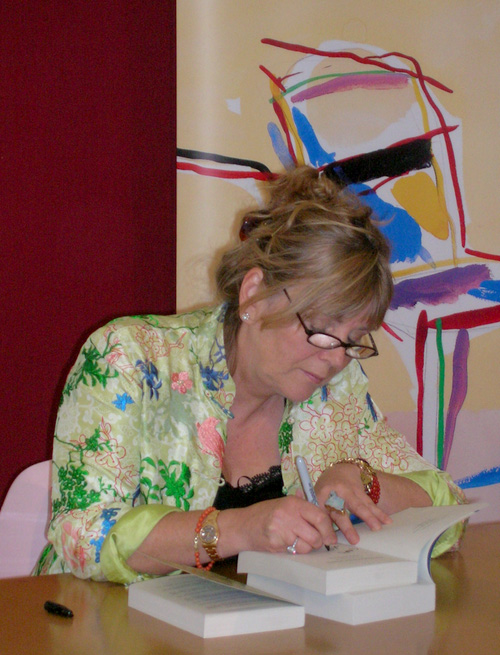
As I have noted with regard to the adventures of John Rebus, I am indebted to Dinali Fernando and her husband Steve for whole hosts of thrillers. The latter strongly recommended Kate Atkinson when I borrowed four books. I wondered about this, for I had not been too impressed with her debut novel, Behind the Scenes at the Museum, which was amongst the entries I had to judge for the Eurasian section of the Commonwealth Writing Prize. Two decades later, I had forgotten what it had been about.
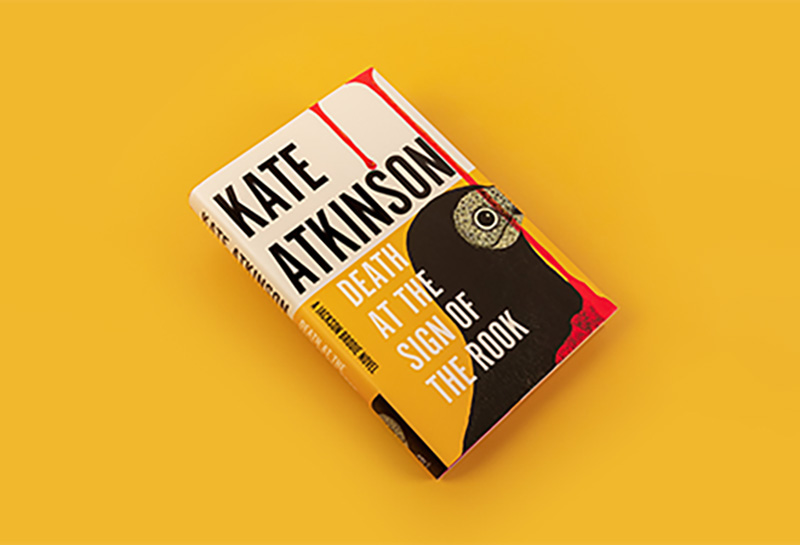
But I am glad Steve persuaded me to read her. Kate Atkinson is distinctively British, and Death at the Sign of the Rook is set in a country house and the surrounding village, and seems a modern descendant of the laidback Agatha Christies I so much enjoy.
There are, however, many differences in that we have a policeman who can go rogue, like Rebus, with again a female sidekick who has a mind of her own, again like Rebus. But Jackson Brodie has retired and set up as a private investigator, while Reggie, a young lady, is still in the police.
There is a lesbian couple living in the converted dairy of the manor house, as has occurred in Agatha Christie too, in A Murder is Announced. But they are peripheral to the story, unlike Ben, the brother of one of them who left the army after losing a leg in Afghanistan. When he turns up at the Manor House to shelter from a snowstorm, along with its chatelaine, Lady Milton, he is asked to answer the door as various characters turn up, including Jackson and Reggie, who then starts fantasising about him.
The others who turn up are two couples, one from America, who have paid for a murder weekend at the hotel. The family is impoverished, and has sold lots of pictures to survive, but most recently a Turner had been stolen, almost certainly by Lady Milton’s housekeeper Sophie, who vanished one night along with the picture. Reggie had been involved in that investigation, but there had been no trace of either picture or young lady.
Jackson Brodie suspects a connection between that theft and the one he has been called in to investigate, which has not been reported to the police. The picture hung opposite the bed of an old woman whose carer vanished after she died, along with it. Her children, adopted twins, have asked Jackson to investigate and also try to trace the carer, though he suspects something strange in that they did not go to the police.
Kate Atkinson
Brodie, in studying the stolen art, is also struck by the disappearance of a Rembrandt from a house in Scotland, along with a member of the cleaning staff. He thinks the three women might be the same one.
But Brodie’s assumption that the three women who vanished when valuable pictures did were identical would not have helped except that Beatrice, as she was also called, kept turning up, including to the funeral home where the old lady’s body was kept. And then that picture turned up, in the village church, and was found by the local vicar, Simon Cate, whose life story is also a prominent feature of the novel. He was an aspiring actor but then smitten by faith, and became a priest, but in time he lost his faith. His wife left him after the death of their son, and he is now in this backwater, where he feels he is of no use to anyone. But he has a great feel for living beings, and his most successful service has been one in which he blessed pets. And he was deeply concerned about the bees that Ben looks after for his sister and her wife.
He too staggers into the manor house in the midst of the storm, in which everyone concerned loses their way comprehensively. But amongst those Ben lets in is a man in a tracksuit with cuts and bruises, who then vanishes after he has been led to a bedroom, when Ben went in search of brandy. We soon work out that it is the escaped murderer about whom Reggie has been alerted.
Simon also turns up, through the back door, carrying the picture and also a gun, for he has found the dead body of one of his parishioners when he went to her house in search of his mobile phone. She had been shot and he had picked up the gun he found there. But he could not tell the police, for though he called he had lost his voice, and for the last few days had communicated only through writing.
This chaotic mix of characters at the manor house is further complicated by the group of players putting on the murder mystery play though some members have either cried off or died before reaching the venue. So, there is much doubling up and confusion over who is an actor and who is not.
The grand now largely empty rooms of the manor house, and its various odd passages and multiple doors, make it a splendid set for the lunacy that runs on and on. Reggie finds herself in a pantry Atkinsonwith a dead body, though this turns out to be the nanny who fell down the stairs and was put there by Lady Milton’s younger son. And there is high drama on the roof when the murderer nearly kills Ben, but he is saved by Reggie, and when he tries to kill Brody with an axe, he is shot by Beatrice, who has been the maid who served at the dinner before the murder mystery play, and explains to Brody how she has managed all her thefts.
And then in the melee, she vanishes on a motorbike, along with the daughter of the old lady’s adopted daughter, the only person who seemed to grieve at the funeral, and to whom the old lady had left her house in a codicil to her will, which her children have not known about. She leaves the picture to the carer, but it is brought to Simon Cate as he lies in hospital, recovering from a heart attack which adds confusion to the play.
Wonderfully convoluted, but all very clear, despite the headlong pace of the book and its shifts from one scene to another, from one character to another (or rather combinations of them) and from one-time span to another. A writer and a detective well worth looking out for. e more books by her on Dinali’s shelves.
by Capt. (Ret.).G.A. Fernando, MBA
There are three essential components to a commercial airline operation: safety, security and teamwork.
Aviation and teamwork at the ‘sharp’ end of a commercial aircraft, i.e. the flight deck, is unique. Unlike many other teams, it may be quite literally the first and the last time a particular combination of small teams of two, three, or four individual airmen (or women) will fly together. Sometimes even in the same airline that employs them.
Therefore, to make conditions safe and practical, while understanding and trusting tech other, they have to rely on a series of Standard Operating Procedures (SOPs), and ‘Normal’ and ‘Emergency’ checklists for every conceivable situation. That is, to be able to do the right things, and do things right. In fact, there is a saying in aviation to the effect that ‘if you make a mistake in aviation, be original and make a new one’.
To ensure that safety standards are constantly maintained, airline pilots’ proficiency is tested every six months, in simulators, under the supervision of examiners from the civil aviation regulator. In Sri Lanka that organisaton is the Civil Aviation Authority-Sri Lanka (CAASL). Three simulator checks are conducted every 12 months in keeping with the tenet that ‘practice makes perfect’. A pithy adage not confined to the world of aviation warns that ‘prior preparation prevents piss-poor performance’.
The simulator exercises include rejected takeoffs, including in cross-wind situations, landings, engine fires and/or engine failures from a variety of causes, cabin pressurisation failure, precision and non-precision approaches, and landings in bad visibility – amongst other conditions that could be expected in actual flight.
In addition, a flight in a real airplane, on a regular passenger service under the supervision of an examiner from the airline, is undertaken to ensure that the company’s standard practices and procedures are carried out and maintained as prescribed in the airline’s manuals. These publications are in turn approved by the national regulator.
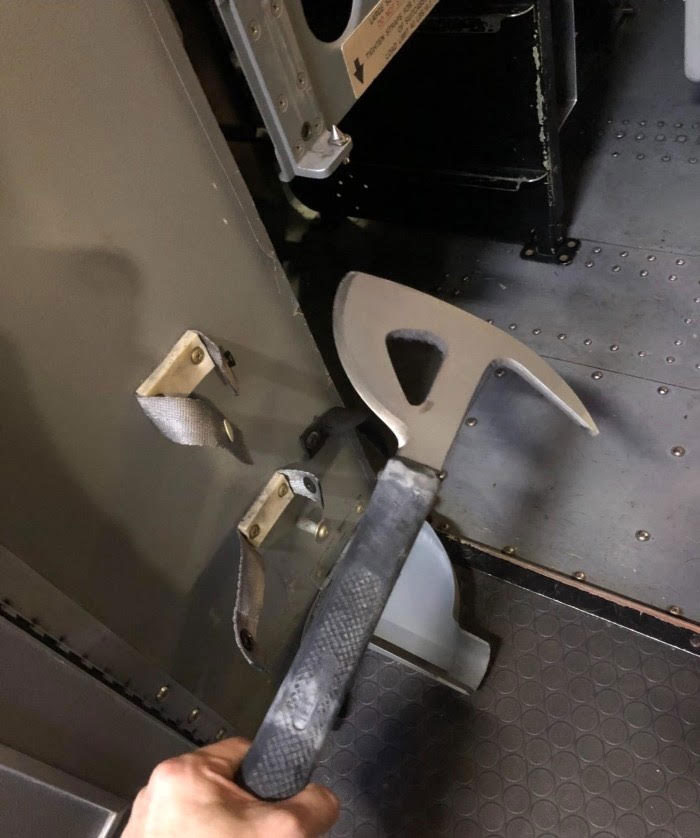
Crash axe
Finally, flight crew members must take a written test annually, on emergency equipment locations and procedures, with 90% as the pass mark.
Since the mid-1980s it has been mandatory for airline pilots to undertake a Crew Resource Management (CRM) programme once every two years. This training essentially emphasises what to do and what not to do to, in a specific emergency situation, or even during normal operations, to make the team cohesive and effective. During the course, the CRM facilitators discuss recent incidents and accidents that have occurred. Results of those events are recorded and could be retrieved, when necessary, by the official aviation bodies.
Not unexpectedly, it is demanding on a pilot to fulfill these requirements on a regular basis throughout his/her career, along with presenting for a bi-annual medical examination, all with the objective of retaining one’s licence to operate an aircraft. It may not be understood, therefore, by persons outside the aviation industry, or even some working in other aspects of an airline organisation, that it is often the passion for flight that keeps many pilots doing what they do to earn a living.
Security
Another important factor is the challenge of maintaining security in all aspects of airline operations, not least in the cockpit. The challenges are many, with new ones surfacing almost every day. It is therefore essential to be always prepared for the activities and ‘methods’ of perpetrators seeking to wreak evil on an aircraft and its occupants. As it is impossible for any airline or national security organisation to cover all aspects, systematic management of risks to effect a safe outcome becomes imperative.
Flydubai Incident
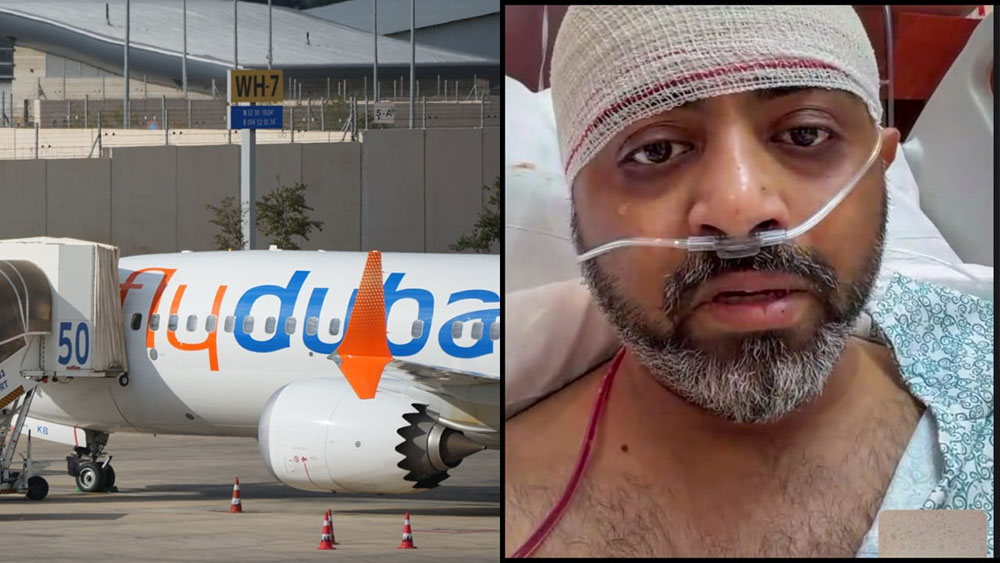
In the recent Flydubai incident of 30 September, 2026, a first officer (co-pilot) attacked the captain of the flight with a crash axe to accomplish his sinister motives, into which investigations are continuing. For the time being, it prompts the questions: should the crash axe be easily accessible to the flight crew? Or even be there at all? I believe it is a case of assessing the greater risk.
With regard to that event, and the circumstances that led to it, other deterrents could have been applied more thoroughly. For example, more thorough screening of pilots’ and other crewpersons’ backgrounds, with emphasis on their mental health, ideological affiliations and previous employment history. Separately, during a time of conflict in the Middle East, should Flydubai have even been operating between Dubai and Tel Aviv? Notwithstanding that cost-cutting and profit maximisation are key aims of any business, an airline’s apparent failure to conduct adequate psychological profiling of flight crew members, while continuing to operate ‘profitable’ routes, regardless of potential danger, can only be regarded and condemned as greed and disregard for human lives.
( Captain. Fernando, RCyAF, SLAF, Air Ceylon, Air Lanka, Singapore Airlines (SIA), SriLankan Airlines, Former Chief Pilot, Air Lanka Boeing 737, Former Deputy Chief Pilot, Lockheed L 1011, Former Crew Resource Management (CRM) Facilitator, SIA, Former Deputy Director (Air Operations) CAASL, Former President, Aircraft Owners and Operators Association Sri Lanka (AOAOASL), President, The Colombo Flying Club, Representative for Aviation, Organisation of Professional Associations (OPA), Hony, and Member Sri Lanka Society of Transport and Logistics.)
By Nilakshan Perera
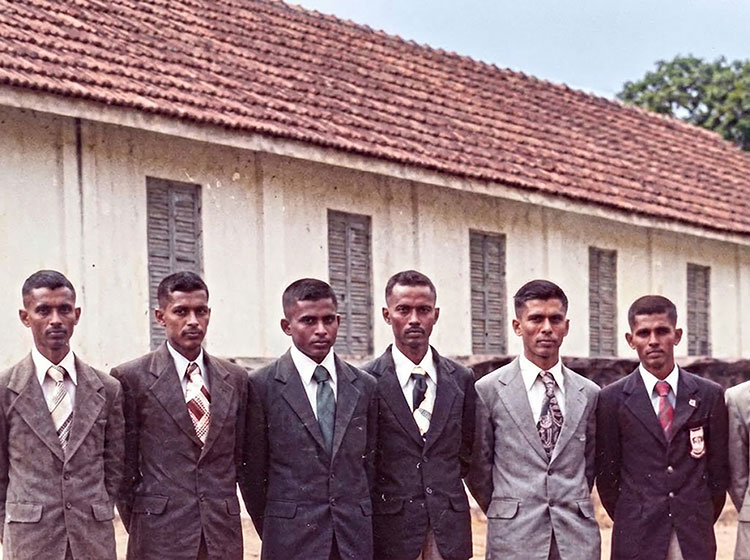
commemorate 45 years since 26 young men embarked on a journey that would become an enduring chapter in the history of the Sri Lanka Army.
For me, the story has a particularly personal beginning. Sometime in early October, 1981, a good friend of mine, with whom I had been in the same cadet platoon, from 1978, and who was the Sergeant of the 1980 platoon, which became Island champions, needed a college blazer for his Army final interview. I borrowed one from a friend in Panadura and carried it for him. He then boarded the same bus from Katubedda, and I accompanied him for his interview. A few days later, he shared the wonderful news that he had been selected for Officer Cadet Intake 16 and would report to Diyatalawa on 16 October, 1981.
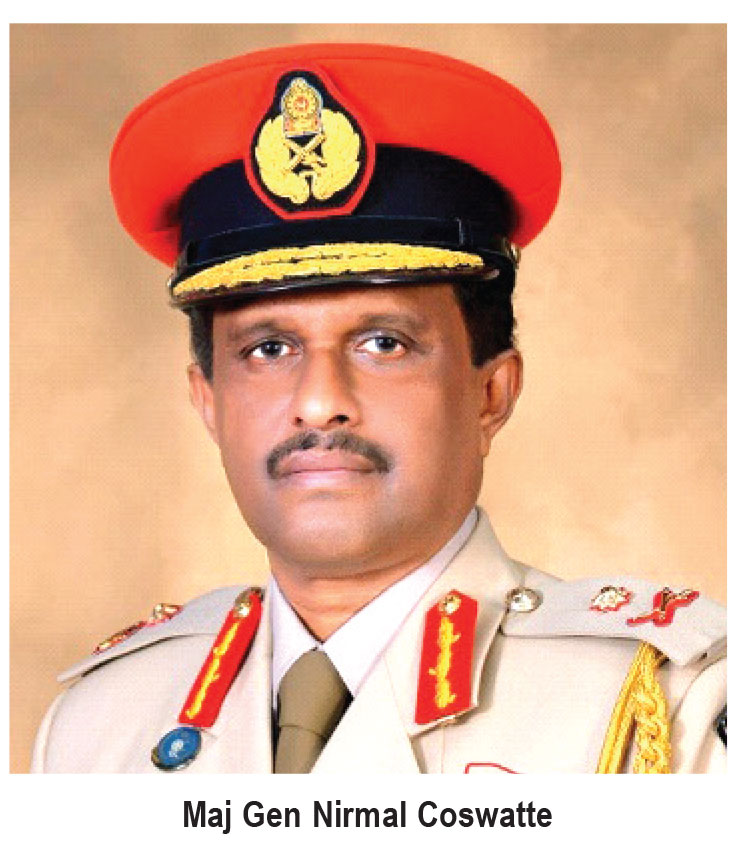
What followed became history. He emerged as the best officer Cadet, winning the coveted Sword of Honour and becoming a Cadet Under Officer. Decades later, he became the 22nd Commander of the Sri Lanka Army, establishing several remarkable milestones. He was the first Special Forces officer to command the Army, a first Para trooper, the first graduate of the United States Army Command and General Staff College to become Army Commander, and the first Cadet Under Officer and Sword of Honour recipient to rise to that position.
His journey was not without adversity. Following the 2010 Presidential Election, he was asked to leave the Army. Amid the uncertainty and threats surrounding him, I was one of the first to visit him at his residence. In 2015, he was reinstated and subsequently served as Military Secretary, Commander Security Forces – Jaffna, and Chief of Staff before assuming command of the Army on 4 July, 2017. The rest is history.
On 16 October, 1981, at Army Headquarters, a bus waited to take 26 young school leavers to Diyatalawa. Among them were Mahesh Senanayake (Ananda), Janaka Walgama (Nalanda), Udaya Perera (De Mazenod), Srimal Kasthuriarachchi (St Anthony’s, Katugastota), Edward Thanjaratnam (St John’s College, Jaffna), Prasanna Wickremesooriya (Nalanda), Jagath Alwis and Pradeep Jayasuriya (Ananda), Sooriya Senanayake (D. S. Senanayake), TRA Aliba (Lumbini), P Raveendran (Hindu College, Jaffna), JN Pushparaj (St Michael’s, Batticaloa), MRC de Silva (St Benedict’s, Kotahena), Uraj de Silva (Prince of Wales), Nirmal Coswatte (Dharmaraja), TM Mahindaratne (Vidyartha), Amal Karuasekera ( Nalanda) and Bimal Dias ( Royal)
The intake also included five servicemen who had already excelled in the Other Ranks, including two Olympic athletes, an Army Decathlon champion, a Sri Lanka volleyball star and a graduate. They were A Premachandra, KTN Perera, SM Piyatilake, KAS Siriwardena, HK Chandrasena.
 Late that night, on their arrival at the Military Academy, they were traditionally welcome by Seniors of Intake 15, (intermediates) near “PANDAMA”. Then came the reality of cadet life, running on the double, relentless discipline and demanding training. Intake 14, as the super seniors, and cadets of Short Service Course 3 were also there to ensure that the newcomers quickly understood the traditions and rigour of SLMA.
They were trained under dedicated instructors, including Course Commanders of initial months, Capt. Lucky Rajasinghe (retired as Col) and Capt. Wasantha Pamunuwa (retired as Col) Course Sergeant TH Thajudeen, PTI Bombardier Senerath Bandara, and Chief Instructor Late Maj. Janaka Perera (retired as Maj Gen), Major Devinda Kalupahana (retired as Maj Gen) and Maj. Lalith Gunaratne (retired as Col)
Their training tested every aspect of an aspiring officer. Exercise “God King” took them to sacred and historic sites such as Kataragama, Kirivehera and Sithulpawwa, connecting military training with the heritage of their motherland. Exercise “Frozen Trout” tested them for 10 days in the cold, mist and rain of Ambewela and Pattipola, covering conventional warfare and battle procedures. Remarkably, Intake 16 underwent this exercise three times. Exercise “Wana Bambara” took them deep into the jungles around Wellawaya for Counter-Revolutionary Warfare training, while exercise “Scorpion” tested their ability to conduct Internal Security and counter-insurgency operations around Walimada. Intake 16 also became the first Officer Cadet Intake at the Sri Lanka Military Academy to undergo the Basic Commando Course before the passing out.
After 22 months of rigorous training, the moment of truth arrived on 23 June, 1983. Of the original 26 cadets, 19 were commissioned as Second Lieutenants. It was the largest passing-out parade of its time, with around 1,000 Army recruits passed out alongside them. The parade was commanded by Major Nanda Mallawarachchi (retired as Maj Gen), while the Officer Cadet contingent was commanded by Cadet Under Officer Mahesh Senanayake, who had won the Sword of Honour for the highest marks in the Order of Merit. He also received the Current Affairs prize, while Cadet Sergeant Janaka Walgama received the Tactics prize. The Chief Guest was the Commander of the Army, Major General TI Weeratunge.
The 19 newly commissioned officers were then posted to their respective regiments and began their national duty with integrity, passion and courage. During the brutal conflict in the North and East, two of their brothers made the supreme sacrifice. Lieutenant Colonel Sooriya Senanayake, of SLLI, was killed in action at Kadduvan, Jaffna, on 30 May, 1992. Lieutenant Colonel TRA Aliba, of VIR, was killed in action, at Mullaitivu, on 18 July, 1996, while commanding the 6th Battalion, Vijayabahu Infantry Regiment, during a major LTTE assault. The intake paid tribute to the memory of Captain KAS Siriwardena, Captain MRC de Silva and Major Uraj de Silva, who passed away due to health complications and unfortune accident, respectively. Their memory remains an inseparable part of the Intake 16 story, and they are remembered with the deepest gratitude.
Only five members went on to complete nearly 35 years of military service and reach retirement at senior rank, General Mahesh Senanayake, Major General Janaka Walgama, Major General Udaya Perera, Major General Jagath Alwis and Major General Nirmal Coswatte. Others took premature retirement and pursued different paths, but the bond forged at Diyatalawa never diminished.
Forty-five years later, the memories remain vivid, the parade square, the mist of Diyatalawa, the hardships, the laughter, the friendships, the sacrifices and the pride of wearing the uniform. They entered Diyatalawa as young men and emerged as officers. Some became generals, one became Commander of the Army, some made the ultimate sacrifice, and others continued to serve the Nation in different ways. But above rank, appointment and circumstance, they remain what they became at Diyatalawa, brothers of Intake 16.
As they mark 45 years since that historic 16 October, 1981, we salute every member of Intake 16, remember with gratitude those who are no longer with us, and honour a generation that served the Nation with pride, courage and dedication.
Forty-five years of service.
Forty-five years of sacrifice.
Forty-five years of brotherhood.
Happy 45th Anniversary,
Intake 16!
16 October, 1981 – 16 October, 2026
Proudly served. Honourably remembered.

‘Death at the Sign of the Rook’

Safety, security and teamwork in aviation

How long can Sri Lanka remain silent on its demographic crisis?

Chathura and Chamalka win schools half marathon titles

Sri Lanka continues to maintain Tier 2 status in the 2026 TIP report

Sri Lankan Ambassador visits Anojan on death row in Saudi Arabia

‘Dates have the highest sugar content to fight Coronavirus’

Sunday Island 27 December – Headlines

#SundayIsland 17th December – Headlines

Sunday Island – 28th March

Sunday Island Headlines – 21 March

Sunday Island – 21st February – Headlines
-

 News7 days ago
Geneva takes up Sallay’s case and govt. ignores opportunity to answer accusations
-

 Features6 days ago
Preventing grievances from becoming communal
-

 Features4 days ago
The Sri Lankan who made Scottish history
-

 Sports4 days ago
Nissanka absence opens door for Sri Lanka’s young guns
-

 News5 days ago
Gnansara Thera to be assigned to prison printing section: Officials
-

 News3 days ago
NDB fraud Rs 60mn more than reported
-

 News3 days ago
Removing monk’s robes matter for Sangha to decide: Mahanayake Theras
-

 Features4 days ago
Future of Sri Lanka’s state university system: Should it be shut down and reopened?