
Features
The Republic: Fiftieth Anniversary and Fifty Days of Aragalaya


by Rajan Philips
Sri Lanka became a Republic on 22 May 1972, and the fiftieth republican anniversary has come and gone largely unnoticed. The only acknowledgement of the occasion so far in the media has been the articles by Dr. Jayampathy Wickramaratne, which were also a reproduction of a chapter on the 1972 Constitution that he wrote for a book felicitating the political life of Prime Minister Sirimavo Bandaranaike. Last Sunday, Prime Minister Ranil Wickremesinghe addressed the nation for the second time in as many weeks. He spoke of the need to address issues facing the country not only in the economic sphere, but also in the political sphere which would involve constitutional changes.
However, the Prime Minister made no reference to the fiftieth anniversary of the Republic and its implications for the constitutional changes that are being considered now. He is only too well aware that the current impetus for constitutional changes is not due to the age of the Republic – its fifty long years, but it is due to the pressure brought on by 50 days of Aragalaya protests. The 50-day mark of Aragalaya was faithfully marked by the youthful protesters, quite unlike the 50th anniversary of the Republic.
The Republic came into being by virtue of the First Republican (1972) Constitution under the auspices of the United Front Government with Mrs. Bandaranaike as Prime Minister and Dr. Colvin R de Silva as the Minister of Constitutional Affairs. The parliament that was elected in 1970 with a landslide majority for the United Front Government, was turned into a Constituent Assembly to “draft, enact and adopt” a new constitution quite outside the ambit of the Soulbury Constitution and, as Dr. Colvin would often intone, “not merely despite the Queen but in defiance of the Queen.” Thus, Sri Lanka became a Republic with one more formal severing of its colonial cords.
The First Republican Constitution lasted only five years and was quite easily undone by its own exceptionally flexible provision for its repeal and replacement by a future parliament commanding a two-thirds majority of its members. The 1977 election gave JR Jayewardene and the United National Party more than a two thirds majority, which JRJ used not only to repeal and replace the 1972 Constitution, but also foist on Sri Lanka a presidential system of government that had no justificatory rationale in national politics or support in the country beyond JRJ’s idiosyncratic mind and his possession of undated letters of resignation given to him by all newly elected UNP MPs.
The upshot was the Second Republican Constitution that was adopted in 1978. In contrast to the supreme flexibility of the 1972 Constitution, the 1978 Constitution was deliberately entrenched against changes by future parliaments except the long parliament (1977-1988) that JRJ presided over. The 1978 Constitution has been in force for 44 years, and has been Sri Lanka’s most contentious constitution. It has also lasted the longest.
Constitutional Changes
The constitutional changes that are currently on offer are not changes to anything in the First Republican Constitution, but to the Second Republican Constitution. The main constitutional changes that are now being bandied as part of the 21st Amendment (21A) primarily involve significant modifications to the powers of the Executive President. An anticipated sequel to 21A is the abolishing of the presidency itself. Although they are not included in the current proposals for 21A, there are two other matters that will need to be addressed through constitutional changes sooner than later.
The first is electoral reform to modify the current proportional representation system to a blend of the old first-past-the-post system and limited proportional representation. Constitutional changes to bring about electoral reform have had nearly unanimous support among MPs in every parliament since 1994, but every President and her/his government from 1994 has singularly failed to leverage this support and transform the electoral system. And it is not likely to happen even now without pressure and prodding from Aragalaya protests.
The second matter is more controversial and involves the question of devolution of powers and consistently positive implementation of the Thirteenth Amendment (13A). There is no consensus over what needs to be done even though, it is fair to say, the call for repealing 13A has lost any consequential political support that it may have previously had. Gotabaya Rajapaksa himself once called for the repeal of 13A, but it is unlikely that he is harbouring such thoughts now, if he is harbouring any constitutional thought at all. More so, with all the financial bailouts from India without which his presidency will be a goner much sooner than it would eventually be.
The controversy over 13A cannot be settled by taking extreme positions – either calling Provincial Councils a steppingstone to separation, which is simply nuts; or insisting that PCs are unworkable so long as the Constitution calls itself a unitary constitution, which is equally nuts. Federal and Unitary arrangements are not disconnected poles with nothing in between, but are the ends of a continuum with several intermediate possibilities. The fact that the unitary article and the 13th Amendment are part of the same constitution is proof of the co-existence pudding. The trouble is nobody is interested in actually eating the pudding, only complaining about what ingredients in it are too much and what ingredients are missing.
In my view, it would be distractive and counterproductive to expand the scope of 21A to include constitutional changes involving 13A and Provincial Councils. The main task is to make the Provincial Councils system work, first by providing for them to be elected along with the next parliament under a reformed electoral system. Constitutional adjustments can be brought in later based on sincere and honest operational experience of the newly elected Provincial Councils. For now, the focus should be on constitutional changes involving the executive presidency first, and electoral reforms soon after.
PM’s Statement
In his Sunday talk last week, the Prime Minister spoke to the “two major issues in the political sphere.” The first issue, he said, is “the re-introduction of the 19th Amendment,” and noted that “… party leaders, are now preparing the 21st Amendment in this regard.” The second issue “is to work towards the abolition of the Executive Presidency. The timing and methodology must be decided by the Party Leaders.”
While abolishing the executive presidential system has been a constant policy plank across all major political parties from 1994, this is the first time a Prime Minister has addressed the nation indicating that parliament must “work towards the abolition of the Executive Presidency,” and that “the timing and methodology must be decided by the Party Leaders.” There are number of ways of looking at this statement and its implications.
First, it must be acknowledged that such a statement would have been unthinkable, and even more unthinkable that it could be made by someone like Ranil Wickremesinghe, without the ground-breaking effects of the Aragalaya protests. To be sure, it is not only the Prime Minister who is talking about abolishing the presidency as a result of Aragalaya, but even President Gotabaya Rajapaksa has been forced by it to meekly indicate his readiness for abolishing the presidency. This was before May 9, when Aragalaya was in full flight. Now the President seems to be changing his tune, but more on that later.
Second, it is possible to see the Prime Minister’s statement both as a notice to the President, as well as a rallying call for supporting constitutional changes both within parliament and outside. Those within parliament who are committed to enacting 21A and abolishing the presidency must stop using them to make rhetorical points and start focusing on winning support among MPs to obtain the requisite two-thirds majority.
Third, insofar as the PM’s statement might also be meant for the ears of Aragalaya protesters, one can only say that the Prime Minister is being better late than never. I say this because it has been reported that in his discussions with the President before being appointed as Prime Minister, Ranil Wickremesinghe has told Gotabaya Rajapaksa that he should resign as President. I say as well that Mr. Wickremesinghe would have strengthened his position immensely, both within and outside parliament, if he had made his position publicly known instead of keeping it as a private suggestion to the President. Belatedly, he has gone public now, but it is too soon to tell if he is too late in publicly stating that 21A must be passed and the Executive Presidency must be abolished. Here is why.
Last week I noted some of the consequences of the deflation of Aragalaya after the tumults out of Temple Trees on May 9. It is not only reactionary politics and Basil Rajapaksa’s antics that have been resurrected by the deflation of Aragalaya. There is also the ministerial resurrection of Wijeyadasa Rajapakse who has been entrusted with the drafting of the 21A Bill. Given his chequered past, no one should be surprised that the draft Bill that he is currently circulating is unacceptable to almost all genuine stakeholders for constitutional reform. In addition, quite a few SLPP MPs and former Ministers are now ganging up against substantive constitutional changes and abolishing the executive presidency.
PMD’s Monkey Business
Above all, the President, either on his own bad advice or that of others, would appear to be keen on consolidating his political position with no apparent interest in addressing the burning issues in either the economic sphere or the political sphere that the Prime Minister has been harping on. While others are talking about separating the Head of State from holding ministerial portfolios, the President is gazetting himself authority over 42 institutions by bringing them under the Defence Ministry. Why should the President be directly bossing over institutions like The Board of Investment, Sri Lanka Telecom and the Port City Economic Commission, and why should such institutions come under the Ministry of Defence?
And why is the President extending the duration of the ‘One Country One Law’ Presidential Task Force headed by the controversial Gnanasara Thero even after the Attorney General has instructed that charges by filed against the monk for using hate speech against religious minorities? Is the Task Force going to be helpful in getting bridge financing from the IMF? Or is there a new credit line from Saudi Arabia that Gnanasara Thero recently visited apparently for enlightenment on religious cohabitation?
If the President seems earnest about consolidating his positions and murky bases, he is also showing himself to be deceptive and manipulative in spreading misinformation about Aragalaya protesters. At least, the President’s Media Division (PMD) is. Last week, the PMD put out a press release that has since been exposed and dismissed as false information. The PMD statement alluded to an organization called “The Confederation of Professionals for a National Policy” and described it as “a group of professionals and youth involved in ‘Aragalaya’ (struggle).” The statement went on to say that this ‘group’ met with the President on Wednesday (June 1), the meeting was held under the patronage of Ven. Prof. Pathegama Gnanissara Thera and Shastrapathi Ven. Vitiyala Kavidhaja Thera, and that the meeting was attended by Dr. Asoka Jayasena and Mr. Nelum Weragoda representing the “group of professionals and youth involved in Aragalaya.”
Unsurprisingly, the PMD statement did not provide the names of Aragalaya youth who allegedly attended the meeting. In fact, there were no names to provide because no one from Aragalaya attended any meeting with the President. The protesters who have been out for over 50 days demanding the resignation of the President have flatly denied meeting with the President as (falsely) claimed by the President’s Media Division. Aragalaya protesters have been quite categorical in denouncing the PMD’s falsehoods: “We don’t want to have any sort of discussion with the President. We just want him to be sent home. That’s the name of our movement “Gota Go Gama” (GGG), meaning for Gota to go.”
Why would the PMD publicly lie about anyone from Aragalaya attending any meeting with the President? The PMD had further stated that the meeting was also attended by the new Minister of Justice Wijeyadasa Rajapakshe, and the discussion at the meeting “focused on short, medium and long-term measures that should be taken to address the current political, social and economic crisis and the adoption of a new ‘people-friendly’ Constitution.” Assuming that Minister Rajapakshe did in fact attend a meeting at the President’s House, where was the Prime Minister in all this while the President was leading a discussion on adopting a new “people-friendly” Constitution? And where was 21A in all this? Never mind abolishing the executive presidency. (To be continued)


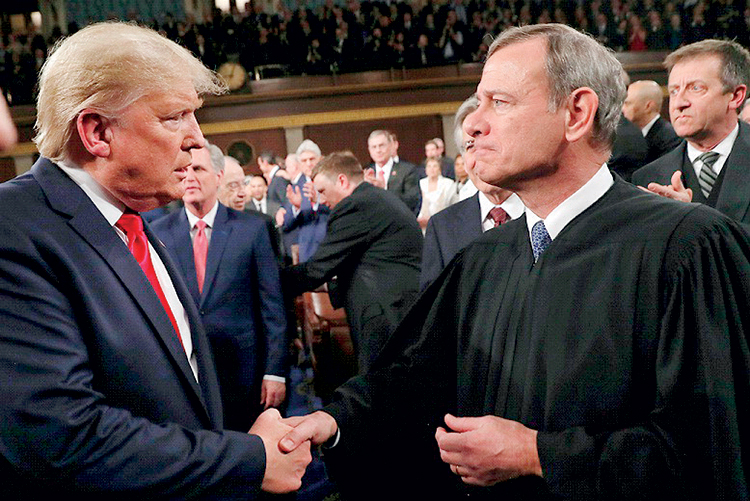
President Donald J. Trump, as the American President often calls himself, is a global spectacle. And so are his tariffs. On Friday, February 20, the US Supreme Court led by Chief Justice John Roberts and a 6-3 majority, struck down the most ballyhooed tariff scheme of all times. Upholding the earlier decisions of the lower federal courts, the Supreme Court held that Trump’s use of ‘emergency powers’ to impose the so called Liberation Day tariffs on 2 April 2025, is not legal. The Liberation Day tariffs, which were comically announced on a poster board at the White House Rose Garden, is a system of reciprocal tariffs applied to every country that exported goods and services to America. The court ruling has pulled off the legal fig leaf with which Trump had justified his universal tariff scheme.
Trump was livid after the ruling on Friday and invectively insulted the six judges who ruled against Trump’s tariffs. There was nothing personal about it, but for Trump, the ever petulant man-boy, there isn’t anything that is not personal. On Tuesday night in Washington, Trump delivered his first State of the Union address of his second presidency. The Chief Justice, who once called the State of the Union, “a political pep rally,” attended the pomp and exchanged a grim handshake with the President.
Tuesday’s State of the Union was the longest speech ever in what is a long standing American tradition that is also a constitutional requirement. The Trump showmanship was in full display for the millions of Americans who watched him and millions of others in the rest of world, especially mandarins of foreign governments, who were waiting to parse his words to detect any sign for his next move on tariffs or his next move in Iran. There was nothing much to parse, however, only theatre for Trump’s Republican followers and taunts for opposing Democrats. He was in his usual elements as the Divider in Chief. There was truly little on offer for overseas viewers.
On tariffs, he is bulldozing ahead, he boasted, notwithstanding the Supreme Court ruling last Friday. But the short lived days of unchecked executive tariff powers are over even though Trump wouldn’t let go of his obsessive illusions. On the Middle East, Trump praised himself for getting the release of Israeli hostages, dead or alive, out of Gaza, but had no word for the Palestinians who are still being battered on that wretched strip of land. On Ukraine, he bemoaned the continuing killings in their thousands every month but had no concept or plan for ending the war while insisting that it would not have started if he were president four years ago.
He gave no indication of what he might do in Iran. He prefers diplomacy, he said, but it would be the most costly diplomatic solution given the scale of deployment of America’s fighting assets in the region under his orders. In Trump’s mind, this could be one way of paying for a Nobel Prize for peace. More seriously, Trump is also caught in the horns of a dilemma of his own making. He wanted an external diversion from his growing domestic distractions. If he were thinking using Iran as a diversion, he also cannot not ignore the warnings from his own military professionals that going into Iran would not be a walk in the park like taking over Venezuela. His state of mind may explain his reticence on Iran in the State of the Union speech.
Even on the domestic front, there was hardly anything of substance or any new idea. One lone new idea Trump touted is about asking AI businesses to develop their own energy sources for their data centres without tapping into existing grids, raising demand and causing high prices and supply shortages. That was a political announcement to quell the rising consumer alarms, especially in states such as Michigan where energy guzzling data centres are becoming hot button issue for the midterm Congress and Senate elections in November. Trump can see the writing on the wall and used much of his speech to enthuse his base and use patriotism to persuade the others.
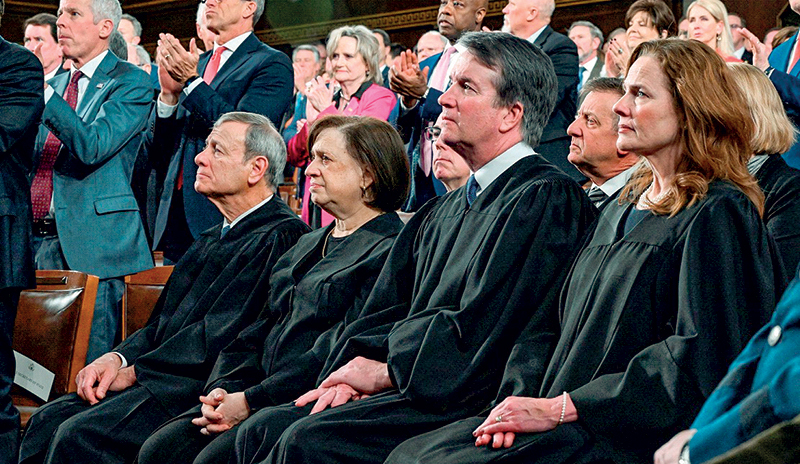
Political Pep Rally: Chief Justice John G. Roberts sits stoically with Justices Elena Kagan, Bret Kavanaugh, and Amy Coney Barrett, as Republicans are on their feet applauding.
Although a new idea, asking AI forces to produce their own energy comes against a background of a year-long assault on established programs for expanding renewable energy sources. Fortunately, the courts have nullified Trump’s executive orders stopping renewable energy programs. But there is no indication if the AI sector will be asked to use renewable energy sources or revert to the polluting sources of coal or oil. Nor is it clear if AI will be asked to generate surplus energy to add to the community supply or limit itself to feeding its own needs. As with all of Trump’s initiatives the devil is in the details and is left to be figured out later.
The Supreme Court Ruling
The backdrop to Tuesday’s State of the Union had been rendered by Friday’s Supreme Court ruling. Chief Justice Roberts who wrote the majority ruling was both unassuming and assertive in his conclusion: “We claim no special competence in matters of economics or foreign affairs. We claim only, as we must, the limited role assigned to us by Article III of the Constitution. Fulfilling that role, we hold that IEEPA (International Emergency Economic Powers Act) does not authorize the President to impose tariffs.”
IEEPA is a 1977 federal legislation that was enacted during the Carter presidency, to both clarify and restrict presidential powers to act during national emergency situations. The immediate context for the restrictive element was the experience of the Nixon presidency. One of the implied restrictions in IEEPA is in regard to tariffs which are not specifically mentioned in the legislation. On the other hand, Article 1, Section 8 of the US Constitution establishes taxes and tariffs as an exclusively legislative function whether they are imposed within the country or implemented to regulate trade and commerce with other countries. In his first term, Trump tried to impose tariffs on imports through the Congress but was rebuffed even by Republicans. In the second term, he took the IEEA route, bypassing Congress and expecting the conservative majority in the Supreme Court to bail him out of legal challenges. The Court said, No. Thus far, but no farther.
The main thrust of the ruling is that it marks a victory for the separation of powers against a president’s executive overreach. Three of the Court’s conservative judges (CJ Roberts, Neil Gorsuch, and Amy Coney Barrett) joined the three liberal judges (all women – Sonia Sotomayor, Elana Kagan and Ketanji Brown Jackson) to chart a majority ruling against the president’s tariffs. The three dissenters were Brett Kavanugh, who wrote the dissenting opinion, Clarence Thomas and Samuel Alito. Justices Gorsuch, Kavanaugh and Barrett were appointed by Trump. Trump took out Gorsuch and Barrett for special treatment after their majority ruling, while heaping praise on Kavanaugh who ruled in favour of the tariffs. Barrett and Kavanaugh attended the State of the Union along with Roberts and Kagan, while the other five stayed away from the pep rally (see picture).
The Economics of the Ruling
In what was a splintered ruling, different judges split legal hairs between themselves while claiming no special competence in economics and ruling on a matter that was all about trade and economics. Yale university’s Stephen Roach has provided an insightful commentary on the economics of the court ruling, while “claiming no special competence in legal matters.” Roach takes out every one of Trump’s pseudo-arguments supporting tariffs and provides an economist’s take on the matter.
First, he debunks Trump’s claim that trade deficits are an American emergency. The real emergency, Roach notes, is the low level of American savings, falling to 0.2% of the national income in 2025, even as trade deficit in goods reached a new record $1.2 trillion. America’s need for foreign capital to compensate for its low savings, and its thirst for cheap imported goods keep the balance of payments and trade deficits at high levels.
Second, by imposing tariffs Trump is not helping but burdening US consumers. The Americans are the ones who are paying tariffs contrary to Trump’s own false beliefs and claims that foreign countries are paying them. 90% of the tariffs have been paid by American consumers, according to the Federal Reserve Bank of New York. Small businesses have paid the rest. Foreign countries pay nothing but they have been making deals with Trump to keep their exports flowing.
According to published statistics, the average U.S. applied tariff rate increased from 1.6% before Trump’s tariff’s to 17%, the highest level since World War II. The removal of reciprocal tariffs after the ruling would have lowered it to 9.1%, but it will rise to 13% after Trump’s 15% tariffs. The registered tariff revenue is about $175 billion, 0.6% of U.S. gross domestic product. The tariff monies collected are legally refundable. The Supreme Court did not get into the modalities for repayment and there would be multiple lawsuits before the lower courts if the Administration does not set up a refunding mechanism.
Lastly, in railing against globalization and the loss of American industries, Trump is cutting off America’s traditional allies and trading partners in Europe, Canada and Mexico who account for 54% of all US trade flows in manufactured goods. Cutting them off has only led these countries to look for other alternatives, especially China and India. All of this is not helping the US or its trade deficit. The American manufacturers (except for sectoral beneficiaries in steel, aluminum and auto industries), workers and consumers are paying the price for Trump’s economic idiosyncrasies. As Roach notes, the Court stayed away from the economic considerations, but by declaring Trump’s IEEPA tariffs unconstitutional, the Court has sent an important message to the American people and the rest of the world that “US policies may not be personalized by the whims of a vindictive and uninformed wannabe autocrat.”
by Rajan Philips
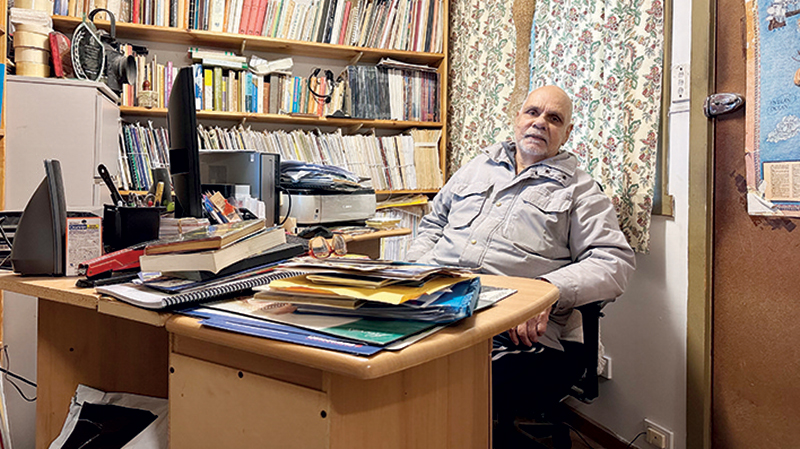
He celebrated his 90th birthday recently, never returned to his homeland because he’s a bad traveler
(Continued from last week)
THE GARRAT LOCOS, were monstrous machines that were able to haul trains on the incline, that normally two locos did. Whilst a normal loco hauled five carriages on its own, a Garrat loco could haul nine. When passenger traffic warranted it and trains had over nine carriages or had a large number of freight wagons, then a Garret loco hauled the train assisted by a loco from behind.
When a train was worked by two normal locos (one pulling, the other pushing) and they reached the summit level at Pattipola (in either direction), the loco pushing (piloting) would travel around to the front the train and be coupled in front of the loco already in front and the two locos took the train down the incline. With a Garraat loco this could not be done as the bridges could not take the combined weight. The pilot loco therefore ran down single, following THE TRAIN.
My father was stationed at Nawalapitiya as a senior driver at the time, and it wasn’t a picnic working with him. He believed in the practical side of things and always had the apprentices carrying out some extra duties or the other to acquaint themselves with the loco. I had more than my fair share.
After the four months upcountry, we were back at Dematagoda on the K. V. steam locos. From the sublime to the ridiculous, I would say after the Garret locos upcountry. Here the work was much easier and at a slower pace, as the trains did not run at speed like their mainline counterparts. The last two months of the third year saw us on the two types of diesel locos on the K.V. line, the Hunslett and Krupp diesels, which worked the passenger trains. For once this was a ‘cushy, sit-down’ job, doing nothing exciting, but keeping a sharp lookout and exchanging tablets on the run. The third year had come to an end and ‘the light at the end of tunnel was getting closer’.
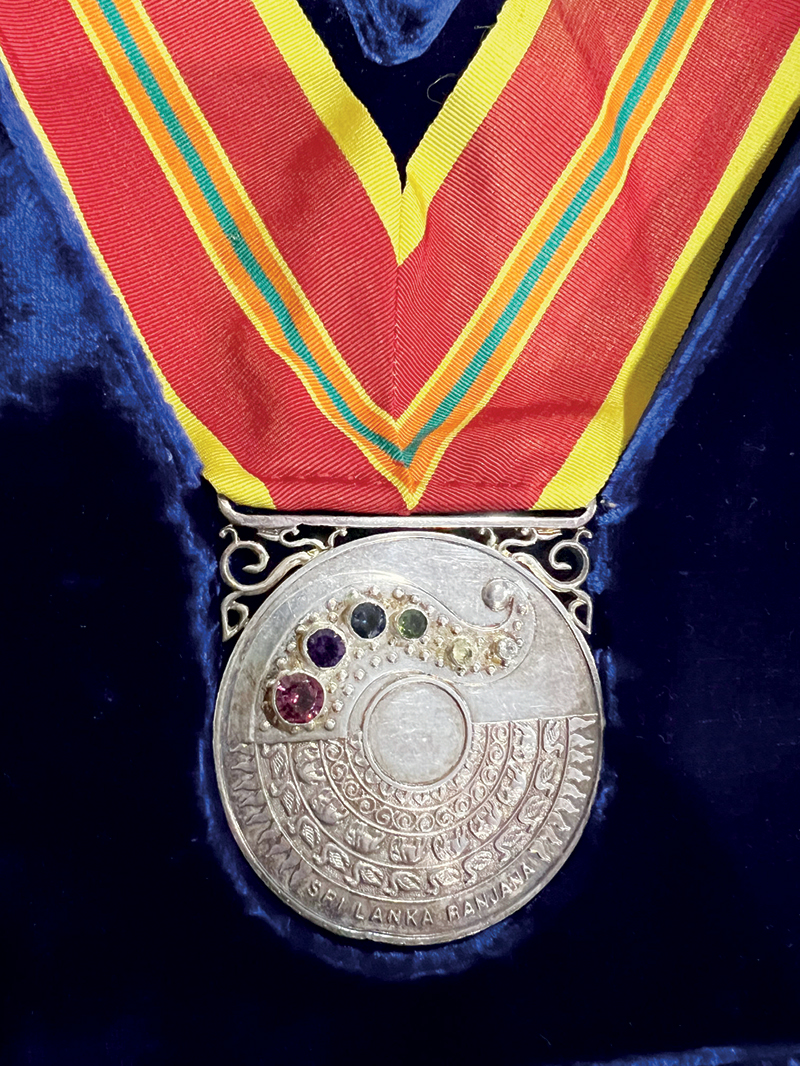
Victor M’s Sri Lanka Ranjana medal
The fourth year saw us all at the Diesel loco shed at Maradana, which was cheek by jowl with the Maradana railway station. The first three months we worked with the diesel mechanical fitters and the following three months with the electrical fitters. Heavy emphasis was placed on a working knowledge of the electrical circuits of the different diesel locos in service, to ensure the drivers were able to attend to electrical faults en-route and bring the train home. This was again a period of lectures and demonstrations
We also spent three months at the Ratmalana workshops, where the diesels were stripped down to the core and refitted after major repairs, to ensure we had a look at what went on inside the many closed and sealed working parts. This was again a 7.00am to 4.00pm day job. Back again at the Diesel shed, Maradana, saw us riding as assistants for the next three months on all the diesel locos in service – The Brush Bragnal (M1), General Electrical (M2), Hunslett locos (G2) and Diesel Rail Cars.
After the final written test on Diesel locos, we began our fifth and final year, which was that of shunting engine driver. The first six months were spent at Maligawatte Yard on steam shunting locos and the next three months shunting drivers on the diesel shunting locos at Colombo goods yard. The final three months were spent as assistants on the M1 and M2 locos working all the fast passenger and mail trains.
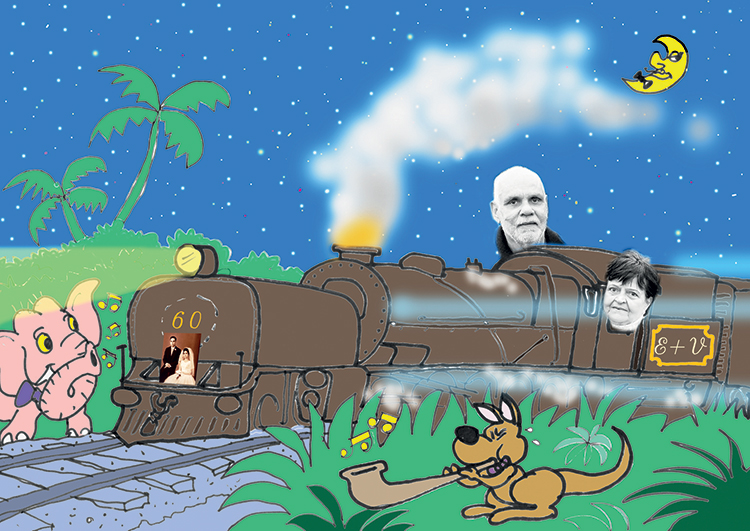
Cartoon to celebrate Victor’s 60th wedding anniversary
I was finally appointed Engine Driver Class III on July 6, 1962, as mentioned earlier I lost eight months of my apprenticeship due to being ill and had to make up the time. This appointment was on three years’ probation, on the initial salary of the scale Rs 1,680 – 72 – Rs 2,184, per annum.
Little did the general traveling public realize that they had well trained and qualified engine drivers working their trains to time Victor was stationed in Galle until December 1967, when he resigned from the railway to migrate to Melbourne, Australia to join the rest of his family. He was the last of 11 siblings to leave Ceylon. Their two elder children were born in Galle. Victor and Esther had three more children in Australia. The children, three boys and two girls) were brought up with love and devotion. They have seven grandchildren and two great grandchildren. They meet often as a family.
He worked for the Victorian State Public Service and retired in 1993 after 25 years’ service. At the time of retirement, he worked for the Ministry for Conservation & Environment. He held the position of Project Officer in charge of the Ministry’s Procedural Documents.
He worked part-time for the Victorian Electoral Office and the Australian Electoral Office, covering State and Federal Elections, from 1972 to 2010. From 1972 to 1982 and was a Clerical Officer and then in 1983 was appointed Officer-in-Charge, Lychfield Avenue Polling Booth, Jacana which is my (the writer’s) electorate.
As part of serving the community Victor participated in a number of ways, quite often unremunerated. He worked part-time for the Department of Census & Statistics, and worked as a Census Collector for the Census of 1972, 1976, 1980 and then Group Leader of 16 Collectors in his area for the 1984, 1988, 1992, 1996, 2000, 2004, 2008 and 2012.
In 1970, Victor began this library, now known as the ‘Victor Melder Sri Lanka Library’, for the purpose of making Sri Lanka better known in Australia. On looking back he has this to say: “Forty-five years later, I can say that it is serving its purpose. In 1993 President Ranasinghe Premadasa of Sri Lanka bestowed on me a national honor – ‘Sri Lanka Ranjana’ for my then 25 years’ service to Sri Lanka in Australia. I feel very privileged to be honored by my motherland, which I feel is the highest accolade one can ever get.”
There were many more accolades over the years:
15.10. 2004, Serendib News, 2004 Business and Community Award.
4.2.2008, Award for Services to the SL Community by The Consulate of Sri Lanka in Victoria (by R. Arambewela)
2024 – SL Consul General’s Award
In 2025 , Victor was one of the ten outstanding Sri Lankans in Australia at the Lankan Fest.
An annual Victor Melder Appreciation award was established to honour an outstanding member by the SriLankan Consulate.
The following appreciation by the late Gamini Dissanayake is very appropriate.
Comment by the late Minister Gamini Dissanayake, in the comment book of the VMSL library.
A man is attached to many things. Attachments though leading to sorrow in the end
are the living reality of life. Amongst these many attachments, the most noble are the attachments to one’s family and to one’s country. You have left Sri Lanka long ago but “she” is within you yet and every nerve and sinew of your body, mind and soul seem to belong there. In your love for the country of your birth you seem to have no racial or religious connotations – you simply love “HER” – the pure, clear, simple, abstract and glowing Sri Lanka of our imagination and vision. You are an example of what all Sri Lankan’s should be. May you live long with your vision and may Sri Lanka evolve to deserve sons like you.
With my best Wishes.
Gamini Dissanayake, Minister from Sri Lanka.
15 February 1987.
The Victor Melder Lecture
The Monash council established the Victor Melder Lecture which is presented every February. It is now an annual event looked forward to by Melbournians. A guest lecturer is carefully chosen each year for this special event.
Victor and his library has featured on many publications such as the Sunday Times in 2008 and LMD International in 2026.
“Although having been a railway man, I am a poor traveler and get travel sickness, hence I have not travelled much. I have never been back to Sri Lanka, never travelled in Australia, not even to Geelong. I am happiest doing what I like best, either at Church or in this library. My younger daughter has finally given up after months of trying to coax, cajole and coerce me into a trip to Sri Lanka to celebrate this (90th) birthday.
I am most fortunate that over the years I have made good friends, some from my school days. It is also a great privilege to grow old in the company of friends — like-minded individuals who have spent their childhood and youth in the same environment as oneself and shared similar life experiences.”
Victor’s love of books started from childhood. Since his young years he has been interested in reading. At St Mary’s College, Nawalapitiya, the library had over 300 books on Greek and Roman history and mythology and he read every one of them.
He read the newspapers daily, which his parents subscribed to, including the ‘Readers Digest’.His mother was an avid fan of Crossword Puzzles and encouraged all the children to follow her, a trait which he continues to this day.
At his workplace in Melbourne, Victor encountered many who asked questions about Ceylon. Often, he could not find an answer to these queries. This was long before the internet existed. He then started getting books on Ceylon/SriLanka and reading them. Very soon his collection expanded and he thought of the Vicor Melder SriLanka Library as source of reference. It is now a vast collection of over 7,000 books, magazines and periodicals.
Another driver of his service to fellow men is his deep Catholic faith in which he follows the footsteps of the Master.
Victor was baptized at St Anthony’s Cathedral, Kandy by Fr Galassi, OSB. Since the age of 10 he have been involved with Church activities both in Sri Lanka and Australia. He remains a devout Catholic and this underlies his spirit of service to fellowmen.
He began as an Altar Server at St Mary’s Church, Nawalapitiya, and continued even in his adult life. In Australia, Esther and Victor have been Parishioners at St Dominic’s Church, Broadmeadows, since 1970.He started as an Adult Server and have been an Altar Server Trainer, Reader and Special Minister He was a member of the ‘Counting Team’ for monies collected at Sunday Masses, for 35 years.
He has actively retired from this work since 2010, but is still ‘on call’, to help when required. To add in his own words
“My Catholic faith has always been important to me, and I can never imagine my having spent a day away from God. Faith is all that matters to Esther too. We attend daily Mass and busy ourselves with many activities in our Parish Church.
For nearly 25 years, we have also been members of a religious order ‘The Community of the Sons & Daughters of God’, it is contemplative and monastic in nature, we are veritable monks in the world. We do no good works, other than show Christ to the world, by our actions. Both Esther and I, after much prayer and discernment have become more deeply involved, taking vows of poverty, obedience and chastity, within the Community. Our spirituality gives us much peace, solace and comfort.”
“This is not my CV for beatification and canonization. My faith is in fact an antidote for overcoming evil, I too struggle like everyone else. I have to exorcise the demons within me by myself. I am a perfect candidate for “being a street angel and home devil” by my constant impatience, lack of tolerance and wanting instant perfection from everyone. “
The above exemplifies the humility of the man who admits to his foibles.
More than 25 years ago The Ceylon Society of Australia was formed in Sydney by a group of Ceylon lovers led by Hugh Karunanayake. Very soon the Melbourne chapter of the organization was formed, and Victor was a crucial part of this. At every Talk, Victor displayed books relevant to the topic. For many years he continued to do so carrying a big box of books and driving a fair distance to the meeting place. Eventually when he could no longer drive his car, he made certain that the books reached the venue through his close friend, Hemal Gurusinghe.
He also was the guest speaker at one of the meetings and he regaled the audience with railway stories.
Victor has dedicated his life on this mission, and we can be proud of his achievements. His vision is to find a permanent home for his library where future generations can use it and continue the service that he commenced. The plea is to get like-minded individuals in the quest to find a suitable and permanent home for the Victor Melder Srilankan Library.
by Dr. Srilal Fernando
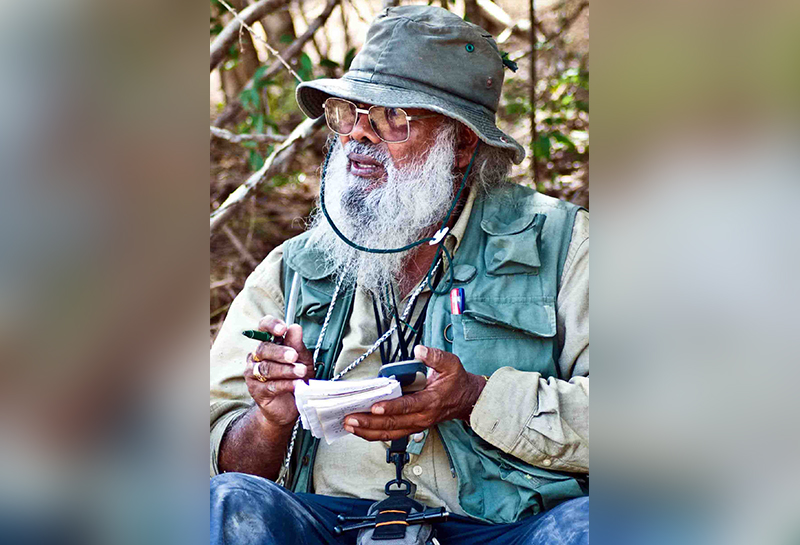
Sri Lanka is set to make scientific history by hosting the world’s first global conference dedicated entirely to snake research, conservation and public health, with the World Congress on Snakes (WCS) 2026 scheduled to take place from October 1–4 at The Grand Kandyan Hotel in Kandy World Congress on Snakes.
The congress marks a major milestone not only for Sri Lanka’s biodiversity research community but also for global collaboration in herpetology, conservation science and snakebite management.
Congress Chairperson Dr. Anslem de Silva described the event as “a long-overdue global scientific platform that recognises the ecological, medical and cultural importance of snakes.”
“This will be the first international congress fully devoted to snakes — from their evolution and taxonomy to venom research and snakebite epidemiology,” Dr. de Silva said. “Sri Lanka, with its exceptional biodiversity and deep ecological relationship with snakes, is a fitting host for such a historic gathering.”
Global Scientific Collaboration
The congress has been established through an international scientific partnership, bringing together leading experts from Sri Lanka, India and Australia. It is expected to attract herpetologists, wildlife conservationists, toxinologists, veterinarians, genomic researchers, policymakers and environmental organisations from around the world.
The International Scientific Committee includes globally respected experts such as Prof. Aaron Bauer, Prof. Rick Shine, Prof. Indraneil Das and several other authorities in reptile research and conservation biology.
Dr. de Silva emphasised that the congress is designed to bridge biodiversity science, medicine and society.
“Our aim is not merely to present academic findings. We want to translate science into practical conservation action, improved public health strategies and informed policy decisions,” he explained.
Addressing a Neglected Public Health Crisis
A key pillar of the congress will be snakebite envenoming — widely recognised as a neglected tropical health problem affecting rural communities across Asia, Africa and Latin America.
“Snakebite is not just a medical issue; it is a socio-economic issue that disproportionately impacts farming communities,” Dr. de Silva noted. “By bringing clinicians, toxinologists and conservation scientists together, we can strengthen prevention strategies, improve treatment protocols and promote community education.”
Scientific sessions will explore venom biochemistry, clinical toxinology, antivenom sustainability and advances in genomic research, alongside broader themes such as ecological behaviour, species classification, conservation biology and environmental governance.
Dr. de Silva stressed that fear-driven persecution of snakes, habitat destruction and illegal wildlife trade continue to threaten snake populations globally.
“Snakes play an essential ecological role, particularly in controlling rodent populations and maintaining agricultural balance,” he said. “Conservation and public safety are not opposing goals — they are interconnected. Scientific understanding is the foundation for coexistence.”
The congress will also examine cultural perceptions of snakes, veterinary care, captive management, digital monitoring technologies and integrated conservation approaches linking biodiversity protection with human wellbeing.
Strategic Importance for Sri Lanka
Hosting the global event in the historic city of Kandy — a UNESCO World Heritage site — is expected to significantly enhance Sri Lanka’s standing as a hub for scientific and environmental collaboration.
Dr. de Silva pointed out that the benefits extend beyond the four-day meeting.
“This congress will open doors for Sri Lankan researchers and students to access world-class expertise, training and international partnerships,” he said. “It will strengthen our national research capacity in biodiversity and environmental health.”
He added that the event would also generate economic activity and position Sri Lanka as a destination for high-level scientific conferences, expanding the country’s international image beyond traditional tourism promotion.
The congress has received support from major international conservation bodies including the International Union for Conservation of Nature (IUCN), Save the Snakes, Cleveland Metroparks Zoo and the Amphibian and Reptile Research Organization of Sri Lanka (ARROS).
As preparations gather momentum, Dr. de Silva expressed optimism that the World Congress on Snakes 2026 would leave a lasting legacy.
“This is more than a conference,” he said. “It is the beginning of a global movement to promote science-based conservation, improve snakebite management and inspire the next generation of researchers. Sri Lanka is proud to lead that conversation.”
By Ifham Nizam

Can West Indies make up for bowling gulf in virtual quarter-final against India?

Flights cancelled as travel warnings issued after strikes on Iran

Trump says Iran’s Supreme Leader Ayatollah Ali Khamenei is dead after US-Israeli strikes

South Africa put spotless record on the line in all-African clash

Fair weather will prevail over most parts of the island

Renewed Lanka’s Easter Bombing probe puts NTJ’s South India radicalisation network back under lens

‘Dates have the highest sugar content to fight Coronavirus’

Sunday Island 27 December – Headlines

#SundayIsland 17th December – Headlines

Sunday Island – 28th March

Sunday Island Headlines – 21 March

Sunday Island – 21st February – Headlines
-

 Features6 days ago
LOVEABLE BUT LETHAL: When four-legged stars remind us of a silent killer
-

 Business6 days ago
Bathiya & Santhush make a strategic bet on Colombo
-
 Business6 days ago
Seeing is believing – the silent scale behind SriLankan’s ground operation
-

 Features6 days ago
Protection of Occupants Bill: Good, Bad and Ugly
-
 News6 days ago
Prime Minister Attends the 40th Anniversary of the Sri Lanka Nippon Educational and Cultural Centre
-

 News6 days ago
Coal ash surge at N’cholai power plant raises fresh environmental concerns
-
 Business6 days ago
Huawei unveils Top 10 Smart PV & ESS Trends for 2026
-

 Opinion2 days ago
Jamming and re-setting the world: What is the role of Donald Trump?