
Features
THE FIFTH AMENDMENT, THE PAPER CHASE AND THE ULTIMATE THREAT TO U.S. DEMOCRACY

by Vijaya Chandrasoma
The Fifth Amendment of the Constitution of the United States of America is divided into five clauses, protecting the legal rights of the individual in civil and criminal cases. These are: the right to a grand jury; double jeopardy; self-incrimination; due process; and compensation when private property is used for public use.
The self-incrimination clause protects persons accused of committing a crime from being forced to testify against themselves. According to the US judicial system, a person is presumed innocent, and it is the responsibility of the state to prove guilt. Evidence gained from coerced confessions or from the testimony of the accused in a court of law, when their actual words may be used against them, are protected when they “take the Fifth”.
While taking the Fifth is not considered to be an admission of guilt in the legal sense, Donald Trump, former president of the United States, has often derided the Fifth Amendment in the past as the “refuge of mobsters”. At a rally in Iowa in 2016, he said: “The Mob takes the Fifth. If you are innocent, why should you take the Fifth? Only the guilty takes the Fifth.” He has, on numerous rallies during his presidency, railed about the implied guilt of those who take the Fifth.
Last week, Donald Trump, during his testimony in a case of tax fraud brought against him by Letitia James, the State Attorney of New York, invoked his Fifth Amendments rights on a world record count of 440 questions! Maybe Trump was right, after all, when he said that the Fifth Amendment is a “refuge of mobsters” and crooks.
Trump currently has so many charges against him in Georgia (Election Fraud), Washington D. C. (Seditious Conspiracy, Insurrection, Interfering with an Official Procedure and Defrauding the United States), the aforementioned New York trial (Tax and Insurance Fraud, Money Laundering). Add to these the Select Committee investigating into his role on inciting the events leading to the January 6 Insurrection, one’s head starts spinning.
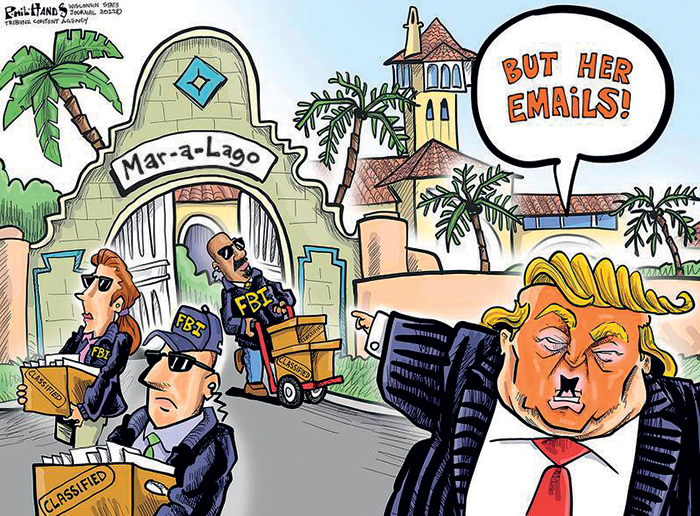
Last week, the spinning increased violently with the news that a search warrant for his resort home at Mar a Lago, Southern Florida, had been issued by Attorney General Merrick Garland, on information that 11 more boxes containing classified documents had been stolen when Trump vacated the White House in January 2021. These documents were being held in an unsecured basement at the resort.
Six months after Trump was forced out of the White House, rumours were rife that Trump had stolen many boxes containing documents, and taken them to Mar a Lago. These documents belonged to the National Archives and Records Administration (NARA) in Washington D.C. When the FBI questioned Trump about the removal of these documents six month later, his lawyers gave up 15 boxes containing White House documents. The Department of Justice gave Trump a free pass on the federal crime of illegal possession of government property, as it was thought that he had surrendered all the stolen documents on request.
Last week, acting on information that there were more documents unlawfully retained at the resort, the FBI, armed with a legally approved search warrant signed by a federal judge, raided the former president’s home. They served the search warrant to the former president three days before. Trump was at his club in Bedminster, New Jersey at the time, but his lawyers were present at all times during the search.
In a statement after the raid, Trump sobbed that his beloved home at Mar a Lago was “under siege, raided, and occupied by a large group of FBI agents. They even broke into my safe.” Reminds me of my European History teacher at Royal. Describing the violence during the French Revolution, he famously said, “Even the windows were broken.”
Trump, ever the victim, never the criminal, wailed that this unlawful raid was yet another witch hunt by the Democrats. He maintained that all the documents confiscated by the FBI were deemed declassified by him with his invisible presidential wand; that even if they were not so declassified, they were surreptitiously planted by the FBI. And, in any event, the documents belonged to him. They did not, they belonged to the National Archives.
His supporters immediately sprang to his defence, echoing his contradictory screams of victimization, that Trump is the target of a shadowy conspiracy, painting the FBI as jackbooted thugs – like the German Gestapo – operating on the orders of a tyrannical federal government.
Florida governor Ron de Santis, the leading non-Trump favourite for the Republican presidential nomination in 2024 called it “another escalation in the weaponization of federal agencies against the regime’s political opponents”. Florida Senator Rick Scott, whose telephone was seized by the FBI the day after the Mar a Lago search, indicating that he was suspected of complicity in the storage of stolen documents, described the FBI action as “third world country stuff.” The maniacs of the QAnon (a radical right wing cult), led by Congresswomen Tailor Green and Boebert are demanding the defunding of the FBI, while declaring a call to arms, with threats of an “armed rebellion” and “a civil war.”
Fears of violence have grown after the Mar a Lago search. A man armed with an AR 15 style rifle and a nail gun attacked the FBI office in Cincinnati, Ohio. He was killed by the police after shooting a nail gun at people. No one else was wounded. Another man drove his car into a barricade near the Capitol in Washington DC and killed himself.
The FBI and the Department of Homeland Security have warned the public of an increase in violent threats posted in social media against federal officials and facilities, including a plan to place a so called “dirty bomb” in front of the FBI headquarters in Washington DC.
Attorney General Garland has received death threats after the search, as has Judge Bruce Reinhart, who is also facing a political firestorm for authorizing the search warrant. In despicable and vengeful desperation, Trump is threatening to release Closed Circuit TV footage at Mar a Lago during the search, which will identify, target and endanger the safety of FBI agents who were just doing their jobs.
After the attack on the FBI office in Ohio, Trump had a message conveyed to Attorney General Garland to the effect that “The country is on fire. What can I do to reduce the heat?” A veiled threat by the arsonist offering to help the firefighters!
Even if these seized documents were mainly collections of Aesop’s Fables and Grimms Fairy Tales, the removal of any documents, classified or not, from the White House by the outgoing president is in itself a federal crime. Not even Aesop or Grimm would have had the imagination to describe the criminality of the haul of documents seized by the FBI from Mar a Lago.
These documents show potential violations of three federal statutes, including the Espionage Act. They included five sets of documents marked “Top Secret SCI” (Sensitive Compartmented Information), granted access only to a handful of senior government executives on a “need-to-know” Top Secret Clearance by the Intelligence Community. These documents are considered germane to the nation’s nuclear arsenal and ongoing CIA investigations, which are deemed to have the potential to threaten the security of the nation.
Beyond belief is that these boxes of Top Secret documents had been lying, unsecured, in a basement of a golf club/resort, accessible to anyone visiting the resort, for over a year.
This will be an added case against Trump, which will be prosecuted along with the multitude of the other cases listed above. Trump is running low on his choice of defence lawyers, not only because of the volume of cases against him, but because few in the legal community wish to represent him as he famously stiffs his lawyers, refusing to pay their bills. Also, his regular lawyers like Rudy Guiliani, Lindsay Graham and Sydney Powers are too busy fighting their own indictments of election fraud and sedition.
The question that immediately arises is not that Trump is guilty of stealing Top Secret documents, but why he did it. And why they were being stored in an insecure basement of his home/resort? There is only one answer which is in perfect sync with the criminality of the former president. These documents are worth billions to our adversaries. Trump, who is beholden to no one but himself, certainly not to his country, who has never forsaken the opportunity to make a quick buck, would have sold them to the highest bidder. North Korean President Kim Jong Un, with whom Trump once claimed to be in love, his erstwhile puppet master Vladimir Putin and Saudi Arabian Prince Mohammed Bin Salman (MBS), come to mind as likely customers.
After the Mar a Lago raid, Fox News, as is their wont, rushed to the defence of Mein Fuhrer. Yet again, they try to defend the indefensible, to cover up and Foxsplain away the many instances of Trump’s crimes of extortion, obstruction of justice and sedition. In their eyes, Trump can do no wrong. And they persuade their many old, mainly white audience that Trumpism is the future of the country, against the evidence of their own ears and eyes. They lie, they obfuscate, they misinterpret the news to anger their already racist audience.
It was not always so. During the couple of decades I lived in the USA at the turn of the century, members of the Republican Party, including Fox News, espoused the classical conservative viewpoint. The Republican Party of yore was the Party of Lincoln, of law and order, small government, low taxation on the super wealthy and corporations, minimum anti-pollution ecological regulations, in short, espousing the Ayn Rand philosophy of “Full speed ahead and the devil take the hindmost”. Christianity was never poured down our throats. Live and let live was the order of the day. These opinions were right wing, but not virulently or violently racist and completely devoid of fact.
Although I am of a more progressive bent, I could live with these traditionally conservative policies. America had kind of lost its way and its thriving middle class of the 1970s with Reagan’s “trickle down” supply side economics in the ‘80s. But I was confident that, especially after the progress made by the Obama administration, the nation would finally auto-correct and catch up with the social democratic policies of the rest of the developed world.
I was spectacularly wrong.
Trump came along, and brought to the surface all the fascist prejudices of white supremacy seething during the administration of a black man. And Trump gave them the licence, even great pride to make public and violently act out these radical racist feelings without fear of government retaliation.
Unfortunately, after the Trump base of the radical right and Evangelicals crawled out of the woodwork, traditional conservatives continued to get their daily dose of misinformation from Fox News. They have been radicalized and corrupted by the fact-free propaganda machine of Trumpism. They consume as gospel the daily tariff of lies and criminal propaganda catered by Trump, through Fox News.
Fox News is the modern American counterpart of Goebbels’ German propaganda machine of the 1930s. They still pretend to believe and trumpet the big lie about 2020 election fraud. They continue to make ridiculous excuses for Trump’s criminal acts, bordering on treason. With this latest crime of stealing Top Secret documents, which amounts to espionage and treason, Trump faces his greatest test yet of his ability to survive scandal and escape imprisonment.
Should he succeed, and either he or one of his acolytes take control of Congress in the midterms in November and the White House in 2024, the United States of America would have abandoned the Great Experiment of Democracy born in 1789. Trump’s White Supremacist America would transform the world’s oldest democracy to the largest, most violently corrupt, nuclear-armed Banana Republic the world has even seen.
Hitler is long dead, but his dreams of an ethnically pure, white nation are being kept alive in the United States of America by Trump and his white supremacist Republican cult.



 The International Labour Organisation (ILO) now defines a living wage as the wage level necessary for workers and their families to afford a decent standard of living, given national circumstances, for normal hours of work. This standard of living is operationalised through the cost of essential goods and services, typically including food, housing, healthcare, education, transport, and a modest allowance for contingencies and social participation.
In contrast, “cost of living” in economics is a broader price index concept that tracks the overall prices of a representative consumption basket but is not inherently normative about what constitutes decency or dignity.
Living wage methodologies effectively translate a cost-of-living basket, specified for a given family size and living standard, into a monthly income requirement for workers, thereby linking real wages to human development objectives rather than only to market productivity.
Methodologies for computing a living wage
Most contemporary living wage estimates follow a structured “cost of a basic but decent life” approach built around three steps: defining a reference family, costing a normative consumption basket, and converting that cost into a wage per worker.
The Anker methodology, widely used in global supply chains and in Sri Lanka, is a leading example: it defines a model family (e.g., 2 adults and approximately 2–3 children), estimates the cost of a low-cost nutritious diet, adequate housing, and non-food essentials, and then allocates that cost over expected number of full-time workers per family.
Within the Anker framework, the food component is based on locally appropriate diets meeting caloric and nutritional norms, priced using local market surveys and adjusted for waste and home preparation.
Housing costs are derived from standards for minimally acceptable housing (e.g., durable materials, sufficient space, basic services), using rents or imputed rental values from empirical fieldwork. Other essential expenditures, health, education, transport, clothing, and a small margin for unexpected events, are typically estimated as a percentage mark-up over food and housing costs, derived from national household survey data.
Finally, the methodology sets a reference number of workers per family, divides total family living costs by this number to get a net living wage, and then adjusts to a gross living wage by adding payroll taxes and mandatory deductions. Periodic updates are made using consumer price indices (CPIs) to reflect inflation or deflation and, where necessary, new field surveys to capture structural shifts in prices and consumption patterns.
Sri Lanka’s living wage estimates and their link to cost of living (Anker Methodology)
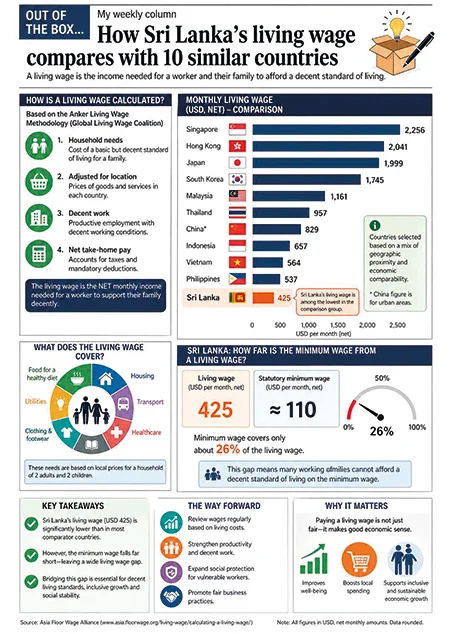 Sri Lanka has been the subject of several living wage studies, notably for the tea estate sector and for urban and rural areas, using the Anker methodology.
In the tea estate sector, an updated 2024 Anker report estimates the cost of a “basic but decent” standard of living for a typical family at about LKR 78,067 per month (approximately USD 260), implying a gross living wage of LKR 48,584 per month (USD 160) and a net, take-home living wage of LKR 44,357.
For urban Sri Lanka, the Anker Living Wage Reference Value was originally set at LKR 84,231 per month in April 2022, corresponding to a net living wage of LKR 77,492 plus social security contributions. After cumulative inflation of about 36.9 percent between April 2022 and June 2025, the updated gross urban living wage is estimated at approximately LKR 115,291 per month (around USD 385), consisting of a net living wage of LKR 106,068 and social security contributions of LKR 9,223
These Sri Lankan figures are explicitly derived from cost-of-living calculations: they incorporate the cost of food, housing, utilities, health, education, and other essentials at local prices and then convert these into wages per adult worker, assuming roughly 1.7–1.8 full-time earners per family. Because living wage estimates are indexed to actual price dynamics, periods of high inflation, as Sri Lanka experienced in 2022–2023, translate almost mechanically into sharp upward revisions in living wages, underlining the tight coupling between living wage levels and the evolving cost of living.
Comparative living wages: Sri Lanka and other countries
Cross-country comparisons require careful normalisation because living wages reflect local prices, family structures, and social norms, but several datasets provide a structured basis for comparison. [asia.floorwage](https://asia.floorwage.org/living-wage/calculating-a-living-wage/)
The Asia Floor Wage Alliance, for example, publishes a regional living wage benchmark expressed in purchasing power parity (PPP) terms, with a 2024 benchmark of 1,750.54 PPP dollars per month converted into local currencies using country-specific PPP exchange rates.
Using this PPP-based approach, the 2024 living wage equivalent for Sri Lanka is estimated at around LKR 158,353 per month, assuming a PPP exchange rate of about 90.5 Sri Lankan rupees per PPP dollar.
This PPP-normalised figure is substantially higher than the Anker 2024–2025 estate-sector and urban living wage estimates in nominal rupees, partly because the Asia Floor Wage benchmark is set to ensure a more harmonised standard across Asian garment-producing economies and uses a single PPP wage target.
These figures indicate that, within this PPP-based framework, Sri Lanka’s living wage in local currency is relatively high compared to countries such as India and Bangladesh, but the comparison reflects both different PPP exchange rates and domestic price structures.
From a cost-of-living perspective, this pattern is consistent with Sri Lanka being a lower-middle-income country with relatively higher prices for some essentials compared with low-income South Asian economies, especially after recent macroeconomic and inflationary shocks.
Global patterns and high-income economies
Global datasets covering more than 200 countries show that typical-family living wage levels, whether calculated in PPP or nominal terms, tend to correlate positively with national income levels, with North America, Western Europe, and Australia displaying the highest living wage values.
In this global distribution, living wages in middle- and low-income regions of Asia, Africa, and Latin America are lower in absolute terms, though the ratio of living wage to median wages or statutory minimum wages can be high, underscoring the gap between decent-work standards and prevailing labour market outcomes.
Interestingly, some studies note that rural living wage estimates can be relatively high in poorer countries because limited infrastructure and service availability raise the cost of accessing a given standard of living, such as safe water, transport, and education.
For Sri Lanka, rural Anker living wage benchmarks similarly reveal the importance of non-food costs, such as transportation to schools, health facilities, and workplaces, in shaping the total family budget, despite lower nominal rents in many rural areas.
Living wage, social policy, and Sri Lanka’s development trajectory
The emerging international consensus around a living wage is rooted in the human rights-based notion of a “decent life” rather than a subsistence minimum or an arbitrarily set statutory floor.
From a social science perspective, incorporating living wage benchmarks into wage-setting institutions, collective bargaining, and social dialogue reorients labour markets toward social reproduction, intergenerational mobility, and social cohesion, rather than merely cost competitiveness.
For Sri Lanka, where recent crises have eroded real wages and increased household vulnerability, living wage estimates such as the Anker urban and estate-sector benchmarks provide an analytically rigorous yardstick for evaluating whether current wage policies and social transfers are adequate relative to the actual cost of a basic but decent life.
Comparisons with regional PPP-based benchmarks like the Asia Floor Wage suggest that, while Sri Lanka’s living wage requirement in local currency is relatively high, the country also faces significant affordability challenges, especially for low-paid workers in export sectors and informal employment, whose earnings often fall short of these normative thresholds.
In policy terms, the living wage framework highlights the need for coordinated approaches that combine wage-setting reforms, inflation-sensitive social protection, and productivity-enhancing investments, so that rising living-cost-consistent wages do not simply translate into inflationary spirals or employment losses.
For empirical research in Sri Lanka, these benchmarks open avenues for micro-level analysis of wage gaps, household coping strategies, gendered labour outcomes, and the distributional effects of macroeconomic adjustment, all anchored to a transparent and internationally recognised living wage methodology.
(The writer, a senior Chartered Accountant and professional banker, is Professor at SLIIT, Malabe. The views and opinions expressed in this article are personal.)
Echoes of ‘The Walk for Peace’
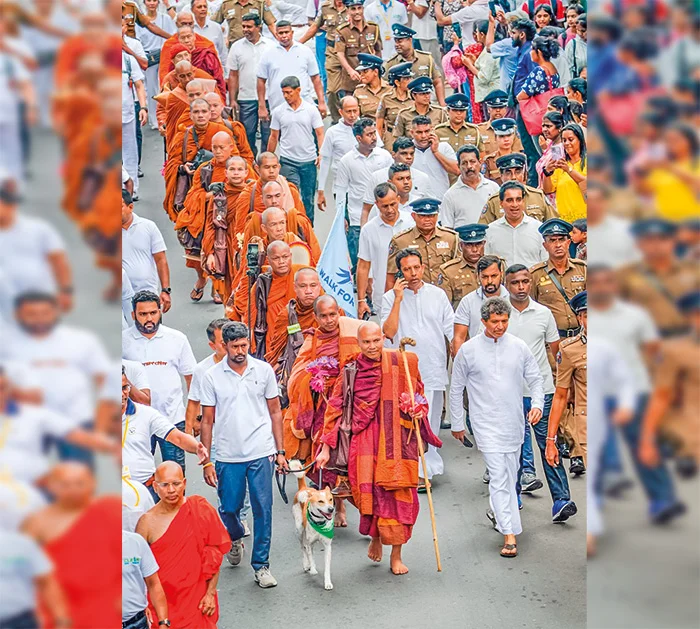
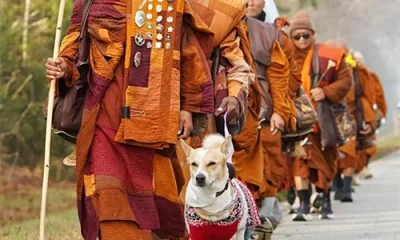
The international Walk for Peace’ reaching Colombo, joined by a large number of monks and devotees, led by spiritual leader Ven Bhikku Pannakara, with the peace dog ‘Aloka,’ completing the 161 km journey.The walk commenced in Dambulla on April 22 following the main ceremony at the Jaya Sri Maha Bodhi in Anuradhapura.Pic by Nishan S.Priyantha
by Ven. Dr. Kirinde Assaji Nayaka Thero
Chief Incumbent, Gangaramaya Temple, Hunupitiya, Colombo
Throughout human history, one of the greatest and most complex challenges has been the establishment of lasting peace and the maintenance of harmonious coexistence. While peace is often understood simply as the absence of war or armed conflict, a deeper, spiritual perspective reveals it as a profound state of social and mental harmony. It is an ideal that must be cultivated within individuals as well as across societies.
Buddhism offers one of the most practical and timeless philosophies of peace. The teachings of the Buddha are rooted in non-violence and the four sublime virtues—loving-kindness, compassion, sympathetic joy, and equanimity. Central to this philosophy is the idea that true peace in the world begins with inner peace within the individual. Conflict, the Buddha taught, arises not on battlefields but within the human mind, driven by greed, hatred, and delusion. Without overcoming these negative forces, lasting peace in the external world remains unattainable.
In today’s world, marked by geopolitical tensions, economic competition, and social unrest—this inward approach to peace is more relevant than ever. Despite technological advancement, humanity continues to grapple with violence and division. The Buddha’s teaching points instead to an internal struggle: a battle against anger, jealousy, and ignorance. Rather than weapons of destruction, Buddhism promotes wisdom, compassion, patience, and discipline as the tools to overcome conflict.
The path to peace begins with understanding its causes. Just as muddy water becomes clear when left undisturbed, the human mind achieves clarity and calm when negative emotions are subdued. This principle is reflected in the Buddha’s intervention during a historic dispute between the Sakya and Koliya clans over water, where he reminded them of the greater value of human life, thereby preventing bloodshed.
In a world increasingly threatened by conflict over limited resources and political power, such lessons remain highly relevant. The Buddha also emphasised the principle of moral causation—actions have consequences.
Yadisaṃ vapate bijaṃ tadisaṃ harate phalaṃ
Kalyaāṇakariī kalyaṃ papakariī ca papakaṃ
Pavutthaṃ tata te bijaṃ phalaṃ paccanubhossasiti
“As one sows the seed, so does one reap the fruit.
The doer of good receives good results, and the doer of evil receives evil results.
Dear one, whatever seed you have planted, you will experience the corresponding fruit of it.”
At the heart of Buddhist ethics is respect for life. All beings fear harm and seek happiness, and therefore, violence against others cannot lead to true well-being. This message is particularly significant in an era where the race for power and advanced weaponry continues to overshadow compassion and humanity.
The fundamental moral discipline in Buddhism is respect for life and opposition to harming living beings. The Buddha taught that all beings desire happiness, and fear suffering, and that harming others will not lead to happiness.
Sabbe tasanti dandassa
sabbe bhayanti maccuno
attanam upamam katva
na haneyya na ghataye.
“All tremble at violence; all fear death. Comparing others with oneself, one should neither kill nor cause others to kill.”
Despite technological advancement, the world appears to be moving backwards in terms of compassion and peace. Power-driven politics and the race for advanced weaponry cannot provide lasting solutions. Global leaders, diplomats, and policymakers must urgently recognise the importance of the tolerant, balanced, and non-violent approach taught in Buddhism. Protecting the right to life of all beings, and acting with compassion beyond divisions of race, religion, or politics, is the only true foundation for world peace.
Sri Lanka, as a nation nourished by the essence of Buddhism, has long upheld this principle. The Sri Lankan tradition, rooted in boundless loving-kindness and compassion, strives to uphold human values even amidst the harsh realities of global politics. From the respect shown by King Dutugemunu towards King Elara, to Sri Lanka’s stance at the 1951 San Francisco Peace Conference invoking the words “Hatred is never appeased by hatred,” to recent humanitarian acts in rescuing sailors in distress—these all reflect a single philosophy: valuing human life above all divisions.
The presentation of a “Joint Declaration for Peace” by the Mahanayake Theros at Gangaramaya Temple recently reaffirmed Sri Lanka’s commitment to global peace. Despite global power struggles, Sri Lanka continues to stand as a symbol of compassion and peace, reminding the world that human kindness is more powerful than weapons.
Institutions such as the Gangaramaya Temple have played a vital role in fostering social harmony. Through charitable, educational, and cultural programmes, the temple has encouraged unity across religious and ethnic lines, while also promoting interfaith dialogue and cooperation.
The annual Navam Maha Perahera, organised by the temple, stands as a powerful symbol of national unity, bringing together people from diverse backgrounds in a shared celebration. Similarly, vocational training and educational initiatives have helped empower young people from all communities, strengthening social cohesion.
A recent “Walk for Peace,” led by Venerable Pannakara Thero and supported by the monastic community, further underscored this commitment. More than a physical journey, it represented a spiritual effort to cultivate peace within the human heart and spread a message of compassion to the wider world.
One of the most touching aspects of the event was the participation of a dog named “Aloka,” which accompanied the monks throughout the journey. This simple yet powerful image reflected the Buddhist teaching that all living beings value life and deserve compassion, highlighting the universal nature of peace.
Ultimately, the Buddha’s message remains clear: peace cannot be achieved through hatred or violence. True peace arises from self-discipline, moral conduct, and the cultivation of a pure mind. As the teaching states, avoiding evil, doing good, and purifying one’s mind is the path laid down by the Buddha.
Let us plant the seeds of peace within our hearts and nurture them with loving-kindness. (“Sabba papassa akarananṃ – kusalassa upasampadā – sacitta pariyodapanaṃ – etaṃ Buddhana sasanaṃ”)
In a time when global tensions continue to rise, this timeless message serves as a powerful reminder that lasting peace begins within each individual—and that compassion remains humanity’s greatest strength.
“Devo vassatu kalena – sassa sampatti hetu ca
Pito bhavatu loko ca – rajaā bhavatu dhammiko”
(“May the rains fall at the right time, bringing about abundant harvests.
May the world be joyful and prosperous.
May the ruler be righteous and just.”)
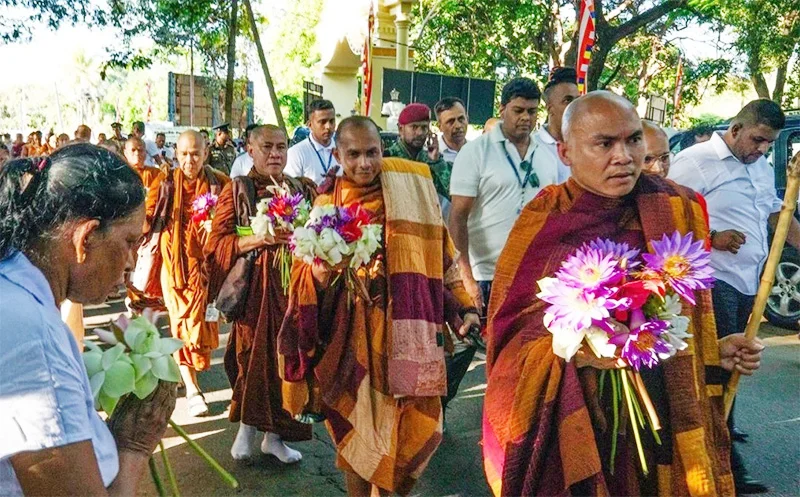
The ongoing peace march by a group of international Buddhist monks has captured the sentiment of Sri Lankans in a manner that few public events have done in recent times. It is led by the Vietnamese monk Venerable Thich Pannakara who is associated with a mindfulness movement that has roots in Vietnamese Buddhist practice and actively promoted among diaspora communities in the United States. The peace march by the monks, accompanied by their mascot, the dog Aloka, has generated affection and goodwill within the Buddhist and larger community. It follows earlier peace walks in the United States where monks carried a similar message of mindfulness and compassion across communities but without any government or even media patronage as in Sri Lanka.
This initiative has the potential to unfold into an effort to nurture a culture of peace in Sri Lanka. Such a culture is necessary if the country as the country prepares to move beyond its history of conflict towards a more longlasting reconciliation and a political solution to its ethnic and religious divisions. The government’s support for the peace march can be seen as part of a broader attempt to shape such a culture. The Clean Sri Lanka programme, promoted by the government as a civic responsibility campaign focused on environmental cleanliness, ethical conduct and social discipline, provides a useful framework within which such initiatives can be situated. Its emphasis on collective responsibility and shared public space makes it sit well with the values that peacebuilding requires.
government’s previous plan to promote a culture of peace was on the occasion of “Sri Lanka Day” celebrations which were scheduled to take place on December 12-14 last year but was disrupted by Cyclone Ditwah. The Sri Lanka Day celebrations were to include those talented individuals from each and every community at the district level who had excelled in some field or the other, such as science, business or arts and culture and selected by the District Secretariats in each of the 25 districts. They were to gather in Colombo to engage in cultural performances and community-focused exhibitions. The government’s intention was to build up a discourse around the ideas of unity in diversity as a precursor to addressing the more contentious topics of human rights violations during the war period, and issues of accountability and reparations for wrongs suffered during that dark period.
Positive Response
The invitation to the international monks appears to have emerged from within Buddhist religious networks in Sri Lanka that have long maintained links with the larger international Buddhist community. The strong support extended by leading temples and clergy within the country, including the Buddhists Mahanayakes indicates that this was not an isolated effort but one that resonated with the mainstream Buddhist establishment. Indeed, the involvement of senior Buddhist leaders has been particularly noteworthy. A Joint Declaration for Peace in the world, drawing on Sri Lanka’s own experience, and by the Mahanayakes of all Buddhist Chapters took place in the context of the ongoing peace march at the Gangaramaya Temple in Colombo, with participation from the diplomatic community. The declaration, calling for compassion, dialogue and sustainable peace, reflects an effort by religious leadership to assert a moral voice in favour of coexistence.
The popular response to the peace march has also been striking. Large numbers of people have been gathering along the route, offering flowers, water and support to the monks. Schoolchildren have been lining the roads, and communities from different religious backgrounds extend hospitality. On the way, the monks were hosted by both a Hindu temple and a mosque, where food and refreshments were provided. These acts, though simple, carry a message about the possibility of harmony among Sri Lanka’s diverse communities. It helps to counter the perception that the Buddhist community in Sri Lanka is inherently nationalist and resistant to minority concerns that was shaped during the decades of war and reinforced by political mobilisation that too often exploited ethnic identity.
By way of contrast, the peace march offers a different image. It shows a readiness among ordinary people to embrace values of compassion and coexistence that are deeply embedded in Buddhist teaching. The Metta Sutta, one of the most well-known discourses in Buddhism, calls for boundless goodwill towards all beings. It states that one should cultivate a mind that is “boundless towards all beings, free from hatred and ill will.” This emphasis on universal compassion provides a moral foundation for peace that extends beyond national or ethnic boundaries. The monks themselves emphasised this point repeatedly during the walk. Venerable Thich Pannakara reminded those who gathered that while acts of generosity are commendable, mindfulness in everyday life is even more important. He warned that as people become unmindful, they are more prone to react with anger and hatred, thereby contributing to conflict.
More Initiatives
The presence of political leaders at key moments of the march has emphasised the significance that the government attaches to the event. Prime Minister Harini Amarasuriya paid her respects to the peace march monks in Kandy, while President Anura Kumara Dissanayake is expected to do so at the conclusion of the march in Colombo. Such gestures signal an alignment between political authority and moral aspiration, even if the translation of that aspiration into policy remains a work in progress. At the same time, the peace march has not been without its shortcomings. The walk did not engage with the Northern and Eastern parts of the country, regions that were most affected by the war and where the need for reconciliation is most acute. A more inclusive geographic reach would have strengthened the symbolic impact of the initiative.
In addition, the positive impact of the peace march could have been increased if more effort had been taken to coordinate better with other civic and religious groups and include them in the event. Many civil society and religious harmony groups who would have liked to participate in the peace march found themselves unable to do so. There was no place in the programme for them to join. Even government institutions tasked with promoting social cohesion and reconciliation found themselves outside the loop. The Clean Sri Lanka Task Force that organised the peace march may have felt that involving other groups would have made it more complicated to organise the events which have proceeded without problems.
The hope is that the positive energy and goodwill generated by this peace march will not dissipate but will instead inspire further initiatives with the requisite coordination and leadership. The march has generated public discussion, drawn attention to the values of mindfulness and compassion, and created a space in which people can imagine a different future. It has been a special initiative among the many that are needed to build a culture of peace. A culture of peace cannot be imposed from above nor can it emerge overnight. It needs to be nurtured through multiple efforts across society, including education, religious engagement, civic initiatives and political reform. It is within such a culture that the more difficult questions of power sharing, justice and reconciliation can be addressed in a constructive manner.
by Jehan Perera

President and Exco of Sri Lanka Cricket step down

Ferreira, Shubham, Rajasthan Royals openers hand Punjab Kings their first defeat

Dulani and Samarawickrama set up Sri Lanka’s victory in T20I series opener

Heat Index at Caution Level in the Northern, North-central and North-western provinces and in Kegalle, Trincomalee and Batticaloa districts during the day time

Showers or thundershowers will occur in most parts of the island after 1.00 pm

Treasury chief’s citizenship details sought from Australia

‘Dates have the highest sugar content to fight Coronavirus’

Sunday Island 27 December – Headlines

#SundayIsland 17th December – Headlines

Sunday Island – 28th March

Sunday Island Headlines – 21 March

Sunday Island – 21st February – Headlines
-
 News7 days ago
Lanka faces crisis of conscience over fate of animals: Call for compassion, law reform, and ethical responsibility
-
 News6 days ago
Whistleblowers ask Treasury Chief to resign over theft of USD 2.5 mn
-

 News6 days ago
No cyber hack: Fintech expert exposes shocking legacy flaws that led to $2.5 million theft
-

 News3 days ago
BIA drug bust: 25 monks including three masterminds arrested
-
 Business4 days ago
Nestlé Lanka Announces Change in Leadership
-

 News3 days ago
Banks alert customers to phishing attacks
-
 News4 days ago
Hackers steal $3.2 Mn from Finance Ministry
-
 News7 days ago
USD 2 mn bribe: CID ordered to arrest Shasheendra R, warrant issued against ex-SriLankan CEO’s wife