
News
“The criminal justice system in South Asia is discriminatory and violent”: Ambika Satkunanathan

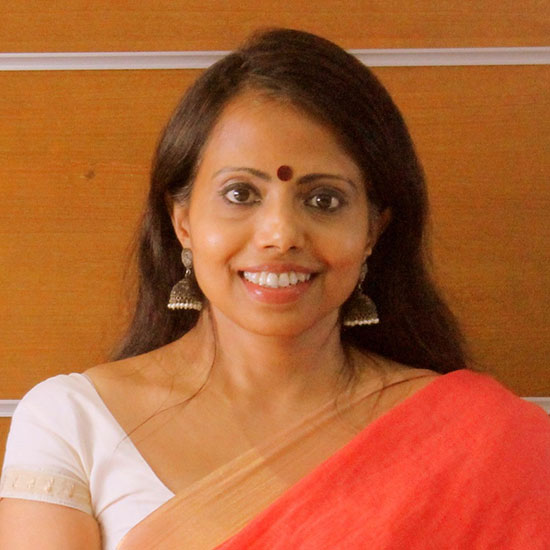
As a lawyer and human-rights champion who led the first-ever national study of prisons in Sri Lanka last year, Ambika Satkunanathan is vocal against the violence that is an endemic part of prison systems, and the ‘retributive’ and ‘vengeful’ nature of state justice that creates worse problems in society and creates criminals rather than rehabilitating them.
“Violence is used to maintain order, which robs the person in prison of dignity and agency from the moment they enter prison until they leave. Violence and discrimination are normalised in the system,” says Ambika, who was commissioner of the Human Rights Commission of Sri Lanka from 2015 to 2020.
“This penchant for violent forms of punishment is a result of societies being wedded to the punitive and carceral approach to dealing with what are essentially social problems,” she adds. “We believe that locking someone up and throwing away the key solves the issue, but it only compounds it.”
Regardless, she says, societies in the Subcontinent continue with this deeply flawed approach because it is easier than addressing the root causes of what is defined as ‘crime’.
The question of what constitutes crime has become increasingly blurred in the recent past in South Asia as more and more human-rights activists and even journalists in the region are being targeted by their own governments, and imprisoned on the basis of draconian colonial-era laws, and kept confined as ‘undertrials’ for years until the case begins. In these instances, prisons are being used not to deter crime but to deter dissent, and to threaten those who speak up against governments, even ‘democratic’ ones.
She shares her observation that South Asian societies are more skewed towards punishing individuals over corporations, and the underprivileged over the privileged. “A large multinational corporation will be able to use technicalities and the immense resources at their disposal to escape accountability for environmental degradation, while someone with a few grams of marijuana will be imprisoned. Therefore, your social position, power and privilege impact how you are treated by the criminal justice system, which is not neutral or objective but is discriminatory and violent,” asserts Ambika, who did her BA and LLB from Monash University in Australia, and LLM from the University of Nottingham.
Women even more vulnerable. “In Sri Lanka, women suffer structural violence in many ways. For instance, they don’t have access to even sanitary napkins, have no access to reproductive health care, and there is inadequate access to pre and postnatal care,” she says, describing a scenario that could apply to a number of rural areas anywhere in the Subcontinent.
Apart from facilities and infrastructure, women also bear the brunt of carrying the ‘honour’ of the family, or loss of reputation, which is more severe for them than for men. “When women are imprisoned, they often lose the support of families or partners / husbands and hence find it difficult to retain legal representation. It prolongs their imprisonment,” says Ambika, who has been a Chevening scholar and currently serves as the chairperson of the Neelan Tiruchelvam Trust, the only indigenous grant-maker in Sri Lanka, combining human-rights and peacebuilding initiatives.
Further, she says, women are more stigmatised and find it challenging to rebuild their lives following release from prison. This in turn pushes them into exploitative situations that leads to them being imprisoned again. “The vicious cycle continues,” she explains.
Women are also vulnerable to the gendered aspect of violence to which they might be subjected – another staple in South Asian societies. For women activists from minority communities in Sri Lanka, the challenges are progressively worse.
“If you are a Tamil woman activist working in the Northern Province, you will face additional challenges, such as surveillance, constant visits by the security agencies to your house to make inquiries about your activities, and phone calls prior to events or demonstrations to intimidate you from participating,” she shares.
Ambika’s own journey from a lawyer to a human-rights champion has been shaped by her identity as a Tamil woman in Sri Lanka – particularly the discrimination she faced. The violence and fear of violence that Tamils have experienced in Sri Lanka cast a shadow that hung over her life as long as she can remember.
“This is what drove me to study law and work to further the protection of human rights. The personal became the political because the political impacted every aspect of my personal life, like that of most Tamils in Sri Lanka,” she says.
She looks back with pride at her work at the Human Rights Commission of Sri Lanka where, despite structural and systemic impediments, she managed to strengthen connections between the Commission and civil society and survivors of human-rights violations. “It helped create an environment of trust whereby they felt they could approach the Commission for remedies,” she says.
At a webinar organised by South Asia Peace Action Network last month on the topic ‘Rights of the incarcerated in South Asia’, Ambika stressed on the importance of civil society organisations in South Asia coming together to share experiences, especially strategies, used to counter similar challenges.
“Other South Asian countries have seen authoritarian regimes similar to the current one in Sri Lanka, and are aware of or have experienced state efforts to stifle dissent and intimidate and harass human-rights activists. Similarly, patriarchy, misogyny, and sexism are not particularly unique to Sri Lanka. Since the problems are similar, so are the solutions. We must learn from each other rather than reinventing the wheel,” she says.
Ambika believes the solution lies with civil society who can help activists who are imprisoned or targeted by the powerful. “The most important way is to openly voice solidarity with the activists. Other means include mounting legal challenges to these state acts as well as engaging in advocacy, both nationally and internationally,” she says.
Providing support to the families of the activists, whether material or otherwise, is often understated, but goes a long way too, she adds. “Often the psychological aspect of incarceration is ignored. Therefore, offering moral support to the families is imperative,” she says, suggesting that supporters can visit imprisoned activists, taking them books or food to show they are not forgotten. “It reminds them that there are people who continue to fight for their release.”
While envisioning a unified and socially just South Asia, Ambika believes there’s a lot more that needs change than just laws. “Before we speak of laws, let’s speak of values. In South Asia, majoritarian and ethno-nationalist politics have taken hold and discrimination against minorities is common,” she says.
Giving examples of how religious minorities face constant threat – the Tamils and Muslims in Sri Lanka; Muslims and Dalits in India; and Sikhs, Shias and Christians in Pakistan – she believes South Asian countries are moving further away from secularism “if not in law, then certainly in deed.”
She has a special bone to pick with the death penalty. Citing both the legal and historical point of view, she refers to the South Asian cultural perspective that leans heavily towards the Hindu and Buddhist principles of the supremacy of all forms of life: “Abolish, abolish, abolish the death penalty! The death penalty is a cruel and inhumane punishment which, as research has shown over and over again, does not in any way prevent crime but instead causes great harm,” she asserts.
As a society, Ambika says, we need to introspect how much we all are responsible in perpetuating crime: “When we address the root causes of social problems, address the deep inequalities within society, we will not have to expend energy formulating humane punishments.” (Money Control)

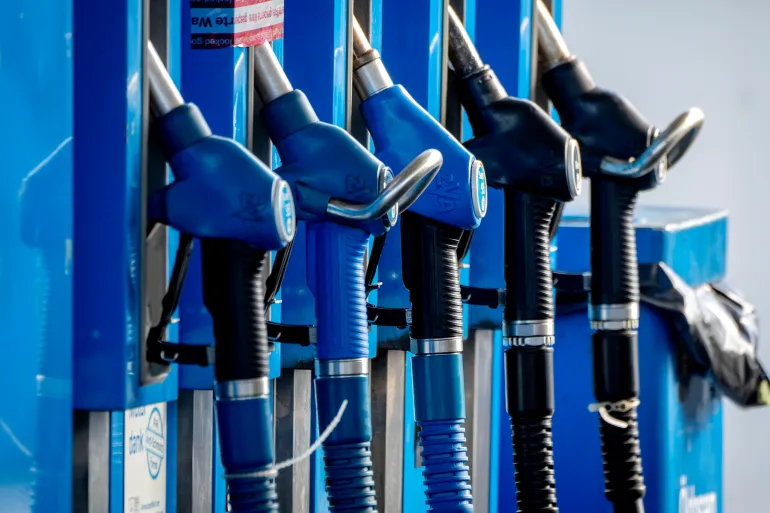
The Ceylon Petroleum Corporation (Ceypetco) has announced a revision of fuel prices, effective from midnight today (21).
Accordingly,
Auto Diesel – Rs. 382 (increased by Rs. 79)
Super Diesel – Rs. 443 (increased by Rs. 90)
Petrol 92 Octane – Rs. 398 (increased by Rs. 81)
Kerosene – Rs. 255. (increased by Rs. 60)
Petrol 95 Octane – Rs. 455 (increased by Rs. 90)

Latest News
Advisory for Severe Lightning issued for Galle, Matara, Kaluthara and Rathnapura districts

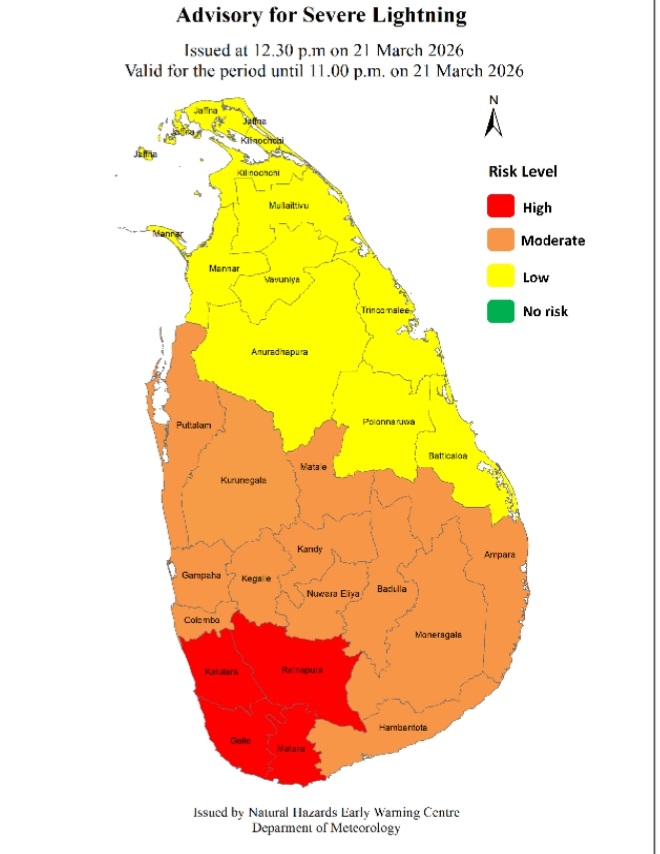
Advisory for Severe Lightning Issued by the Natural Hazards Early Warning Centre Issued at 12.30 p.m. 21 March 2026, valid for the period until 11.00 p.m. 21 March 2026
Thundershowers accompanied with severe lightning are likely to occur at some places in the Galle, Matara, Kaluthara and Rathnapura districts after 1.00 p.m.
There may be temporary localized strong winds during thundershowers. General public is kindly requested to take adequate precautions to minimize damages caused by lightning activity.
ACTION REQUIRED:
The Department of Meteorology advises that people should:
Seek shelter, preferably indoors and never under trees.
Avoid open areas such as paddy fields, tea plantations and open water bodies during thunderstorms.
Avoid using wired telephones and connected electric appliances during thunderstorms.
Avoid using open vehicles, such as bicycles, tractors and boats etc.
Beware of fallen trees and power lines.
For emergency assistance contact the local disaster management authorities.
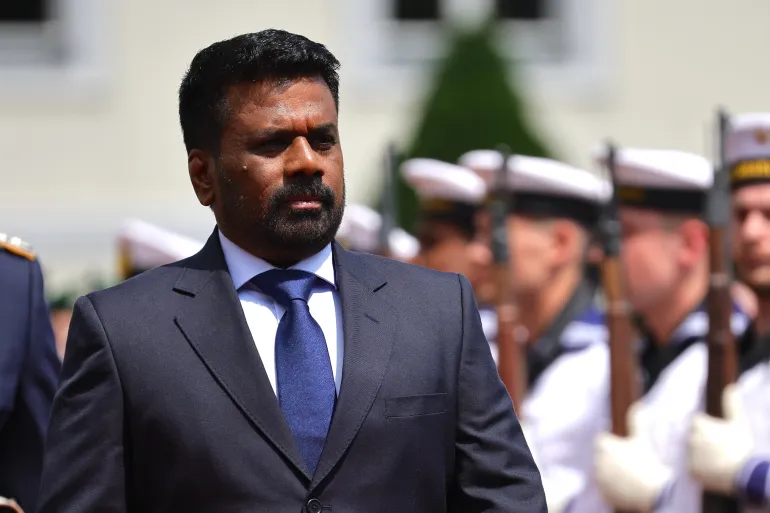
Sri Lanka’s president says his government turned down a request from the United States to land two US combat aircraft at a civilian airport earlier this month.
President Anura Kumara Dissanayake told Sri Lanka’s parliament on Friday that Washington had requested permission for the aircraft to land at Mattala Rajapaksa International Airport in southern Sri Lanka from March 4 to 8.
The request was made on February 26, two days before the US and Israel launched their military offensive against Iran.
“They wanted to bring two warplanes armed with eight antiship missiles from a base in Djibouti”, Dissanayake told lawmakers. “We turned down the request to maintain Sri Lanka’s neutrality”, he added to applause.
The US-Israeli war on Iran has sparked widespread concern globally, as Iranian missile and drone attacks across the wider Middle East have sent energy prices soaring and fuelled fears of a widening conflict.
US President Donald Trump has also been pressuring Washington’s allies to show more support for the war, slamming NATO countries as “cowards” for refusing to help secure the Strait of Hormuz.
Iran has essentially shuttered the critical Gulf waterway amid the war, forcing leaders around the world to scramble to try to offset the effects on their economies and energy supplies.
Amid the turmoil, many countries have refused to get directly involved in the war while calling for urgent de-escalation.
On Friday, Switzerland announced that it would halt any weapons exports to the US that could be used in military operations against Iran, citing its longstanding policy of neutrality.
“The export of war materiel to countries involved in the international armed conflict with Iran cannot be authorised for the duration of the conflict”, the Swiss government said.
Sri Lanka’s president also cited his country’s neutrality in the decision to deny the US request to land the two aircraft at Matalla airport earlier this month.
Dissanayake said he had received another request that same day, on February 26, from Iran to seek permission for three naval vessels to make a goodwill visit to Sri Lanka.
“With two requests before us, the decision was clear,” he said, noting that the government denied both to avoid taking sides as signs of escalating conflict emerged.
“Had we said ‘yes’ to Iran, we would have had to say ‘yes’ to the US, as well”, Dissanayake added.
In early March, Sri Lanka’s navy rescued 32 Iranian crew off IRIS Dena after it was torpedoed by a US submarine off the country’s coast, killing at least 84 people.
Days later, Sri Lanka evacuated more than 200 crew members from a second Iranian vessel, IRIS Bushehr, after the ship requested assistance from Colombo.
[Aljazeera]

CEYPETCO Fuel prices increased from midnight today (21)

Advisory for Severe Lightning issued for Galle, Matara, Kaluthara and Rathnapura districts

Sri Lanka says it denied US request to land two aircraft at Mattala airport

Eid celebrations dimmed by war and displacement across Middle East

Showers may occur at several places in the Western, Sabaragamuwa, Northwestern and Uva provinces and in Galle, Matara, Kandy and Nuwara-Eliya districts after 1.00 pm.

Iranian strikes on bases used by US caused $800m in damage, new analysis shows

‘Dates have the highest sugar content to fight Coronavirus’

Sunday Island 27 December – Headlines

#SundayIsland 17th December – Headlines

Sunday Island – 28th March

Sunday Island Headlines – 21 March

Sunday Island – 21st February – Headlines
-

 Business6 days ago
Browns EV launches fast-charging BAW E7 Pro at Rs. 5.8 million
-

 Life style7 days ago
From culture to empowerment: Indonesia’s vision for Sri Lanka
-

 News4 days ago
CIABOC questions Ex-President GR on house for CJ’s maid
-

 Life style7 days ago
Ranjith Fernando celebrates cricketing journey with Hob Nails to Spikes
-

 News5 days ago
Sri Lankan marine scientist Asha de Vos honoured at UNGA opening
-

 Features6 days ago
Achievements of the Hunduwa!
-

 Latest News7 days ago
QR code system will be implemented for fuel with effect from 06.00 a.m. today (15th)
-

 News5 days ago
Australian HC debunks misleading travel risk claims for Sri Lanka