
Foreign News
Selfies and smiles: South Korea seeks ‘new phase’ in ties with China


South Korea’s President Lee Jae Myung has called for a “new phase” in ties with China as he met its leader Xi Jinping in Beijing on Monday.
Regional security and lifting Beijing’s unofficial ban on Korean pop culture is high on Lee’s agenda, as he continues his four-day trip in China. He is set to meet China’s Premier Li Qiang and the chairman of parliament, Zhao Leji on Tuesday.
It marks the first visit by a South Korean leader since 2019. Bilateral ties had soured under Lee’s predecessor, impeached ex-president Yoon Suk Yeol, who was very critical of China.
Xi, meanwhile, has appeared keen to shore up ties with South Korea amid a diplomatic row between China and Japan.
South Korea is a US security ally – like Japan – but also relies on China for trade. Experts say Lee is expected to keep walking a diplomatic tightrope between Beijing and Tokyo.
The visit marks the second time the two leaders have met since November when Xi visited South Korea for a regional economic summit.
On Monday Lee stated that the visit was “a crucial opportunity” for the “full-scale restoration of South Korea-China relations”, reported South Korean newspaper Chosun. “We want to usher in a new phase in the development of South Korea-China relations.”
Government officials and companies from both countries signed a series of cooperation agreements on technology, trade and environment.
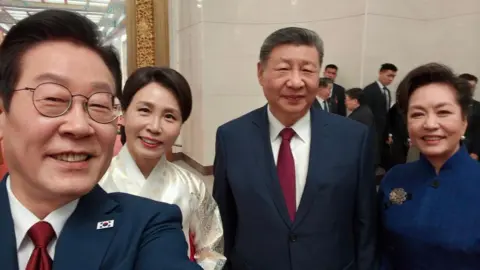
Lee also took selfies with Xi, using a Xiaomi phone that the Chinese president had gifted him last year.
“The image quality is certainly good, right?” Lee posted on X along with the photos.
Xi noted that the “international situation is becoming more turbulent and complex”.
The meeting followed the US’s capture of Venezuelan president Nicolas Maduro over the weekend.
Xi urged Lee to “firmly stand on the right side of history and make correct strategic choices”, China’s official Xinhua news agency reported.
He also brought up the two countries’ shared history of resisting Japan militarism, saying that China and South Korea should now “work hand in hand to safeguard the outcomes of the victory of World War Two and uphold peace and stability in Northeast Asia”.
Xi’s eagerness to meet Lee signals the pressure he faces in finding a regional ally, Park Seung-chan, professor of China studies at Yongin University told the BBC.
“China may beat around the bush but its demand is clear: side with China and denounce Japan.”
During his four-day trip to China, Lee is expected to hold a memorial service in Shanghai for activists who fought for Korea’s independence from Japan.
But while South Korea is “still showing all its deference towards China”, it wants to “strengthen its relationships with both Japan and China”, Mr Park said.
Lee is reportedly planning to visit Japan later this month to meet Prime Minister Sanae Takaichi.
Security on the Korean Peninsula has also been part of the discussions. Lee has sought to engage North Korea diplomatically, but there has been little progress so far. He needs Chinese cooperation in pressuring the North’s Kim Jong Un to give up his nuclear weapons. Beijing is one of Pyongyang’s biggest supporters, economically and diplomatically.
Lee vowed on Monday to work with China on “viable alternatives for peace on the Korean Peninsula”.
On Sunday Seoul’s military said Pyongyang fired ballistic missiles off its east coast. And on Monday the North’s state news agency said the country test-fired hypersonic missiles to assess deterrence capabilities following recent developments, in an apparent reference to the US’s seizure of Maduro.
It remains unclear how much Lee will be able to push China on North Korea. In September, Xi had pledged to strengthen Beijing’s “traditional friendship” with Pyongyang.
And Seoul and Beijing are not natural allies.
US troops have been stationed in South Korea for decades in case of an attack from the North, and last year the two sides agreed to cooperate on building nuclear-powered submarines. The announcement drew warnings from China.
Lee has also sought to put a stop to China’s build-up of maritime structures in waters between the two countries. Beijing says the structures are fish-farming equipment, but they have sparked security concerns in Seoul.
The two leaders agreed on Monday to continue “constructive” dialogue on the matter, South Korea’s presidential spokesperson said.
Another item high on Lee’s agenda is China’s unofficial restrictions on South Korean music and dramas that have been in place for a decade. K-pop and K-dramas are either unavailable or difficult to access on Chinese media platforms.
While China has never acknowledged a ban on Korean artists, it’s believed to be a protest against South Korea’s decision to deploy a US anti-missile system in 2016, which China sees as a threat to its military operations in the region.
China is a massive market for Korean entertainment, which is already a huge global success.
At a Korea-China business forum on Sunday, Lee encouraged deeper bilateral collaboration in beauty products, food and cultural content including movies and music.
A South Korean presidential spokesperson said on Monday that the two leaders agreed to discuss the gradual expansion of cultural exchanges – without specifying concrete commitments on K-dramas or K-pop.
A Chinese foreign ministry spokesperson similarly told reporters on Tuesday that both sides have agreed to “carry out orderly, healthy, and beneficial cultural exchanges”.
Speaking before Korean residents in Beijing on Sunday, Lee said his visit would “serve as a new starting point to fill in the gaps in Korea-China relations, restore them to normal and upgrade them to a new level”.

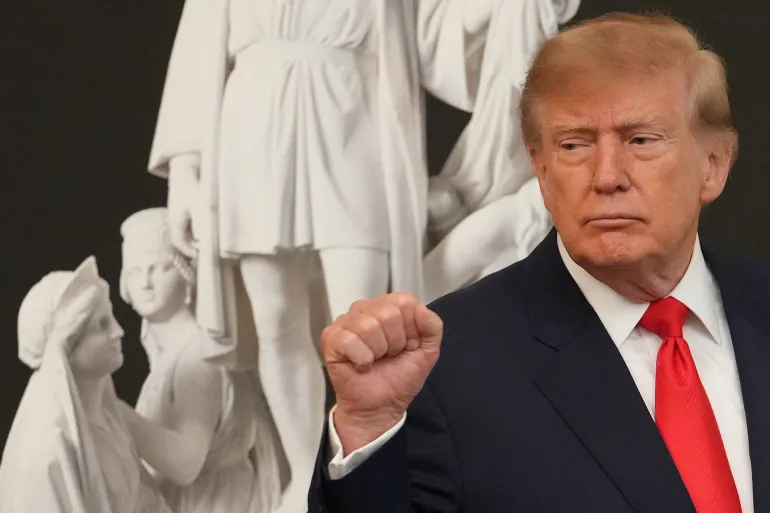
United States President Donald Trump said that Russia has agreed to supply 300,000 tonnes of diesel fuel to global markets amid discussions with Russian President Vladimir Putin.
“I have just concluded a highly successful discussion with President Vladimir Putin, of Russia, wherein it was agreed that Russia will immediately supply over 300,000 Tons of Diesel Fuel to the American and Global Marketplace, another 500,000 Tons during the month of November, and 1,000,000 Tons immediately thereafter,” Trump said in a post on his Truth Social platform.
The president added that Russia would deliver an additional 3 million tonnes of fuel “within a short period of time”. He said that the country would supply 500,000 tonnes in November.
An envoy for Russian President Vladimir Putin, Kirill Dmitriev, praised cooperation between Russia and the United States on diesel and energy in a post on X shortly after.
“Russia-US cooperation on diesel and energy will benefit the world,” Dmitriev wrote on X.
Petrol price pressures
The deal comes despite Ukrainian air strikes, which have taken more than half of the country’s oil refining capacity offline, according to claims made by Ukraine’s Ministry of Defence on Sunday.
The latest announcement comes a week after the G7 countries agreed to release 100 million barrels amid pressure from the White House.
Diesel prices have been elevated in recent months but have started to decline. The average price for a gallon is $6.27 ($1.66 per litre), according to the American Automobile Association (AAA), which tracks daily petrol prices. That’s down $0.10 from this time last week, but up $5.94 from this time one month ago.
[Aljazeera]
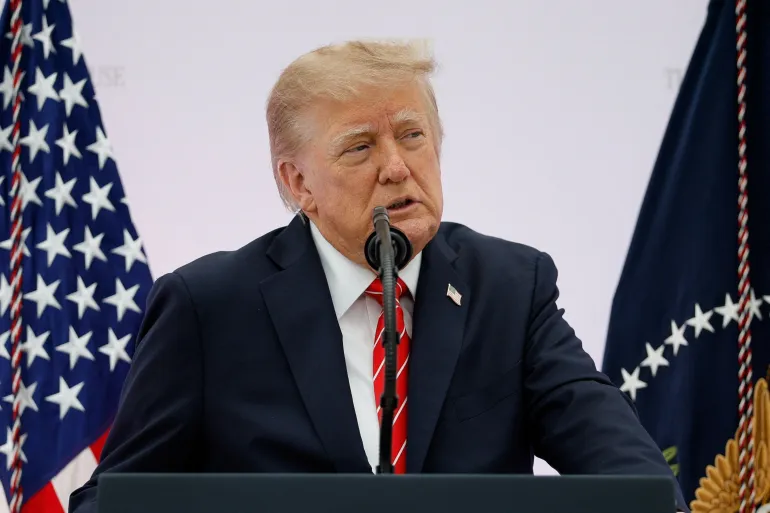
United States President Donald Trump has said the US will not attack Iran before the November 3 midterm elections.
The US president said late on Thursday: “we are having productive discussions with the Islamic Republic of Iran,” in a post on Truth Social. “We will not be attacking Iran at any time prior to the midterm elections to be held in the United States on November 3rd.”
Oil prices fell early on Friday as Middle East supply concerns eased somewhat after tensions in the energy-rich Gulf region had mounted in recent weeks.
The possibility of renewed fighting had appeared to drive up oil prices in trading on Thursday. Some analysts believe Trump’s comments were an attempt to try and bring prices back down.
Iran’s Foreign Minister Abbas Araghchi said Tehran is reviewing the US response to its seven day plan to reopen the Strait of Hormuz, and that Iran will respond within the “next few days”.
He added that negotiations are continuing through mediators, Iran’s Tasnim news agency reported.
Iranian media reported “massive explosions” in the southern Strait of Hormuz on Friday, with Fars citing unnamed military sources as saying tankers using “unauthorised” routes may have struck sea mines.
On Tuesday, US Vice President JD Vance said Iran must make a “meaningful” reduction in its uranium enrichment capacity as part of an agreement to end the war. Experts say this demand may signal a softening of Washington’s earlier insistence that Tehran abandon enrichment altogether.
On Monday, Iranian President Masoud Pezeshkian said negotiations with Washington were “futile”, accusing the US of using negotiations to attack Iran.
Russian President Vladimir Putin told Pezeshkian that Russia will “do everything” to help end the US-led war on Iran, Russian news agencies reported on Thursday.
[Aljazeera]
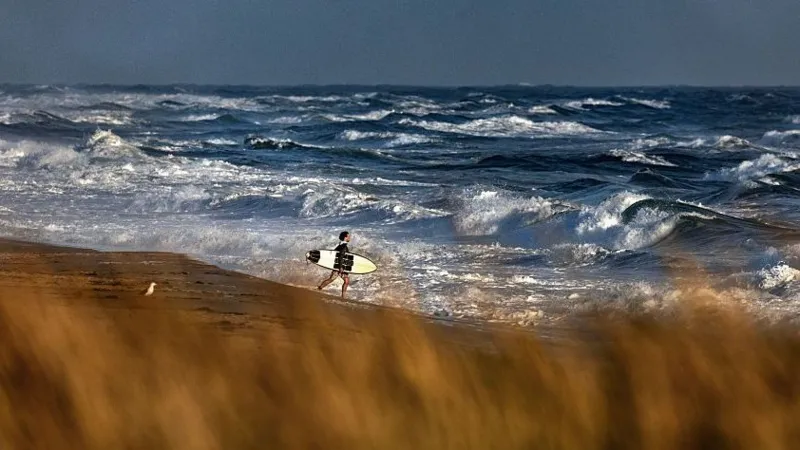
US authorities have found debris from a medical transport aircraft that went missing with six people on board.
The Federal Aviation Administration told the BBC it had lost contact with the Gulfstream G-100 plane just after 01:00 local time (05:00 GMT) on Saturday, while it was travelling from Bermuda to Boston, Massachusetts.
The search for survivors continues off the coast of Nantucket, a Massachusetts island, the US Coast Guard said.
Authorities have notified the next of kin of those on the flight, four Canadian nationals and two Bermudian nationals.
“Search crews located a debris field confirmed to be from the aircraft off the coast of Nantucket,” the US Coast Guard said in an update on Saturday night. It added that ships, helicopters and planes were involved in searches that would through continue the night.
The plane departed from Bermuda’s L.F. Wade International Airport at 23:40 local time, according to flight data from FlightAware, and was due to land at Boston’s Logan International at 01:30 EDT (05:30 GMT).
According to the tail number released by the Coast Guard, the plane belonged to Latitude Air Ambulances, a company that provides international medical flights for patients returning home.
Among those on board were two pilots and two medical staff, both Canadian, Clarence Togeretz, director of flight operations at Latitude, told CBC News.
The crew flew to Bermuda to collect a patient and their relative, who are not Canadian, Togeretz said.
FlightAware’s tracker shows the aircraft significantly dropped in altitude before its communications went dark, plummeting from around 7,300m (24,000ft) to 3,300m (11,000ft).
Radio transmissions shows trouble with communications between the air traffic controller and the pilot, the Boston Globe reported based on transmissions provided by LiveATC.net.
“You’re coming in blind? Is that what you said?,” the air traffic controller asked. “Are you declaring an emergency, or no?”
The pilot’s response was inaudible.
“You’re coming in a little weak so I didn’t hear what your response was, if you were declaring an emergency or not,” the air traffic controller said, according to the Globe.
The air traffic controller later confirmed the pilot had declared an emergency.
An area fire dispatcher asked emergency crews just after 01:00 EDT to prepare to meet a plane with an “electrical issue”.
The dispatcher later said “the aircraft has lost radio and radar”.
The Coast Guard said it would provide an update on Sunday morning local time.
[BBC]

Sri Lanka ITEC Alumni Association formally launched

Measures underway to protect Diyagama Forest as a Reserve — Deputy Minister of Environment

Showers or thundershowers will occur in most parts of the island after 1.00 p.m.

NPP govt. reminded of its responsibilities as US warship leaves Colombo

CERT: Beware of foreign Uni. scams on social media

Shiranthi receives treatment at National Eye Hospital

‘Dates have the highest sugar content to fight Coronavirus’

Sunday Island 27 December – Headlines

#SundayIsland 17th December – Headlines

Sunday Island – 28th March

Sunday Island Headlines – 21 March

Sunday Island – 21st February – Headlines
-

 News6 days ago
Geneva takes up Sallay’s case and govt. ignores opportunity to answer accusations
-

 Features7 days ago
The first woman in the foreign service or Ceylon Overseas Service it was then called
-

 News7 days ago
Nearly 20 Iranian tankers stranded off Lanka amid US sanctions
-

 Features5 days ago
Preventing grievances from becoming communal
-

 Sports3 days ago
Nissanka absence opens door for Sri Lanka’s young guns
-

 Features6 days ago
Sri Lanka Cricket Bill: Governance reform is not yet a cricket strategy
-

 News4 days ago
Gnansara Thera to be assigned to prison printing section: Officials
-

 News7 days ago
Lanka enters new phase of prosecutions as hurdles clear