
Features
THE CREATION OF THE HUNTER

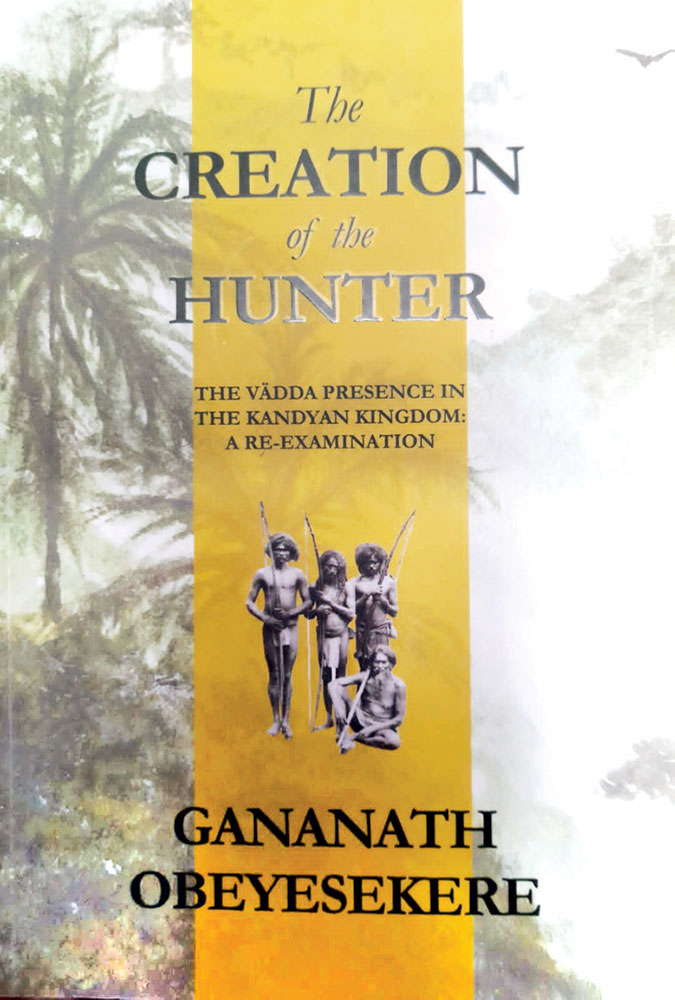
Review: Robert Sidharthan Perinbanayagam,
Professor of Sociology
(emeritus),
Hunter College of the City University of New York
Gananath Obeyesekere (Colombo: Sailfish Publications:2022)
In earlier works Obeyesekere demolished the claims of both Western scholars and European colonizers that cannibalism was a general practice among the natives of some of the countries they sought to rule and exploit and with his work he de-apotheosized Captain Cook and his sanctification by some western scholars. In his work on Sri Lanka he was at it again. With his book on the Pattini cult and the practices at the temple in Kataragama, he challenged certain constructions about Sinhala society and its ethnic make-up and religious practices. In his work on Buddhism in modern Sri Lanka he showed how it was influenced by Protestant Christianity just as it did in Bengal, in the shape of the Brahma Samaj. And so on.
Now, in another of his learned works Gananath Obeyesekere comes this time to challenge another thesis developed by many authors about the Väddas of Sri Lanka and to provide an alternative, strictly evidence based, interpretation. He describes his approach in this mind-bogglingly detailed study of the Väddas as follows:
The historical methodology I adopt is as follows. It is impossible to deal with the long historical run of the Vädda presence in Sri Lanka without understanding their presence in more recent times. Thus, I will focus on the Kandy period literature, particularly between the late 16th and the early 19th centuries, a period for which we have reasonable historical records. Once we have this historical understanding, followed by the colonial intrusions, especially the disruptive British conquest of the Kandyan kingdom, and also our current fieldwork, we might be able to reach back to earlier times, albeit with extreme caution and tentativeness owing to the paucity of records. The texts that I examine are not classical historical and literary works in Pali and Sinhala written by highly sophisticated literati, mostly monks, but rather those written by a village intelligentsia on palm leaf manuscripts (pus-kola pot) found nowadays in public and private collections.
This methodological approach consists of using folk documents as sources of data. These documents are: bandaravalia, and vamsa katha(stories about given families), kadaim pot( boundary records of given provinces) and vitti pots(records of various events and episodes).This approach is indeed a revolutionary one with which to study Sri Lankan historiography and is certainly a departure from the standard ones.
This methodological approach allows Obeyesekere to explore a variety of issues: the territory inhabited by the Vaddas, the religious life of the the Vaddas and the rituals they practiced; their connection to the cult of Pattini and to the temple to Murugan/Skanda at Kataragama and its relationship to that of the Sinhalas; on Buddhism and its arrival in Sri Lanka and its impact on Sri Lanka, the frequent connection to Southern Indian communities; the careers of various monarchs; the role of the Vaddas in various local conflicts etc. Insofar as this is the case, it is impossible to deal with them all here and I will deal with the overarching theme of the work which is the story of the Vaddas. I will discuss Obeyesekere ’s work focusing on two themes: Who were the Väddas? And what happened to them?1
Who were the Väddas?
One answer to the first question was given by two early anthropologists the Seligmans. Obeyesekere notes:
C.G. and Brenda Z. Seligmann dealing with one of the world’s most “primitive” hunting and gathering groups, the Väddas of Sri Lanka, published in 1911 their work entitled The Väddas. It was one of the first systematic forays into ethnographic fieldwork… .
The Väddas, they imagined to be a wild man of the woods, clad only in a scanty loin cloth, carrying his bow and arrows on which he depended for his subsistence, simple and untrained, indeed, little removed from the very animals he hunted. Nowadays many middle-class Sri Lankans have accepted a version of this image assisted by grotesque caricatures of the Vädda represented in the local media.
Obeyesekere challenges these observations. In the opening chapter Obeyesekere shows the role the Väddas played in the Kandyan kingdom. I will give a good example of this. Seeking support for a military campaign the King of Kandy tries to recruit some who can fight his battles. Obeyesekere reproduces one report:
In order to seek help from his own region of Matale, he summoned Niyarepola Alahakon Mohottala, and asked him to name the denizens (that is, men and animals) of Matale and the reply, Your worship (hamudurvane) there are only three [noble] houses in the rata of Matale” and when the king asked what these houses were, “Your worship [hamuduruvane) there is Kulatunga Mudiyanse of Udupihilla, Vanigasekere Mudiyanse of Aluvihara, Candrasekere Mudiyanse of Dumbukola , [and then also] Gamage Vädda and Hampat Vädda of Hulangamuva, and when the king asked who are the people in the lands beyond – (epita rata), your worship, on the other side of the steep waters (hela-kandura) of Biridevela, there is Kannila Vädda in control of (hirakara hiṭiya) Kanangamuva, and Herat Banda in control of Nikakotuva, and Maha Tampala Vädda at Palapatvala, Domba Vädda at Dombavela-gama, Valli Vädda at Vallivela, Mahakavudalla Vädda at Kavudupalalla, Naiyiran Vädda [some texts Nayida] at Narangamuva, Imiya Vädda at Nalanda,
Dippitiya Mahage [a female] controlling an area of nine gavuvas(leagues) in the district known as Nagapattalama, and Makara Vädda and Konduruva employed in the watch of the boundary (kadaima), Mahakanda Vädda controlling Kandapalla [today’s Kandapalla korale], Hempiti Mahage controlling Galevela, Baju Mahage controlling the Udasiya Pattuva of Udugoda Korale, Minimutu Mahage controlling the [same] Pallesiya Pattuva, Devakirti Mahage controlling Melpitiya
One can’t think of a better example of the integration of the Väddas and the Sinhala people, and that some Väddas shared high social status with the Sinhala others.–that is to say, they were not just primitive hunters and gatherers.Here is another example from Obeyesekere’ s work that shows the integration of the Vaddas with the mainstream and that they like their Sinhala neighbors, have taken to agriculture.
The text goes on to say that King Prakramabahu (that is Vira Prakrama) gave the Vädda followers of Eriyave Malala Vädda equal proportions of land from the four sub-districts (hatara pattuva) of the Vanni and advised them not to quarrel among themselves. Their lands were demarcated with stone markers, earth bunds and with fences made of sticks (that presumably will sprout). The king also gave deeds of gift or sannas indicating that the lands were theirs “till the sun and moon lasted,” a standard phrase in all such deeds. When they were given the lands they were now to be called vanni unnähäla or “lords of the Vanni” by royal command and they were entitled to dues and/or services from villages of carpenters (k badda), washer folk (rada-badda), drummers (berava-badda), and villages that have unspecified new sources of services (nava-badda).
It is clear from these descriptions that the Vaddas were not isolated from the mainstream society but were an essential part of it.
Where have all the Väddas gone?
The numbers of the Vadda people have been dwindling seriously over the years leading to this question.
Here is Obeyesekere’ s summary:
“I want to make a preliminary conclusion by addressing the implications of the physical omnipresence of the Vddas, if not their demographic significance, in a tentative manner. Let me emphasize that as far as Sri Lanka was concerned there were no “indigenous peoples,” no “aborigines,” no “wild men” and “tribes” of the Western imagination. I am as much an “aborigine” as anyone else and as genetically and culturally hybrid.
Nowadays, we are accustomed to think that the main structural opposition in history is between Sinhalas and Tamils. Yet, this oppositional relationship is a historically contingent one, that is, it depends on particular historical circumstances such that periods of Sinhala-Tamil opposition might be followed by alliances expressive of amity; or both opposition and amity might co-exist in the same time span; at other times neither opposition nor amity seem to matter and both communities went on ‘living and partly living’ if I might borrow a well-known phrase.”
Obeyesekere’ s conclusion about the significance of his work in modern Sri Lanka needs to be quoted in full:
“Ultimately, we hope that this research questions the current nationalist ideology of the Sinhala-Buddhists that Sri Lanka was an exclusive Buddhist civilization. I hope to eventually demonstrate that the non-Buddhist Väddas were a powerful visible presence although their approximate numbers cannot be calculated. Contrary to early European and current Buddhist prejudice we shall show that there was a constant interplay between Väddas and Sinhala Buddhists, such that over historical time Väddas could become Sinhala Buddhists and Sinhala Buddhists could become Väddas.”
Another of his observations deserves to be quoted too:
“This leads to my final point: if Vdda versus Sinhala was a structural opposition of the long run and a historically consistent phenomenon, the opposition between Tamil and Sinhala was historically contingent, and only emerges when Tamilness is associated with false belief or heresy. Otherwise, Tamil affinity, in its technical sense, is intrinsic to Sinhala-ness and this is primordially recognized in the Vijaya story of Sinhala origins. The historically contingent oppositional feature against which the Sinhala place themselves is the Tamil-Shaivite one and that also when it is expressed in terms of invasion or conquest. This is in radical contrast to the oppositional dialectic of Tamil and Sinhala nationalism of our own day. However, the Kandyan discourse, as with contemporary nationalism, anchors the discourse on the exemplary example of “kings of yore.” Is this an invention of tradition or a truth about history or both?”
This work, ostensibly about the Väddas, is much more than that: It is, to begin with, about the heterogeneous composition of Lankan society with the Sinhala society as the dominant one but the Sinhalas contain former and current Väddas, Indians such as the Mallalas from Malladesa, Malayalees from Kerala, Tamils from Tamil Nadu, many of whom came as soldiers to fight for the local kings and some were given land grants in return for their services and stayed behind.
Obeyesekere further challenges the simple use of the logic of structuralist theories. While its basic premises, in my view, are not disputable, it can be used in crude and mechanical ways: the civilized (we) and savages (they), we (eaters of animals and birds) and they (eaters of each other), we (have great literature and you don’t.) George Babington McCauley famously said:”A single shelf of a good European library was worth the whole native literature of India and Arabia.” And so it goes.
Clearly anthropologising Sri Lanka through empirical studies, with both historical data and studies of modern times have inestimable value in every imaginable way and this work is a signal example of the contribution that such studies can make to dispel misconceptions as well as ideological reconstructions.2
NOTES
1.Obeyesekere discusses these topics with due regard to evidence and connects them to the larger story of Sri Lanka though keeping faith with his theme of the search for the hunter. The documents from which he draws his information were composed in the immediacy of the people and the events they describe have a strong claim to authenticity.
One may add these documents are in many ways comparable the Doomsday Book from England and the Scottish Chronicles.
2.One can see also the use of the Vaddas and their relations with the Sinhala people in Leonard Woolf’s novel The Village in the Jungle.It shows the Sinhala characters treating the Vadda people with contempt. To treat them thus, it is obvious that they were not isolated in jungle habitats. Further, Woolf’s characters both the Vaddas and the Sinhalas are shown to be hunting for their sustenance. It seems to me that Woolf was describing not only a village in the jungle but also jungle in the village! Woolf must surely know since he was king of Beddagama—or at least the agent of King George of England!

The long standing foreign policy of Sri Lanka was Non-Alignment. However, in the context of emerging geopolitical rivalries, there was a need to question the adequacy of Non-Alignment as a policy to meet developing challenges. Neutrality as being a more effective Policy was first presented in an article titled “Independence: its meaning and a direction for the future” (The Island, February 14, 2019). The switch over from Non-Alignment to Neutrality was first adopted by former President Gotabaya Rajapaksa and followed through by successive Governments. However, it was the current Government that did not miss an opportunity to announce that its Foreign Policy was Neutral.
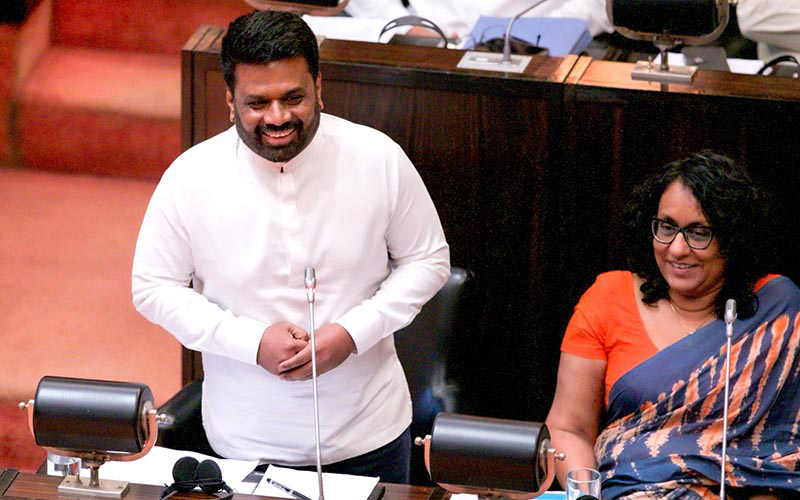
The policy of Neutrality has served the interests of Sri Lanka by the principled stand taken in respect of the requests made by two belligerents associated with the Middle East War. The justification for the position adopted was conveyed by President Anura Kumara Dissanayake to Parliament that Iran had made a formal request on February 26 for three Iranian naval ships to visit Sri Lanka, and on the same evening, the United States also requested permission for two war planes to land at Mattala International Airport. Both requests were denied on grounds of maintaining “our policy of neutrality”.
WHY NEUTRALITY
Excerpts from the article cited above that recommended Neutrality as the best option for Sri Lanka considering the vulnerability to its security presented by its geographic location in the context of emerging rivalries arising from “Pivot to Asia” are presented below:
“Traditional thinking as to how small States could cope with external pressures are supposed to be: (1) Non-alignment with any of the major centers of power; (2) Alignment with one of the major powers thus making a choice and facing the consequences of which power block prevails; (3) Bandwagoning which involves unequal exchange where the small State makes asymmetric concessions to the dominant power and accepts a subordinate role of a vassal State; (4) Hedging, which attempts to secure economic and security benefits of engagement with each power center: (5) Balancing pressures individually, or by forming alliances with other small States; (6) Neutrality”.
Of the six strategies cited above, the only strategy that permits a sovereign independent nation to charter its own destiny is neutrality, as it is with Switzerland and some Nordic countries. The independence to self-determine the destiny of a nation requires security in respect of Inviolability of Territory, Food Security, Energy Security etc. Of these, the most critical of securities is the Inviolability of Territory. Consequently, Neutrality has more relevance to protect Territorial Security because it is based on International Law, as opposed to Non-Alignment which is based on principles applicable to specific countries that pledged to abide by them
“The sources of the international law of neutrality are customary international law and, for certain questions, international treaties, in particular the Paris Declaration of 1856, the 1907 Hague Convention No. V respecting the Rights and Duties of Neutral Powers and Persons in Case of War on Land, the 1907 Hague Convention No. XIII concerning the Rights and Duties of Neutral Powers in Naval War, the four 1949 Geneva Conventions and Additional Protocol I of 1977” (ICRC Publication on Neutrality, 2022).
As part of its Duties a Neutral State “must ensure respect for its neutrality, if necessary, using force to repel any violation of its territory. Violations include failure to respect the prohibitions placed on belligerent parties with regard to certain activities in neutral territory, described above. The fact that a neutral State uses force to repel attempts to violate its neutrality cannot be regarded as a hostile act. If the neutral State defends its neutrality, it must however respect the limits which international law imposes on the use of force. The neutral State must treat the opposing belligerent States impartially. However, impartiality does not mean that a State is bound to treat the belligerents in exactly the same way. It entails a prohibition on discrimination” (Ibid).
“It forbids only differential treatment of the belligerents which in view of the specific problem of armed conflict is not justified. Therefore, a neutral State is not obliged to eliminate differences in commercial relations between itself and each of the parties to the conflict at the time of the outbreak of the armed conflict. It is entitled to continue existing commercial relations. A change in these commercial relationships could, however, constitute taking sides inconsistent with the status of neutrality” (Ibid).
THE POTENTIAL of NEUTRALITY
It is apparent from the foregoing that Neutrality as a Policy is not “Passive” as some misguided claim Neutrality to be. On the other hand, it could be dynamic to the extent a country chooses to be as demonstrated by the actions taken recently to address the challenges presented during the ongoing Middle East War. Furthermore, Neutrality does not prevent Sri Lanka from engaging in Commercial activities with other States to ensuring Food and Energy security.
If such arrangements are undertaken on the basis of unsolicited offers as it was, for instance, with Japan’s Light Rail Project or Sinopec’s 200,000 Barrels a Day Refinery, principles of Neutrality would be violated because it violates the cardinal principle of Neutrality, namely, impartiality. The proposal to set up an Energy Complex in Trincomalee with India and UAE would be no different because it restricts the opportunity to one defined Party, thus defying impartiality. On the other hand, if Sri Lanka defines the scope of the Project and calls for Expressions of Interest and impartially chooses the most favourable with transparency, principles of Neutrality would be intact. More importantly, such conduct would attract the confidence of Investors to engage in ventures impartial in a principled manner. Such an approach would amount to continue the momentum of the professional approach adopted to meet the challenges of the Middle East War.
CONCLUSION
The manner in which Sri Lanka acted, first to deny access to the territory of Sri Lanka followed up by the humanitarian measures adopted to save the survivors of the torpedoed ship, earned honour and respect for the principled approach adopted to protect territorial inviolability based on International provisions of Neutrality.
If Sri Lanka continues with the momentum gained and adopts impartial and principled measures recommended above to develop the country and the wellbeing of its Peoples, based on self-reliance, this Government would be giving Sri Lanka a new direction and a fresh meaning to Neutrality that is not passive but dynamic.
by Neville Ladduwahetty

The interference into affairs of other nations by the USA’s Central Intelligence Agency (CIA) started in 1953, six years after it was established. The Anglo-Iranian Oil Company supplied Britain with most of its oil during World War I. In fact, Winston Churchill once declared: “Fortune brought us a prize from fairyland beyond our wildest dreams.”
When in 1951 Dr. Mohammad Mosaddegh was reluctantly appointed as Prime Minister by the Shah of Iran, whose role was mostly ceremonial, he convinced Parliament that the oil company should be nationalised.
Mohammed Mosaddegh
Mosaddegh said: “Our long years of negotiations with foreign companies have yielded no result thus far. With the oil revenues we could meet our entire budget and combat poverty, disease and backwardness of our people.”
It was then that British Intelligence requested help from the CIA to bring down the Iranian regime by infiltrating their communist mobs and the army, thus creating disorder. An Iranian oil embargo by the western countries was imposed, making Iranians poorer by the day. Meanwhile, the CIA’s strings were being pulled by Kermit Roosevelt (a grandson of former President Theodore Roosevelt), according to declassified intelligence information.
Although a first coup failed, the second attempt was successful. General Fazlollah Zahedi, an Army officer, took over as Prime Minister. Mosaddegh was tried and imprisoned for three years and kept under house arrest until his death. Playing an important role in the 1953 coup was a Shia cleric named Ayatollah Abol-Ghasem Mostafavi-Kashani. He was previously loyal to Mosaddegh, but later supported the coup. One of his successors was Ayatollah Ruhollah Mostafavi Musavi Khomeini, who engineered the Islamic Revolution in 1979. Meanwhile, in 1954 the Anglo-Iranian Oil Company had been rebranded as British Petroleum (BP).
Map of the Middle East
When the Iran-Iraq war broke out (September 1980 to August 1988), the Persian/Arabian Gulf became a hive of activity for American warships, which were there to ensure security of the Gulf and supertankers passing through it.

CIA-instigated coup in Iran in 1953 Dr. Mohammad Mosaddegh
The Strait of Hormuz, the only way in and out of the Gulf, is administered by Oman and Iran. While there may have been British and French warships in the region, radio ‘chatter’ heard by aircraft pilots overhead was always from the US ships. In those days, flying in and out of the Gulf was a nerve-wracking experience for airline pilots, as one may suddenly hear a radio call on the common frequency: “Aircraft approaching US warship [name], identify yourself.” One thing in the pilots’ favour was that they didn’t know what ships they were flying over, so they obeyed only the designated air traffic controller. Sometimes though, with unnecessarily distracting American chatter, there was complete chaos, resulting in mistaken identities.
Air Lanka Tri Star
Once, Air Lanka pilots monitored an aircraft approaching Bahrain being given a heading to turn on to by a ship’s radio operator. Promptly the air traffic controller, who was on the same frequency, butted in and said: “Disregard! Ship USS Navy [name], do you realise what you have just done? You have turned him on to another aircraft!” It was obvious that there was a struggle to maintain air traffic control in the Gulf, with operators having to contend with American arrogance.
On the night of May 17, 1987, USS Stark was cruising in Gulf waters when it was attacked by a Dassault Mirage F1 jet fighter/attack aircraft of the Iraqi Air Force. Without identifying itself, the aircraft fired two Exocet missiles, one of which exploded, killing 37 sailors on board the American frigate. Iraq apologised, saying it was a mistake. The USA graciously accepted the apology.
Then on July 3, 1988 the high-tech, billion-dollar guided missile cruiser USS Vincennes, equipped with advanced Aegis weapons systems and commanded by Capt. Will Rogers III, was chasing two small Iranian gun boats back to their own waters when an aircraft was observed on radar approaching the US warship. It was misidentified as a Mirage F1 fighter, so the Americans, in Iranian territorial waters, fired two surface-to-air Missiles (SAMs) at the target, which was summarily destroyed.
The Vincennes had issued numerous warnings to the approaching aircraft on the military distress frequency. But the aircraft never heard them as it was listening out on a different (civil) radio frequency. The airplane broke in three. It was soon discovered, however, that the airplane was in fact an Iran Air Airbus A300 airliner with 290 civilian passengers on board, en route from Bandar Abbas to Dubai. Unfortunately, because it was a clear day, the Iranian-born, US-educated captain of Iran Air Flight 655 had switched off the weather radar. If it was on, perhaps it would have confirmed to the American ship that the ‘incoming’ was in fact a civil aircraft. At the time, Capt. Will Rogers’ surface commander, Capt. McKenna, went on record saying that USS Vincennes was “looking for action”, and that is why they “got into trouble”.
Although USS Vincennes was given a grand homecoming upon returning to the USA, and its Captain Will Rogers III decorated with the Legion of Merrit, in February 1996 the American government agreed to pay Iran US$131.8 million in settlement of a case lodged by the Iranians in the International Court of Justice against the USA for its role in that incident. However, no apology was tendered to the families of the innocent victims.
These two incidents forced Air Lanka pilots, who operated regularly in those perilous skies, to adopt extra precautionary measures. For example, they never switched off the weather radar system, even in clear skies. While there were potentially hostile ships on ground, layers of altitude were blocked off for the exclusive use of US Air Force AWACS (Airborne Warning and Control System) aircraft flying in Bahraini and southern Saudi Arabian airspace. The precautions were even more important because Air Lanka’s westbound, ‘heavy’ Lockheed TriStars were poor climbers above 29,000 ft. When departing Oman or the UAE in high ambient temperatures, it was a struggle to reach cruising level by the time the airplane was overhead Bahrain, as per the requirement.
In the aftermath of the Iran Air 655 incident, Newsweek magazine called it a case of ‘mistaken identity’. Yet, when summing up the tragic incident that occurred on September 1, 1983, when Korean Air Flight KE/KAL 007 was shot down by a Russian fighter jet, close to Sakhalin Island in the Pacific Ocean during a flight from New York to Seoul, the same magazine labelled it ‘murder in the air’.
After the Iranian coup, which was not coincidentally during the time of the ‘Cold War’, the CIA involved itself in the internal affairs of numerous countries and regions around the world: Guatemala (1953-1990s); Costa Rica (1955, 1970-1971); Middle East (1956-1958); Haiti (1959); Western Europe (1950s to 1960s); British Guiana/Guyana (1953-1964); Iraq (1958-1963); Soviet Union, Vietnam, Cambodia (1955-1973); Laos, Thailand, Ecuador (1960-1963); The Congo (1960-1965, 1977-1978); French Algeria (1960s); Brazil (1961-1964); Peru (1965); Dominican Republic (1963-1965); Cuba (1959 to present); Indonesia (1965); Ghana (1966); Uruguay (1969-1972); Chile (1964-1973); Greece (1967-1974); South Africa (1960s to 1980s); Bolivia (1964-1975); Australia (1972-1975); Iraq (1972-1975); Portugal (1974-1976); East Timor (1975-1999); Angola (1975-1980); Jamaica (1976); Honduras (1980s); Nicaragua (1979-1990); Philippines (1970s to 1990s); Seychelles (1979-1981); Diego Garcia (late 1960s to present); South Yemen (1979-1984); South Korea (1980); Chad (1981-1982); Grenada (1979-1983); Suriname (1982-1984); Libya (1981-1989); Fiji (1987); Panama (1989); Afghanistan (1979-1992); El Salvador (1980-1992); Haiti (1987-1994, 2004); Bulgaria (1990-1991); Albania (1991-1992); Somalia (1993); Iraq (1991-2003; 2003 to present), Colombia (1990s to present); Yugoslavia (1995-1995, and to 1999); Ecuador (2000); Afghanistan (2001 to present); Venezuela (2001-2004; and 2025).
If one searches the internet for information on American involvement in foreign countries during the periods listed above, it will be seen how ‘black’ funds were/are used by the CIA to destabilise those governments for the benefit of a few with vested interests, while poor citizens must live in the chaos and uncertainty thus created.
A popular saying goes: “Each man has his price”. Sad, isn’t it? Arguably the world’s only superpower that professes to be a ‘paragon of virtue’ often goes ‘rogue’.
God Bless America – and no one else!
BY GUWAN SEEYA
Features
Mannar’s silent skies: Migratory Flamingos fall victim to power lines amid Wind Farm dispute

By Ifham Nizam
A fresh wave of concern has gripped conservationists following the reported deaths of migratory flamingos within the Vankalai Sanctuary—a globally recognised bird habitat—raising urgent questions about the ecological cost of large-scale renewable energy projects in the region.
The incident comes at a time when a fundamental rights petition, challenging the proposed wind power project, linked to India’s Adani Group, remains under examination before the Supreme Court, with environmental groups warning that the very risks they highlighted are now materialising.
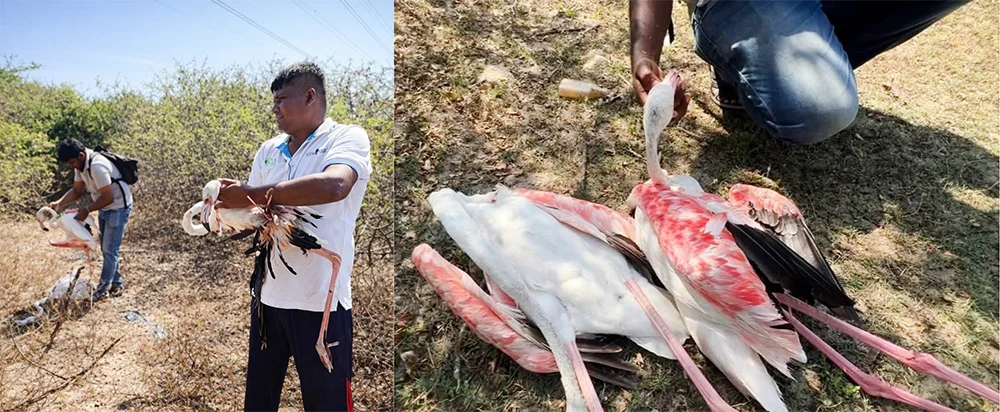
At least two flamingos—believed to be part of the iconic migratory flocks that travel thousands of kilometres to reach Sri Lanka—were found dead after entanglement with high-tension transmission lines running across the sanctuary. Another bird was reportedly struggling for survival.
Professor Sampath Seneviratne, a leading ornithologist, expressed deep concern over the development, noting that such incidents are not isolated but indicative of a broader and predictable threat.
“These migratory birds depend on specific flyways that have remained unchanged for centuries. When high-risk infrastructure, like poorly planned power lines, intersect these routes, collisions become inevitable,” he said. “What we are witnessing now could be just the beginning if proper mitigation measures are not urgently implemented.”
Environmentalists argue that the Mannar region—particularly the Vankalai wetland complex—is one of the most critical stopover sites in South Asia for migratory waterbirds, including flamingos, pelicans, and various species of waders. The sanctuary’s ecological value has also supported a niche with growing eco-tourism sector, drawing birdwatchers from around the world.
Executive Director of the Centre for Environmental Justice, Dilena Pathragoda, said the incident underscores the urgency of judicial intervention and stricter environmental oversight.
“This tragedy is a direct consequence of ignoring scientifically established environmental safeguards. We have already raised these concerns before court, particularly regarding the location of transmission infrastructure within sensitive bird habitats,” Pathragoda said.
“Renewable energy cannot be pursued in isolation from ecological responsibility. If due process and proper environmental impact assessments are bypassed or diluted, then such losses are inevitable.”
Conservation groups have long cautioned that the installation of wind turbines and associated grid infrastructure—especially overhead transmission lines—within or near sensitive habitats could transform these landscapes into lethal zones for avifauna.
An environmental activist involved in the ongoing legal challenge said the latest deaths validate earlier warnings.
“This is exactly what we feared. Development is necessary, but not at the cost of biodiversity. When projects of this scale proceed without adequate ecological assessments and safeguards, the consequences are irreversible,” the activist stressed.
The debate has once again brought into focus the delicate balance between renewable energy expansion and biodiversity conservation. While wind energy is widely promoted as a clean alternative to fossil fuels, experts caution that “green” does not automatically mean “harmless.”
Professor Seneviratne emphasised that solutions do exist, including rerouting transmission lines, installing bird diverters, and conducting comprehensive migratory pathway studies prior to project approval.
“Globally, there are well-established mitigation strategies. The issue here is not the absence of knowledge, but the failure to apply it effectively,” he noted.
The timing of the incident is particularly worrying. Migratory flamingos typically remain in Sri Lanka until late April or May before embarking on their return journeys. Conservationists warn that if hazards remain unaddressed, larger flocks could face similar risks in the coming weeks.
Beyond ecological implications, experts also highlight potential economic fallout. Wildlife tourism—especially birdwatching—contributes significantly to local livelihoods in Mannar.
Repeated reports of bird deaths could deter eco-conscious travellers and damage the region’s reputation as a safe haven for migratory species.
Environmentalists are now calling for immediate intervention by authorities, including a temporary halt to high-risk operations in sensitive zones, pending a thorough environmental review.
They stress that protecting animal movement corridors—whether elephant migration routes or avian flyways—is a fundamental pillar of modern conservation.
As the controversy unfolds, one question looms large: can Sri Lanka pursue sustainable energy without sacrificing the very natural heritage that defines it?
Pathragoda added that for now, the sight of fallen flamingos in Mannar stands as a stark reminder that development, if not carefully planned, can carry a heavy and irreversible cost.

Presidential Suite at Sri Jayewardenepura General Hospital opened to the public

Cabinet Sub-Committee appointed to streamline the Public Service meets for the second time

PSL 2026: Teams allowed to submit two XIs and pick one after toss

Japan Premier League [JPL], building cricket from the ground up

Showers may occur at a few places in the Sabaragamuwa province and in Galle, Matara, Kalutara and Nuwara-Eliya districts in the evening

Energy Minister indicted on corruption charges ahead of no-faith motion against him

‘Dates have the highest sugar content to fight Coronavirus’

Sunday Island 27 December – Headlines

#SundayIsland 17th December – Headlines

Sunday Island – 28th March

Sunday Island Headlines – 21 March

Sunday Island – 21st February – Headlines
-

 News3 days ago
Senior citizens above 70 years to receive March allowances on Thursday (26)
-

 Features5 days ago
Trincomalee oil tank farm: An engineering marvel
-
 News20 hours ago
Energy Minister indicted on corruption charges ahead of no-faith motion against him
-

 News2 days ago
US dodges question on AKD’s claim SL denied permission for military aircraft to land
-

 Features5 days ago
The scientist who was finally heard
-

 Business2 days ago
Dialog Unveils Dialog Play Mini with Netflix and Apple TV
-

 News3 days ago
CEB Engineers warn public to be prepared for power cuts after New Year
-
 News3 days ago
Japanese boost to Sri J’pura Hospital, an outright gift from Tokyo during JRJ rule