
Features
Ruwan Wijewardena UNP leader-in-waiting


By Harim Peiris
Former MP and State Minister of Defence Ruwan Wijewardena, was recently elected UNP Deputy Leader and consequently the leader-in-waiting, by that besieged party’s working committee. For a party, which has only a single National List seat in parliament, on which it cannot agree who should be nominated and which received less than half the votes, the fourth placed JVP did, the rather long drawn out process of finally replacing its leader, has begun. That this leadership transition only formally began once the party had been all but wiped off the electoral map, is a testament to the anachronistic nature of the UNP’s internal decision-making processes. The UNP’s only contribution to current politics was to weaken the opposition and enable the SLPP to secure a two-third majority in parliament.
Wijewardenas replace Senanayakes as UNP’s first family
The electoral defeat of the UNP, in the 1970 general election, witnessed the end of the domination of that party’s leadership by the Senanayake family and saw a transition to the Wijewardena family, the maternal wing of both JR Jayawardena and Ranil Wickremesinghe, with a brief interlude for the leaderships of Ranasinghe Premadasa and DB Wijetunga.
A similar situation was also witnessed in the UNP’s arch rival, the Sri Lanka Freedom Party (SLFP) which was dominated, since inception, by that party’s founding family, the Bandaranaikes’, which domination ran its natural course for over half a century, since 1951, and witnessed a more natural and dignified transition to a fellow founding member’s clan, the Rajapakse family, in 2005.
The Wijewardena clan can also celebrate a half century, since 1970, of dominating the United National Party (UNP) leadership, even at the expense of finally running the party to the ground. The clan’s control and near dominance of the party leadership has certainly not run its course. Accordingly, it was no surprise, at least to this analyst, that from a crowded field of pretenders to the UNP throne, ranging from Karu Jayasuriya to Naveen Dissanayake and including such colourful figures as Ravi Karunanayake and Arjuna Ranatunga, that the soft spoken and relative new comer to politics, Ruwan Wijewardena, would receive the nod from his near kinsman and by extension the rest of the handpicked working committee, to take over the now nearly defunct party.
The SJB option or perish
Ruwan Wijewardena, the UNP leader-in-waiting, whom media reports state has to wait, yet still more, till next year, to take over the party, has only one realistic course of action open to him. It is the only viable option for a party with a grand history but no future. That option is for the UNP to become a constituent party of the Samagi Jana Balawegaya (SJB), rather like the JHU and the other regional parties. However, for this option to take place, Mr. Wijewardena must be prepared to accept, or enforce, the easing upstairs or retirement from politics of some of those, whom the SJB correctly believes to be liabilities rather than assets in its attempts to be a credible check and balance and eventually a viable alternative to the Rajapaksa led SLPP government. The UNP’s only hope for survival, even as a shadow of its former self, is in the shade and as a part of the Opposition Leader Sajith Premadasa-led Samagi Jana Balavegaya (SJB). This option is similar from the other side of the aisle, most obviously to the course taken by the SLFP under former President Maithripala Sirisena or even the Dinesh Gunawardena-led Mahajana Eksath Peramuna (MEP) – both parties with proud histories, but with no future on its own.
However, the odd thing with the UNP leadership contest is that despite having no real option than join the SJB, the UNP leader-in-waiting has to parrot the mantra, that he will be rebuilding the party to its grand old days. There were breakaway parties that believed that having the party nameboard, the head office premises, and the symbol, was what popular or public support was all about and were rudely surprised to realize that this is in fact not so. In the Tamil polity, the best example would be the TULF, still around under veteran leader V. Anandasangari, but despite fielding candidates, under its well-known rising sun symbol, which was in 1977, the second largest party in parliament, is now existent, only in name.
A second decimation in the PC polls
There is a significant preference, within the SLPP, to have the provincial council polls. This preference comes mainly from the compelling internal need to provide secondary positions to party loyalists and activists who were unable to enter parliament. Doing so sooner rather than later, will help keep the opposition off balance. Having the PC polls, will also remove a potential irritant in the relationship with India. However, for the UNP, a pending PC polls, sans a tie up with the SJB, spells near doom. Superficial analysis which assumes that the UNP will retain the 2% of the national vote, or 250,000 votes country wide, which it garnered in the August parliamentary elections, is naïve. The UNP, if it contests alone, will be again wiped out, but worse. At the general election, there was some doubt, however small, about whether it would be the SJB or the UNP which would emerge on top, in the battle to be number two. Now that doubt not only no longer exists, but the UNP has such weak public appeal, that it polled less than half the JVP vote and failed to secure a single district seat in parliament. UNP support or the famed party machinery, has conclusively and permanently moved lock, stock and barrel to the SJB. Should young Mr. Ruwan Wijewardena seek to roll back the clock and have a rematch on the fight with the SJB, he would fare far worse than his cousin Ranil Wickremesinghe did. If on the contrary he accepts the political leadership of Sajith Premadasa and crafts a course for the UNP, which challenges the SLPP Government and is steadfastly a part of the opposition, he will generate for the UNP, a new lease of life and a new path, not as a leading party, whose heyday is over, but as an appendage to the SJB, in much the same way as the SLFP and the MEP are within the SLPP.




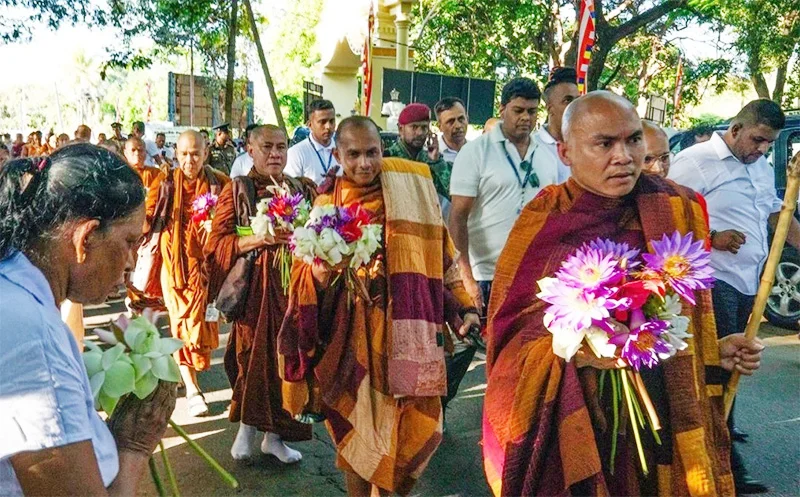
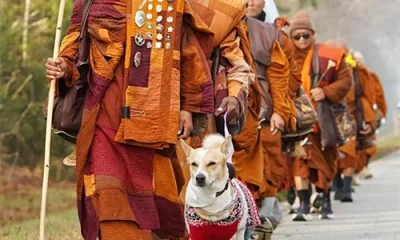
The ongoing peace march by a group of international Buddhist monks has captured the sentiment of Sri Lankans in a manner that few public events have done in recent times. It is led by the Vietnamese monk Venerable Thich Pannakara who is associated with a mindfulness movement that has roots in Vietnamese Buddhist practice and actively promoted among diaspora communities in the United States. The peace march by the monks, accompanied by their mascot, the dog Aloka, has generated affection and goodwill within the Buddhist and larger community. It follows earlier peace walks in the United States where monks carried a similar message of mindfulness and compassion across communities but without any government or even media patronage as in Sri Lanka.
This initiative has the potential to unfold into an effort to nurture a culture of peace in Sri Lanka. Such a culture is necessary if the country as the country prepares to move beyond its history of conflict towards a more longlasting reconciliation and a political solution to its ethnic and religious divisions. The government’s support for the peace march can be seen as part of a broader attempt to shape such a culture. The Clean Sri Lanka programme, promoted by the government as a civic responsibility campaign focused on environmental cleanliness, ethical conduct and social discipline, provides a useful framework within which such initiatives can be situated. Its emphasis on collective responsibility and shared public space makes it sit well with the values that peacebuilding requires.
government’s previous plan to promote a culture of peace was on the occasion of “Sri Lanka Day” celebrations which were scheduled to take place on December 12-14 last year but was disrupted by Cyclone Ditwah. The Sri Lanka Day celebrations were to include those talented individuals from each and every community at the district level who had excelled in some field or the other, such as science, business or arts and culture and selected by the District Secretariats in each of the 25 districts. They were to gather in Colombo to engage in cultural performances and community-focused exhibitions. The government’s intention was to build up a discourse around the ideas of unity in diversity as a precursor to addressing the more contentious topics of human rights violations during the war period, and issues of accountability and reparations for wrongs suffered during that dark period.
Positive Response
The invitation to the international monks appears to have emerged from within Buddhist religious networks in Sri Lanka that have long maintained links with the larger international Buddhist community. The strong support extended by leading temples and clergy within the country, including the Buddhists Mahanayakes indicates that this was not an isolated effort but one that resonated with the mainstream Buddhist establishment. Indeed, the involvement of senior Buddhist leaders has been particularly noteworthy. A Joint Declaration for Peace in the world, drawing on Sri Lanka’s own experience, and by the Mahanayakes of all Buddhist Chapters took place in the context of the ongoing peace march at the Gangaramaya Temple in Colombo, with participation from the diplomatic community. The declaration, calling for compassion, dialogue and sustainable peace, reflects an effort by religious leadership to assert a moral voice in favour of coexistence.
The popular response to the peace march has also been striking. Large numbers of people have been gathering along the route, offering flowers, water and support to the monks. Schoolchildren have been lining the roads, and communities from different religious backgrounds extend hospitality. On the way, the monks were hosted by both a Hindu temple and a mosque, where food and refreshments were provided. These acts, though simple, carry a message about the possibility of harmony among Sri Lanka’s diverse communities. It helps to counter the perception that the Buddhist community in Sri Lanka is inherently nationalist and resistant to minority concerns that was shaped during the decades of war and reinforced by political mobilisation that too often exploited ethnic identity.
By way of contrast, the peace march offers a different image. It shows a readiness among ordinary people to embrace values of compassion and coexistence that are deeply embedded in Buddhist teaching. The Metta Sutta, one of the most well-known discourses in Buddhism, calls for boundless goodwill towards all beings. It states that one should cultivate a mind that is “boundless towards all beings, free from hatred and ill will.” This emphasis on universal compassion provides a moral foundation for peace that extends beyond national or ethnic boundaries. The monks themselves emphasised this point repeatedly during the walk. Venerable Thich Pannakara reminded those who gathered that while acts of generosity are commendable, mindfulness in everyday life is even more important. He warned that as people become unmindful, they are more prone to react with anger and hatred, thereby contributing to conflict.
More Initiatives
The presence of political leaders at key moments of the march has emphasised the significance that the government attaches to the event. Prime Minister Harini Amarasuriya paid her respects to the peace march monks in Kandy, while President Anura Kumara Dissanayake is expected to do so at the conclusion of the march in Colombo. Such gestures signal an alignment between political authority and moral aspiration, even if the translation of that aspiration into policy remains a work in progress. At the same time, the peace march has not been without its shortcomings. The walk did not engage with the Northern and Eastern parts of the country, regions that were most affected by the war and where the need for reconciliation is most acute. A more inclusive geographic reach would have strengthened the symbolic impact of the initiative.
In addition, the positive impact of the peace march could have been increased if more effort had been taken to coordinate better with other civic and religious groups and include them in the event. Many civil society and religious harmony groups who would have liked to participate in the peace march found themselves unable to do so. There was no place in the programme for them to join. Even government institutions tasked with promoting social cohesion and reconciliation found themselves outside the loop. The Clean Sri Lanka Task Force that organised the peace march may have felt that involving other groups would have made it more complicated to organise the events which have proceeded without problems.
The hope is that the positive energy and goodwill generated by this peace march will not dissipate but will instead inspire further initiatives with the requisite coordination and leadership. The march has generated public discussion, drawn attention to the values of mindfulness and compassion, and created a space in which people can imagine a different future. It has been a special initiative among the many that are needed to build a culture of peace. A culture of peace cannot be imposed from above nor can it emerge overnight. It needs to be nurtured through multiple efforts across society, including education, religious engagement, civic initiatives and political reform. It is within such a culture that the more difficult questions of power sharing, justice and reconciliation can be addressed in a constructive manner.
by Jehan Perera
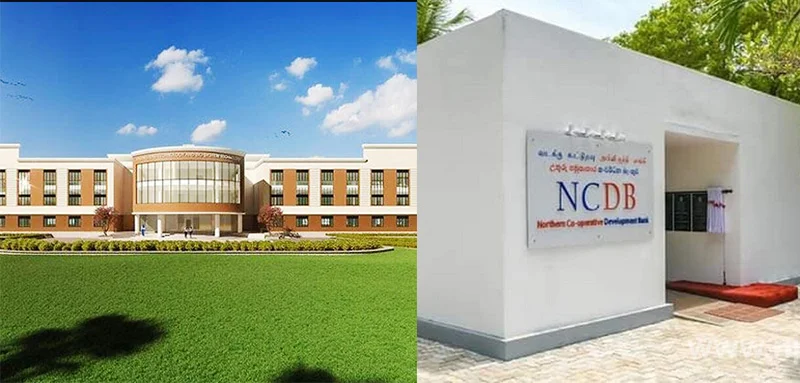
 The countryside and peripheral regions have been neglected in the national imagination for many decades. This has also been the case with regional universities which were seen as mere appendages to the university system, and sometimes created to appease political constituencies in the regions. The exclusion of the rural world and the institutions in those regions was not accidental nor inevitable, but the consequence of conscious policies promoted under an extractive and exploitative global order. Neoliberalism globalisation, initiated in the late 1970s with far-reaching policies of free trade and free flow of capital, or the “open economy,” as we call it in Sri Lanka, is now dying. The United States and the Western countries that promoted neoliberalism, as a class project of finance capital to address the falling profits during the long economic downturn in the 1970s, are themselves reversing their policies and are at loggerheads with each other. However, those economic processes will continue to have national consequences into the future.
At the heart of such policies is the neoliberal city, which has become the centre of the economy with expanding financial businesses and a real estate boom. Such financialised cities also had their impact on universities, in lower income countries, where commercialised education with high fees, rising student debt, research for businesses and transnational educational linkages with branch campuses of Western universities, have become a reality.
In the case of Sri Lanka, while neoliberal policies began with the IMF and World Bank Structural Adjustment Programmes, in the late 1970s, the long civil war forestalled the accelerated growth of the neoliberal city. I have argued, over the last decade and a half, that it is with the end of the civil war, in 2009, coinciding with the global financial crisis, that a second wave of neoliberalism in Sri Lanka led to global finance capital being absorbed in infrastructure and real estate in Colombo. The transformation of Colombo into a neoliberal city was overseen by Gotabaya Rajapaksa as Defence Secretary with even the Urban Development Authority brought under the security establishment. While Colombo was drastically changing with a skyline of new buildings and shiny luxury vehicles drawing on massive external debt, there were also moves to promote private higher education institutions. The Board of Investment (BOI) registered many hundred so-called higher education institutions; these were not regulated and many mushroomed like supermarkets and disappeared in no time when they incurred losses.
In contrast to these so-called private higher education institutions that proliferated in and around Colombo, Sri Lanka, drawing on its free education system, has, over the last many decades, also created a number of state universities in peripheral regions. However, these regional universities lack adequate funding and a clear vision and purpose. The current conjuncture with the neoliberal global order unravelling, and the immediate global crisis in energy and transport are grim reminders of the importance of local economies and self-sufficiency. In this column I consider the role of our regional universities and their relationship to the communities within which they are embedded.
Regional context
The necessity and the advantage of robust public services is their reach into peripheral regions and marginalised communities. This is true of public transport, as it is with public hospitals. Private buses will always avoid isolated rural routes as their margins only increase on the busy routes between cities and towns. And private hospitals and clinics flock to the cities to extract from desperate patients, including by unscrupulous doctors who divert patients in public hospitals to be served in the private health facilities they moonlight. Similarly, it is affluent cities and towns that are the attraction for private educational institutions.
Public institutions, including universities, can only ensure their public role if they are adequately funded. Over the last decade and a half, with falling allocations for education, our state universities have been pushed into initiating fee levying courses, both at the post-graduate level and also for undergraduate international students. These programmes are seen as avenues to decrease the dependence of universities on budgetary support. However, the reality is that it is only universities in Colombo that can draw in students capable of paying such high fees. Furthermore, such fee levying courses end up pushing academics into overwork including by offering additional income.
Therefore, allocations for underfunded regional universities need to be steadily increased. Housing facilities and other services for academics working in rural districts would ensure their continued presence and greater engagement with the local communities. Increased time away from teaching and research funding earmarked for community engagement will provide clear direction for academics. Indeed, such funding with a clear vision and role for regional universities can provide considerable social returns. In a time when repeated crises are affecting our society, agricultural production to bolster our food system as well as rural income streams and employment are major issues. Here, regional universities have an important role today in developing social and economic alternatives.
Reimagining development
In recent months, there have been interesting initiatives in the Northern Province, where the Universities of Jaffna and Vavuniya have been engaging state institutions on issues of development. In an initiative to bring different actors together, high level meetings have been convened between the staff of the Agriculture Faculty and officials of the Provincial Agriculture Ministry to figure out solutions for long pending agricultural problems. Similar meetings have also been organised between provincial authorities and the Faculties of Technology and Engineering in Kilinochchi. These initiatives have led to academics engaging communities and co-operatives on their development needs, particularly in formulating new development initiatives and activating idle projects and assets in the region. Such engagement provides opportunities for academics to share their knowledge and skills while learn from communities about challenges that lead to new problems for research.
One of the most rewarding engagements I have been part of is an internship programme for the Technology Faculty of the University of Jaffna, where four batches of final year students, from food technology, green farming and automobile specialities, have been placed for six months within the co-operative movement through the Northern Co-operative Development Bank. This initiative has created a strong relationship between the Technology Faculty and the co-operative movement, with a number of former students now working fulltime in co-operative ventures. They are at the centre of developing solutions for rural co-operatives, including activating idle factories and ensuring quality and standards for their products.
I refer to these concrete initiatives because universities’ role in research and development in Sri Lanka, as in most other countries, are often narrowly conceived to be engagement with private businesses. However, for rural regions, the challenge, even with technological development, is the generation of appropriate technologies that can serve communities.
In Sri Lanka, we have for long emulated the major Western universities and in the process lost sight of the needs of our own youth and communities. Rethinking the development of our universities may have to begin with an understanding of the real challenges and context of our people. Our universities and their academics, if provided with a progressive vision and adequate resources and time to engage their communities, have the potential to address the many economic and social challenges that the next decade of global turmoil is bound to create.
Ahilan Kadirgamar is a political economist and Senior Lecturer, University of Jaffna.
(Kuppi is a politics and pedagogy happening on the margins of the lecture hall that parodies, subverts, and simultaneously reaffirms social hierarchies)
by Ahilan Kadirgamar
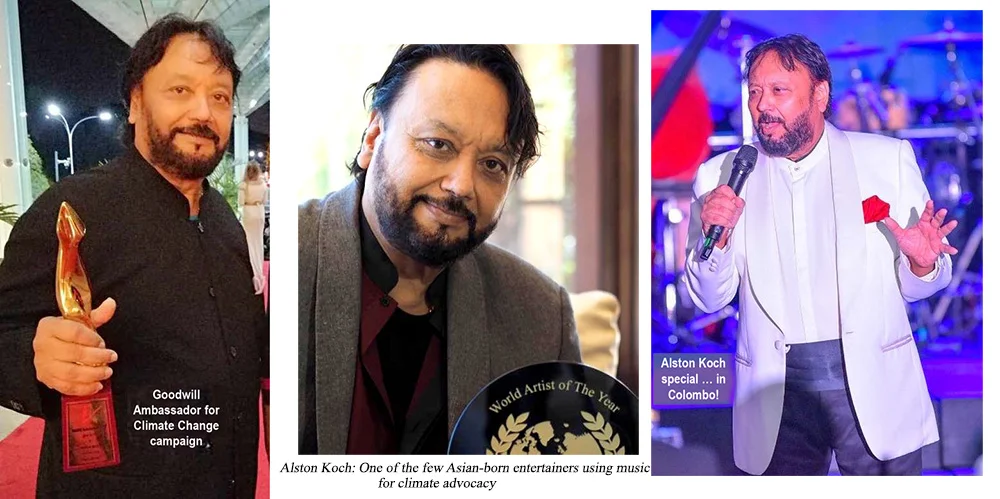
 The name Alston Koch is generally associated with the hit song ‘Disco Lady.’ Yes, he has had several other top-notch songs to his credit but how many music lovers are aware that Alston is one of the few Asian-born entertainers using music for climate advocacy, since 2008.
He is back in the ‘climate change’ scene, with SUNx Malta, to celebrate Earth Day 2026, with the release of ‘A Symphony for Change’ – a vibrant Dodo4Kids video by Alston.
The inspiring musical video highlights ocean conservation and empowers children as future climate champions, honouring Maurice Strong’s legacy through education, creativity, and global collaboration for a sustainable planet.
The four-minute animated musical, composed and performed by platinum award-winning artiste Alston Koch, brings to life a resurrected Dodo, guiding children on a mission to clean up marine environments.
With a catchy melody and an uplifting message, the video blends entertainment with education—making climate awareness accessible and engaging for the next generation.
SUNx Malta is a Climate Friendly Travel system, focused on transforming the global tourism sector that is low-carbon, SDG-linked, and nature-positive.
Professor Geoffrey Lipman, President of SUNx Malta, described the project as a joyful collaboration with purpose:
“It’s always a pleasure to produce music with Alston for the good of our planet. And this time, to incorporate our Dodo4Kids in the video urging the next generation of young climate champions to help save our seas.”
For Alston, now based in Australia, the collaboration continues a long-standing journey of climate-focused creativity:
Says Alston: “I have been working on climate songs since the first release, in 2009, of the video ‘Act Now.’ Since then, I’ve performed at major global events—from Bali to Glasgow. I wrote this song because the climate horizon is darkening, and our kids and grandkids are our best hope for a brighter future.”
Alston’s very first climate song is ‘Can We Take This Climate Change,’ released in 2008.
It was written by Alston for the World Trade Organisation presentation, in London, and presented at ‘Live the Deal Climate Change’ conference in Copenhagen.
The Sri Lankan-born singer was goodwill ambassador for the campaign, and the then UK Minister Barbara Follett called it a “gift in song to the world suffering due to climate change.”
Alston said he wrote it after noticing butterflies, birds, and fruit trees disappearing from his childhood days.
In 2017, his creation ‘Make a Change’ was released in connection with World Tourism Day 2017.
Alston Koch’s work on climate advocacy is pretty inspiring, especially as climate change is now creating horrifying problems worldwide, and in Sri Lanka, too.
Alston also indicated to us that he has plans to visit Sri Lanka, sometime this year, and, maybe, even plan out a date for an Alston Koch special … a concert, no doubt.
Can’t wait for it!

Plane crashes near South Sudan’s Juba, killing all 14 on board

Gunmen kidnap 23 children from Nigerian orphanage

US press gala shooting suspect charged with attempting to kill Trump

Showers above 75 mm are likely at some places in the Western, Sabaragamuwa, Central, North-western, North-central and Southern provinces and in Mannar district

Hazlewood and Bhuvneshwar lead rout of Delhi Capitals

Govt. assures UN of readiness to introduce ‘vetting process’ for troops on overseas missions

‘Dates have the highest sugar content to fight Coronavirus’

Sunday Island 27 December – Headlines

#SundayIsland 17th December – Headlines

Sunday Island – 28th March

Sunday Island Headlines – 21 March

Sunday Island – 21st February – Headlines
-
 News6 days ago
Lanka faces crisis of conscience over fate of animals: Call for compassion, law reform, and ethical responsibility
-
 News5 days ago
Whistleblowers ask Treasury Chief to resign over theft of USD 2.5 mn
-

 News5 days ago
No cyber hack: Fintech expert exposes shocking legacy flaws that led to $2.5 million theft
-

 News2 days ago
BIA drug bust: 25 monks including three masterminds arrested
-

 Business3 days ago
Nestlé Lanka Announces Change in Leadership
-

 News2 days ago
Banks alert customers to phishing attacks
-
 News3 days ago
Hackers steal $3.2 Mn from Finance Ministry
-
 News6 days ago
USD 2 mn bribe: CID ordered to arrest Shasheendra R, warrant issued against ex-SriLankan CEO’s wife