
Features
The child is a person


Our attention has been refocussed on the LGBTQI + issue in recent times, and more so after the unambiguous and categorical statement made by the Archbishop of Colombo, Macolm Cardinal Ranjith a few days ago.
In The Sunday Island lead news item on 17 August, he is quoted as saying among other things, “A group of psychologists are issuing certificates that allow children to change their gender identity”. And then he has gone on to homosexuality – as “a danger to our younger generation”. He has further claimed that certain political parties and their leaders were involved in promoting this agenda.
As a medical academic, I have advocated that any human sexual activity is acceptable between consenting adults – with absolute emphasis on ‘consenting’, the issues of same gender sex is not at issue where I am concerned. It is a matter of private personal preference and choice between consenting adults.
But I am very much concerned about an emerging trend that to me, to say the least, is highly alarming. That is, the strong emerging trends of transsexualism pervading the West and the pharma-politico-financial backing it is receiving in recent times. There is now a backlash on men trying to be women and taking advantage of the situation in invading ‘private places’ previously dedicated to women, and legal encroachment in individual and team sports. The worst aspect of it is the encroachment of these powerful corporate social segments on the Rights of the Child.
In this narrative, what I will attempt to do is make a few random ‘brush strokes’ on the large canvas of the current scenery on the ‘Child as a Person’ that may paint an abstract picture of this subject. You may see a pattern, or you may not. It will be in the eyes of the beholder.
“The child is the father of the man.”
Wrote William Wordsworth – in his 1802 poem, “My Heart Leaps Up”.
On first reading of this old aphorism, it seems a confounding paradoxical statement. What did the poet mean when he used this confusing idea? It is said that he meant that the foundation of our adult personalities is laid during our childhood. But is it really so? As a child grows into adulthood, he/she will gradually lose the curiosity and the sense of wonder about the world. The child gradually begins to conform to the dictates of society, beginning with the dictates of parents. Then comes the restraining confines of school discipline about which Ivan Illych wrote in his path-breaking book “Deschooling Society” in 1970 – 55 years ago! Schools as mass collective education catering to the lowest common denominator. But, on the other hand, it is my view, that the basic core attitudes of an individual are first formed at home. It is from the home that one will learn the rudiments of ‘good’ and ‘bad’ or of ‘right’ and ‘wrong’. That is often why, some children who come from dysfunctional family backgrounds, whatever later attempts are made, end up in anti-social circumstances.
What we can learn from this thought from Wordsworth is that even as early as the beginning of the 19th century, the importance of childhood in the future development of the adult had been appreciated. What it certainly does is to put our topic of the day – “The child is a person” in perspective. In other words, Wordsworth’s idea, enhances our topic of the day.
The recognition that ‘the child is a person’ is a necessary precondition to accept that the child is the future.
This saying attributed to Abraham Lincoln:
“A child is a person who is going to carry on what you have started … the fate of humanity is in his hands.”
Perhaps he was the first to use the title of this article. When I chose it, I did not know that Abraham Lincoln had use the phrase before. There is another proverb that is more telling – and perhaps for that reason, remains anonymous:
“He who takes a child by the hand, takes the future by the scruff of its neck!”
This leaves us with little doubt about the importance of the child as a person. But before that, let us ask another question, rhetorically: ‘When does a child become an individual?’. ‘When does a child become a person?’
Here, we get into serious controversy. The multiple issues of ‘the embryo, the foetus and the unborn child’, reproductive rights, women’s rights and their socio-religious implications fall upon us like a ton of bricks. For example, are the words ‘foetus’, ‘unborn child’ and ‘unborn baby’ interchangeable? Are there any differences between these words and their usage? Are they mere semantics that no subtle importance need be attached to them? Does it depend only on the perspective of the person who uses them? Let us leave aside such complexities for our purpose of this article. Let us be aware that there are areas that “even angels fear to tread”. But we will bear those issues in mind, nevertheless.
Capacity of children to make legal decisions.
I wouldn’t want to delve into ‘foetal rights’ at this point as it is voluminous enough for books and volumes by itself. Therefore, we plunge straight into ‘child rights’ though ‘foetal rights’ is necessarily and conceptually the basis of ‘Child Rights’.
The child’s wishes and decisions in the family courts, for example. It was long thought that a child lacked legal capacity to give valid consent in law regarding decisions such as consenting to medical procedures. Therefore, the capacity to make decisions and act in the child’s best interest was vested in their parent or guardian. These parental powers existed until the child attained legal adulthood.
The current approach views parental powers in a different way: they establish that these are effective only so long as they are needed for the protection of the person and property of the child. Therefore, it is no longer the accepted rule that children remain under parental control until they are of a certain age. At some point of the child’s life, the parental right yields to the child’s right to decide for him or herself. However, this is increasingly seen by the courts as an incremental process, in the course of which, the child’s independence and ability to make decisions grow, while the extent of the parental responsibilities and right to decision-making gradually diminish.
In England and Wales, the term ‘Gillick competence’ is used in medical law to decide whether a child under the age of 16 is able to consent to their own medical treatment, without the need for parental permission or knowledge.
By the way, ‘The Gillick case’ involved a UK health departmental (NHS) circular advising doctors on the contraception of minors (for this purpose, under sixteens). The circular stated that the prescription of contraception was a matter for the doctor’s discretion and that they could be prescribed to under sixteens without parental consent. This matter was litigated because an activist, Victoria Gillick, ran an active campaign against the policy. Gillick sought a declaration that prescribing contraception was illegal because the doctor would commit an offence of encouraging sex with a minor (which in Sri Lanka, is statutory rape) and that it would be treatment without consent as consent in this aspect should be vested in the parent; she was unsuccessful before the High Court but succeeded in the Court of Appeal.)
It means that the legal authority for parents to make medical decisions on behalf of their children is revoked when the child reaches sufficient maturity to make their own decisions. There is no hard-and-fast age at which a child can be considered ‘Gillick competent’, and it is something decided on a case-by-case basis.
Gender Dysphoria
This is an area in which I want to invest some extra time during this narrative; on what I believe is an issue that is heavily laden with controversy. Serious current controversy. Here, whether the child is a person, and what decision-making role they can play, at what age, which is critical for their future personal identity, come into serious contention.
Specialist paediatricians in Sri Lanka should be very much aware of this relatively new phenomenon. Which to my mind, is a frightening development where paediatricians and child psychiatrists are at the epicentre of this global controversy. Perhaps, it is not quite correct for me to call it global. Perhaps, not yet.
It is still very much a subject of medical controversy in the West including Australia. But the fall out may not be too far in coming to our shores. And paediatricians, must be fully cognisant of all issues concerned and policy decisions taken in this regard at the level of professional bodies as well as at the Ministry of Health.
Where should I begin?
I wouldn’t want to get into the debatable area of biological sex. Whether there are six of them (as is now classified) or less. But we can simplify by making them three. Male, female and all others lumped into the category – intersex. Intersex being individuals born with any of several variations in sex characteristics including chromosomes, gonads, sex hormones or genitals that, according to the Office of the United Nations High Commissioner for Human Rights, “do not fit the typical definitions for male or female bodies“.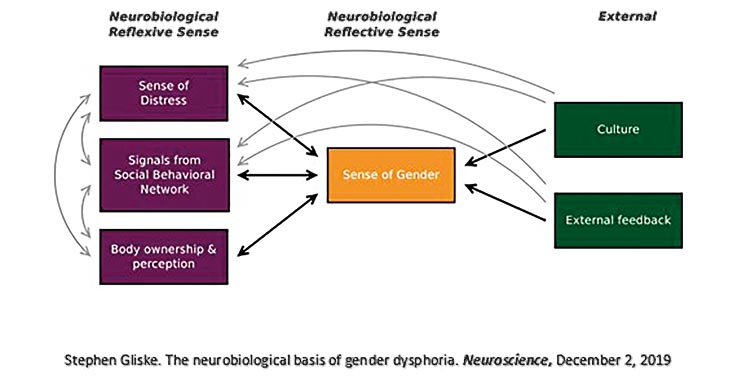
One of the most famous intersex personalities of recent times was Caster Semenya, the South African middle-distance runner and 2016 Olympic gold medalist in the 800 metres, who was assigned as a female at birth with naturally elevated testosterone levels due to an enzyme (5α-Reductase) deficiency. In a landmark case for athletes’ rights, Caster Semenya, the star South African runner, won her case at the European Court of Human Rights (ECtHR) on July 10, 2025. “Caster Semenya’s victory is a victory for all women and all athletes because the European Court found that the Court of Arbitration for Sport and Swiss Federal Tribunal had failed to uphold human rights norms despite credible claims of discrimination.” reported Human Rights Watch. But our issue here today, is not about intersex.
But I am digressing.
From biological sex, we get into “gender assignment”. Gender assignment is the discernment (subjective judgement) of an infant’s sex at birth. Assignment may be done prior to birth through prenatal sex discernment – as is commonly done now by obstetricians by ultra sound scans. In the majority of births, it is a relative, a midwife, a nurse or a physician who inspects the genitalia when the baby is delivered, and sex or gender is assigned without any expectation of ambiguity. The global number of births with ambiguous genitals is in the range of 0.02% to 0.05%.
If it was only such cases of ‘intersex’, that has aroused controversy, that would be a non-issue. As we come to understand, it goes far beyond that. For instance, a whimsical comment by a female child “I am a boy” would be enough to register her in a gender dysphoria clinic to be kept under observation for later interventions to change her ‘birth gender’.
In consequence, what was once straight forward biological sex determined on a biological construct has changed to a very fluid ‘social construct’. A child’s sex or gender is increasingly being determined by societal imperatives and not biological analysis.
Gender dysphoria has been broadly stated as ‘the sense of unease arising from one’s physical sexual characteristics which are not aligning with one’s gender identity’.
Today, increasingly, gender identity is the personal sense of one’s own gender. Gender identity can correlate with a person’s assigned sex at birth or can differ from it. ‘Gender expression’ typically reflects a person’s gender identity. New terminology is coming into this gender lexicon – for instance, “body-ownership networks”. The factors that determine gender is no longer chromosomes or genes. There are many determinants. Here is the least complex interpretation of what is now termed the ‘Sense of Gender’ – diagrammatically. (See diagram)
As can be seen, gender identity is becoming highly complex in today’s world.
Puberty Blockers
The mainstay of conservative management of, and treatment for, gender dysphoria is puberty blockers. I am not sure how many of our paediatricians are into this, as of now.
You know that the so-called puberty blockers, known formally as gonadotropin-releasing hormone (GnRH) antagonists, are medications that cause the body to stop producing sex hormones. They are delivered either as injections (also used in breast and prostate cancer treatment), which are administered by a healthcare worker every three months, or via an implant, which needs to be replaced annually.
For ‘transgender children’, taking these drugs will prevent breast tissue development and menstruation, or the growth of facial hair and a deepening voice. The effects of drugs are completely reversible, and if a person stops taking them their body will resume sex hormone production as it had done before they started.
Why might a child want puberty blockers? Because the child is unsure of its gender preference. The monitoring of such children has begun, in some instances, when they were as young as 4 years old. Puberty blockers are commenced sometimes soon after puberty (ages 12-14) when they have begun producing sperms and ova (when, they can be frozen for future fertility) or even before when they lose their fertility options! The controversial issue in this is who will be the decision-maker in this process? The child or the parents?
Dianna Kenny, Professor of Psychology, consulting psychologist, psychotherapist University of Sydney who has collected data on children enrolled in gender dysphoria clinics has discovered the emergence of a ‘new pandemic’. The statistics are alarming. There has been a dramatic increase in the number of children enrolled in gender dysphoria clinics since 2019.
Social Contagion
Diana Kenny in an article titled “Is gender dysphoria socially contagious?” explores the influence of ‘social contagion’ on what she calls “the disquieting upsurge in the number of children and young people whose parents are presenting to gender clinics around the world for advice regarding social transition, puberty blocking agents, cross sex hormones, and ultimately surgery in an attempt to change their gender.”
Evidence has been quoted of children prompted into what is now termed “rapid-onset gender dysphoria” by peer pressures. After the article on the subject by Dr. Lisa Littman of Brown University was first published, there was a ‘mob reaction’ by transgender activists who denounced the paper calling it hate speech and transphobic. The gender dysphoria issue has turned not only political, but disquietingly aggressive. Increasingly, younger and younger children are not just being given, but driven, to ‘radical surgical treatment’ for gender dysphoria.
In this context, let me digress a bit to relieve the monotony.
Lisa Marchiano, a Yungian psychoanalyst in Philadelphia, in her article titled “Outbreak: On Transgender Teens and Psychic Epidemics” published in ‘Psychological Perspectives’ – a Quarterly Journal of Yungian Thought in 2017 (Carl Yung) – writes this interesting historical aside:
“The earliest written record from the town of Hamelin in Lower Saxony is from 1384. It states simply, “It is 100 years since our children left.” Historical accounts indicate that sometime in the 13th century, a large number of the town’s children disappeared or perished, though the details of the event remain a mystery. “The Pied Piper of Hamelin”, as far I as have been able to determine, is the only Grimm’s fairy tale that is based substantially on a historical event. Both the actual event and the Grimm’s tale suggest an archetypal situation in which adults have allowed children to be seduced away into peril. This tale is a disconcertingly apt metaphor for various social contagions that have overtaken collective life throughout the centuries.”
William Manchester’s ‘A World Lit Only by Fire’ places the events in 1484, 100 years after the written mention in the town chronicles that “It is 100 years since our children left”, and further proposes that the Pied Piper was a psychopathic paedophile.
Now that is an interesting perspective on the children who followed the pied piper into oblivion. Is this what today’s adults are doing to our children. Taking decisions for them and taking them away into a “gender land of no return”? Decisions that could often irreversibly disturb their lives – psychologically? As some have said – ‘Seduce them into peril’??
The case against Tavistock and Portman NHS Trust
A UK News report dated Oct 7, 2020, describes a landmark case that will be heard in High Court about whether children who wish to undergo gender reassignment should be prescribed “experimental” puberty blockers and cross-sex hormones.
Kiera Bell, a 23-year-old woman who began taking puberty blockers when she was 16 before “detransitioning” last year – i.e., going back to being a girl, is suing the Tavistock and Portman NHS Trust, which runs the UK’s only gender identity development service (GIDS) for children.
The legal challenge is also being brought by Mrs A, the mother of a 16-year-old autistic girl who is currently on the waiting list for treatment.
In January 2021, the pair were given the go-ahead to bring the action against the trust after claiming that the way informed consent is obtained from children is “materially misleading”.
At the hearing in London, Ms Bell and Mrs A’s lawyers will argue that children under the age of 18 cannot give “informed consent” to treatment which has “irreversible, lifelong consequences”.
Professor Carl James Heneghan, a clinical epidemiologist and a Fellow of Kellogg College, Oxford and the Director of the University of Oxford’s Centre for Evidence-Based Medicine and Editor-in-Chief of BMJ Evidence-Based Medicine has called the use of puberty blockers to treat transgender children an “unregulated live experiment on children.”
It was reported that in 2019 five clinicians working at the Gender Identity Development Service (GIDS) at the Tavistock and Portman NHS Foundation Trust in London in the United Kingdom (UK) resigned, and one of the governors of the Trust also resigned. Among other reasons, they adduced that puberty ‘blockers’ are prescribed experimentally to gender diverse youth, without sufficiently robust evidence around efficacy and safety, and without sufficiently robust diagnosis.
Other countries….
Under some of the proposed new laws across the United States, doctors could be barred from prescribing puberty-blocking drugs to children. A measure introduced in South Carolina last year would revoke the licenses of doctors who treat transgender children.
Meanwhile, the South Dakota legislature voted down a bill that will see doctors charged with a misdemeanour if they prescribe puberty blockers. The Republican state representative Fred Deutsch, who sponsored the bill, said on Twitter ahead of the vote on Feb. 10, 2020: “The world is upside-down; protecting children from sterilization and mutilation is causing a firestorm,”
The issue has spilled beyond the borders of the United States, with many countries mulling new laws preventing poorly discriminated decisions on prescribing puberty blockers for children.
On the other hand, Brazil lowered the age at which young people can access gender reassignment surgery from 21 to 18 and dropped the age requirement for hormone therapy from 18 to 16 – although those under 18 must have the consent of a parent or guardian.
There are other connected and important issues. One is:
The gender dysphoria epidemic and the vested interests of the medico-pharma-insurance industry is quite similar to the ADHD medication controversy, of the recent past.
The debates and controversies go on. The paediatric endocrinologists, child psychologists and transgender surgeons are teeming on either side of the barricades – where, and on what side would you stand? The ‘child as a person’ seems to have been lost in this medical / legal battle ground.
I hope with these ‘brush strokes’ of information, I have adequately covered the topic that I ventured to write on, mainly due to the emergence of discussions on transgenderism and gender dysphoria that seems to be slowly, but surreptitiously, creeping into our legal system under the coercive influence of multiple Western agencies such as the UNHRC and the IMF. The complexities of this developing socio-political-legalistic phenomenon is both bewildering and frightening.
Are there conditions and constraints to ‘The child being a person’? Here are some concluding thoughts, not as conclusions, but as questions.
· When would a child be considered ‘Gillick competent’ in Sri Lanka?
· Will adults allow a child to decide on its own gender identity?
· Should adults decide that their child is a male or female before the child can decide for itself?
· Is it ethical to offer a child the option of gender surgery against the will of their parents as is being done in some centres in the West now?
· Where does society draw the line on when a child becomes a person?
· When does a child become a person?
· When will adults allow a child to be a person?
· When should adults allow a child to be a person?
I am not sure what kind of reaction I will have from Paediatricians and Child Psychiatrists in Sri Lanka to this narrative as there are strongly contrary positions taken by them the world over. Will the outcome of these controversies determine the future of humans as a thriving species?
Questions and more questions for both the legal and medical professionals. In the final analysis, I am leaving you with more questions than answers. In a world that has, in many ways, turned itself upside down, that would not be too surprising, would it?
(I have taken extensive extracts for this article from my presentation for the Dr. BJC Perera Research Prize Oration 2020, Sri Lanka College of Paediatricians.)
by Dr. Susirith Mendis ✍️
Emeritus Professor
University of Ruhuna
(susmend2610@gmail.com)

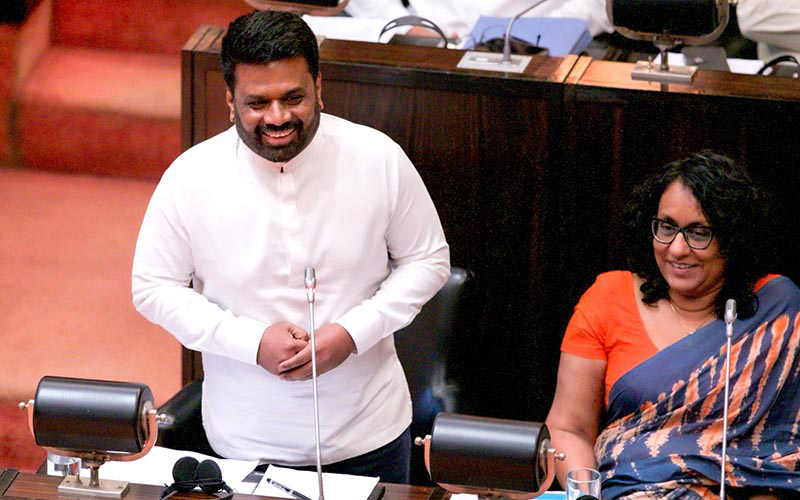
The long standing foreign policy of Sri Lanka was Non-Alignment. However, in the context of emerging geopolitical rivalries, there was a need to question the adequacy of Non-Alignment as a policy to meet developing challenges. Neutrality as being a more effective Policy was first presented in an article titled “Independence: its meaning and a direction for the future” (The Island, February 14, 2019). The switch over from Non-Alignment to Neutrality was first adopted by former President Gotabaya Rajapaksa and followed through by successive Governments. However, it was the current Government that did not miss an opportunity to announce that its Foreign Policy was Neutral.
The policy of Neutrality has served the interests of Sri Lanka by the principled stand taken in respect of the requests made by two belligerents associated with the Middle East War. The justification for the position adopted was conveyed by President Anura Kumara Dissanayake to Parliament that Iran had made a formal request on February 26 for three Iranian naval ships to visit Sri Lanka, and on the same evening, the United States also requested permission for two war planes to land at Mattala International Airport. Both requests were denied on grounds of maintaining “our policy of neutrality”.
WHY NEUTRALITY
Excerpts from the article cited above that recommended Neutrality as the best option for Sri Lanka considering the vulnerability to its security presented by its geographic location in the context of emerging rivalries arising from “Pivot to Asia” are presented below:
“Traditional thinking as to how small States could cope with external pressures are supposed to be: (1) Non-alignment with any of the major centers of power; (2) Alignment with one of the major powers thus making a choice and facing the consequences of which power block prevails; (3) Bandwagoning which involves unequal exchange where the small State makes asymmetric concessions to the dominant power and accepts a subordinate role of a vassal State; (4) Hedging, which attempts to secure economic and security benefits of engagement with each power center: (5) Balancing pressures individually, or by forming alliances with other small States; (6) Neutrality”.
Of the six strategies cited above, the only strategy that permits a sovereign independent nation to charter its own destiny is neutrality, as it is with Switzerland and some Nordic countries. The independence to self-determine the destiny of a nation requires security in respect of Inviolability of Territory, Food Security, Energy Security etc. Of these, the most critical of securities is the Inviolability of Territory. Consequently, Neutrality has more relevance to protect Territorial Security because it is based on International Law, as opposed to Non-Alignment which is based on principles applicable to specific countries that pledged to abide by them
“The sources of the international law of neutrality are customary international law and, for certain questions, international treaties, in particular the Paris Declaration of 1856, the 1907 Hague Convention No. V respecting the Rights and Duties of Neutral Powers and Persons in Case of War on Land, the 1907 Hague Convention No. XIII concerning the Rights and Duties of Neutral Powers in Naval War, the four 1949 Geneva Conventions and Additional Protocol I of 1977” (ICRC Publication on Neutrality, 2022).
As part of its Duties a Neutral State “must ensure respect for its neutrality, if necessary, using force to repel any violation of its territory. Violations include failure to respect the prohibitions placed on belligerent parties with regard to certain activities in neutral territory, described above. The fact that a neutral State uses force to repel attempts to violate its neutrality cannot be regarded as a hostile act. If the neutral State defends its neutrality, it must however respect the limits which international law imposes on the use of force. The neutral State must treat the opposing belligerent States impartially. However, impartiality does not mean that a State is bound to treat the belligerents in exactly the same way. It entails a prohibition on discrimination” (Ibid).
“It forbids only differential treatment of the belligerents which in view of the specific problem of armed conflict is not justified. Therefore, a neutral State is not obliged to eliminate differences in commercial relations between itself and each of the parties to the conflict at the time of the outbreak of the armed conflict. It is entitled to continue existing commercial relations. A change in these commercial relationships could, however, constitute taking sides inconsistent with the status of neutrality” (Ibid).
THE POTENTIAL of NEUTRALITY
It is apparent from the foregoing that Neutrality as a Policy is not “Passive” as some misguided claim Neutrality to be. On the other hand, it could be dynamic to the extent a country chooses to be as demonstrated by the actions taken recently to address the challenges presented during the ongoing Middle East War. Furthermore, Neutrality does not prevent Sri Lanka from engaging in Commercial activities with other States to ensuring Food and Energy security.
If such arrangements are undertaken on the basis of unsolicited offers as it was, for instance, with Japan’s Light Rail Project or Sinopec’s 200,000 Barrels a Day Refinery, principles of Neutrality would be violated because it violates the cardinal principle of Neutrality, namely, impartiality. The proposal to set up an Energy Complex in Trincomalee with India and UAE would be no different because it restricts the opportunity to one defined Party, thus defying impartiality. On the other hand, if Sri Lanka defines the scope of the Project and calls for Expressions of Interest and impartially chooses the most favourable with transparency, principles of Neutrality would be intact. More importantly, such conduct would attract the confidence of Investors to engage in ventures impartial in a principled manner. Such an approach would amount to continue the momentum of the professional approach adopted to meet the challenges of the Middle East War.
CONCLUSION
The manner in which Sri Lanka acted, first to deny access to the territory of Sri Lanka followed up by the humanitarian measures adopted to save the survivors of the torpedoed ship, earned honour and respect for the principled approach adopted to protect territorial inviolability based on International provisions of Neutrality.
If Sri Lanka continues with the momentum gained and adopts impartial and principled measures recommended above to develop the country and the wellbeing of its Peoples, based on self-reliance, this Government would be giving Sri Lanka a new direction and a fresh meaning to Neutrality that is not passive but dynamic.
by Neville Ladduwahetty

The interference into affairs of other nations by the USA’s Central Intelligence Agency (CIA) started in 1953, six years after it was established. The Anglo-Iranian Oil Company supplied Britain with most of its oil during World War I. In fact, Winston Churchill once declared: “Fortune brought us a prize from fairyland beyond our wildest dreams.”
When in 1951 Dr. Mohammad Mosaddegh was reluctantly appointed as Prime Minister by the Shah of Iran, whose role was mostly ceremonial, he convinced Parliament that the oil company should be nationalised.
Mohammed Mosaddegh
Mosaddegh said: “Our long years of negotiations with foreign companies have yielded no result thus far. With the oil revenues we could meet our entire budget and combat poverty, disease and backwardness of our people.”
It was then that British Intelligence requested help from the CIA to bring down the Iranian regime by infiltrating their communist mobs and the army, thus creating disorder. An Iranian oil embargo by the western countries was imposed, making Iranians poorer by the day. Meanwhile, the CIA’s strings were being pulled by Kermit Roosevelt (a grandson of former President Theodore Roosevelt), according to declassified intelligence information.
Although a first coup failed, the second attempt was successful. General Fazlollah Zahedi, an Army officer, took over as Prime Minister. Mosaddegh was tried and imprisoned for three years and kept under house arrest until his death. Playing an important role in the 1953 coup was a Shia cleric named Ayatollah Abol-Ghasem Mostafavi-Kashani. He was previously loyal to Mosaddegh, but later supported the coup. One of his successors was Ayatollah Ruhollah Mostafavi Musavi Khomeini, who engineered the Islamic Revolution in 1979. Meanwhile, in 1954 the Anglo-Iranian Oil Company had been rebranded as British Petroleum (BP).
Map of the Middle East
When the Iran-Iraq war broke out (September 1980 to August 1988), the Persian/Arabian Gulf became a hive of activity for American warships, which were there to ensure security of the Gulf and supertankers passing through it.

CIA-instigated coup in Iran in 1953 Dr. Mohammad Mosaddegh
The Strait of Hormuz, the only way in and out of the Gulf, is administered by Oman and Iran. While there may have been British and French warships in the region, radio ‘chatter’ heard by aircraft pilots overhead was always from the US ships. In those days, flying in and out of the Gulf was a nerve-wracking experience for airline pilots, as one may suddenly hear a radio call on the common frequency: “Aircraft approaching US warship [name], identify yourself.” One thing in the pilots’ favour was that they didn’t know what ships they were flying over, so they obeyed only the designated air traffic controller. Sometimes though, with unnecessarily distracting American chatter, there was complete chaos, resulting in mistaken identities.
Air Lanka Tri Star
Once, Air Lanka pilots monitored an aircraft approaching Bahrain being given a heading to turn on to by a ship’s radio operator. Promptly the air traffic controller, who was on the same frequency, butted in and said: “Disregard! Ship USS Navy [name], do you realise what you have just done? You have turned him on to another aircraft!” It was obvious that there was a struggle to maintain air traffic control in the Gulf, with operators having to contend with American arrogance.
On the night of May 17, 1987, USS Stark was cruising in Gulf waters when it was attacked by a Dassault Mirage F1 jet fighter/attack aircraft of the Iraqi Air Force. Without identifying itself, the aircraft fired two Exocet missiles, one of which exploded, killing 37 sailors on board the American frigate. Iraq apologised, saying it was a mistake. The USA graciously accepted the apology.
Then on July 3, 1988 the high-tech, billion-dollar guided missile cruiser USS Vincennes, equipped with advanced Aegis weapons systems and commanded by Capt. Will Rogers III, was chasing two small Iranian gun boats back to their own waters when an aircraft was observed on radar approaching the US warship. It was misidentified as a Mirage F1 fighter, so the Americans, in Iranian territorial waters, fired two surface-to-air Missiles (SAMs) at the target, which was summarily destroyed.
The Vincennes had issued numerous warnings to the approaching aircraft on the military distress frequency. But the aircraft never heard them as it was listening out on a different (civil) radio frequency. The airplane broke in three. It was soon discovered, however, that the airplane was in fact an Iran Air Airbus A300 airliner with 290 civilian passengers on board, en route from Bandar Abbas to Dubai. Unfortunately, because it was a clear day, the Iranian-born, US-educated captain of Iran Air Flight 655 had switched off the weather radar. If it was on, perhaps it would have confirmed to the American ship that the ‘incoming’ was in fact a civil aircraft. At the time, Capt. Will Rogers’ surface commander, Capt. McKenna, went on record saying that USS Vincennes was “looking for action”, and that is why they “got into trouble”.
Although USS Vincennes was given a grand homecoming upon returning to the USA, and its Captain Will Rogers III decorated with the Legion of Merrit, in February 1996 the American government agreed to pay Iran US$131.8 million in settlement of a case lodged by the Iranians in the International Court of Justice against the USA for its role in that incident. However, no apology was tendered to the families of the innocent victims.
These two incidents forced Air Lanka pilots, who operated regularly in those perilous skies, to adopt extra precautionary measures. For example, they never switched off the weather radar system, even in clear skies. While there were potentially hostile ships on ground, layers of altitude were blocked off for the exclusive use of US Air Force AWACS (Airborne Warning and Control System) aircraft flying in Bahraini and southern Saudi Arabian airspace. The precautions were even more important because Air Lanka’s westbound, ‘heavy’ Lockheed TriStars were poor climbers above 29,000 ft. When departing Oman or the UAE in high ambient temperatures, it was a struggle to reach cruising level by the time the airplane was overhead Bahrain, as per the requirement.
In the aftermath of the Iran Air 655 incident, Newsweek magazine called it a case of ‘mistaken identity’. Yet, when summing up the tragic incident that occurred on September 1, 1983, when Korean Air Flight KE/KAL 007 was shot down by a Russian fighter jet, close to Sakhalin Island in the Pacific Ocean during a flight from New York to Seoul, the same magazine labelled it ‘murder in the air’.
After the Iranian coup, which was not coincidentally during the time of the ‘Cold War’, the CIA involved itself in the internal affairs of numerous countries and regions around the world: Guatemala (1953-1990s); Costa Rica (1955, 1970-1971); Middle East (1956-1958); Haiti (1959); Western Europe (1950s to 1960s); British Guiana/Guyana (1953-1964); Iraq (1958-1963); Soviet Union, Vietnam, Cambodia (1955-1973); Laos, Thailand, Ecuador (1960-1963); The Congo (1960-1965, 1977-1978); French Algeria (1960s); Brazil (1961-1964); Peru (1965); Dominican Republic (1963-1965); Cuba (1959 to present); Indonesia (1965); Ghana (1966); Uruguay (1969-1972); Chile (1964-1973); Greece (1967-1974); South Africa (1960s to 1980s); Bolivia (1964-1975); Australia (1972-1975); Iraq (1972-1975); Portugal (1974-1976); East Timor (1975-1999); Angola (1975-1980); Jamaica (1976); Honduras (1980s); Nicaragua (1979-1990); Philippines (1970s to 1990s); Seychelles (1979-1981); Diego Garcia (late 1960s to present); South Yemen (1979-1984); South Korea (1980); Chad (1981-1982); Grenada (1979-1983); Suriname (1982-1984); Libya (1981-1989); Fiji (1987); Panama (1989); Afghanistan (1979-1992); El Salvador (1980-1992); Haiti (1987-1994, 2004); Bulgaria (1990-1991); Albania (1991-1992); Somalia (1993); Iraq (1991-2003; 2003 to present), Colombia (1990s to present); Yugoslavia (1995-1995, and to 1999); Ecuador (2000); Afghanistan (2001 to present); Venezuela (2001-2004; and 2025).
If one searches the internet for information on American involvement in foreign countries during the periods listed above, it will be seen how ‘black’ funds were/are used by the CIA to destabilise those governments for the benefit of a few with vested interests, while poor citizens must live in the chaos and uncertainty thus created.
A popular saying goes: “Each man has his price”. Sad, isn’t it? Arguably the world’s only superpower that professes to be a ‘paragon of virtue’ often goes ‘rogue’.
God Bless America – and no one else!
BY GUWAN SEEYA
Features
Mannar’s silent skies: Migratory Flamingos fall victim to power lines amid Wind Farm dispute

By Ifham Nizam
A fresh wave of concern has gripped conservationists following the reported deaths of migratory flamingos within the Vankalai Sanctuary—a globally recognised bird habitat—raising urgent questions about the ecological cost of large-scale renewable energy projects in the region.
The incident comes at a time when a fundamental rights petition, challenging the proposed wind power project, linked to India’s Adani Group, remains under examination before the Supreme Court, with environmental groups warning that the very risks they highlighted are now materialising.
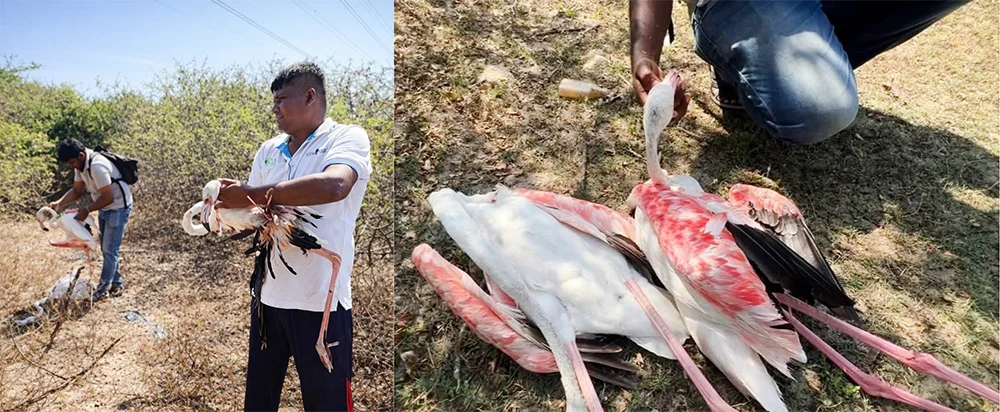
At least two flamingos—believed to be part of the iconic migratory flocks that travel thousands of kilometres to reach Sri Lanka—were found dead after entanglement with high-tension transmission lines running across the sanctuary. Another bird was reportedly struggling for survival.
Professor Sampath Seneviratne, a leading ornithologist, expressed deep concern over the development, noting that such incidents are not isolated but indicative of a broader and predictable threat.
“These migratory birds depend on specific flyways that have remained unchanged for centuries. When high-risk infrastructure, like poorly planned power lines, intersect these routes, collisions become inevitable,” he said. “What we are witnessing now could be just the beginning if proper mitigation measures are not urgently implemented.”
Environmentalists argue that the Mannar region—particularly the Vankalai wetland complex—is one of the most critical stopover sites in South Asia for migratory waterbirds, including flamingos, pelicans, and various species of waders. The sanctuary’s ecological value has also supported a niche with growing eco-tourism sector, drawing birdwatchers from around the world.
Executive Director of the Centre for Environmental Justice, Dilena Pathragoda, said the incident underscores the urgency of judicial intervention and stricter environmental oversight.
“This tragedy is a direct consequence of ignoring scientifically established environmental safeguards. We have already raised these concerns before court, particularly regarding the location of transmission infrastructure within sensitive bird habitats,” Pathragoda said.
“Renewable energy cannot be pursued in isolation from ecological responsibility. If due process and proper environmental impact assessments are bypassed or diluted, then such losses are inevitable.”
Conservation groups have long cautioned that the installation of wind turbines and associated grid infrastructure—especially overhead transmission lines—within or near sensitive habitats could transform these landscapes into lethal zones for avifauna.
An environmental activist involved in the ongoing legal challenge said the latest deaths validate earlier warnings.
“This is exactly what we feared. Development is necessary, but not at the cost of biodiversity. When projects of this scale proceed without adequate ecological assessments and safeguards, the consequences are irreversible,” the activist stressed.
The debate has once again brought into focus the delicate balance between renewable energy expansion and biodiversity conservation. While wind energy is widely promoted as a clean alternative to fossil fuels, experts caution that “green” does not automatically mean “harmless.”
Professor Seneviratne emphasised that solutions do exist, including rerouting transmission lines, installing bird diverters, and conducting comprehensive migratory pathway studies prior to project approval.
“Globally, there are well-established mitigation strategies. The issue here is not the absence of knowledge, but the failure to apply it effectively,” he noted.
The timing of the incident is particularly worrying. Migratory flamingos typically remain in Sri Lanka until late April or May before embarking on their return journeys. Conservationists warn that if hazards remain unaddressed, larger flocks could face similar risks in the coming weeks.
Beyond ecological implications, experts also highlight potential economic fallout. Wildlife tourism—especially birdwatching—contributes significantly to local livelihoods in Mannar.
Repeated reports of bird deaths could deter eco-conscious travellers and damage the region’s reputation as a safe haven for migratory species.
Environmentalists are now calling for immediate intervention by authorities, including a temporary halt to high-risk operations in sensitive zones, pending a thorough environmental review.
They stress that protecting animal movement corridors—whether elephant migration routes or avian flyways—is a fundamental pillar of modern conservation.
As the controversy unfolds, one question looms large: can Sri Lanka pursue sustainable energy without sacrificing the very natural heritage that defines it?
Pathragoda added that for now, the sight of fallen flamingos in Mannar stands as a stark reminder that development, if not carefully planned, can carry a heavy and irreversible cost.
-

 News3 days ago
Senior citizens above 70 years to receive March allowances on Thursday (26)
-

 Features5 days ago
Trincomalee oil tank farm: An engineering marvel
-

 News16 hours ago
Energy Minister indicted on corruption charges ahead of no-faith motion against him
-

 News2 days ago
US dodges question on AKD’s claim SL denied permission for military aircraft to land
-

 Features5 days ago
The scientist who was finally heard
-

 Business2 days ago
Dialog Unveils Dialog Play Mini with Netflix and Apple TV
-

 News3 days ago
CEB Engineers warn public to be prepared for power cuts after New Year
-
 News3 days ago
Japanese boost to Sri J’pura Hospital, an outright gift from Tokyo during JRJ rule