
Sports
Tharusha shatters two decade old record, Sithuli qualifies for Asian event


Sir John Tarbat Senior Athletics Championships
by Reemus Fernando
Holy Cross College, Gampaha triple jumper Neha Hettiarachchi and Lyceum International Wattala high jumper Tharusha Mendis established new meet records and Samudradevi Balika, Nugegoda high jumper Sithuli Sadithya reached qualifying standards for the Asian Youth Championships as they compensated for the frustrations in track events on day two of the Sir John Tarbat Senior Athletics Championships at Diyagama.
For the second consecutive day, the officials struggled to complete the scheduled events and when this story was field from Diyagama around 6.30 pm on Wednesday, track events were still being conducted under fading light. In a bid to save time the organizers opted to select the fastest from heats straight to the finals in hurdles events. Yet many events were held behind schedule. Athletes had to wait for hours after warming up and completing their call room procedures for their events to start.
Hettiarachchi, Mendis and Sadithya compensated for this gloom in track events with impressive field event performances.Hettiarachchi cleared a distance of 12.79 metres in the Under 20 girls’ triple jump to break Vidusha Lakshani’s 2014 meet record as she matched Asia’s fourth-best performance this year.
The day’s most stunning performance belonged to Tharusha Mendis of Lyceum. Mendis who failed to be among the top eight at the Junior Nationals in April registered a stunning 1.96 metres jump to establish a new record in the Under 16 boys’ high jump. “I struggled to clear even 1.65 metres. But today I managed to win,” Mendis told The Island. Mendis erased a record that had stood unchanged for 20 years (2002 – 1.95m by Isuru de Silva of Joseph Vaz College) In the Under 18 age category, Samudradevi Balika, Nugegoda high jumper Sithuli Sadithya reached locally set qualifying standards for next month’s Asian Youth Championships as she cleared a height of 1.67 metres to win the Under 18 girls’ high jump. Her closest rivals cleared 1.50 metres.
Incidentally, Sadithya commenced her competition with a height of 1.55 metres. She needed just one attempt to clear both the 1.55 metres and 1.60 metres. She had to make a second attempt to clear 1.64 metres before overcoming the height of 1.67 metres in her first. Sanuka Mihisara Gunaratne of Central College, Badulla came almost close to matching the qualifying standards for the Asian Youth Championships to be held in October as he won the Under 18 boys’ 2000 metres steeplechase in a time of 6:18.2 seconds. In the corresponding girls’ event P.S. Kumari of Ratnayake Central, Walala was the winner (8:00.9 secs). In the Under 18 boys’ triple jump, favourite, Senura Hansaka Sandeepa of Lyceum International School, Wattala had to fight hard to win as H.K. Dissanayake of Gnanodaya Central, Wariyapola cleared a distance which was just two centimetres short of the title-winning distance of 14.29 metres. P.S. Pawan of Bandaranaike College, Meerigama too cleared the 14 metres mark to win third place.






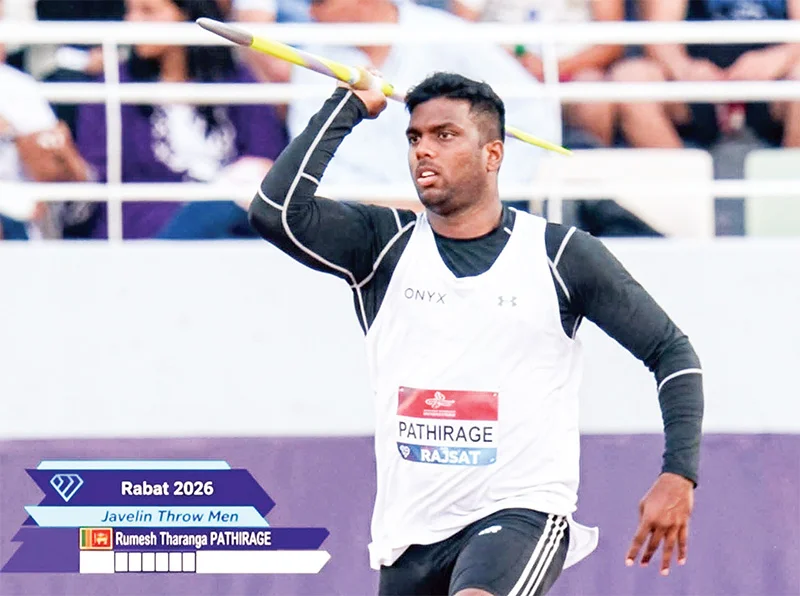
National javelin record holder Rumesh Tharanga etched his name into Sri Lankan athletics history by becoming the first athlete from the country to secure a top-three finish at a Diamond League meeting when he produced a remarkable performance in Rabat during the early hours of Monday (Sri Lanka time).
Competing among the world’s elite throwers, the 23-year-old delivered a massive throw of 85.97 metres with his very first attempt to take an early lead in the men’s javelin contest. Although two-time world champion Anderson Peters later edged ahead with a throw of 86.08 metres, Tharanga held on to finish second and create a historic milestone for Sri Lankan athletics.
Tharanga became only the second Sri Lankan athlete to compete in the prestigious Diamond League, following sprint star Yupun Abeykoon. His runner-up finish is the best result ever achieved by a Sri Lankan at the World Athletics top-tier one-day meeting series, which is now in its 17th edition.
Despite throwing more than four metres short of his season’s best, Tharanga stood tall against a world-class field packed with Olympic and World Championship medallists. The former St. Peter’s College athlete consistently surpassed the 82-metre mark in all of his successful attempts, demonstrating impressive consistency under pressure.
Among the distinguished competitors, former Olympic and world medallists struggled to match Tharanga’s performance. Only Keshorn Walcott, who threw 82.53 metres, managed to exceed the 82-metre barrier apart from the leading duo. Former Olympic champion Thomas Röhler finished fourth with 81.61 metres, while Olympic silver medallist Julius Yego placed fifth with 80.59 metres.
The 85.97-metre effort ranks as the fourth-best throw of Tharanga’s career and is expected to significantly boost his world ranking. Earlier this year, he rewrote the national record books with a sensational throw of 89.37 metres in March, a mark that currently stands as the world-leading performance of the season.
With his latest achievement on one of athletics’ biggest stages, Tharanga has further strengthened his reputation as Sri Lanka’s brightest medal prospect for future global competitions, including the World Championships and the Olympic Games. His historic Diamond League podium finish serves as another indication that the Sri Lankan star is rapidly establishing himself among the world’s leading javelin throwers. (RF)
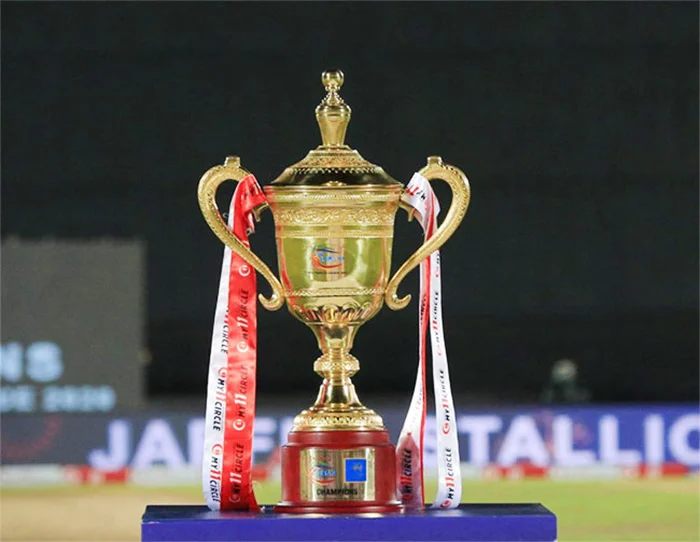
The countdown to the sixth edition of the Lanka Premier League has begun with the Player Draft taking place in Colombo. The draft provided an opportunity for the franchises to finalize their squads from a talent pool featuring leading international and domestic cricketers.
A total of 421 players were available for selection after more than 650 players from across the globe registered their interest in participating in the tournament. The draft marked the official start of preparations for LPL 2026, which will be played from July 17 to August 18 across Colombo, Dambulla and Pallekele.
Among the standout names available in the Platinum category were Afghanistan wicketkeeper-batter Rahmanullah Gurbaz, Zimbabwe captain Sikandar Raza, South Africa spinner Tabraiz Shamsi, New Zealand fast bowler Kyle Jamieson, Australia all-rounder Ashton Agar and Pakistan internationals Hasan Ali and Mohammad Nawaz.
Franchises also had the opportunity to strengthen their squads with established T20 performers such as Mujeeb Ur Rahman, Fazalhaq Farooqi, Evin Lewis, Chris Lynn, Wiaan Mulder, and Ryan Burl.
The five participating teams – Colombo Kaps, Dambulla Sixers, Galle Gallants, Jaffna Kings and Kandy Royals – will assemble squads of between 18 and 20 players as they balance local talent with overseas experience ahead of the new season.
The player pool also includes several notable Pakistan cricketers, including Iftikhar Ahmed, Usman Khan, Hasan Nawaz, Sufyan Moqim, Akif Javed and Mohammad Wasim Jnr.
Teams seeking spin options will have a wealth of choices, including Ish Sodhi, Sandeep Lamichhane, Piyush Chawla, Mehidy Hasan Miraz and Cole McConchie, while experienced international campaigners such as Litton Das is a direct signing, Mushfiqur Rahim, Martin Guptill, Temba Bavuma, Gulbadin Naib and Rahkeem Cornwall are also available for selection.
As part of tournament regulations, every franchise must select at least one player from the Associate Star category. Among the leading candidates are USA fast bowler Shadley van Schalkwyk, Nepal star Dipendra Singh Airee, Scotland seamer Safyaan Sharif, USA captain Monank Patel, Corey Anderson and Ali Khan.
The Associate Star category also features a strong contingent from the United Arab Emirates, offering franchises an opportunity to tap into one of cricket’s fastest-rising associate nations. UAE captain Muhammad Waseem headlines the group alongside wicketkeeper-batter Vriitya Aravind, all-rounders Basil Hameed and Aayan Afzal Khan, experienced pacers Junaid Siddique and Zahoor Khan, emerging batter Alishan Sharafu and left-arm fast bowler Muhammad Jawadullah.
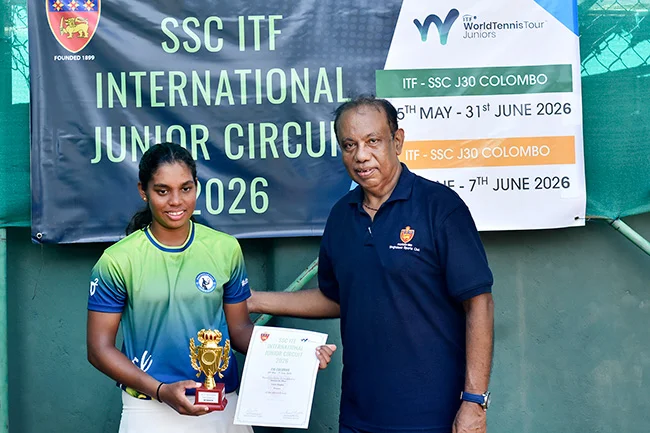
Sri Lanka’s leading junior tennis player Dinara de Silva scripted another memorable win by capturing both the singles and doubles titles at the SSC ITF International Junior J30 Tournament Week 1, held at the SSC Courts in Colombo from May 25 to May 31.
Dinara showcased her class and experience throughout the competition before lifting the girls’ singles title with a hard-fought 7-6, 6-4 victory over Hong Kong’s Hiu Lam Ella Wong in the championship match.
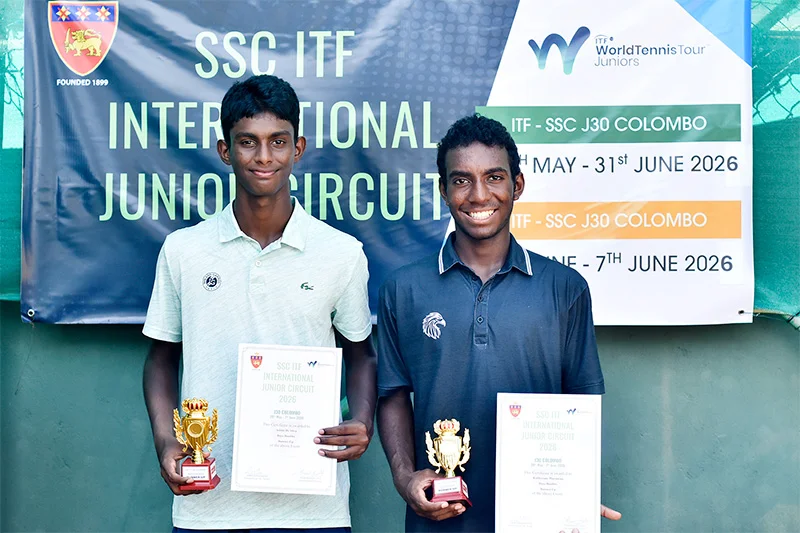
Boys’ Doubles runners-up Ashlin de Silva and Mayooran Kubherane pose with their trophies after reaching the final.
The Sri Lankan star had earlier produced one of the most dominant performances of the tournament in the semifinals, brushing aside India’s Ahida Singh 6-0, 6-0 to secure her place in the final.
Dinara’s triumph was further enhanced when she teamed up with fellow Sri Lankan Yuhansa Peiris to clinch the girls’ doubles title. The local duo defeated Hong Kong pair Ling Sum Kanna and Hiu Lam Ella Wong 5-4, 5-4 in an exciting final to complete a memorable double triumph.
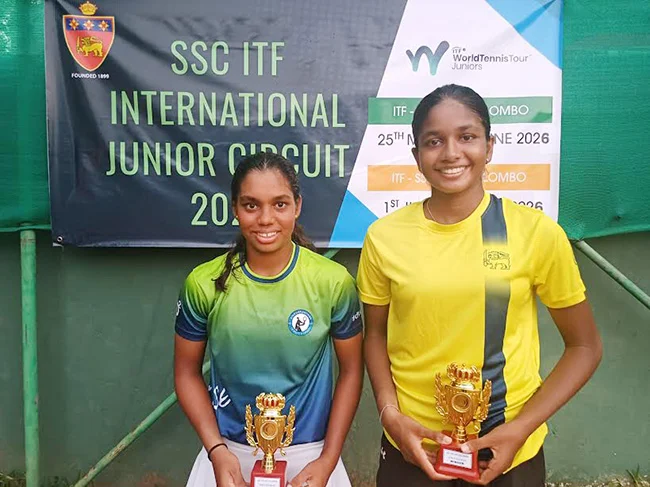
Girls’ Doubles Champions Dinara de Silva and Yuhansa Peiris.
Yuhansa also enjoyed an impressive run in the singles event, reaching the semifinals before going down to eventual runner-up Wong. The Hong Kong player prevailed 6-3, 3-6, 10-3 in a closely contested encounter.
Sri Lanka also had representation in the boys’ doubles final, where Ashlin de Silva and Mayooran Kubherane produced a spirited performance before narrowly losing to India’s Fazal Ali Meer and Singapore’s Zachary Sag. The Sri Lankan pair finished runners-up after a thrilling contest recording 5-4, 3-5, 10-8.

Protesters call on Kenyan government to halt femicide crisis

US Defense Department bars journalists from its press office

Rainy conditions are expected to increase in the southwestern parts of the island from this evening (02 June)

IMF turning a blind eye to NPP corruption: Opp.

Shavendra tells Beijing meet Sri Lanka should not become an arena for geopolitical rivalry among major powers

Govt. leaders speak to Basil more than I do – Namal

‘Dates have the highest sugar content to fight Coronavirus’

Sunday Island 27 December – Headlines

#SundayIsland 17th December – Headlines

Sunday Island – 28th March

Sunday Island Headlines – 21 March

Sunday Island – 21st February – Headlines
-

 News3 days ago
IMF urges Lanka not to meddle with exchange rate
-
 Business4 days ago
Sri Lanka’s construction industry losing ground while no one watches
-
 News3 days ago
State of emergency extended
-
 Midweek Review6 days ago
Israeli-US aggression won’t go unanswered -Iranian Ambassador
-

 Features4 days ago
The Division Bell Mystery
-

 News1 day ago
UNP challenges NPP move to amend Vihara – Devalagam Act
-

 News3 days ago
Fort Magistrate to announce whether to summon Arsecularatne PC to testify at Kapila’s inquest
-

 News5 days ago
RTI query of Ditwah funds: Presidential Secretariat mum on key questions