
News
Sri Lanka sees decline in road accidents, fatalities


Engineer advocates for increased funding to meet safety goals
By Rathindra Kuruwita
The number of deaths in road accidents in Sri Lanka has been decreasing since 2020, Kamala Gunawardena, a highway consultant with over 20 years of experience and consultant to the World Bank on road safety, says.
Sri Lankan police categorised accidents into four groups; fatal, grievous, non-grievous, and damage only, she said.According to the annual summary of road accidents, compiled by the National Council for Road Safety there were 3,003 deaths due to road accidents in 2016, 3,101 in 2017, 3,097 in 2018, 3,097 in 2019, 2,829 in 2020, 2,513 in 2021, 2,515 in 2022 and 2,280 in 2023.
Road accidents that fall under the ‘fatal accidents’ category, too, had dropped, Gunawardena, who is an engineer by profession, said. There were 2,824 accidents classified as fatal in 2016. There were 2,924 such accidents in 2017, 2,949 in 2018, 2,641 in 2019, 2,242 in 2020, 2,414 in 2021, 2,395 in 2022, and 2,171 in 2023.
“Even in the ‘damage only’ category, there were 13,675 such road accidents in 2016, in 2020 there were only 5,807 and in 2023 there were 5,903 such accidents,” she added.
Gunawardena said motor cyclists and pedestrians were most likely to be killed in road accidents. In 2019, 776 pedestrians died from road accidents. The number was 671 in 2020, 612 in 2021, 792 in 2022 and 702 in 2023 according to the statistics from the National Council for Road Safety. 1,162 motor cyclists were killed from road accidents in 2019, she said. The numbers were 1,021 in 2020, 1,124 in 2021, 820 in 2022 and 702 in 2023.
“When it comes to drivers, 282 were killed in 2019, 200 in 2020, 298 in 2021, 189 in 2022 and 168 in 2023. Meanwhile 405 passengers were killed due to road accidents in 2019, 279 in 2020, 264 in 2021, 314 in 2022 and 249 in 2023.”
Gunawardena said even Sri Lanka had an average of 38,000 crashes annually and there were around 3,000 fatalities and about 8,000 serious injuries.
She added that Sri Lanka needed an additional investment of about two billion US dollars to achieve the Sustainable Development Goal 3.6 target of a 50 percent reduction in national road crash fatalities.
Gunawardena said Sri Lanka had many ‘black spots’ on its roads, i.e., a location with a high concentration of accidents compared with other similar sections on the road system.
“If we go into more detail, these are stretches of about 500 metres in length, on which either five or 10 fatal road accidents have taken place in the last three years,” she said.












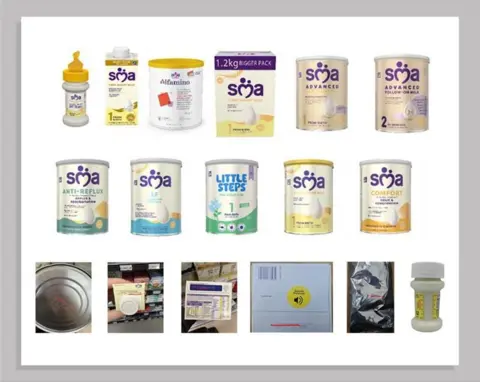
Nestle has issued a global recall of some baby formula products over concerns they contain a toxin which can cause food poisoning.
The food and drink giant said specific batches of its SMA infant formula and follow-on formula were not safe to be fed to babies.
The batches were sold across the world, Nestle said, and they potentially contain cereulide, which can trigger nausea and vomiting when consumed.
The company said there had been no confirmed reports of illness associated with the products, but was recalling them “out of an abundance of caution”.
“The safety and wellbeing of babies is our absolute priority,” Nestle said. “We sincerely apologise for any concern or inconvenience caused to parents, caregivers, and customers.”
The company confirmed to the BBC that the recall was global. Affected products were sold in several European countries, including France, Germany, Austria, Denmark, Italy and Sweden.
It stressed that all other Nestle products and batches of the same products that have not been recalled are safe to consume.
Nestle promised refunds for customers and said the problem was caused by an ingredient provided by one of its suppliers.
Nestle France said it was carrying out a “preventive and voluntary recall” of certain batches of its Guigoz and Nidal infant formulas.
In Germany, the formula products are called Beba and Alfamino.
Batch numbers of the affected products in the UK can be found on Nestle’s UK website, or through food.gov.uk.
Customers are advised to look for the corresponding code on the base of the tin or box for powdered formulas or the base of the outer box and on the side or top of the container for ready-to-feed formulas.
Cereulide is a toxin produced by some strains of the Bacillus cereus bacteria that can cause food poisoning symptoms, which can be quick to develop and include vomiting and stomach cramps.
It is unlikely to be deactivated or destroyed by cooking, using boiling water or when making the infant milk, the Food Standards Agency (FSA) warned.
The FSA’s head of incidents, Jane Rawling, said parents, guardians and caregivers should not feed infants or young children the affected products.
She added: “I want to reassure parents, guardians and caregivers that we are taking urgent action, helping to ensure all of the affected product is removed from sale as a precaution.
“If you have fed this product to a baby and have any concerns about potential health impact, you should seek advice from healthcare professionals by contacting your GP or calling NHS 111.”
[BBC]

The Cabinet of Ministers has approved the proposal presented by the Minister of Transport, Highways, and Urban Development to award the contract for printing and supplying vehicle number plates for the Department of Motor Traffic for a period of five (5) years to M/s South Asian Technologies based on the recommendations of the High-Level Standing Procurement Committee and the Procurement Appeal Board.

The National Lotteries board has been established subject to the Finance Act No. 11 of 1963. Having identified the requirement of amending that act which was imposed around 62 years to cater the current requirements of the lottery market, the Cabinet of Mnisters at their meeting held on 14.02.2017 granted approval to draft a new bill for the purpose.
Accordingly, the National Lotteries Board has recognized further amendments to be performed to the fundamental draft bill prepared by the Legal Draftsmen.
Therefore, the Cabinet of Ministers granted approval for the
resolution furnished by the President in his office as the Minister of Finance, Planning and Economic Development to direct the Legal Draftsmen to finalize the formulation of the draft bill for the National Lotteries Board as soon as possible including the proposed new amendments as well.

Selfies and smiles: South Korea seeks ‘new phase’ in ties with China

Nestle issues global recall of some baby formula products over toxin fears

M/s South Asian Technologies awarded contract to supply vehicle number plates

A new act for National Lotteries Board to be introduced
Motor Vehicles (Driving License Levy) Regulations No. 3 of 2022 to be amended
Mrs. P. K. L. S. Panduwawala appointed to the post of Surveyor General

‘Dates have the highest sugar content to fight Coronavirus’

Sunday Island 27 December – Headlines

#SundayIsland 17th December – Headlines

Sunday Island – 28th March

Sunday Island Headlines – 21 March

Sunday Island – 21st February – Headlines
-

 News15 hours ago
Broad support emerges for Faiszer’s sweeping proposals on long- delayed divorce and personal law reforms
-

 News2 days ago
Private airline crew member nabbed with contraband gold
-

 News4 days ago
Health Minister sends letter of demand for one billion rupees in damages
-

 Opinion6 days ago
Remembering Douglas Devananda on New Year’s Day 2026
-
 News7 days ago
Leading the Nation’s Connectivity Recovery Amid Unprecedented Challenges
-

 Features2 days ago
Pharmaceuticals, deaths, and work ethics
-

 Latest News2 days ago
Curran, bowlers lead Desert Vipers to maiden ILT20 title
-

 News15 hours ago
Interception of SL fishing craft by Seychelles: Trawler owners demand international investigation