
Latest News
Seychelles’ opposition leader wins presidential poll


Seychelles’ main opposition leader Patrick Herminie has won presidential elections, defeating incumbent Wavel Ramkalawan in a runoff vote, according to official results released by the electoral commission.
Herminie gained 52.7% of the vote, compared with Ramkalawan’s 47.3%.
In his victory speech, Herminie promised to lower the cost of living, revive public services, and unite the island nation, saying the result marked “a new chapter for all Seychellois”.
After losing his bid for a second term, Ramkalawan congratulated Herminie on his victory, saying he leaves “a legacy that makes many presidents blush”.
The election went to a run-off after neither candidate won an outright majority in the first round two weeks ago.
A former parliamentary speaker, Herminie was charged with witchcraft in 2023 in what he said was a politically motivated attempt to thwart his presidential ambitions.
The charges were dropped in 2024, paving the way for him to run for office.
“I will be the president of all Seychellois, and I will end divisions by ceasing preferences and giving everyone the opportunity to thrive,” Herminie said in his victory speech.
Ramkalawan is the latest incumbent to lose elections in Africa, with Malawi’s President Lazarus Chakwera voted out of power last month amid growing discontent with the rising cost of living.
Herminie’s party, United Seychelles (US), won parliamentary elections with a solid majority last month, regaining control after previously losing it to Rakalawan’s Linyon Demokratik Seselwa (LDS).
[BBC]

Latest News
Heat Index at ‘Caution Level’ in the Western, Sabaragamuwa, Southern, Eastern, North-western, Northern and North-central provinces and in Monaragala district
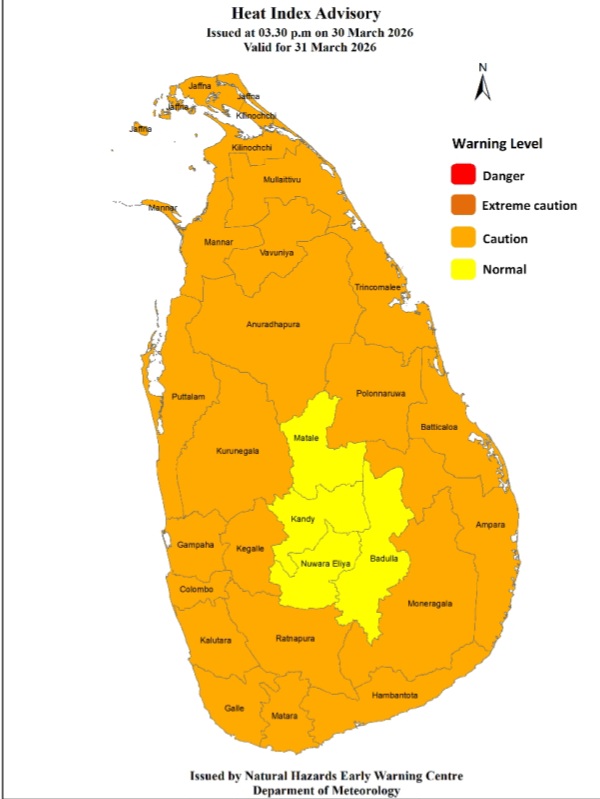
Warm Weather Advisory
Issued by the Natural Hazards Early Warning Centre
Issued at 3.30 p.m. on 30 March 2026, valid for 31 March 2026.
The Heat index, the temperature felt on human body is likely to increase up to ‘Caution level’ at some places in the Western, Sabaragamuwa, Southern, Eastern, North-western, Northern and North-central provinces and in Monaragala district.
The Heat Index Forecast is calculated by using relative humidity and maximum temperature and this is the condition that is felt on your body. This is not the forecast of maximum temperature. It is generated by the Department of Meteorology for the next day period and prepared by using global numerical weather prediction model data.

Effect of the heat index on human body is mentioned in the above table and it is prepared on the advice of the Ministry of Health and Indigenous Medical Services.
ACTION REQUIRED
Job sites: Stay hydrated and takes breaks in the shade as often as possible.
Indoors: Check up on the elderly and the sick.
Vehicles: Never leave children unattended.
Outdoors: Limit strenuous outdoor activities, find shade and stay hydrated.
Dress: Wear lightweight and white or light-colored clothing.
Note:
In addition, please refer to advisories issued by the Disaster Preparedness & Response Division, Ministry of Health in this regard as well. For further clarifications please contact 011-7446491.

The Public Utilities Commission of Sri Lanka (PUCSL) has granted approval to increase electricity tariffs with effect from 1st April .
The Ceylon Electricity Board (CEB) requested a 13.56% electricity tariff revision for the second quarter of this year.
The revision announced by the PUCSL for domestic consumers:
0–30 units category, electricity tariffs will rise by 4.3%,
31–60 units category, tariffs will rise by 6.9%,
61–90 units category, tariffs will rise by 6.9%,
91–120 units category, tariffs will rise by 7.2%,
Above 180 units, electricity tariffs will rise by 25.3%
The PUCSL has decided not to increase electricity tariffs for religious and charitable institutions that consume below 180 units monthly and a 9.6% increase for institutions that consume above 180 units.
Ectricity tariffs for the general and household consumer categories has been increased by 8%, while the electricity tariff increase for the industrial sector is 8.7%, the increase in tariff for government institutions is 14.4%.
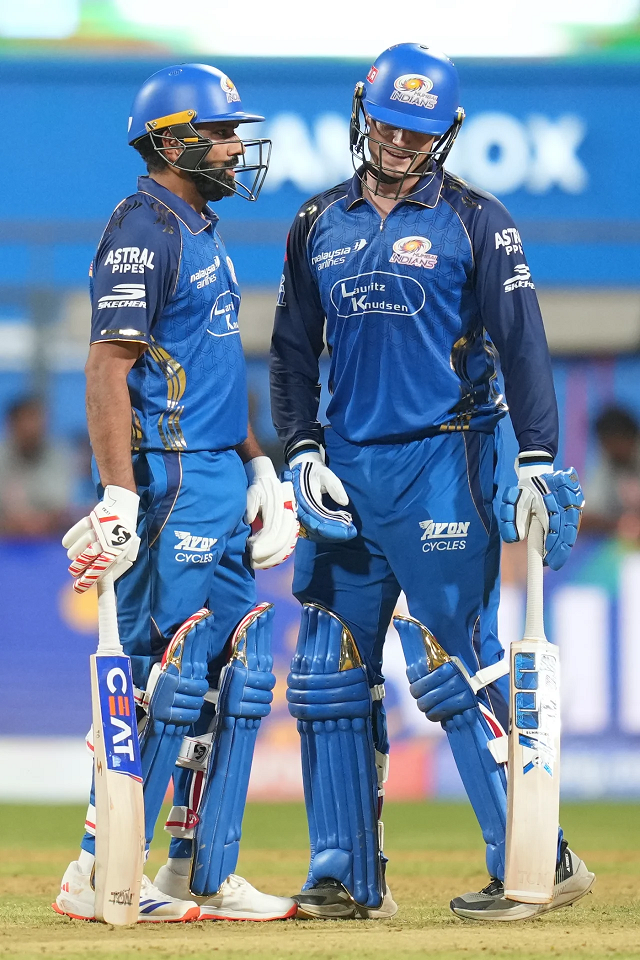
Before Sunday, Mumbai Indians had never chased down a 220-plus target in their previous seven attempts. MI had never won their opening game of the IPL since 2012. On day two of IPL 2026, MI broke two jinxes as they chased down 221 in 19.1 overs to begin their season with a comfortable six-wicket win over Kolkata Knight Riders. Rohit Sharma wound back the clock, smashing 78 off 38 balls, while Ryan Rickelton thumped 81 off 43, the duo adding 148 runs for the opening wicket off 71 balls.
That KKR were coming into this opening game severely depleted on the bowling front was known. The extent of it was visible on Sunday night with Vaibhav Arora and Blessing Muzarabani toothless, Varun Chakravarthy ineffective and Sunil Narine a shadow of his former self.
At the halfway mark, KKR might have been happy reaching 220 for 4, their second-highest score against MI in the IPL. Ajinkya Rahane, who at the toss said that he had “never seen so much of grass at Wankhede”, scored 67 off 40 balls while Angkrish Raghuvanshi, another Mumbai lad, made 51 off 29 as KKR breached the 220 mark. But against a KKR unit missing several of their frontline seamers, MI barely had any hiccups, completing the highest-successful IPL chase at the Wankhede with five balls to spare.
It was a typical Rohit innings that Wankhede has witnessed so many times, laced with some of the most pristine shots. He was on 12 off eight at one stage, but once in, he lit up Mumbai like only he can. Coming into the game, he had a strike rate of less than 100 against Varun in T20s. So, what did he do? He lofted the spinner inside-out over covers first ball and then lifted him for six the next ball. By the time the powerplay was done, Rohit had raced to a 23-ball fifty, his fastest in the IPL and MI’s chase was on course.
They raced to 80 in the first six, past 100 in 8.1 overs and by the time Rohit fell, thanks to a lovely catch by Anukul Roy running back from mid-off, MI’s required rate had gone below nine, which at the start of the innings was above 11 an over.
There were a few raised eyebrows when Rickelton was picked over the more experienced Quinton de Kock , but the former justified his selection. Rickelton needed just the first couple of overs to get a hang of the surface and once he did, there was no stopping him. He deposited Arora for back-to-back sixes, one over extra cover and then over deep midwicket, and that kickstarted a brutal takedown of the KKR bowlers.
While he saw Rohit do his thing in the powerplay, Rickelton took on Narine after the six-over mark. He slog swept him over deep midwicket in his first over and then launched him over the ropes twice in three balls in the next to raise a 24-ball fifty.
He didn’t stop there and only fell courtesy a stunning direct hit from the deep by Anukul. Suryakumar Yadav, the Impact Sub, came and went, but Hardik Pandya and Tilak Varma took MI closer. Hardik finished on an unbeaten 18 off 11 balls, while Naman Dhir hit the winning runs off Anukul as MI started their IPL 2026 in style.
Finn Allen brought his stellar form international cricket to the IPL. After facing five dot balls against Hardik, he went after MI debutant AM Ghazanfar, pumping him to the deep square fence and then spanking him for an 86-metre six over wide long-on. Another six capped off Ghazanfar’s opening over. Rahane then went after Hardik, thumping him for back-to-back sixes and Allen then got on strike and went 4, 4, 4. A monster 26-run over against Hardik helped KKR race past fifty in 3.5 overs, their fastest against MI in the IPL.
Shardul Thqkur, on MI debut, then brought his experience into play and sent back Allen who shoveled a slower length ball to long-off but Rahane carried on. He struck two fours off Thakur as KKR finished on 78 for 1 in six overs.
Two Mumbai boys on opposite ends were critical to their team’s cause. After removing Allen, Thakur sent back Cameron Green, whose innings lasted just ten balls and he then dismissed Rahane with a hard length delivery outside off that was mistimed to extra cover. At this point, KKR were still going at over ten an over but had lost steam, thanks to some terrific bowling from Bumrah, Trent Boult and Thakur.
Enter the other Mumbai boy, Raghuvanshi. He was on 17 off 14 at one stage but found a new lease of life after being dropped by Rohit at long-on. He closed out the 15th over with a four and six against Ghazanfar and then launched Thakur over long-on. Raghuvanshi added 60 off 30 balls with Rinku Singh for the fourth wicket, reaching his fifty off 28 balls as KKR raced past 200 in the 19th over.
Rinku struck unbeaten on 33 off 21 as KKR finished on 220 for 4 but it wasn’t enough.
Brief scores:
Mumbai Indians 221 for 4 in 19.1 overs (Ryan Rickelton 81, Rohit Sharma 78, Suryakumar Yadav 16, Tilak Varma 20, HardikPandya 18*; Vaibhav Arora 1-52, Kartik Tyagi 1-43, Sunil Narine 1-30) beat Kolkata Knight Riders 220 for 4 in 20 overs (Ajinkya Rahane 67, Finn Allen 37, Cameron Green 18, Angkrish Raghuvanshi 51, Rinku Singh 33*; Hardik Pandya 1-39, Shardul Thakur 3-39) by six wickets
[Cricinfo]

Burning of low-grade coal at N’cholai plant increases pollution: Parliament

Tariff shock from 01 April as power costs climb across the board

CDL under new management completes major Norwegian ship order

Govt. making arrangements for 3,500 SL Hajj pilgrims

NGO activists warn of ‘democratic dangers’ as PSTA draft bill looms over Parliament

SLC cracks the whip on fitness as slackers face selection axe

‘Dates have the highest sugar content to fight Coronavirus’

Sunday Island 27 December – Headlines

#SundayIsland 17th December – Headlines

Sunday Island – 28th March

Sunday Island Headlines – 21 March

Sunday Island – 21st February – Headlines
-

 News6 days ago
Senior citizens above 70 years to receive March allowances on Thursday (26)
-

 Features3 days ago
A World Order in Crisis: War, Power, and Resistance
-

 News4 days ago
Energy Minister indicted on corruption charges ahead of no-faith motion against him
-

 News5 days ago
US dodges question on AKD’s claim SL denied permission for military aircraft to land
-

 Business5 days ago
Dialog Unveils Dialog Play Mini with Netflix and Apple TV
-

 News6 days ago
CEB Engineers warn public to be prepared for power cuts after New Year
-

 Sports4 days ago
SLC to hold EGM in April
-

 Latest News5 days ago
A strong Technical and Vocational Education and Training (TVET) system equips individuals with practical, relevant, and future-oriented skills helping to innovate responsibly towards a greener and sustainable future – PM