
Editorial
RW moves the pawns


Nobody talks any more about the local government elections the president aborted earlier this year. It is as clear as clear can be why RW resorted to the “no money” ploy to accomplish that objective. The UNP had struck a deal with the SLPP to run together, each complementing the other, and both parties along with other aspirants went through the cosmetic motions of paying their deposits and handing nomination for an election that was even then very much in doubt. Colombo, a traditional UNP bastion, which old timers would remember was wrested by the greens led by Messrs. J.R. Jayewardene and V.A. Sugathadasa soon after Mr. Bandaranaike’s ‘People’s Revolution’ of 1956, was conceded to the UNP and so possibly was Kandy. SLPP General Secretary Sagara Kariyawasam repeatedly claimed his party was not afraid of elections while the issue of holding them was being canvassed both before the Elections Commission and the courts.
A sitting SJB MP, Mr. Mujibur Rahman, resigned his seat in parliament to run for Mayor of Colombo. The president did say at one point of time that he had sent a message to Rahman to warn him that he shouldn’t vacate his parliamentary seat, but the latter has denied this claim. Whether the messenger failed to deliver, or there was no such message, or whether it was unreceived or not was never thrashed out in the public domain. But the fact remains that veteran politician AHM Fowzie who has batted for both the UNP and SLFP in national and municipal politics is back in parliament filling Rahman’s vacancy. He’s already defied the SJB whip to vote for the recent resolution on the IMF deal when the SJB had decided to be absent at voting time. He’s been suspended though not expelled from his party for his pains. This has provoked the question of whether Fowzie has expectations of office but many believe that at age 85-years, he’s more interested in ensuring that is son succeeds him in politics.
Be that as it may, last week’s removal of three Gotabaya Rajapaksa appointed provincial governors and their replacement by the president have many national political implications. Undoubtedly the appointment of CWC President Senthil Thondaman as the new Governor of the Eastern Province is related to RW’s aspiration to be the elected president of the country. Senthil’s cousin, Jeevan Thondaman, the CWC’s general secretary, was recently appointed the country’s youngest cabinet minister by RW. Now Senthil has been made a governor and the obvious signal is that Wickremesinghe is wooing plantation Tamil votes in any forthcoming presidential election. Both Thondamans are direct descendants of the late S. Thondaman, the leader of the plantation worker community of recent Indian descent, who wielded tremendous political clout in post-Independence Ceylon and Sri Lanka.
Speculative reports that Wickremesinghe may even attempt to hold a presidential election at the end of this year has been widely published. Given that he was elected by parliament in July last year to serve GR’s balance term which runs till November 2024, Wickremesinghe cannot call an early presidential election without an amendment to the constitution. Whether he can engineer the necessary two thirds majority to push through such an amendment is regarded unlikely by analysts who argue that even the 134 votes in parliament that RW mustered to be elected to serve the balance GR term, has not held. Also the question arises whether a court will hold that a mere two thirds majority is sufficient to enact such a constitutional amendment as it can be argued that the matter involves the franchise of the people that also requires a referendum. But it should not be forgotten that when Mahinda Rajapaksa sought to annul the constitutionally stipulated two term limit on the presidency, the then Chief Justice Shirani Bandaranayake ruled that no referendum was necessary as abolishing the term limit enhanced rather than diminished the franchise. That proved unfortunate for MR who lost his 2015 bid for a third term.
The SJB which a few days ago unanimously anointed Sajith Premadasa as its next presidential candidate will most likely favour an early presidential election and may support such an election by supporting the necessary constitutional amendment. But the SLPP which has not yet decided on its next presidential candidate may probably prefer more time to make up its mind. Some SLPPers have already expressed support for Ranil Wickrenesinghe. Other are sitting on the fence.
The Rajapksas and their supporters are now out of the woodwork and at least one of the three governors appointed last week seem to have been an SLPP nominee. It is not clear whether the appointment of Mrs. P.S.M. Charles as the new Governor of the Northern Province was part of Wickremesinghe’s strategy of mending fences with the Tamils. She had earlier served as Governor of the North and wartime GA of Vavuniya. RW is now empowered by the Constitution to dissolve parliament and hold a fresh election if the SLPP stretches its luck. But he’ll have to do so with the full knowledge that his UNP is hardly in a position to put up a credible fight without some arrangement with the SJB.
The JVP/NPP is also a clear loser of the local elections not being held. Most analysts believed that it had every chance of making a showing that it is a credible alternative to the SJB. RW is also reportedly considering staggered provincial elections, it has been said. But if there was no money for local elections how can there be funds for any elections? Sri Lanka’s foreign friends and multilateral donor agencies are less than likely to do business with a government determined to deny its people their franchise.









Friday 3rd April, 2026
Sri Lankan governments are said to be like cattle-rustling trucks displaying various religious blessings above their windshields. A government once came to power promising to create a righteous society but did the very antithesis of its pledge. Its rule paved the way for a culture of political violence, election malpractices and corruption. One of the promises made by the JVP-NPP government during its election campaigns was to restore the rule of law. Those who voted for it may have expected it to ensure that everyone would be equal before the law. But it is doing the diametrical opposite of its promise. Ruling party politicians and backers violate the law with impunity.
The Gampaha Magistrate’s Court has recently ordered that an office forcibly taken over by a gang of JVP goons at Yakkala last year be handed back to the Frontline Socialist Party (FSP), which occupied it previously. In September 2025, a group of JVP cadres, led by a deputy minister, descended on the place, assaulted the FSP members staying there and seized the property, with the police siding with the ruling party mob. The JVPers produced what they described as a court order, claiming that the place rightfully belonged to them. The FSP protested, but in vain. The JVP asked the police to act according to the “court order”. The police put up a barricade near the disputed office for the safety of the JVP members. It is now clear that the JVP members not only misled the police but also caused an affront to the dignity of the judiciary by making a false claim. But no action has been taken against them.
Energy Minister Kumara Jayakody, facing a serious charge of corruption, was not arrested, unlike other suspects. He was indicted and bailed out on the same day. The Commission to Investigate Allegations of Bribery or Corruption arrests and hauls up before court Opposition politicians and state officials, whose offences pale into insignificance in comparison to the aforementioned corruption charge against Jayakody and the multi-billion-rupee coal procurement racket he has allegedly committed.
It has been reported that the Hambantota police recently warned and released a person taken into custody for clearing a section of a forest reserve under the Mahaweli Authority (MA) in Hambantota. A group of environmentalists and some concerned farmers protested when the suspect started clearing the protected area by using a backhoe, claiming that he was acting with the blessings of two JVP politicians in the area. The MA security personnel rushed to the scene and took the suspect and the backhoe into custody.
Ordinary people taken into custody for destroying forests are handed over to the police immediately afterwards and charges are pressed against them within 24 hours. But the MA took two days to make a complaint to the police against the above-mentioned suspect. In response to an RTI request, the police have said they released the suspect after warning him as the MA withdrew its complaint. Obviously, the MA and the police have succumbed to government pressure. There is sufficient ground for legal action against the MA officials and the police for releasing a suspect involved in illegal forest clearance.
If the JVP leaders and rank and file have any sense of gratitude, they ought to protect and conserve forests, which sheltered them during their first and second uprisings and helped save their lives. They should learn from the Buddha, who paid his gratitude to the Bo tree that had given him shade when he attained Enlightenment; he spent the second week after attaining Buddhahood, gazing steadily at that Bo tree without blinking. Sadly, two years into office, the JVP-led government has allowed its politicians and supporters to destroy forests with impunity. It looks as if the JVP politicians had waited for decades, looking at forests without blinking, until an opportunity presented itself for them to cut down trees and grab land.
Two policemen who went above and beyond the call of duty to arrest a drug dealer in another police area have been taken off their regular duties as a disciplinary measure because some government politicians have taken exception to their action, which, in our view, should be commended. This was revealed at a recent meeting, where Deputy Minister of Public Security Sunil Watagala ordered the police to ensure that their personnel confined their drug busting ops to their bailiwicks. Curiously, no action has been taken against the police officers who released an offender responsible for grabbing a section of a forest reserve and clearing it.


Thursday 2nd April, 2026
The truth about the 2019 Easter Sunday terror attacks remains buried under a mountain of conspiracy theories. The way most stakeholders have sought to get at the truth reminds us of the ancient folk tale, The Blind Men and the Elephant. They have grasped only fragments of what they believe to be the truth, each assuming that his or her limited perspective represents the entire reality. There are still others who have let their political prejudices and self-interest colour their vision of the issue, making it even more difficult to uncover the truth. However, all these viewpoints need to be examined carefully if investigators are to avoid the confirmation bias that could make them selective in gathering and examining evidence. It is against this backdrop that a host of arguments and counterarguments in Udaya Gammanpila’s book (in Sinhala), Pasku praharaye mahamolakaru soya yema (“Searching for the mastermind behind the Easter Sunday attacks”), launched on 31 March, should be viewed.
Udaya’s book is an attempt to demolish some dominant conspiracy theories about the mastermind behind the Easter Sunday carnage, challenge the credibility of the investigators who have launched a fresh probe into the terror attacks and assail the integrity of the ongoing investigation.
Former Attorney General (AG) Dappula de Livera caused quite a stir by claiming that there had been a ‘grand conspiracy’ behind the Easter Sunday attacks because he failed to secure a service extension from the then President Gotabaya Rajapaksa, Udaya has alleged, claiming that the former AG has refused to cooperate with investigators and support his claim with evidence.
The book says President Anura Kumara Dissanayake shelved the report of the Alwis Committee appointed by President Ranil Wickremesinghe. The committee held former Senior DIG Ravi Seneviratne, who was in charge of the CID at the time of the Easter Sunday attacks, accountable for the CID’s lapses that led to the carnage. President Dissanayake brought Seneviratne out of retirement and appointed him Secretary to the Ministry of Public Security. Udaya claims that former SSP Shani Abeysekera, who was reappointed CID Director in retirement, in an affidavit in a Fundamental Rights case, concealed the fact that on 12 April 2019, nine days before the Easter Sunday attacks, the military intelligence had sent a detailed report to the CID about the involvement of Zahran Hashim’s terror group, National Thowheed Jamaath (NTJ), in the killing of two policemen at Vavunathivu in November 2018, pointing out that the CID would be able to ascertain more information by interrogating Zahran’s brother Rilwan and another person called Army Mohamed. Udaya is of the view that Abeysekera concealed this fact to cover up his failure to prevent the carnage despite having received credible information about Zahran’s terrorist activities. The intelligence agencies provided 337 reports on Islamic extremist groups and Zahran’s terrorist activities to the police, Udaya has said, quoting from a probe commission report and arguing that if they had been behind the Easter Sunday attacks, they would never have furnished such information to the police.
The alleged disappearance of Sara Jasmine, widow of the Katuwapitiya bomber, Muhammadu Hastun, is used as a peg to hang the conspiracy theory that she fled to India as she had links to India’s RAW. Minister Nalinda Jayatissa himself propagated this claim while in the Opposition. Some politicians have alleged that Gotabaya Rajapaksa had a fresh DNA test conducted, at the behest of the then top intelligence officer Maj. General Suresh Sallay, to mislead the world into believing that Sara was among the NTJ activists killed in suicide blasts at Sainamaradu a few days after the Easter Sunday attacks. In the first two tests, DNA samples obtained from Sara’s mother did not match the DNA profiles of the victims. Udaya says that as the forensic reconstruction of the remains of the Sainamaradu bomb victims was extremely difficult, many body parts collected from the blast site had been buried in a bag; the third DNA test was conducted on the remains in the bag, and that was the reason for the different test results.
Udaya has said Azad Moulana, whose claims form the basis for a Channel 4 programme that holds Sri Lankan military intelligence responsible for the Easter Sunday carnage, is a lawbreaker, seeking political asylum in a developed country. Claiming that Moulana had links with the NTJ and helped Zahran’s brother, Rilwan, receive treatment for injuries sustained in a test blast in the East, Udaya has pointed out that the house where Moulana says Sallay met Zahran in February 2018 had been built only in August/September 2018. Most of all, Sallay was abroad from December 2016 to December 2019. The NTJ bomber who failed to explode himself at the Taj Hotel went to Dehiwala on his own, according to instructions given by Zahran before the attacks, and therefore Moulana’s claim that the military intelligence sought his help to give someone at the Taj Hotel transport does not bear scrutiny, Udaya says.
As for the unexploded bomb at the Taj Hotel, a list of hotel guests’ names was sent to intelligence agencies only a few moments before the blasts on 21 April, and the bomber, Jameel Mohamed, had used his father’s name for registration, and therefore even if the list had been sent earlier, nobody would have been able to trace him, Udaya argues in his book, pointing out that military intelligence officers tried to contact Jameel only after being alerted by a retired SSP, who had served as an intelligence officer. Jameel’s wife, who panicked, unable to contact her husband after receiving a voice message from him, kept on calling his number while he was still at the Taj Hotel. All calls that went unanswered, as seen in hotel CCTV footage, were from Jameel’s wife and not from the military intelligence, Udaya says. Jameel’s wife then contacted Jameel’s brother, who sought the help of the aforementioned former SPP. Bombs had gone off by that time, and the former SSP, realising the gravity of the situation, informed the intelligence agencies. Jameel contacted his wife, using a security guard’s telephone from a mosque in Dehiwala, where he went from the Taj Hotel. In the meantime, the intelligence officers rushed to his house, used his wife’s phone to call the unknown number, spoke to the security guard and asked him not to allow Jameel to leave. Jameel, who had left by that time, blew himself up in a guesthouse in the area.
Udaya argues that an efficient intelligence operative, using the nom de guerre, Sonic Sonic, who has been described in some quarters as the Easter Sunday terror mastermind, won the confidence of Podi Zahran (Rahuman Mohamed Zahran) working for the NTJ and obtained information about the terror group. According to Udaya’s book, after the Easter Sunday blasts, Sonic Sonic did not ask Podi Zahran to have IS take responsibility for the attacks, contrary to conspiracy theorists’ claims; instead, he only asked Podi Zahran why IS had not taken responsibility if it was behind the carnage, and this query has been misinterpreted as an attempt to pressure Podi Zahran to have IS say it was behind the attacks, as part of a cover-up.
What one gathers from Udaya’s book is that Zahran was the IS leader in Sri Lanka, and he organised and executed the Easter Sunday attacks. Drawing inspiration from the Bangladesh IS leader who carried out a suicide attack, Zahran blew himself up as he did not want to be caught alive. Following the raid on the Wanathawilluwa camp, where a huge stock of explosives belonging to the NTJ was taken into custody, and the breakaway of a group of NTJ members, including the ‘Deputy IS leader in Sri Lanka’, Mohamed Naufer, Zahran feared that someone would betray him and there would be a crackdown on his terror network.
Udaya’s book provides fresh insights into some crucial issues that have been used to concoct conspiracy theories and level unsubstantiated allegations against the intelligence agencies. It is bound to provoke debate. One can only hope that there will not be a witch-hunt against the author.
Wednesday 1st April, 2026
The JVP-NPP government continues to signal left and turn right. President Anura Kumara Dissanayake often does the diametrical opposite of what he promised to do while he was an Opposition MP, so much so that his political opponents mockingly ask whether former JVP MP Dissanayake has disappeared and the incumbent President is a doppelganger. SLPP General Secretary Sagara Kariyawasam tongue in cheek lamented, at a media briefing on Monday, that the former progressive Opposition MP Dissanayake had gone missing and someone else resembling him had become President.
President Dissanayake is unashamedly defending Energy Minister Kumara Jayakody, who is under a cloud, claiming that ministers cannot be sacked for what they allegedly did before being appointed to the Cabinet. But while in the Opposition, he said no politician facing allegations of wrongdoing must be elected to Parliament or any other institution, much less elevated to the Cabinet. Jayakody has also been accused of manipulating the coal procurement process in favour of an India company, which has supplied more than a dozen shipments of low-grade coal, causing a massive decrease in electricity generation at the Norochcholai power plant and a huge increase in oil-fired electricity generation as a result. This is one of the reasons for the latest electricity tariff hike.
During his presidential election campaign, Dissanayake promised that if elected President, he would ensure that nobody would be above the law. But Minister Jayakody was not arrested and remanded despite a serious charge against him that he caused a loss of about Rs. 8 million to the state through a crooked deal while serving as the procurement manager of the state-owned fertiliser company about 10 years ago. He was indicted and bailed out on the same day recently. This is in sharp contrast to the manner in which the Commission to Investigate Allegations of Bribery or Corruption has acted against former Minister Johnston Fernando and his two sons; they have been arrested and held on remand for the alleged misuse of a state-owned lorry and causing a loss of about Rs. 2.5 million to the Treasury.
Dissanayake and his party urged the previous governments to uphold transparency and accountability among other things. They pressured the SLPP-UNP government to disclose the current IMF agreement. But President Dissanayake and his ministers refuse to reveal the contents of their MoUs/pacts with India and the US.
Dissanayake used to launch into tirades against India and the US while he was an Opposition MP, demanding an end to their interference with Sri Lanka’s internal affairs. He once declared in Parliament that Jaffna had become a den of Indian spies on a mission to destabilise this country. But today he is eating out of the hands of Indian and American leaders.
A powerful millers’ cartel is manipulating the rice market. Dissanayake used to thunder in Parliament, condemning previous governments for pandering to the whims and fancies of big-time rice millers. But since his election as President, he has not cared to take any action to tame the millers’ Mafia, and farmers and consumer rights groups accuse his government of going out of its way to look after the interests of the large-scale millers who are known to have huge slush funds to bankroll election campaigns.
Dissanayake and his comrades condemned the previous government for keeping fuel prices high by increasing taxes, imposing a loss-recovery levy and obtaining illegal commissions from petroleum suppliers. The JVP/NPP made a solemn pledge to do away with corruption, reduce taxes and special levies and bring fuel prices to affordable levels. But the fuel prices soared under the JVP-NPP government even before the eruption of the Iran war. It has ignored a proposal that the loss-recovery levy on fuel be converted into a special commodity tax that can be collected from the private companies engaged in fuel trade. President Dissanayake’s government has enabled supermarket chains to monetise environmental pollution, as it were, by charging customers for single-use polythene bags instead of providing them with biodegradable grocery bags free of charge, as in other countries. It has ignored a proposal by environmentalists that supermarkets, etc., be made to transfer the proceeds from the polythene tax to the Treasury so that they can be utilised for environment protection/conservation projects.
The rich are getting richer under the current dispensation, with rice millers importing Rolls-Royces and indulging in a vulgar display of their wealth while farmers are forced to pawn their agricultural equipment and consumers are complaining of high prices of rice. The JVP/NPP politicians, who came to power promising to practise austerity, are now moving about in the fuel-guzzling luxury vehicles they promised to auction at Galle Face to raise funds for education and health. What they are practising at present runs counter to the Marxist ideals they claimed to espouse while out of power.
Thus, a wag asks whether we are witnessing a transfer of consciousness, whereby some capitalists of the same ilk as J. R. Jayewardene have taken possession of the JVP bigwigs’ frames.

Kuwait desalination plant, oil refinery hit by missile and drone strikes

Chamodi Prabodha to lead Sri Lanka women’s U19 National Team for the tour of Australia

Sri Lanka Cricket Appoint National coaches for Bowling, Fielding and Spin Bowling

Trump fires Pam Bondi as US attorney general, elevates Todd Blanche

Klaasen fifty, Travishek onslaught hand Sunrisers Hyderabad first points of the season

Atmospheric conditions will be favorable for afternoon thundershowers in most parts of the island.

‘Dates have the highest sugar content to fight Coronavirus’

Sunday Island 27 December – Headlines

#SundayIsland 17th December – Headlines

Sunday Island – 28th March

Sunday Island Headlines – 21 March

Sunday Island – 21st February – Headlines
-

 Features7 days ago
A World Order in Crisis: War, Power, and Resistance
-

 News4 days ago
Tariff shock from 01 April as power costs climb across the board
-
 News7 days ago
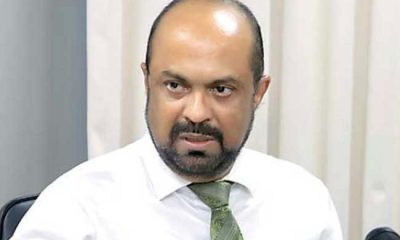
Minister Jayakody indicted in Colombo High Court over alleged corruption
-
 News5 days ago
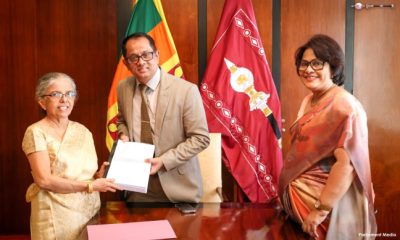
Inquiry into female employee’s complaint: Retired HC Judge’s recommendations ignored
-
 News7 days ago
Police look for male partner of Chinese woman found stabbed to death at an apartment in Kohuwala
-

 News2 days ago
2025 GCE AL: 62% qualify for Uni entrance; results of 111 suspended
-

 Features5 days ago
New arithmetic of conflict: How the drone revolution is inverting economics of war
-

 Business3 days ago
Hour of reckoning comes for SL’s power sector