
Latest News
Rohit Sharma’s 87 headlines India’s essay on unpredictable Lucknow surface

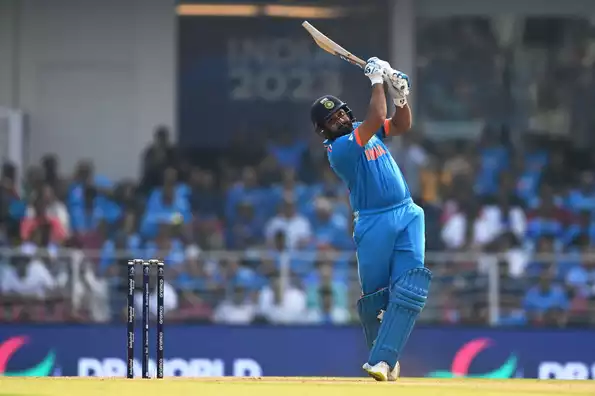
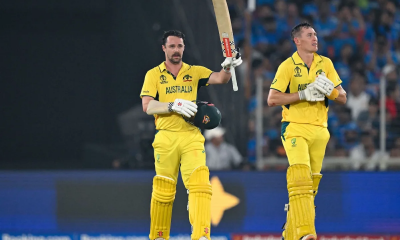
Rohit Sharma batted on a different pedestal to his peers on a wildly unpredictable Lucknow surface against England as his 101-ball 87 helped India wade past their wobbly start. Suryakumar Yadav then chipped in with a vital 49 that took India to 229 for 8 in 50 overs
For the first time in this World Cup, India have had to bat first and suffered multiple early blows courtesy the unevenness of the pitch and how differently it behaved even on successive deliveries.
On the hot Sunday afternoon, Rohit began to chance his arms early, like he’s done all through this World Cup. David Willey was the earliest recipient of that carnage as Rohit hit him for two sixes in the 18-run third over. Shubman Gill, who was looking to ease into the innings in his captain’s company was undone by a Chris Woakes delivery that unexpectedly nipped back in to go through his bat-pad gap and rattle the stumps.
There were early signs that the ball was stopping on the pitch, as Willey tied Virat Kohli down right at the start of his innings. Kohli played out eight dot balls before deciding to try and break the rut, but his attempt to hit over the infield was futile as his shot went straight to Ben Stokes at mid-off. India were further rattled by Shreyas Iyer’s decision to pull a ball that wasn’t short enough and end up top-edging it to Mark Wood at mid-on.
From 40 for 3 in the 12th over, India’s essay was rebuilt by Rohit and KL Rahul, who were batting together in an ODI for the first time since January 2020. Even as the innings progressed, the bounce on this surface was hard to trust but Rohit still scored at a brisk pace, getting to his 54th ODI fifty off 66 balls. The closest England came to dismissing Rohit in the middle overs was when the umpire raised his finger for an LBW appeal, only for the Indian captain to get it overturned on review.
In the midst of slow progress, Liam Livingstone started out with a maiden over as he got sharp and quick turn. Rahul however, got the better of the spinner in his second over, sweeping to the vacant backward square leg region and getting a streaky four off the outside edge too. Rohit reverse-lapped him past the short third man in another over where Livingstone conceded a couple of fours. Against the run of play, however, Willey got Rahul to play a risky shot that cost the keeper-batter his wicket. As a partnership between Rohit and Suryakumar Yadav began to grow, Jos Buttler brought back Adil Rashid for a second spell after he went for just 22 runs off six overs in his first.
The leggie struck right away to end Rohit’s exceptional innings, that also saw him get to 18,000 international runs, as the latter looked to slog a googly but didn’t get enough behind it to clear the deep midwicket. Livingstone ran in from the deep and completed a sharp catch. Rashid put India at the risk of folding for a sub-200 total when he trapped Ravindra Jadeja leg-before but Suryakumar earned his ODI stripes with a solid 49 off 47 balls. Buttler brought back Mark Wood to take an aim at India’s long tail and the bowler found success immediately with the wicket of Mohammed Shami, that left India in a vulnerable position of 183 for 7 in 42 overs.
Suryakumar found himself in familiar territory – batting in the death overs – and unleashed a shot only he could – a monstrous flick off Wood over fine leg for a six. But he fell in the 47th over trying to clear the off-side field with a big shot, giving Willey his third wicket of the game. Jasprit Bumrah and Kuldeep Yadav frustrated England right at the end, with the former even hitting a 149kmph delivery from Wood for a four past mid-on. He and Kuldeep added 21 valuable runs for the ninth wicket.
Brief Scores:
India 229/9 in 50 overs (Rohit Sharma 89, Suryakumar Yadav 49, KL Rahul 39; David Willey 3-45, Adil Rashid 2-35 Chris Woakes 2-33) vs England








Todd Murphy is firming to play his first home Test, after the SCG’s head curator declared the pitch’s green covering would be near-irrelevant come day one.
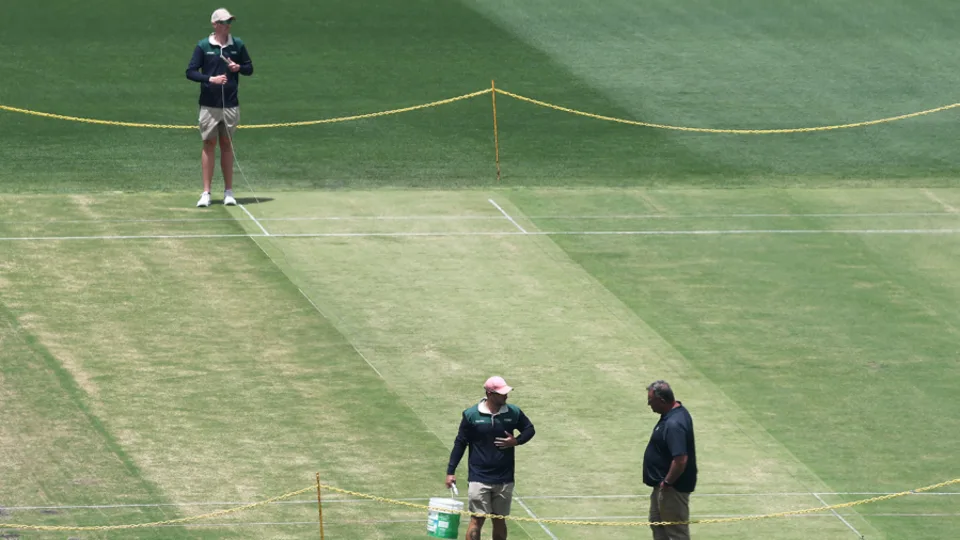
With administrators still on edge after last week’s two day debacle in Melbourne, an extremely green SCG surface raised eyebrows in Sydney on Thursday.
But chief curator Adam Lewis insisted on Friday that should not be a concern, and he was hopeful Sydney would extend into a fifth day.
“You want to see green tinge three days out,” Lewis said. “If you’re not seeing any live grass three days out, then that’s when it’s a worry, … I’m really comfortable with where we’re sitting.
“We had a little bit of sun this morning. They’re saying a bit more sun tomorrow. That will take the greenness out of the pitch. We’re really happy with the pitches at the moment. We’re looking good.”
Lewis admitted he felt for MCG counterpart Matt Page last week, but said he felt no external pressure to ensure the fifth Test in Sydney went the distance.
It’s estimated that Cricket Australia (CA) has lost in the vicinity of AUD15 million in profits this summer, with the opening Test in Perth also finishing inside two days.
Even Prime Minister Anthony Albanese joked at a function with teams on Thursday night that they had to ensure the game went to day three, in order to support the McGrath Foundation fundraiser.
One of the hardest grounds in the world to bowl on between 2014 and 2023, last year’s SCG Test was over in just two-and-a-half days.
Lewis said that his ground staff would go with 6mm of grass this year compared to 7mm last season, while also reducing its density. That in itself generally acts to flatten out the wicket and produce less movement, while also inviting the chance of spin late in the match.
“We just thought … we could thin our density out a little bit,” Lewis said. “That’s what we’ve done this year. We’ve practised that in the Shield matches and we’ve received very good marks.”
CA CEO Todd Greenberg said he too was confident the SCG Test would last the distance.
“I’ve had more phone calls and conversations about wickets and millimetres of grass than I thought I’d ever have,” Greenberg said. “But I’m hopeful and confident we will have a long and productive Test match here.”
All of which should spell good news for Murphy. Australia’s coaching staff had a prolonged conversation around the pitch on Friday morning, after leaving Murphy out and going with four quicks at the MCG.
Murphy then spent most of Friday’s training session bowling to Australia’s top order, while Alex Carey also had an extended run keeping to him.
With seven Tests to his name overseas, Murphy would be expected to come in for Jhye Richardson if he does play in Sydney.
England have promised to take the attack to Murphy, who played two Tests during the 2023 Ashes were he conceded 4.72 an over.
“Whoever plays, I think that’s the mantra of our team, is to try and put pressure on people,” opener Zak Crawley, said. “Todd’s a very good bowler, but I can envisage us trying to put some pressure on him, like we would all their bowlers.
That’s going to come with some risks, and if it’s turning it’s definitely going to be a threat. But I think we’ll try and put pressure on all their bowlers.”
The other question for Australia will be whether Cameron Green remains in the side, after Beau Webster was spotted fielding in the gully during slips training on Friday. Green has averaged 18.66 with the bat in this series. The SCG was the scene of Webster’s debut a year ago against India.
[Cricinfo]

Palestine was the deadliest place to work as a journalist in 2025, with the Middle East as a whole the most dangerous region for media professionals, according to a global journalist union.
The International Federation of Journalists (IFJ) said the region accounted for 74 deaths last year – more than half of the 128 journalists and media workers killed – in a new report released on Wednesday.
The Middle East was followed by Africa with 18 deaths, Asia Pacific (15), the Americas (11) and Europe (10), according to the report. The vast majority of those killed were men, but the list included 10 women.
“128 journalists killed in a single year is not just a statistic; it is a global crisis. These deaths are a brutal reminder that journalists are being targeted with impunity, simply for doing their job,” IFJ General Secretary Anthony Bellanger said.
Palestinian journalists were the biggest cohort of victims: 56 Palestinian media professionals were killed in 2025. Yemen followed, with 13 deaths, Ukraine, with eight, and Sudan, with six, according to the IFJ.
The Paris-based media union cited Israel’s killing of Al Jazeera journalist Anas al-Sharif as the most “emblematic” of the 56 journalists murdered in Palestine last year covering Israel’s genocidal war on Gaza. Al-Sharif, 28, was killed on August 10 alongside several colleagues when Israeli forces struck a media tent outside Gaza City’s al-Shifa Hospital.
The attack also killed Al Jazeera correspondent Mohammed Qreiqeh, Al Jazeera camera operators Ibrahim Zaher and Mohammed Noufal, freelance camera operator Momen Aliwa and freelance journalist Mohammed al-Khalidi.
IFJ also cited an Israeli strike in early September on a Yemeni newspaper office as “one of the worst-ever attacks on a media office”. Thirteen journalists and media workers at the Houthi-affiliated “26 September” newspaper were killed, along with more than 20 other people.
Another nine deaths were ruled as accidents, while others – including two journalists in Syria and two in Iran – were “targeted and killed” because of their work, IFJ said.
While the Middle East was the deadliest region for the third year in a row in 2025, the Asia Pacific accounted for the largest number of journalists and media workers behind bars. Most cases in 2025 were in China and Hong Kong, which together accounted for 143 journalists, followed by 49 in Myanmar and 37 in Vietnam.
Europe was another detention hotspot last year, accounting for 149 imprisoned journalists. IFJ attributed the figure, up 40 percent from a year earlier, to “intensified repression in Azerbaijan and Russia”.
[Aljazeera]

United States President Donald Trump has said that he will delay the implementation of tariffs on upholstered furniture, kitchen cabinets and vanities for one year, amid growing concerns over cost-of-living issues.
Trump signed an order on Wednesday night, during the New Year’s Eve holiday, pausing a planned 50 percent tariff on cabinets and vanities and a 30 percent tariff on upholstered furniture.
But the order maintained the 25 percent tariff he put in place for those products in September.
The US president had previously described the furniture tariffs as a step to “bolster American industry and protect national security”.
Polls indicate that rising prices and the cost of living are major concerns for people in the US as the country approaches its 2026 midterm elections, scheduled for November.
Voters hold President Trump’s policies, and tariffs in particular, at least partly responsible for their economic woes. A Politico poll released in December found that 30 percent of respondents cited tariffs as the primary reason prices were high, and 32 percent said that Trump bears “full responsibility” for the state of the economy.
A majority of respondents cited the cost of living as a top issue facing the country, while 32 percent cited the state of the economy. Democratic politicians have sought to hammer Trump and his Republican Party on affordability concerns, which Trump has waved away as a “hoax” perpetuated by his political rivals.
The Italian foreign ministry said on Thursday that the US had also agreed to slash proposed import duties on pasta products from 13 companies.
Previously, the Trump administration had threatened the pasta companies with additional tariffs of 92 percent, in addition to import taxes on European Union products.
Italy’s foreign ministry said that the US Commerce Department had agreed to bring that rate down to 2.26 percent for La Molisana and 13.98 percent for Garofalo, two Italian food companies the administration had accused of undercutting other pasta producers through unfairly low prices.
The other companies will face a rate of 9.09 percent.
“The recalculation of the duties is a sign that US authorities recognise our companies’ constructive willingness to cooperate,” the foreign ministry said.
[Aljazeera]

Over 400,000 Russians killed, wounded for 0.8 percent of Ukraine in 2025

SCG curator ‘really happy’ with pitch for final Ashes Test

Showery condition is expected to enhance in the Eastern, Northern and Uva provinces during the coming days, due to the development of a low-level atmospheric disturbance to the East of Sri Lanka

GMOA warns of trade union action unless govt. urgently resolves critical issues in health sector

Elephant census urged as death toll nears 400

CTU raises questions about education reforms

‘Dates have the highest sugar content to fight Coronavirus’

Sunday Island 27 December – Headlines

#SundayIsland 17th December – Headlines

Sunday Island – 28th March

Sunday Island Headlines – 21 March

Sunday Island – 21st February – Headlines
-

 Sports5 days ago
Gurusinha’s Boxing Day hundred celebrated in Melbourne
-

 News3 days ago
Leading the Nation’s Connectivity Recovery Amid Unprecedented Challenges
-

 Sports6 days ago
Time to close the Dickwella chapter
-

 Features4 days ago
It’s all over for Maxi Rozairo
-

 News6 days ago
Environmentalists warn Sri Lanka’s ecological safeguards are failing
-

 News4 days ago
Dr. Bellana: “I was removed as NHSL Deputy Director for exposing Rs. 900 mn fraud”
-

 News3 days ago
Dons on warpath over alleged undue interference in university governance
-
 Features6 days ago
Digambaram draws a broad brush canvas of SL’s existing political situation