
Sports
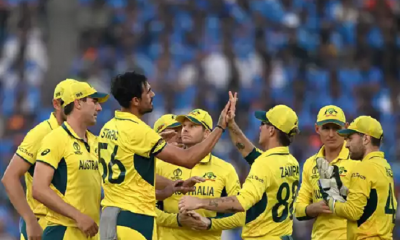
Head knocks the wind out of India as Australia clinch sixth World Cup

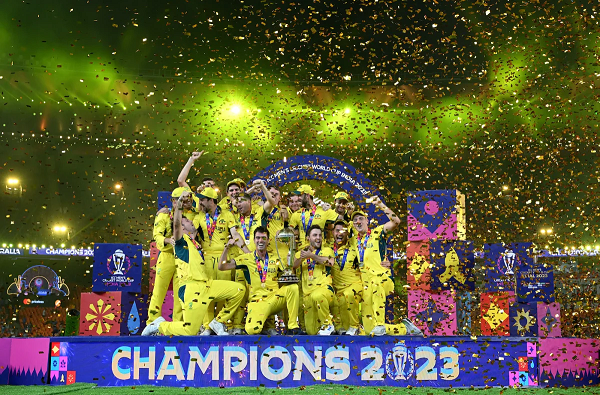
After 10 consecutive wins to reach the final, India were outplayed by Australia on a slow Ahmedabad pitch as the visitors clinched an eye-popping sixth men’s World Cup title. If Australia’s bowlers put the choke-hold to restrict India to 240, it was Travis Head who delivered the final slam with his rollicking 120-ball 137 as they cruised to a six-wicket win.
Head, playing decisive roles in the semifinal and final of a World Cup, ensured he placed his name in history and joined an elite list of Mohinder Amarnath, Aravinda de Silva and Shane Warne to win Player of the Match awards in the knockout games.
The chase was not without stutters early on, as Australia slipped to 47/3 albeit with a healthy run-rate. Mohammed Shami, tasked with the new ball for the first time in this World Cup, struck with his second ball to have David Warner caught at slip. Jasprit Bumrah, after conceding 15 in his first over, bounced back to have Mitchell Marsh caught behind and outfoxed Steven Smith with a slower ball. Smith chose not to review with replays later confirming that he was struck outside off, and it betrayed signs of nerves in the chase.
However, Head along with a disciplined Marnus Labuschagne slowly and steadily reversed the pressure with a 192-run stand. With the spinners not getting much purchase on a slow surface, the duo stuck to their plans of rebuilding with a mixture of defence and attack. India’s second line of attack fell apart as Head first slog-swept Kuldeep Yadav for a six and Jadeja was consistently milked. It meant that the final became the only game in this World Cup where India’s spinners went wicketless, with the slowness off the surface largely negating their threat whatsoever.
Nevertheless, the duo played the conditions perfectly hitting boundaries early in the return spells to ensure that India never had an opening thereafter. They put on a massive partnership for the fourth wicket, to take the game away clinically from India. Head fell eventually with Australia needing just 2 more which was duly completed by Glenn Maxwell, to finish off the job started by their captain with the ball.
Earlier in the day, a clinical display of bowling to the conditions had enabled Australia to restrict India to a middling total of 240 after putting them in to bat.
In front of a capacity crowd over 100000, Pat Cummins decided to take a chance and bowl first on the dry pitch despite India’s imperious batting record through the tournament. His judgement call threatened to be proven wrong as India, led by Rohit Sharma once again, got the momentum in the powerplay.
Sharma set the tone with a string of boundaries hitting Josh Hazlewood off his lengths even as Shubman Gill fell miscuing to mid on. But Virat Kohli got going just like Sharma, hitting Mitchell Starc for three consecutive boundaries to keep India’s run-rate up.
So far it had played to India’s template with Rohit racing towards a quickfire fifty. But Australia kept them on their toes with the introduction of spin which paid dividends. Sharma tried to hit Maxwell out but ended up miscuing one high up and Travis Head completed a superb catch running back and across from cover-point. An already silenced crowd was stunned further when Shreyas Iyer fell nicking behind to a cutter from Cummins.
Losing two wickets in the space of four balls forced India into a position of consolidation, which was done resolutely by the duo of Kohli and KL Rahul. While they remained steadfast, it was also a period where Australia were equally standout with the ball, allowing no freebies whatsoever. The duo went through a period of 97 balls without a boundary with even the likes of Mitchell Marsh keeping the lines tight.
Leading the way with the bowling plans for the pacers was Cummins (10-0-34-2 without conceding a boundary) who had set the tone with his off-pace cutters. But India had their hopes up as Kohli brought up his 9th fifty of the tournament and 5th consecutive one. Those hopes were dashed though by Cummins’ ploy, as another banged-in cutter saw Kohli chopping on after 54. The weight of the 765 runs that Kohli had amassed through the tournament mattered little at this point as India were pushed into another corner.
They responded by changing up the batting order with Ravindra Jadeja getting a promotion. But even this ploy did not mess up Australia’s lines as the boundaries simply did not come. Rahul, who held up one end, also brought up a fifty but there was no big finish to cap it off this time. Australia now found reverse swing as well which added to the challenge. Hazlewood had Jadeja nicking behind from round the wicket while Starc mirrored that at the other angle to prise out the defiant Rahul.
Suryakumar Yadav’s attempts to shepherd the tail as well as give India a boost did not come off as he gloved a slow bouncer from Hazlewood, effectively ending any chance of a late surge as India were eventually bowled out for 240 – a total that proved too little on the back of Head’s calculated assault.
Brief scores
India 240 in 50 overs (Rohit Sharma 47, Virat Kohli 54, K L Rahul 66; Mitchell Starc 3-55, Josh Hazelwood 2-60, Pat Cummins 2-34) lost to Australia 241/4 in 43 overs (Travis Head 137, Marnus Labuschagne 58*; Jasprit Bumrah 2-43 ) by six wickets
(Cricbuzz)







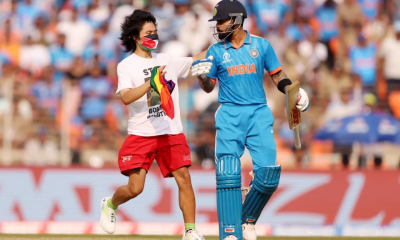


An animal rights group is urging Crystal Palace to retire their live bald eagle mascot with immediate effect, saying a “bright stadium filled with boisterous fans is no place for animals”.
In a letter to Palace CEO Sharon Lacey, People for the Ethical Treatment of Animals (Peta) asked the Premier League club to stop using the eagle, named Phoenix, in pre-match displays at Selhurst Park and to never use live animal mascots again.
The London team, known as the Eagles since 1973, introduced a live eagle to matchdays in 2010. Kayla, who died in 2020, performed the role for 10 years and her replacement Phoenix made her debut against West Ham in August 2024.
Peta says birds can become “frightened, disoriented and panicked” in stadium environments, putting themselves and fans at risk.
Using them for displays and entertainment also denies the animals, who “would naturally avoid humans”, the opportunity to engage with their natural instincts, leading to “frustration and stress”, the group said.
The organisation has “detailed records” of incidents involving live mascots, including birds, being injured or killed in collisions with walls, windows and match balls, as well as a falcon embedding its talons in a spectator’s scalp after landing on his head.
In 2017, a Charlton Athletic fan was found guilty of trying to punch Kayla the eagle at a League Cup fixture two years earlier.
“Many professional sports teams use only willing humans as mascots and the club already has Pete the Eagle to excite the crowd,” said Dr Carys Bennett, Peta’s senior corporate projects manager.
“Bald eagles are widely recognised as symbols of freedom. They deserve better than to be used as an entertainment prop to amuse the Eagles’ fans.
[BBC]

Without Mark Chapman and Rachin Ravindra, the hosts have a top-three spot for Devon Conway. They have as many as six seamers in the squad to pick from, with Glenn Phillips and Michael Bracewell offering part-time spin in a fairly stacked bowling attack.
[Cricbuzz]
Latest News
Bangladesh and Nepal to host Women’s Under-19 T20 World Cup from January 21 to February 6

Four venues in Bangladesh and Nepal will host the 2027 Under-19 Women’s T20 World Cup, which is set to run from January 21 to February 6. Chattogram, Sylhet, Kirtipur and Mulpani are the four venues, with Chattogram set to host the two semi-finals on February 4 as well as the final on February 6.
The 16-team event will feature four groups of four teams each, with the group stage set to be followed by a two-group Super Six stage, and then the semi-finals and final.
This is the third edition of the tournament, with India having won the first two back-to-back in 2023 and 2025. The defending champions have been drawn in group A alongside Ireland, West Indies and Nepal. Group B has 2025 runners-up South Africa as well as New Zealand, Pakistan and Samoa.
Australia, Bangladesh, Nigeria and UAE make up Group C, while England, Sri Lanka, USA and Scotland have been drawn in Group D.
The tournament will kick off with four matches on January 21, with Sylhet hosting Bangladesh vs UAE and Australia vs Nigeria, and Mulpani hosting Sri Lanka vs Scotland and England vs USA. The other two venues and other eight teams will be involved on January 22: New Zealand vs Samoa and South Africa vs Pakistan in Chattogram, and Nepal vs Ireland and India vs West Indies in Kirtipur.
All 41 games of the tournament will be played during the day. Morning matches will begin at 9.30am local time, and afternoon games at 1.30pm local time.
“The ICC U19 World Cup is the stage that showcases the future of our sport and serves as the ultimate platform for young players to make the leap towards elite careers representing their countries,” ICC CEO Sanjog Gupta said. “These future stars representing 16 teams will garner the world’s attention and become relatable role models for many young girls playing the sport, serving inspiration for their continued cricket journeys.
“The choice of our hosts – Bangladesh and Nepal – is also reflective of the ICC’s belief and investment in the future of the cricket ecosystem. With deep passion for cricket and nearly 40% of the two countries’ populations below the age of 20, they serve as the ideal hosts for one of the world’s biggest youth sporting events.”
(Cricinfo)

Crystal Palace urged to retire bald eagle mascot

Little time to unpack as India open in Christchurch

Senior England players to miss Sri Lanka T20Is for WPL 2027

Bangladesh and Nepal to host Women’s Under-19 T20 World Cup from January 21 to February 6

Showers above 100 mm are likely at some places in the Western, Sabaragamuwa, Central, North-western, Northern and Southern provinces and in Anuradhapura district.

Low-quality coal causes power cuts: Ex-LECO Chief

‘Dates have the highest sugar content to fight Coronavirus’

Sunday Island 27 December – Headlines

#SundayIsland 17th December – Headlines

Sunday Island – 28th March

Sunday Island Headlines – 21 March

Sunday Island – 21st February – Headlines
-

 Features4 days ago
Kotahena:A Small Enclave, An Extraordinary Legacy
-

 News4 days ago
Asgiri Mahanayake calls for immediate release of Gnanasara Thera
-

 News3 days ago
Record 1,600 students take Russian Classical Ballet examination in Sri Lanka
-
 News6 days ago
AC President recuses himself from hearing prison attire case pertaining to Gnanasara Thera
-
 News6 days ago
Naval officer testifies Yoshitha received Rs. 5.15 mn in salaries during SLN service
-

 News3 days ago
Karannagoda pushed for £24,536 for Yoshitha’s UK training, Court told
-

 Editorial6 days ago
Saving Anojan: Beyond Executioner’s Blade
-

 News7 days ago
CID informs Fort Magistrate’s Court investigation into money laundering case against Namal completed