
News
Reptiles in rock and time: Unveiling Sri Lanka’s ancient herpetological art


Hidden beneath the ancient canopy of Sri Lanka’s dry forests and shaded cliff faces lies a gallery like no other — a prehistoric museum where stone meets story. Painted and engraved thousands of years ago, these rock surfaces reveal how early islanders saw their world: not as conquerors, but as companions to the wild.
Among the elephants, deer, and human forms that adorn these caves, reptiles take centre stage — monitor lizards, crocodiles, tortoises, pythons, and geckos, all rendered with striking realism and reverence.
“Each stroke, each figure, is a message from the island’s earliest naturalists,” says Dr. Nimal Rathnayake, archaeologist and herpetologist, who has explored dozens of rock shelters across the island. “They reveal not only how our ancestors lived, but how deeply they observed and understood reptiles — the creatures that shared their landscapes.”
Ancient Art, Living Legacy
The world’s oldest known cave paintings — abstract symbols in Spain’s Cave of Maltravieso — date back some 64,000 years, likely drawn by Neanderthals. In Indonesia, a wild pig painted 45,500 years ago represents the earliest figurative art.
In Sri Lanka, cave paintings at Fa-Hien Lena in the Western Province, dated to over 11,000 years old, mark South Asia’s oldest known artistic expressions. These vivid works portray human and animal figures with a symbolic richness that still defies complete interpretation.
“Every pigment, every chipped line represents a memory,” says Dr. Rathnayake. “These caves are living archives — where biodiversity and belief converge.”
Sri Lanka’s Reptilian Heritage in Paint
Sri Lanka’s record of prehistoric rock art parallels its modern status as a biodiversity hotspot. With 246 known reptile species — including 164 endemic to the island — it is no surprise that early inhabitants immortalised them on stone.
“From pythons and crocodiles to geckos and tortoises, reptiles dominate many of these cave paintings,” says Dr. Rathnayake. “These weren’t random decorations. The proportions, the posture, the detailing — all reveal an astonishing level of observation. These people knew their reptiles.”
Sites like Dorawakakanda, Tharulengala, Tantirimale, and Phillegodagalge show depictions of land monitors (Varanus bengalensis), star tortoises (Geochelone elegans), mugger crocodiles (Crocodylus palustris), Indian rock pythons (Python molurus), and the iconic Sri Lankan golden rock gecko (Calodactylodes illingworthorum).
The Tharulengala Wonder
In the dry lowlands of Hulannuge, Ampara, stands one of Sri Lanka’s most extraordinary rock art sites — the Tharulengala Rock Cave. Carbon dating places its paintings at around 4,800 years old. The cave’s 16-metre wall bursts with figures: humans, elephants, and reptiles painted in ash, red, and white pigments.
Among the most striking is an enormous gecko — nearly 84 cm in length — believed to represent Calodactylodes illingworthorum, the Sri Lankan golden rock gecko. “It’s almost herpetologically accurate,” Dr. Rathnayake notes. “The limbs, digits, and the curved tail — even the clusters of eggs painted nearby — correspond exactly with how we see them in nature today.”
Other reptiles — a crocodile, a Russell’s viper, and a land monitor — share the same wall, painted in naturalistic proportions. Archaeologists once mistook the gecko for a crocodile, but closer zoological study proved otherwise. “It’s a perfect example of art meeting science across millennia,” Rathnayake adds.
Dorawakakanda’s Engraved Menagerie
In Kegalle’s wet zone, Dorawakakanda Cave offers a different form of artistry. Instead of pigments, its ancient occupants used chisels — or rather, sharp stones — to engrave shapes into rock. Here, elephants, fish, humans, and two land monitors stand etched into the stone.
“Imagine carving these without metal tools,” says Dr. Rathnayake, admiring the craftsmanship. “The engravings capture both movement and life — even after two thousand years.”
The site’s significance extends beyond artistry. “These images show ecological coexistence,” he explains. “It tells us that people of this era didn’t just hunt; they observed, respected, and recorded what they saw.”
Phillegodagalge: The Python’s Shadow
Deep in Kudimbigala Forest Heritage, near the entrance to Kumana National Park, lies the cavernous Phillegodagalge Cave. At first glance, its long, ribbed figures resemble centipedes. But closer analysis reveals the unmistakable form of the Indian rock python (Python molurus).
“The rib patterns are too consistent for an invertebrate,” says Dr. Rathnayake. “These were skilled observers — the ribs, length, and proportions point clearly to a python.”
Deraniyagala’s early research suggested that pythons were consumed by prehistoric hunters, a fact echoed in the site’s depictions. “What you see here could be both a record of diet and devotion,” he adds. “A species feared, revered, and ultimately remembered in art.”
Tantirimale: Crocodiles and Sea Turtles
In the North Central Province, the caves of Tantirimale house some of the most evocative prehistoric paintings on the island. Believed to date back 4,000 years, these artworks feature geometric patterns and animal figures — including a Leatherback Turtle (Dermochelys coriacea) and a Crocodile.
“The artist has even captured the ridges on the turtle’s shell,” notes Dr. Rathnayake. “It’s a remarkably accurate representation.” Archaeological excavations in Anuradhapura unearthed marine turtle bones dating to around 800 BC — evidence that sea turtles were traded or used for ornaments. “That connection between coastal species and inland art tells us these people were travellers, traders, and naturalists,” he adds.
Two Women’s Cave — Genu Dennage Galge
Few sites in Sri Lanka remain as hauntingly untouched as the Two Women’s Cave, or Genu Dennage Galge, at Buddama Village in Monaragala. Its single chamber, framed by drip-ledges to divert water, contains ghostly figures of elephants, birds, and a land monitor painted in white and green pigment. “This cave might have had a very different purpose,” says Dr. Rathnayake. “Based on the drawings, it could have been a slaughterhouse — a place where animals were slaughtered for food. The land monitor, prominently displayed, reflects what was most commonly hunted and eaten.” The scene includes possible depictions of deer, birds, and elephants — but it’s the monitor that commands attention. “Even in death, it was remembered,” he says softly.

Who Were the Artists?
Scholars like H.C.P. Bell, the Seligmanns, and Somadeva agree that these paintings are the work of Veddas, Sri Lanka’s indigenous hunter-gatherers. Early 20th-century Vedda women told the Seligmanns that they created drawings while waiting for their men to return from hunting, mixing ash and saliva to make paint and applying it with their fingers.
But not all art is ancient. “In some caves, we find recent graffiti and carvings by visitors,” Dr. Rathnayake warns. “Distinguishing authentic prehistoric art from modern additions is a challenge — one that calls for better protection and research.”
Conservation: An Urgent Call
Despite their age and significance, many of Sri Lanka’s rock art sites remain vulnerable. At Tharulengala and Dorawakakanda, visitors have carved their names or touched the paintings, smudging ash drawings that survived nearly five millennia. “Even geckos — ironically, the same species painted on the walls — lay their eggs on these surfaces, further damaging the art,” notes Dr. Rathnayake. “We need a clear, coordinated conservation plan. Spraying protective acrylic coatings, managing access, and continuous monitoring are essential steps.”
The Archaeology Department, he believes, must work with herpetologists, conservators, and local communities. “These are not just archaeological artefacts; they are ecological documents — the earliest evidence of humans recording wildlife.”
Echoes in Stone
Standing inside Tharulengala or Two Women’s Cave, one can almost hear the prehistoric hum of life. The same geckos that inspired early artists still cling to those walls, their eggs adhering beside their ancient likenesses.
“These caves are time capsules,” Dr. Rathnayake reflects. “Few places in the world allow such direct continuity between species and story.”
For him, the study of rock art is more than academic. It’s an act of cultural and environmental recovery — a reminder that Sri Lanka’s earliest artists were also its first conservationists.
“They didn’t separate art, nature, or spirituality,” he says. “They lived within them. That’s the message we must rediscover today.”
By Ifham Nizam ✍️


By Anuradha Hiripitiyage
Electricity tariffs should be reduced by between 3 and 5 percent instead of being increased by 2.88 percent in the fourth quarter, as proposed by the National System Operator (NSO), Electricity Consumers’ Association Secretary Sanjeewa Dhammika said.
Addressing a media briefing in Maradagahamula, Divulapitiya, Gampaha, yesterday (16), Dhammika said a proper assessment of electricity generation costs, including the contribution of hydropower, could justify a reduction in tariffs.
He said the NSO had sought approval from the Public Utilities Commission of Sri Lanka (PUCSL) for a 2.88 percent tariff increase, which was expected to generate an additional Rs. 4,438 million.
However, the Commission had indicated that an increase of only 1.46 percent was warranted, amounting to Rs. 2,245 million, he said, adding that even this increase was unnecessary.
Dhammika alleged that the proposed revision sought to pass on to electricity consumers the financial burden arising from the non-arrival of five coal shipments and failed tenders.
“The Government had said that the burden of coal-related losses would not be passed on to the public. It is therefore unjust to make consumers bear these costs,” he said.
He pointed out that the PUCSL had forecast that hydropower would account for 32.34 percent of total electricity generation in the coming quarter, while the cost of such generation would represent only 3.45 percent of the overall cost of electricity production.
Consumers should benefit from the lower cost of hydropower generation rather than bear the burden of more expensive thermal power generation, he said.
Dhammika also questioned the inclusion of Rs. 669 million in capacity charges that had not been approved by the PUCSL, as well as a further Rs. 1,069 million to repay loans relating to incomplete projects.
Including such charges in the proposed tariff revision was unjustifiable, he said.
The PUCSL has given the public until October 30 to submit their views on the proposed tariff revision.
Dhammika said the possibility of increased hydropower generation in the coming weeks, as reservoir levels rise, should also be taken into account when determining electricity tariffs.
He maintained that tariffs could be reduced by 3 to 5 percent if hydropower generation was properly assessed and coal-related losses and unapproved charges were excluded from the calculations.
He further claimed that electricity tariffs could be reduced by as much as 10 percent through the promotion of renewable energy and the effective use of solar power and battery storage systems.
The Electricity Consumers’ Association urged the Government to withdraw the proposed tariff increase, insisting that consumers should not be made to bear costs arising from coal supply problems and other disputed charges.

By S.K. Samaranayake
Most Ven. Warakagoda Sri Gnanaratana Mahanayake Thera of the Asgiri Chapter has called for the immediate release of Ven. Galagodaaththe Gnanasara Thera, who is currently serving a prison sentence, following a court ruling.
The Asgiri Mahanayake made the appeal when a delegation of senior prison officials, including Assistant Commissioner of Prisons and Director of Operations Senaka Pallegedara, called on him on the 16th.
During the meeting, the prelate warned that the continued incarceration of Ven. Gnanasara Thera could lead to a volatile situation and cause public agitation.
Responding to the appeal, the prison officials informed the Mahanayake Thera that the authority to order the release of Ven. Gnanasara Thera did not rest with the Prisons Department but with the President.
Other senior prison officials, including Rajeev Srimal Silva, Sampath Warnakulasooriya and Mangala Welivita, were also present at the meeting.
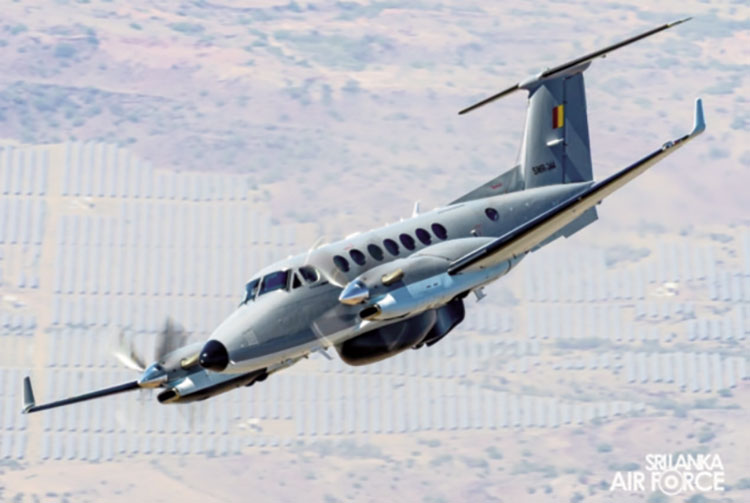
The Sri Lanka Air Force participated in a multinational air exercise in India, alongside the air forces of the United States, France and Germany, as Sri Lanka continues to expand military cooperation with foreign countries.
A Sri Lankan Air Force Beechcraft King Air 360ER aircraft, and a six-member crew, took part in Exercise Tarang Shakti 2026, held at Air Force Station Jodhpur, from September 26 to October 12.
The exercise was hosted by the Indian Air Force, under the theme “Power in Partnership,” and involved Australia, Bangladesh and the United Arab Emirates, among other participating countries.
According to the Sri Lanka Air Force, the exercise was aimed at enhancing operational cooperation and interoperability among participating air forces and providing opportunities to share tactics and operational experience.
India’s public broadcaster reported that the exercise included training and experience in planning and conducting joint multinational combat operations, including counter-air, air defence, reconnaissance and air-to-air refuelling missions.
The exercise also involved 32 countries as observers.
Sri Lanka’s participation comes amid increased military engagement with foreign partners. India and Sri Lanka recently exchanged 240 military personnel under a tri-service exchange programme.
Sri Lankan military personnel also recently participated in a counter-terrorism exercise with Russia, while a senior US Army Pacific official visited Sri Lanka and discussed opportunities for greater joint training.

Rose Bowl expanded to include Australia vs New Zealand T20Is

Trump claims US Navy blockade stops Iranian ships in Hormuz

Showers above 75 mm are likely at some places in the Western, Sabaragamuwa, Central and North-central provinces and in Trincomalee and Mullaitivu districts

Cut power bills by 3-5%, don’t hike them, consumers demand

Asgiri Mahanayake calls for immediate release of Gnanasara Thera

Lanka Air Force joins multinational exercise in India

‘Dates have the highest sugar content to fight Coronavirus’

Sunday Island 27 December – Headlines

#SundayIsland 17th December – Headlines

Sunday Island – 28th March

Sunday Island Headlines – 21 March

Sunday Island – 21st February – Headlines
-

 News6 days ago
Sri Lanka escalates anti-graft drive with Shiranthi’s jailing
-

 Latest News5 days ago
Farhan and Sadaqat help Pakistan seal series in style
-

 News6 days ago
Iranian ships stranded, Lanka fears US sanctions
-

 Latest News4 days ago
Nissanka’s return headlines Sri Lanka’s Test squad against Pakistan
-
 Features5 days ago
Intake 16: 45 years of duty and honour
-
 News5 days ago
Malwathu Chapter issues statement on talks with President over Gnanasara Thera’s robes
-
 News6 days ago
Navi Pillay’s Lankan affairs in focus as she wins 2026 Nobel Peace Prize
-
 News5 days ago
CP alleges NPP has taken the blame for illegal US sanctions on Iranian vessels