
Opinion
Reforming Dhamma education


The time has come for the Sri Lankan intelligentsia to admit, grudgingly as it may be, that Buddhism has come to a crisis state just as other social institutions in the country. It keeps inventing new rituals at a rate, rituals that have no meaning or purpose other than enriching a corrupt business enterprise, putting enormous economic hardships on the followers. As a result, it is argued that modern Buddhism has become a source of stress, guilt and anxiety instead of a source of solace and guidance for a meaningful life here and now for its followers, especially those who are financially challenged. It is this dangerous and harmful trend of deceiving, using fear and guilt tactics in the name of the Compassionate One, and creating a bartering system for commercial enterprises that compelled this writer to call this a crisis. If those Brahmins who opposed and debated Buddha back then could see Sri Lankan Buddhism today, they would rejoice with glee – finally, they have surpassed Buddha’s teaching.
Sadly, there is absolutely no way for the followers to know that they are being used as we have been brainwashed for centuries. That is why education reforms are urgently needed. The civic-minded have a responsibility to enlighten the masses, cautiously, without hurting their feelings, and to initiate necessary changes to ensure that the sacrifices our ancestors made to preserve this treasure, the Buddha Dhamma, is not wasted on the nation. And stop the exploitation of vulnerable faithful. There is no denying that breaking this vicious cycle is a tall order; but the socio-economic and emotional decline of the followers will continue beyond recovery if it is not addressed promptly.
The reader must evaluate themselves if the writer is crying wolf or is there grounds for his reasoning. As the Buddha taught, continuity with change is a natural law that governs everything in this universe. Not only nature, but all systems by which humans organise their society – the political, social, economic, intellectual, psychological, and most importantly religious systems are subjected to change according to this law. In our case, the five centuries of colonial rule had a major impact in accelerating that change. This is reflected in the colonial view: “the pioneer of civilisation has to get rid of the religion of India to enable him to introduce a better culture…” (The Buddhist Committee of Inquiry, 1956). Those forces were powerful, and they accomplished their goals; for example, we did not have five ordained monks in the country to perform Upasampada ceremonies by the 17th century. Let us admit that we lost Dhamma altogether at some point, as evident by the fact that a copy of the Tipitaka had to be brought in from Thailand for the Buddha Jayanthi celebration in 1956.
We are not responsible for what happened centuries ago, but we are guilty of ignoring the ongoing catastrophe. The Buddhist revival that started in 1956 did not have a solid foundation; it was driven by imported ideas. Let us be honest, they had good intentions but to what extent did the views of Olcott and Blavatsky align with the teachings of the Buddha remains anyone’s guess. Since we received an already transformed version of Buddhism, that could be applicable to the local leaders as well. Let us be clear, they all were well intended and they did their best, and we have benefited immensely from their efforts, this writer included. However, now it is our time to do our best to change it, instead of remaining prisoners of historical ironies.
What have we accomplished over the seven decades since the Buddha Jayanthi celebration? Materially, we have overshot our expectations: there are more temples, a Buddha statue at every street corner, mass media is choked with full of Dhamma talks, and people, especially women, attending religious services in increasing numbers. The largest sleeping Buddha statue in the world, with an ear big enough for one to sleep in, as the monk boasted. On the other hand, what has been the social and spiritual outcome? Statistics are there for anyone to see, but it suffices to say that Sri Lanka appears at the very bottom of all socio-economic indices of 193 countries, particularly notable is the corruption index. Spiritually, Buddhism has been reduced to the level of pouring medicinal concoctions around Bodhi trees and offering food and drinks to plastic statues for salvation. The same Brahminic practices that Buddha rejected, offering sacrifices and prayer in return for a better rebirth, are fine-tuned to be commercial enterprises, while what the Buddha taught is completely ignored. This points to the failure of our Buddhist education of both children and novice monks. Again, those who formulated the system did not know any better, they were going with an already transformed imported version of Buddhism.
So, what was Buddhism before it was transformed is a fair question to ask. Before the transformation, it was Dhamma, there was no ‘ism’ in it. Buddha had a simple message, and it was based on the natural law he discovered and named ‘Dependent Arising.’ This is the same ‘continuity with change’ referred to earlier, or the cause-and-effect law, as science calls it. It states that all phenomena that exist in this universe arise due to causes and conditions, and they cease to exist when their causes and conditions cease. According to Vinaya Pitaka, hearing this simple statement from Assaji, venerable Sariputta became a stream entrant. Is it a secret message in code? Why is it so difficult for us to understand its meaning? What is its relevance to daily life, or the next?
For forty years, Buddha explained it in many ways to suit his audience and occasion. That created a vast amount of information we referred to as Tipitaka, a tome of over fifty thousand printed pages. Over the centuries, commentators tried to reinterpret, summarise, and catalogue all that into a coherent narrative in diverse ways. Unfortunately, the results are not what was hoped for; instead of simplifying them, they ended up complicating it further. During this process, Dhamma transformed into Buddhism, not one, but thirteen different schools with vastly different interpretations and practices.
According to Dependent Arising, there is no independent existence; and humans are a part of a vast interconnected and interdependent network. That makes life a continuously changing state (anicca) with no agency (anatta); not a satisfactory situation (dukkha), like a piece of driftwood caught in a mountain stream at the whim of its forces, beyond control. Buddha explained that we do not have to surrender to this condition; there is a way to liberate ourselves from it and live a happy and harmonious life (samadhi) here and now.
The escape path the Buddha described is the Noble Eightfold Path (Magga). It is a way to live in harmony (samadhi) within and with everything else. The Path has three interrelated aspects: wisdom (panna), ethical conduct (sila), and harmony. Buddhist ethics are meant to conserve, propagate, and advance the said harmony with the vast network. It is not a reward and punishment system set by an unseen higher power, but a set of practices based on the cause-and-effect law. All actions, speech, and thoughts impact the network positively or negatively. Having the wisdom and discipline to control one’s thoughts and actions is the way to live a happy, prosperous and meaningful life.
Achieving that wisdom and having the ability to control thoughts and actions at the highest level brings ultimate happiness and contentment – Enlightenment (Arhant). Arhant has stopped the cause-and-effect process at mental level, but it continues to control their physical body. At the passing of the Arhant the cause-and-effect comes to a complete stop; this is the ultimate happiness – Nibbana.
The Buddha did not preach another truth, but he elaborated this one truth in diverse ways. There are no metaphysics or magical formulas associated with this approach. Every aspect of it can be explained using modern science. If there are any mystic formulas, they were added by the commentators, and Dhamma can be realised without them. The challenge to intelligentsia, academics, educationists, reformists, and civic minded individuals is to get this message to the masses in an accessible way. I omitted religious leaders for a reason; Theravada orthodoxy fiercely resists change, just as they resisted the re-establishment of Bhikkhuni Sasana on false grounds until the intervention of the Supreme Court. They will resist any change as without the bartering system and scare tactics the commercial enterprise will not work. One can only hope that the Bhikkhunis will not become the female version of the same failed system.
There is another challenge, unlearning is much harder than learning. This makes education reform a multigenerational project. Therefore, the time to start is now. As the first step, the transmission of wrong views, beliefs, rituals, and mysticism to the Alpha Generation, i.e., the cohort born between 2010 and 2024, must be curtailed. Most importantly, teaching poems as facts for government examinations should be stopped. They must be given the freedom of free thinking to separate epics, legends, and historical embellishments from facts; and that temple murals are expressions of artistic freedom.
The cultural aspects of rituals must be separated from the spiritual aspects. For example, our ancestors used oil lamps to light temples and grounds; they had no other way. But now we have electricity; must we light hundreds or thousands of oil lamps? Is there a hidden reason or benefit? No, let us explain that in clear terms.
In formulating the curriculum, we must rely on what the Buddha taught and reject the transformed bartering system found today. The utility of Dhamma, or the relevance of sed. It must be explained to the children and novice monks alike, in accessible terms, how unethical behavior has resulted in the socio-economic collapse of the country. Encourage them to rationalize how ethical living can solve all problems we face. Dhamma education can be delivered in the language of science by linking it with STEM education; both are about living a happy and prosperous life. Unlike the older generations, the technology savvy next generation will grasp the truth readily. Buddha’s message is a simple one, using science as the language, we can deliver it to the Alpha generation without complicating it the way our ancestors did for us. Let us get the process going, now.
by Geewananda Gunawardana, Ph.D.


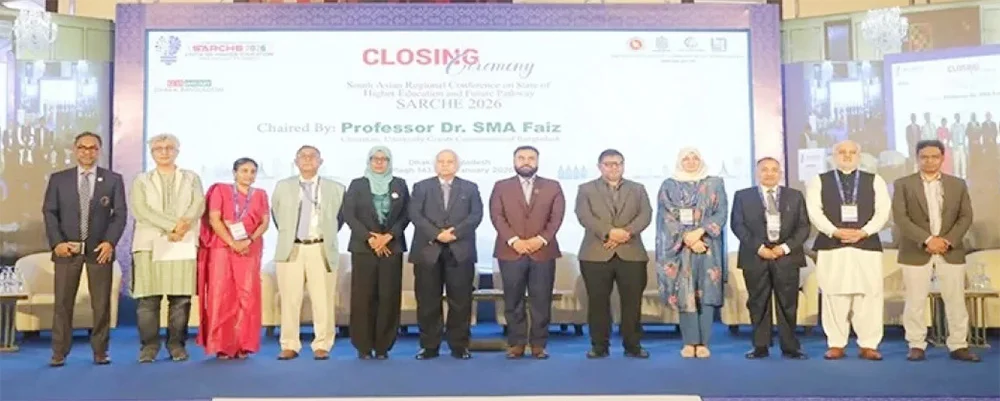
On the 15January 2026, the ‘Dhaka Declaration’ was adopted with eight strategic commitments, aimed at building a stable, inclusive, innovative and globally acceptable higher education system in the South Asian region at the third South Asian Regional Conference on State of Higher Education (SARCHE), 2026.
Advisors of the interim government, vice-chancellors of different public and private universities, scholars, researchers and diplomats were present at the third SARCHE 2026 Conference in Dhaka, emphasising the paramount importance of Education diplomacy.
The Nobel Laureate, Chief Adviser of the government, Professor Muhammad Yunus on 12th January 2026 inaugurated a three-day South Asian regional conference on higher education in Dhaka. The conference titled “South Asian Regional Conference on State of Higher Education and Future Pathway (SARCHE 2026)” organised by the Bangladesh government and World Bank funded Higher Education Acceleration and Transformation (HEAT) Project of the University Grants Commission (UGC) of Bangladesh.
Prof. Yunus’s call
Chief Adviser Professor Muhammad Yunus, has called upon the academics to align the education system with the youths’ expectations and aspirations and stressed on revival of the SAARC to enhance regional academic cooperation. “Today, I feel very excited that academics at the highest level could get together in Dhaka. It’s important that this is Dhaka. I hope you will have a chance to kind of review of the things that have happened in Dhaka in the past few months,” he said, referring to post-2024 July Uprising events in Bangladesh. Prof Yunus said review of those events will clarify what university education and education as a whole are really about, adding, this should be the core subject of discussion at the gathering.Highlighting the role of students in the 2024 uprising, he said, “Who are these young people that we are dealing with? They have their own mind. They stood up and raised their voices and brought down the ugliest fascist regime you could ever think of given their lives”.The Chief Adviser made the remarks while addressing the inaugural ceremony of the three-day “South Asian Regional Conference on State of Higher Education and Future Pathway (SARCHE 2026)” at a city hotel in Dhaka, Bangladesh. A total of 30 international representatives, including delegates from the United Kingdom, the Maldives, Malaysia, Nepal, Pakistan and Sri Lanka as well as representatives from the World Bank were represented in the event.”It would be a missed opportunity if you don’t spend some time on understanding what they did a few months back in this very city. What was their expectation? What was their aspiration? Why did they stand up in front of guns and give their lives knowingly it will happen,” the Chief Adviser said.To reflect the students’ motivation behind joining the uprising, he referred to school student Shaheed Shahriar Khan Anas’s letter, which he wrote to his mother before embracing the martyrdom, stating that it was his duty to take to the street with his friends, who were subjected to state-sponsored crackdown.Noting that the event was not a sudden outburst, Prof Yunus said it happened in Sri Lanka and in Nepal too, but it happened in a bigger way in Dhaka.
WB thanked for organisng event
He thanked the World Bank for organizing the conference, saying, “This was our responsibility to organize, but we failed. The World Bank has to step into make it happen”.Organizing such gatherings was part of the responsibility under the South Asian Association for Region-al Cooperation (SAARC), the Chief Adviser said, adding, but the SAARC as a word has been forgotten and “that’s a shame on us”. “This was supposed to be the idea of SAARC that we get together and make exchanges and learn from each other,” he said, noting his efforts since he has taken the responsibility as the Chief Adviser to revive the SAARC. “I am repeatedly reminding that we must get back to SAARC. That’s where our family belongs to. And I will not give up repeating that appeal to the governments of the region,” Prof Yunus said,Speaking about the forthcoming national elections and the referendum on February 12, he said the uprising tore everything apart and that the young people created their own July Charter to undo what the country was stuck with.
Referendum on Constitution
Chief Adviser said there would be a referendum to decide what the future constitution of Bangladesh should be, because they believed the root of the problems lay in the constitution. He said those issues were not taught in classrooms and questioned where universities stood in this reality. Noting that the young people have now formed their own political party, Prof Yunus said, “I’m sure some of them will get elected. “He called on educators to reflect on what education and university education should be in this very different world, warning that old ways of doing things are self-destructing and that change must happen quickly, just as the youth acted quickly during the July and August uprising.”So this is one issue, I hope this will be taken up seriously in this gathering where we are, what is being missed, how we can run and be in the front, rather than falling behind,” the Chief Adviser said.
He then said that the education system was not appropriate because it is job-oriented, adding, the system is designed around the idea that students must become suitable for jobs, and “If he or she fails to take a job, we think failure on the part of that student, not us”.Prof Yunus questioned whether the purpose of education is to prepare people for the job market. Human beings are not born as slaves and that each human being is a free person, he said, adding, jobs come from the tradition of slavery, where people work under orders for pay, which he equated with slavery.Stating that the young people who marched on the state refused to be slaves, he said, “So, what kind of education that you will be giving? This is a question I raise with you. You may dismiss it. You may pause for a while. But this is my point. Should we continue this education to create slaves? Turning creative beings into slaves, that’s a criminal job”. Prof Yunus said he translated creativity into entrepreneurship and argued that education should teach young people to be entrepreneurs rather than job seekers. He said young people should be told they are job creators and agents of change, driven by imagination, adding that imagination is the essence of human beings, and that people are born with enormous imagi-native power, which drove the youth to give their lives for the vision of a new Bangladesh.
Besides, representatives of UGCs and higher education commissions from SAARC member countries, vice-chancellors of universities from different countries, academicians and researchers took part in the conference.
Aim of the conference
According to the UGC, Bangladesh the conference has been organised aimed at elevating higher education in Bangladesh to a new height and further strengthen the UGC network among SAARC countries.
A total of eight sessions were held over the three-day conference. Emphasizing on “The Current State of Higher Education in South Asia: Governance, Quality and Inclusion” and “Research, Innovation, Sustainability and Social Engagement, Artificial Intelligence (AI) Integration, Digital Transformation and Smart Learning Ecosystems”, “Increasing Employment for Graduates and Industry–Academia collaboration”, “Future Pathways of Higher Education: Cooperation, Solidarity and Networking, “Stakeholder Dialogue on Higher Education Transformation: Voices of Civil Society”, and “Dialogue with Vice-Chancellors: the Context of the HEAT Project, gender issues in higher education will be held while the conference l ended following the adoption of the “Dhaka Higher Education Declaration”.
UGC, Bangladesh warns against fake foreign university branches in Bangladesh. Reports in various media outlets have highlighted several foreign universities, institutes are running unauthorized branch campuses, tutorial centers, and study centers across the country. The University Grants Commission (UGC) has cautioned students and parents against enrolling in three unauthorized foreign universities reportedly operating branch campuses in Bangladesh. According to the commission, American World University, USA; Trinity University, USA; and the Spiritual Institute of New York (State University) have no government or UGC approval to conduct academic activities in the country.
On the other hand, higher education has considered as a strategic necessity for the Maldives and called for enhanced regional cooperation, industry – academia collaboration, and impact – oriented research to support inclusive growth and resilience across the region.
While Pakistan has reached its greater heights in implementation of their AI policy, World bank is acting as a strong partner in developing these endeavors of regional partners.
Lessons to be learnt
We as a country has spent huge amount of expenditure in higher education, grants and research endeavors where majority of them have took place in western academic scenario. Our attitude as Sri Lankans do not wish to learn from regional partners and we highly embrace western based cultures and their development, while regional partners have emerged beyond Sri Lanka. Very few academia is passionately engaged in development initiatives while majority have violated bonds and residing in overseas lavishly having used government expenditure which should have spent on the public wellbeing of this Country. I wonder how many governments should take control of this paradise isle to understand this reality, still we are grappling with 17 universities under the Universities act with very few international student recruitments. The case of other State Universities cannot cater the increasing local demand as they need to keep their standards. In such a scenario admission of international students and their increasing demands are questionable? Our immigration do not facilitate as a separate compartment to facilitate international student recruitment like in Malaysia.
The government enacted the Private University Act in Bangladesh in 1992 and replaced in 2010. These laws were enacted to enable private universities to supplement the governments efforts in meeting the growing demand for higher education. Under the Act, private individuals, groups and philanthropic organizations are permitted to establish and operate self -financed, degree-awarding universities by fulfilling prescribed conditions. Due to rapid increase, the 2010 Act introduced Stricker provisions focused on quality assurance, accountability and good governance. It mandates statutory bodies such as Board of trustees, Syndicate and Academic Council and clearly defines their roles and responsibilities. The Vice chancellor serves as the chief executive and academic officer of the university and is the ex-officio member the Board of Trustees. The honorable president of Bangladesh act as the chancellor of all private universities and appoint key officials upon recommendations of the Board of trustees. The Act also mandates establishment of an accreditations council to ensure quality assurance UGC supervises and monitors private universities on behalf of the Ministry of Education, approves academic programs, curricula, prescribe minimum faculty qualifications and requires transparency through annual audited financial reporting.
However, many decades have gone and the Transnational education specifically in higher education in Sri Lanka is a struggle of Authority and Power. Many of the view that the Ministry of Higher Education does not cater the entire gamut of private Higher Education Institutes operating in Sri Lanka and do not address public issues. While UGC alone handles many of the public issues even in the transnational education with no authority in non-state sector. Hence, proper enactments under one umbrella need to be empowered for the sake of public. Sri Lankan practice is the Committees appointed to address public issues does not have genuine interest or knowledge to serve this sector rather depend on benefits derived.
Therefore, SARCHE 2026 has opened eyes of Sri Lanka on how the private sector should have healthy competition with public sector, while contributing massively to strengthen the economy.
Transnational Education in Sri Lanka
According to British Council reports on transnational Education,20224 and the SAARC regional Coordinator for the British Council was of the view that Sri Lanaka does not maintain a official repository for transnational education. The Company registrar or the Board of investment do not have a official repository which serves only for higher education purpose. There is no regulatory authority to address the agency problem engaged in transnational education where finally many have reported as unethical business practices.
While India, Pakistan, Maldives and Bangladesh massively invest on Transnational education to strengthen their economies we still do not have a national plan to address this with a regulatory mechanism with proper licensing, listing for Agents to operate in Sri Lanka in order to mitigate Education fraud.
Conclusion
There was a time when students who could not secure admissions to public universities turned to private universities as a last option. That really has changed significantly. Today, many students who qualify for public universities still choose private universities because they do not get admission to their preferred subjects. The primary reason is the freedom to study the subject of their choice. However, in Sri Lanka very few private entities provides a truly a university experience. While regional partners have improved beyond 100 in establishing private universities, still private public partnership in those countries are very best examples for Sri Lanka. According to the UGC,2023 Annual report there were 341,000 students enrolled across 110 private universities in Bangladesh, now has increased to 170 according to SARCHE,2026.
Pakistan maintains best examples of Artificial Intelligence models with World Bank Funding to their University System. University Business linkages in India, Pakistan and Bangladesh provide strong examples in Transfer of Technology. While Maldives will cater for the next round of SAARC conference on the state of higher education. They invite Sri Lanka along with regional partners for preparation of qualification framework with mutual recognition of qualifications with credit transfer facility. The “Dhaka declaration of Higher Education “was adopted at the SARCHE 2026, It intend to cooperate with regional partners in many aspects in Higher Education. With these concluding remarks it is high time to consider different aspects of higher education in the proposed reforms.
By Dr. Janadari Wijesinghe

The scientific community in the English-speaking world publishes its research findings using technical and scientific English (naturally!). It has its own particular vocabulary. Many words are exclusive for a particular technology as they are specialised technical terms. Also, the inclusion in research papers of mathematical and statistical terms and calculations is important where they support the overall findings.
There is a whole array of specialist publications, journals, papers and letters serving the scientific community world-wide. These publications are by subscription only but can easily be found in university libraries upon request.
Academics quote the number of their research papers published with pride. They are the status symbols of personal achievement par excellence! And most importantly, these are used to help justify the continuation of funding for the upcoming academic year.
Such writings are carefully crafted works of precision and clarity. Not a word is out of place. All words used are nuanced to fit exactly the meaning of what the authors of the paper wish to convey. No word is superfluous (= extra, not needed); all is well manicured to convey the message accurately to a knowledgeable, receptive reader. As a result, people from all around the world are using the Internet to access these research findings thus establishing the English language as a major form of information dissemination.
Reporting is best when it is measurable and can be quantified. Figures mean a lot in the scientific world. Sizes, quantities, ranges of acceptance, figures of probability, etc., all are used to lend authority to the research findings.
Before a paper can be accepted for publication it must be submitted to a panel for peer review. This is where several experts in the subject or speciality form a panel to assess the work and approve or reject it. Careers depend on well-presented reports.
Preparation Before Starting Research
There is a standard procedure for a researcher to follow before any practical work is done. It is necessary to evaluate the current status of work in this subject. This requires reading all the relevant, available literature, books, papers, etc., on this subject. This is done for the student to get ‘up to speed’ and in tune with the preceding research work in this field. During this process new avenues for research and investigation may open up for investigation.
Much research is done incorporating the ‘design of experiments’ statistical approach. Research these days rely heavily on statistics to prove an argument and the researcher has to be familiar and conversant with these statistical techniques of inquiry and evaluation to add weight to his or her findings.
We are all much richer due to the investigations done in the English-speaking world by the investigative scientific community using English as a tool of communication. In scientific research, the best progress in innovation, it seems, is when students can all collaborate. Then the best ideas develop and come out.
Sri Lankans should not exclude themselves from this process of knowledge creation and dissemination. Sri Lanka needs to enter this scientific world and issue its own publications in good English. Sri Lanka needs experts who have mastered this form of scientific communication and who can participate in the progress of science!
The most wonderful opportunities open up from time to time for graduates of the STEM subjects (science, technology, engineering and mathematics) mainly in companies using modern technology. The reputation of Sri Lanka depends on having a horse in this race – quite apart from the need to provide suitable careers for its own population. People have ambitions and need to be able rise up intellectually and get ahead. Therefore, students in the STEM subjects need to be able to read, analyse and compare several different research papers, i.e., students need to have critical thinking skills – in English. Often, these skills have to be communicated. Students need to be able to write to this high standard of English.
Students need to be able to put their thoughts on paper in a logical, meaningful way, their thoughts backed up by facts and figures according to the principles of the academic, research world. But natural speakers of English have difficulties in mastering this type of English and doing analyses and critical thinking – therefore, it must be multiple times more difficult for Sri Lankans to master this specialised form if English. Therefore, special attention needs to be paid to overcoming this disadvantage.
In addition, the researcher needs to have knowledge of the “design of experiments,” and be familiar with everyday statistics, e.g., the bell curve, ranges of probability, etc.
How can this high-quality English (and basic stats) possibly be taught in Sri Lanka when most campuses focus on the simple passing of grammar exams?
Sri Lanka needs teachers with knowledge of this advanced, specialist form of English supported with statistical “design of experiments” knowledge. Secondly, this knowledge has to be organised and systematized and imparted over a sufficient time period to students with ability and maturity. Over to you NIE, Maharagama!
by Priyantha Hettige
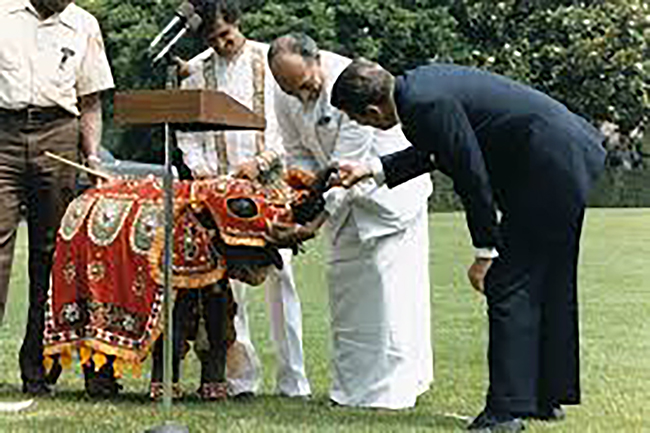
When President J. R. Jayewardene stood at the White House in 1981 at the invitation of U.S. President Ronald Reagan, he did more than conduct diplomacy; he reminded his audience that Sri Lanka’s engagement with the wider world stretches back nearly two thousand years. In his remarks, Jayewardene referred to ancient explorers and scholars who had written about the island, noting that figures such as Pliny the Elder had already described Sri Lanka, then known as Taprobane, in the first century AD.
Pliny the Elder (c. AD 23–79), writing his Naturalis Historia around AD 77, drew on accounts from Indo-Roman trade during the reign of Emperor Claudius (AD 41–54) and recorded observations about Sri Lanka’s stars, shadows, and natural wealth, making his work one of the earliest Roman sources to place the island clearly within the tropical world. About a century later, Claudius Ptolemy (c. AD 100–170), working in Alexandria, transformed such descriptive knowledge into mathematical geography in his Geographia (c. AD 150), assigning latitudes and longitudes to Taprobane and firmly embedding Sri Lanka within a global coordinate system, even if his estimates exaggerated the island’s size.
These early timelines matter because they show continuity rather than coincidence: Sri Lanka was already known to the classical world when much of Europe remained unmapped. The data preserved by Pliny and systematised by Ptolemy did not fade with the Roman Empire; from the seventh century onward, Arab and Persian geographers, who knew the island as Serendib, refined these earlier measurements using stellar altitudes and navigational instruments such as the astrolabe, passing this accumulated knowledge to later European explorers. By the time the Portuguese reached Sri Lanka in the early sixteenth century, they sailed not into ignorance but into a space long defined by ancient texts, stars, winds, and inherited coordinates.
Jayewardene, widely regarded as a walking library, understood this intellectual inheritance instinctively; his reading spanned Sri Lankan chronicles, British constitutional history, and American political traditions, allowing him to speak of his country not as a small postcolonial state but as a civilisation long present in global history. The contrast with the present is difficult to ignore. In an era when leadership is often reduced to sound bites, the absence of such historically grounded voices is keenly felt. Jayewardene’s 1981 remarks stand as a reminder that knowledge of history, especially deep, comparative history, is not an academic indulgence but a source of authority, confidence, and national dignity on the world stage. Ultimately, the absence of such leaders today underscores the importance of teaching our youth history deeply and critically, for without historical understanding, both leadership and citizenship are reduced to the present moment alone.
Anura Samantilleke

Crown Princess’s son arrested for alleged assault before rape trial in Norway

Shower will occur in the Northern, North-central, Eastern and Uva provinces and in Nuwara-Eliya and Matale districts

Interpol crackdown: Sri Lankan man among seven arrested in UK for human smuggling

Sri Lanka calls on global consular corps to protect nationals amid fishermen incident

Korean boost for Thriposha programme: Partnership worth USD 10 mn

Development Officers’ Association steps up protest campaign

‘Dates have the highest sugar content to fight Coronavirus’

Sunday Island 27 December – Headlines

#SundayIsland 17th December – Headlines

Sunday Island – 28th March

Sunday Island Headlines – 21 March

Sunday Island – 21st February – Headlines
-
 Opinion4 days ago
Sri Lanka, the Stars,and statesmen
-
 Business5 days ago
Climate risks, poverty, and recovery financing in focus at CEPA policy panel
-

 Business3 days ago
Hayleys Mobility ushering in a new era of premium sustainable mobility
-

 Business3 days ago
Advice Lab unveils new 13,000+ sqft office, marking major expansion in financial services BPO to Australia
-

 Business3 days ago
Arpico NextGen Mattress gains recognition for innovation
-

 Business2 days ago
Altair issues over 100+ title deeds post ownership change
-

 Business2 days ago
Sri Lanka opens first country pavilion at London exhibition
-

 Editorial3 days ago
Govt. provoking TUs