
Features
Recalled to Life: America’s Brush with Neo-Fascism


by Kumar David
Several months ago when things were coming to a boil I argued that despite Trump’s autocratic intentions, expectations of a collapse of democracy in America were unduly gloomy. It was my view that society and polity was more robust than many gave credit for and that at rock bottom fascism was impossible though appalling events were likely – and did occur after November 3, 2020. My case for the sturdiness of American polity was (Quoting):
a) The people are unusually robust and independent. It is very difficult for some Mussolini mob to cow down 100s of millions of over-‘testosteroned’ Americans.
b) Constitutional processes are very strong. If DJT loses the election, as seems likely, he will be escorted out. His riff-raff won’t be able to stop that.
c) Except for the Trump loonies (maybe 25% of the electorate) even the GOP won’t be able to stomach an unconstitutional grab for power. Nor will the Supreme Court, even with the new nominee in place, sanction it.
d) The military will not move grossly unconstitutionally.
In comparison, SL is a banana republic since it does not have (a) to (d), nor does it have deep 200 year old constitutional traditions, nor virile public opinion. (END QUOTE).
I have been proved more correct than I imagined possible but time has moved on and we will, post January 20, have to give thought to America’s future after its brush with disaster. It will not, within foreseeable historical times, become a dictatorship; that is impossible. What is possible is unrest, skirmishes and political instability, mediated by livelihood issues, equity concerns and racial tension. And don’t forget that what transpires in America will be influenced by, and will determine what happens in the rest of the world. My concern for the protection of American democracy – socialism is not imminent – brought a sharp rebuke from a reader, a Mr or Ms Ajay, who cautioned “Sometimes one wonders if (KD’s Marxism) has gone too far in the opposite direction and defected to the West; it appears he is looking at the world through American eyes”. A brief diversion to explore modern Marxism is therefore warranted.
 The theoretical and philosophical crux of classical Marxism consists of two concepts; dialectics and the materialist outlook. To keep it simple let’s say dialectics is the same as how science comprehends change, development and evolution. Forget the mumbo-jumbo of interpretation-of-opposites, quantity transforming into quality etc. inherited from Hegel and reflect on how science thinks of change. The classic example of dialectics in science is not Marx, it is Darwinian evolution. Darwin’s observations of species change, followed by Mendel’s population genetics, leading all the way to 21st century genetics (some call it genomics) is dialectical. How and why do things change? What dynamic drives mutations, metamorphoses, transformations and revolutions in the physical, biological and the social world; how do we employ concepts to generalise and abstract processes of change? That is dialectics at work in nature and its comprehension in thought. If you are practical scientist who is not philosophically inclined, forget all this and get on with your real-world science.
The materialist conception of society and history, however, affects us all, especially if you have an interest in sociology or politics. Marx’s materialism argues that the way humans and societies “produce and reproduce” their material lives is crucially important. Work, skills even in primitive times, production and technology, and even war to grab more resources, are the raw material of what is called historical materialism. On this foundation, societies organise, appropriate the usufruct as per their social organisation – class structure – and therefrom issue unavoidable class struggles leading at times to revolutionary makeovers of the state. Ideology, that is what people think of themselves and others, (great Imperial Civilisation, Tamil is the oldest living language, God’s command to subdue the heathen, our glorious Mahavamsa culture) are not garbage, Marx never said that. But he did think that ideas are a product, to a prodigious extent, of the aforesaid social premises. Of course ideas reflects back as any good dialectician will grant. For example, the rise of Islam cannot be grasped without knowledge of Arabian society; but in turn the impact Islam has had on the world is driven by its belief systems. My plea to Mr/Ms Ajay is that I try to be loyal to these essential premises while I think through day to day issues which of course is the job of this column.
What about modern Marxism? True, Marx did not pay enough attention to race and ethnicity and focussed on class. Second, great advances in science and technology, and their intrusion into production and society – just think communications, electricity, IT, aviation, space travel, and the impact of social media – are a new world (Marx would call then advances productive powers) to be assimilated. Third, Marx left his life’s project incomplete. He did not complete Kapital (just the first volume and 75% of the second; the third was a trunk-load of scrawls and scribbles). The work on the State, Finance and Internationalism, once projected by young Marx, would have needed a few life times to complete! Legions of latter day Marxists have devoted themselves, sometimes reaching contradictory conclusions, to these tasks. It is totalising and assimilating all this that makes modern Marxism. It blends seamlessly with the values of the Enlightenment – liberty, reason and justice. This is certainly not the same as ‘Liberalism’ so pejoratively spoken of today.
That was an expensive digression in word-count terms. Enough lofty abstractions, back to my topic. I spoke confidently of political stability in the US but the scene these last two months is distressing. Following the Trump incited storming of the Capitol by extremist mobs fed on lies and conspiracy theories, it has come to light that members of the Capitol Police Force were involved in opening gates and the invasion; officers have been suspended, more than a dozen are under investigation; hundreds of rioters have been arrested; staff are being probed for sedition and conspiracy. The FBI says armed militias are organising in all 50 State capitals on 20 January to coincide with the Biden-Harris swearing-in and a 4,000 person armed neo-Nazi rally is planned for Washington DC. The Mayor of DC, a Democrat has called on people not to attend the inauguration to avoid confrontation. Twitter, Facebook and Amazon have banned Trump; the House impeached him for a second time (another first in US history) a week before he leaves office; the Trump mob is enraged; death threats have been made against Bidden, Harris and Pelosi. What a month!
The Transport Secretary and Education Secretary (Cabinet Ministers) and the Attorney General (Minister of Justice), the National Security Advisor, the White House Chief of Staff and a gamut of officials have resigned in recent days and been replaced by nondescript persons or people of questionable repute. A TV commentator asked “Who is the government? There is no government now”. Two state-powers are running the country in parallel. To resort to a Leninist imagery, it is ‘Dual Power’ but of an unusual form. (Lenin used the term for the September to December 1917 period when two ‘governments’ ran separate structures of state and military command – the Provincial Government and the Petrograd Soviet).
Geographically separated dual power existed in Lanka at the time the LTTE governed the Vanni. I don’t want to overdo it, but the allegiances of sections of US State apparatus these weeks is suspect. I have known America from 44 years ago when I spent a year in New York as a visiting professor, but have never seen anything like this; these ugly shouting matches in public places. I am truly afraid that the US is headed for deep and protracted conflict.
As I write these lines, a suicidal attempt at a Trumpist putsch, with or without his personal involvement, but incited by him, is not impossible. Spokesmen on American TV fear that a desperate lunatic in the White House with his finger on the nuclear button bent on creating turmoil in whose fog he can prolong his tenure is perilous. I have to modify these passages very day as the situation changes. Trump visited Alamo town last Tuesday in a last ditch effort to fire up the faithful. The symbolism is rich; “The Alamo” a fortress nearby, was the site of a battle between Texas and Mexico in 1836 in which every American soldier was killed.
I have asserted in this column on previous occasions that the way forward in America depends primarily on addressing the livelihood concerns of the poorest miserable half of society; this is the way to castrate the Trump base – cutting the existential ground under its feet. However this is premised on the new Administration restoring normalcy in the sense that it can govern at all in the face of millions who believe that the election was stolen. The rioting mobs invoked by Trump are determined to prevent just that; the ultra-right and the fascist are dead set on preventing Team-Biden from getting started on the task of governance. This is dangerous since there may be no option but to meet it head on with force; crush or capitulate. The great undefined then is not confrontation per se but the use of state power. Lanka has had the dreadful experience of what happens when a Sinhala State and a Tamil Insurrection collide violently. No one wins; no one has won yet; the country still lies in economic shambles and the state is turning increasingly authoritarian.
Nevertheless I do not envisage a fatal blow to American democracy within the next four years though the unfolding rebellion is ugly and putting it down by force may be the least desirable but only feasible option. I wonder what my former HK colleagues and Western liberal media and commentators, who encouraged nine months of non-stop rioting and destruction of public property in Hong Kong, now have to say! I hold Hong Kong’s Pan-Democrats, student mobs and their foreign cheer-leaders entirely responsible for the repressive laws enacted by Beijing and for denting the One-Country-Two-Systems programme which was chugging along tolerably, though not without hiccups and burps.
China will become the world’s largest economy and a diplomatic and military power on par with the US soon, but as a global exemplar and a moral influence the American legacy will last. The PRC’s economic model will be the preferred strategy for developing countries, but China’s moral influence will be crippled unless the Communist Party learns to live with other mass inspirations such as Islam in Xinjiang Province.


 When the National People’s Power won elections in 2024, there was much hope that the country’s education sector could be made better. Besides the promise of good governance and system change that the NPP offered, this hope was fuelled in part by the appointment of an academic who was at the forefront of the struggle to strengthen free public education and actively involved in the campaign for 6% of GDP for education, as the Minister of Education.
Reforms in the education sector are underway including, a key encouraging move to mainstream vocational education as part of the school curriculum. There has been a marginal increase in budgetary allocations for education. New infrastructure facilities are to be introduced at some universities. The freeze on recruitment is slowly being lifted. However, there is much to be desired in the government’s performance for the past one year. Basic democratic values like rule of law, transparency and consultation, let alone far-reaching systemic changes, such as allocation of more funds for education, combating the neoliberal push towards privatisation and eradication of resource inequalities within the public university system, are not given due importance in the current approach to educational and institutional reforms. This edition of Kuppi Talk focuses on the general educational reforms and the institutional reforms required in the public university system.
General Educational Reforms
Any reform process – whether it is in education or any other area – needs to be shaped by public opinion. A country’s education sector should take into serious consideration the views of students, parents, teachers, educational administrators, associated unions, and the wider public in formulating the reforms. Especially after Aragalaya/Porattam, the country saw a significant political shift. Disillusionment with the traditional political elite mired in corruption, nepotism, racism and self-serving agendas, brought the NPP to power. In such a context, the expectation that any reforms should connect with the people, especially communities that have been systematically excluded from processes of policymaking and governance, is high.
Sadly, the general educational reforms, which are being implemented this year, emerged without much discussion on what recent political changes meant to the people and the education sector. Many felt that the new government should not have been hasty in introducing these reforms in 2026. The present state of affairs calls for self-introspection. As members affiliated to the National Institute of Education (NIE), we must acknowledge that we should have collectively insisted on more time for consultation, deliberations and review.
The government’s conflicts with the teachers’ unions over the extension of school hours, the History teachers’ opposition to the removal of History from the list of compulsory exam subjects for Grades 10 and 11, the discontent with regard to the increase in the number of subjects (now presented as modules) for Grade 6 classes could have been avoided, had there been adequate time spent on consultations.
Given the opposition to the current set of reforms, the government should keep engaging all concerned actors on changes that could be brought about in the coming years. Instead of adopting an intransigent position or ignoring mistakes made, the government and we, the members affiliated to NIE, need to keep the reform process alive, remain open to critique, and treat the latest policy framework, the exams and evaluation methods, and even the modules, as live documents that can be made better, based on constructive feedback and public opinion.
Philosophy and Content
As Ramya Kumar observed in the last edition of Kuppi Talk, there are many refreshing ideas included in the educational philosophy that appears in the latest version of the policy document on educational reforms. But, sadly, it was not possible for curriculum writers to reflect on how this policy could inform the actual content as many of the modules had been sent for printing even before the policy was released to the public. An extensive public discussion of the proposed educational vision would have helped those involved in designing the curriculum to prioritise subjects and disciplines that need to be given importance in a country that went through a protracted civil war and continue to face deep ethno-religious divisions.
While I appreciate the statement made by the Minister of Education, in Parliament, that the histories of minority communities will be included in the new curriculum, a wider public discussion might have pushed the government and NIE to allocate more time for subjects like the Second National Language and include History or a Social Science subject under the list of compulsory subjects. Now that a detailed policy document is in the public domain, there should be a serious conversation about how best the progressive aspects of its philosophy could be made to inform the actual content of the curriculum, its implementation and pedagogy in the future.
University Reforms
Another reform process where the government seems to be going headfirst is the amendments to the Universities Act. While laws need to be revisited and changes be made where required, the existent law should govern the way things are done until a new law comes into place. Recently, a circular was issued by the University Grants Commission (UGC) to halt the process of appointing Heads of Departments and Deans until the proposed amendments to the University Act come into effect. Such an intervention by the UGC is totalitarian and undermines the academic and institutional culture within the public university system and goes against the principle of rule of law.
There have been longstanding demands with regard to institutional reforms such as a transparent process in appointing council members to the public university system, reforms in the schemes of recruitment and selection processes for Vice Chancellor and academics, and the withdrawal of the circular banning teachers of law from practising, to name a few.
The need for a system where the evaluation of applicants for the post of Vice Chancellor cannot be manipulated by the Council members is strongly felt today, given the way some candidates have reportedly been marked up/down in an unfair manner for subjective criteria (e.g., leadership, integrity) in recent selection processes. Likewise, academic recruitment sometimes penalises scholars with inter-disciplinary backgrounds and compartmentalises knowledge within hermetically sealed boundaries. Rigid disciplinary specificities and ambiguities around terms such as ‘subject’ and ‘field’ in the recruitment scheme have been used to reject applicants with outstanding publications by those within the system who saw them as a threat to their positions. The government should work towards reforms in these areas, too, but through adequate deliberations and dialogue.
From Mindless Efficiency to Patient Deliberations
Given the seeming lack of interest on the part of the government to listen to public opinion, in 2026, academics, trade unions and students should be more active in their struggle for transparency and consultations. This struggle has to happen alongside our ongoing struggles for higher allocations for education, better infrastructure, increased recruitment and better work environment. Part of this struggle involves holding the NPP government, UGC, NIE, our universities and schools accountable.
The new year requires us to think about social justice and accountability in education in new ways, also in the light of the Ditwah catastrophe. The decision to cancel the third-term exams, delegating the authority to decide when to re-open affected schools to local educational bodies and Principals and not change the school hours in view of the difficulties caused by Ditwah are commendable moves. But there is much more that we have to do both in addressing the practical needs of the people affected by Ditwah and understanding the implications of this crisis to our framing of education as social justice.
To what extent is our educational policymaking aware of the special concerns of students, teachers and schools affected by Ditwah and other similar catastrophes? Do the authorities know enough about what these students, teachers and institutions expect via educational and institutional reforms? What steps have we taken to find out their priorities and their understanding of educational reforms at this critical juncture? What steps did we take in the past to consult communities that are prone to climate disasters? We should not shy away from decelerating the reform process, if that is what the present moment of climate crisis exacerbated by historical inequalities of class, gender, ethnicity and region in areas like Malaiyaham requires, especially in a situation where deliberations have been found lacking.
This piece calls for slowing-down as a counter practice, a decelerating move against mindless efficiency and speed demanded by neoliberal donor agencies during reform processes at the risk of public opinion, especially of those on the margins. Such framing can help us see openness, patience, accountability, humility and the will to self-introspect and self-correct as our guides in envisioning and implementing educational reforms in the new year and beyond.
(Mahendran Thiruvarangan is a Senior Lecturer attached to the Department of Linguistics & English at the University of Jaffna)
Kuppi is a politics and pedagogy happening on the margins of the lecture hall that parodies, subverts, and simultaneously reaffirms social hierarchies
by Mahendran Thiruvarangan

Looking back at the past year, the anxiety among influential sections of the population that the NPP government would destabilise the country has been dispelled. There was concern that the new government with its strong JVP leadership might not be respectful of private property in the Marxist tradition. These fears have not materialised. The government has made a smooth transition, with no upheavals and no breakdown of governance. This continuity deserves recognition. In general, smooth political transitions following decisive electoral change may be identified as early indicators of democratic consolidation rather than disruption.
Democratic legitimacy is strengthened when new governments respect inherited institutions rather than seek to dismantle them wholesale. On this score, the government’s first year has been positive. However, the challenges that the government faces are many. The government’s failure to appoint an Auditor General, coupled with its determination to push through nominees of its own choosing without accommodating objections from the opposition and civil society, reflects a deeper problem. The government’s position is that the Constitutional Council is making biased decisions when it rejects the president’s nominations to the position of Auditor General.
Many if not most of the government’s appointments to high positions of state have been drawn from a narrow base of ruling party members and associates. The government’s core entity, the JVP, has had a traditional voter base of no more than 5 percent. Limiting selection of top officials to its members or associates is a recipe for not getting the best. It leaves out a wide swathe of competent persons which is counterproductive to the national interest. Reliance on a narrow pool of party affiliated individuals for senior state appointments limits access to talent and expertise, though the government may have its own reasons.
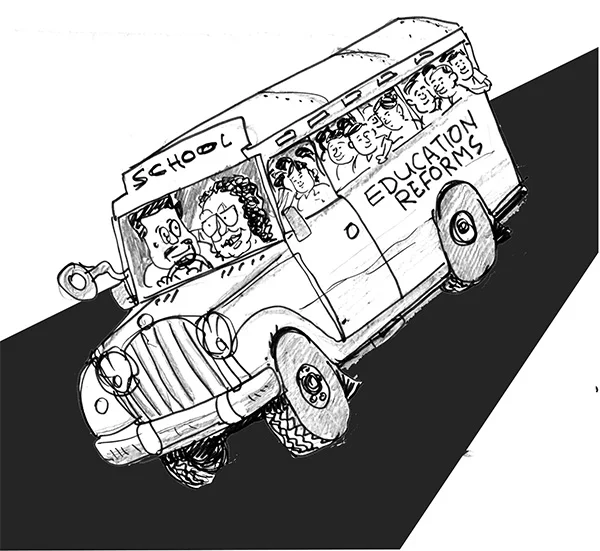
The recent furor arising out of the Grade 6 children’s textbook having a weblink to a gay dating site appears to be an act of sabotage. Prime Minister (and Education Minister Harini Amarasuriya) has been unfairly and unreasonably targeted for attack by her political opponents. Governments that professionalise the civil service rather than politicise them have been more successful in sustaining reform in the longer term in keeping with the national interest. In Sri Lanka, officers of the state are not allowed to contest elections while in service (Establishment Code) which indicates that they cannot be linked to any party as they have to serve all.
Skilled Leadership
The government is also being subjected to criticism by the Opposition for promising much in its election manifesto and failing to deliver on those promises. In this regard, the NPP has been no different to the other political parties that contested those elections making extravagant promises. The problem is that the economic collapse of 2022 set the country back several years in terms of income and living standards. The economy regressed to the levels of 2018, which was not due to actions of the NPP. Even the most skilled leadership today cannot simply erase those lost years. The economy rebounded to around five percent growth in the past year, but this recovery now faces new problems following Cyclone Ditwah, which wiped out an estimated ten percent of national income.
In the aftermath of the cyclone, the country’s cause for shame lies with the political parties. Rather than coming together to support relief and recovery, many focused on assigning blame and scoring political points, as in the attacks on the prime minister, undermining public confidence in the state apparatus at a moment when trust was essential. Despite the politically motivated attacks by some, the government needs to stick to the path of inclusiveness in its approach to governance. The sustainability of policy change depends not only on electoral victory but on inclusive processes that are more likely to endure than those imposed by majorities.
Bipartisanship recognises that national rebuilding and reconciliation requires cooperation across political divides. It requires consultation with the opposition and with civil society. Opposition leader Sajith Premadasa has been generally reasonable and constructive in his approach. A broader view of bipartisanship is that it needs to extend beyond the mainstream opposition to include ethnic and religious minorities. The government’s commitment to equal rights and non-discrimination has had a positive impact. Visible racism has declined, and minorities report feeling physically safer than in the past. These gains should not be underestimated. However, deeper threats to ethnic harmony remain.
The government needs to do more to make national reconciliation practical and rooted in change on the ground rather than symbolic. Political power sharing is central to this task. Minority communities, particularly in the north and east, continue to feel excluded from national development. While they welcome visits and dialogue with national leaders, frustration grows when development promises remain confined to foundation stones and ceremonies. The construction of Buddhist temples in areas with no Buddhist population, justified on claims of historical precedent, is perceived as threatening rather than reconciliatory.
Wider Polity
The constitutionally mandated devolution framework provided by the Thirteenth Amendment remains the most viable mechanism for addressing minority grievances within a united country. It was mediated by India as a third party to the agreement. The long delayed provincial council elections need to be held without further postponement. Provincial council elections have not been held for seven years. This prolonged suspension undermines both democratic practice and minority confidence. International experience, whether in India and Switzerland, shows that decentralisation is most effective when regional institutions are electorally accountable and operational rather than dormant.
It is not sufficient to treat individuals as equal citizens in the abstract. Democratic equality also requires recognising communities as collective actors with legitimate interests. Power sharing allows communities to make decisions in areas where they form majorities, reducing alienation and strengthening national cohesion. The government’s first year in office saw it acknowledge many of these problems, but acknowledgment has not yet translated into action. Issues relating to missing persons, prolonged detention, land encroachment and the absence of provincial elections remain unresolved. Even in areas where reform has been attempted, such as the repeal of the Prevention of Terrorism Act, the proposed replacement legislation falls short of international human rights standards.
The New Year must be one in which these foundational issues are addressed decisively. If not, problems will fester, get worse and distract the government from engaging fully in the development process. Devolution through the Thirteenth Amendment and credible reconciliation mechanisms must move from rhetoric to implementation. It is reported that a resolution to appoint a select committee of parliament to look into and report on an electoral system under which the provincial council elections will be held will be taken up this week. Similarly, existing institutions such as the Office of Missing Persons and the Office of Reparations need to be empowered to function effectively, while a truth and reconciliation process must be established that commands public confidence.
Trust in institutions requires respect for constitutional processes, trust in society requires inclusive decision making, and trust across communities requires genuine power sharing and accountability. Economic recovery, disaster reconstruction, institutional integrity and ethnic reconciliation are not separate tasks but interlinked tests of democratic governance. The government needs to move beyond reliance on its core supporters and govern in a manner that draws in the wider polity. Its success here will determine not only the sustainability of its reforms but also the country’s prospects for long term stability and unity.
by Jehan Perera
While agreeing wholeheartedly with most of the sentiments expressed by Dr Geewananda Gunawardhana in his piece “Pharmaceuticals, deaths, and work ethics” (The Island, 5th January), I must take exception to what he stated regarding corruption: “Enough has been said about corruption, and fortunately, the present government is making an effort to curb it. We must give them some time as only the government has changed, not the people”
With every change of government, we have witnessed the scenario of the incoming government going after the corrupt of the previous, punishing a few politicians in the process. This is nothing new. In fact, some governments have gone after high-ranking public servants, too, punishing them on very flimsy grounds. One of the main reasons, if not the main, of the unexpected massive victory at the polls of this government was the promise of eradication of corruption. Whilst claiming credit for convicting some errant politicians, even for cases that commenced before they came to power, how has the NPP government fared? If one considers corruption to be purely financial, then they have done well, so far. Well, even with previous governments they did not commence plundering the wealth of the nation in the first year!
I would argue that dishonesty, even refusal to take responsibility is corruption. Plucking out of retirement and giving plum jobs to those who canvassed key groups, in my opinion, is even worse corruption than some financial malpractices. There is no need to go into the details of Ranwala affairs as much has been written about but the way the government responded does not reassure anyone expecting and hoping for the NPP government to be corruption free.
One of the first important actions of the government was the election of Ranwala as the speaker. When his claimed doctorate was queried and he stepped down to find the certificate, why didn’t AKD give him a time limit to find it? When he could not substantiate obtaining a PhD, even after a year, why didn’t AKD insist that he resigns the parliamentary seat? Had such actions been taken then the NPP can claim credit that the party does not tolerate dishonesty. What an example are we setting for the youth?
Recent road traffic accident involving Ranwala brough to focus this lapse too, in addition to the laughable way the RTA was handled. The police officers investigating could not breathalyse him as they had run out of ‘balloons’ for the breathalyser! His blood and urine alcohol levels were done only after a safe period had elapsed. Not surprisingly, the results were normal! Honestly, does the government believe that anyone with an iota of intelligence would accept the explanation that these were lapses on the part of the police but not due to political interference?
The release of over 300 ‘red-tagged’ containers continues to remain a mystery. The deputy minister of shipping announced loudly that the ministry would take full responsibility but subsequently it turned out that customs is not under the purview of the ministry of shipping. Report on the affair is yet to see the light of day, the only thing that happened being the senior officer in customs that defended the government’s action being appointed the chief! Are these the actions of a government that came to power on the promise of eradication of corruption?
The new year dawned with another headache for the government that promised ‘system change.’ The most important educational reforms in our political history were those introduced by Dr CWW Kannangara which included free education and the establishment of central schools, etc. He did so after a comprehensive study lasting over six years, but the NPP government has been in a rush! Against the advice of many educationists that reforms should be brought after consultation, the government decided it could rush it on its own. It refuses to take responsibility when things go wrong. Heavens, things have started going wrong even before it started! Grade Six English Language module textbook gives a link to make e-buddies. When I clicked that link what I got was a site that stated: “Buddy, Bad Boys Club, Meet Gay Men for fun”!
Australia has already banned social media to children under 15 years and a recent survey showed that nearly two thirds of parents in the UK also favour such a ban but our minister of education wants children as young as ten years to join social media and have e-buddies!
Coming back to the aforesaid website, instead of an internal investigation to find out what went wrong, the Secretary to the Ministry of Education went to the CID. Of course, who is there in the CID? Shani of Ranjan Ramanayake tape fame! He will surely ‘fix’ someone for ‘sabotaging’ educational reforms! Can we say that the NPP government is less corrupt and any better than its predecessors?
by Dr Upul Wijayawardhana

Selfies and smiles: South Korea seeks ‘new phase’ in ties with China

M/s South Asian Technologies awarded contract to supply vehicle number plates

A new act for National Lotteries Board to be introduced
Motor Vehicles (Driving License Levy) Regulations No. 3 of 2022 to be amended
Mrs. P. K. L. S. Panduwawala appointed to the post of Surveyor General
Implementing the programme to provide concession for pepper, coffee and cardamom plantations affected by the disaster

‘Dates have the highest sugar content to fight Coronavirus’

Sunday Island 27 December – Headlines

#SundayIsland 17th December – Headlines

Sunday Island – 28th March

Sunday Island Headlines – 21 March

Sunday Island – 21st February – Headlines
-
 News15 hours ago
Broad support emerges for Faiszer’s sweeping proposals on long- delayed divorce and personal law reforms
-
 News2 days ago
Private airline crew member nabbed with contraband gold
-

 News4 days ago
Health Minister sends letter of demand for one billion rupees in damages
-

 Opinion6 days ago
Remembering Douglas Devananda on New Year’s Day 2026
-
 News7 days ago
Leading the Nation’s Connectivity Recovery Amid Unprecedented Challenges
-
 Features2 days ago
Pharmaceuticals, deaths, and work ethics
-

 Latest News2 days ago
Curran, bowlers lead Desert Vipers to maiden ILT20 title
-

 News15 hours ago
Interception of SL fishing craft by Seychelles: Trawler owners demand international investigation