
News
Prez: Crisis beyond govt. control

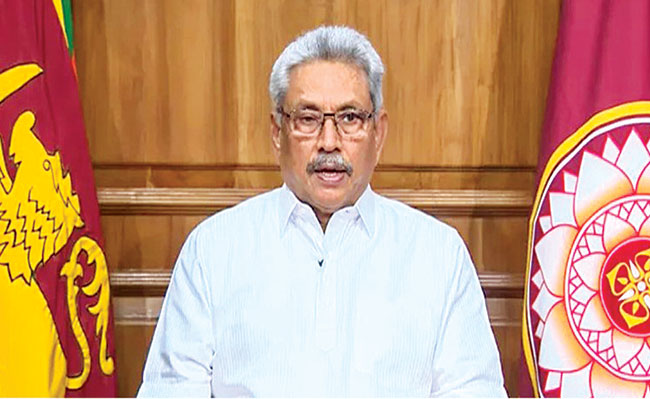
Acknowledging that the growing difficulties experienced by the people, President Gotabaya Rajapaksa has urged them to have faith in him. Blaming the foreign exchange crisis for the current predictment, the President said, in a pre-recorded speeech delivered last night, that he was aware of the shortages of essential items and increase in prices and sensitive to the many sufferings the people have to experience over the past two months.
Text of the President’s statement: “I know that this situation will continue for reasons beyond our control though we make maximum possible efforts with regard to these situations.
“I accept responsibility for the actions I take. Today, I am determined to make tough decisions to find solutions to the inconveniences that the people are experiencing. I have appointed a National Economic Council and an Advisory Committee to assist it. I will constantly monitor whether the decisions I make through this are implemented. Therefore, first of all I request you to have faith in the actions I will take on behalf of the people.
“I am well aware of the difficulties faced by the people. I was able to better understand and manage all the difficulties faced by the soldiers who were at the forefront of the war against the brutal terrorism and the innocent civilians who were affected by the war.
“Our country is not the only country in the world affected by the prevailing crisis situation. The entire world is engulfed with various hardships. Increasing shipping costs, rising commodity prices and shortages of certain goods caused by the Covid-19 pandemic are all beyond our control. However, we have adopted concessionary initiatives for the benefit of the people.
“This crisis was not created by me. When those who contributed to the creation of this crisis are criticizing the government in front of the people today, I am attempting to immediately resolve this crisis and provide relief to the people.
In a crisis situation like this, it is the responsibility of the politicians and intellectuals of a country to collectively find solutions to the issues.
The root cause of current issues is our foreign exchange crisis.
“The projected export earnings for this year is USD 12 billion, before the rupee was floated. According to the data of the last two months, we have to bear USD 22 billion as the import cost this year. Accordingly, this will result in a trade deficit of USD 10 billion.
Based on recent data, this year we will receive about USD 3 billion from tourism, as well as export services such as information technology, and USD 2 billion from remittances from expatriate workers. Accordingly, the trade deficit will be USD 5 billion.
Meanwhile, USD 6.9 billion will have to be paid in loan installments and sovereign bonds this year. Then there will be a deficit of USD 11.9 billion.
We expect to generate USD 2.5 billion from other grants and investments. Accordingly, there is a total deficit of USD 9.4 billion in foreign exchange.
However, once the rupee is floated, export earnings are expected to reach USD 13 billion. This will also reduce the cost of imports from USD 22 billion to USD 20 billion. If that happens, the trade deficit could be reduced to USD 7 billion. We should aim for this target.
“We can also expect USD 4 billion by providing export services and USD 5 billion in remittances from expatriate workers. Accordingly, our trade deficit will be USD 2.4 billion.
“We must take action to fill this deficit and increase our foreign exchange reserves.
To this end, we have initiated discussions with international financial institutions as well as with our friendly countries regarding repayment of our loan installments. The government is in discussions with various parties to implement a new method regarding this which will be beneficial to our country. Yesterday’s discussion with the International Monetary Fund was also held for this purpose.
Through those discussions, we hope to find a way to pay off our annual loan installments, sovereign bonds, and so on. Subsequent to my discussions with the International Monetary Fund, I have decided to work with them after examining the advantages and disadvantages.
“Due to some decisions I have taken in the recent past, we were able to control the import expenditure to a great extent. We suspended importing vehicles two years ago because we saw this issue in advance. In addition, we encouraged local industries. We also stopped the importation of many non-essential food items and took steps to cultivate those crops in our own country. Now we can witness the successful results of those initiatives.
“The most serious issue we face in controlling the cost of imports is the rapidly rising fuel prices in the world market. Generally, more than 20 percent of our import expenditure is spent on purchasing fuel. In the last few months alone, fuel prices in the world market have more than doubled. This is the reason why the increase in fuel prices in our country was inevitable. Fuel is widely used in our country not only for vehicles but also to generate electricity.
“This is why, I constantly took steps to discuss and encourage relevant agencies to use renewable energy sources as much as possible.
Therefore, by limiting the use of fuel and electricity as much as possible, the citizens too can extend their support to the country at this time. I hope that you will understand the responsibility lies with you at this challenging time.
The tourism industry, which was collapsed due to the COVID-19 pandemic, is revving. The last two months have seen a clear increase in tourist arrivals to Sri Lanka.
Also, due to the acceleration of the government’s provision of infrastructure facilities in the IT and telecommunications sectors, the revenue generated through these sectors is increasing.
“We are a nation that has experienced many adversities and at the same time conquered those challenges throughout the history. We have faced foreign invasions, great famines, natural disasters and threats of terrorism. The way we dealt with the Covid-19 situation has been praised even by international organizations. However, we all need to understand that we have to face difficulties when implementing solutions for the issues for a certain period of time. Therefore, I urge all of you not to be discouraged but to unite as a nation to overcome this crisis.
You requested me to build a secure, disciplined, and a modern developed country, as well as a better education for your children. Almost two and a half years of my tenure were devoted to protect you and your child from the 4
pandemic. I will dedicate remaining period of my tenure to accomplish those original goals.
I urge the Cabinet, the Parliament and public officials to work together as a team to achieve our desired goal of providing a better country for our children with a great commitment.
I entered into politics on your invitation. All of you have placed an utmost trust in me. I will never betray the trust you have placed in me and protect it with a great commitment.”






The Government’s ‘Rebuilding Sri Lanka’ Fund, established to provide relief and support to communities affected by Cyclone Ditwah, continues to receive financial contributions on a daily basis.
Accordingly, the Containers Transport Owners Association made a financial contribution of Rs. 1.5 million, while the Association of SriLankan Airlines Licensed Aircraft Engineers contributed Rs. 1.35 million to the Fund.
The respective cheques were formally presented to the Secretary to the President, Dr. Nandika Sanath Kumanayake, at the Presidential Secretariat on Friday (19).
The occasion was attended by W. M. S. K. Manjula, Chairman of the Containers Transport Owners Association, together with Dilip Nihal Anslem Perera and Jayantha Karunadhipathi.
Representing the Association of SriLankan Airlines Licensed Aircraft Engineers were Deshan Rajapaksa, Samudika Perera and Devshan Rodrigo handed over the cheque.

A meeting between Prime Minister Dr. Harini Amarasuriya and a delegation of UNICEF representatives was held on Saturday, (December 20) at the Prime Minister’s Office.
During the meeting, the Prime Minister explained the measures taken by the Government to ensure the protection of the affected student community and to restore the damaged school system, as well as the challenges encountered in this process.
The Prime Minister stated that reopening schools located in landslide-prone areas would be extremely dangerous. Accordingly, the Government is focusing on identifying such schools and relocating them to suitable locations based on scientific assessments.
The Prime Minister further noted that financial assistance has been provided to students affected by the disaster, enabling parents to send their children back to school without an additional financial burden. Emphasizing that school is the safest place for children after their homes, the Prime Minister expressed confidence that the school environment would help restore and improve students’ mental well-being
The Prime Minister also highlighted that attention has been given to several key areas, including the relocation of disaster-affected schools, restoration of school infrastructure, merging and operating certain schools jointly, facilitating teaching and learning through digital and technological strategies, and providing special transportation facilities. She emphasized that the Government is examining these issues and is committed to finding long-term solutions.
The UNICEF representatives commended the Government’s commitment and the initiatives undertaken to restore the education sector and assured their support to the Government. Both parties also discussed working together collaboratively on future initiatives.
The meeting was attended by the UNICEF representatives to Sri Lanka Emma Brigham, Lakshmi Sureshkumar, Nishantha Subash, and Yashinka Jayasinghe, along with Secretary to the Ministry of Education Nalaka Kaluwewa, Director of Education Dakshina Kasturiarachchi, Deputy Directors Kasun Gunarathne and Udara Dikkumbura.
(Prime Minister’s Media Division)


Drug controversy:
“Setting up state-of-the-art drug testing facility will cost Rs 5 billion”
Activists call for legal action against politicians, bureaucrats
Serious questions have been raised over Sri Lanka’s drug regulatory system following revelations that the National Medicines Regulatory Authority’s (NMRA) quality control laboratory is not accredited by the Sri Lanka Accreditation Board (SLAB), casting doubt on both the reliability of local test results and the adequacy of oversight of imported medicines.
Medical and civil rights groups warn that the issue points to a systemic regulatory failure rather than an isolated lapse, with potential political and financial consequences for the State.
Chairman of the Federation of Medical and Civil Rights Professional Associations, Specialist Dr. Chamal Sanjeewa, said the controversy surrounding the Ondansetron injection, which was later found to be contaminated, had exposed deep weaknesses in drug regulation and quality assurance.
Dr. Sanjeewa said that the manufacturer had confirmed that the drug had been imported into Sri Lanka on four occasions this year, despite later being temporarily withdrawn from use. The drug was manufactured in India in November 2024 and in May and August 2025, and imported to Sri Lanka in February, July and September. On each occasion, 67,600 phials were procured.
Dr. Sanjeewa said the company had informed the NMRA that the drug was tested in Indian laboratories, prior to shipment, and passed all required quality checks. The manufacturer reportedly tested the injections against 10 parameters, including basic quality standards,
pH value, visual appearance, component composition, quantity per phial, sterility levels, presence of other substances, bacterial toxin levels and spectral variations.
According to documents submitted to the NMRA, no bacterial toxins were detected in the original samples, and the reported toxin levels were within European safety limits of less than 9.9 international units per milligram.
Dr. Sanjeewa said the credibility of local regulatory oversight had come under scrutiny, noting that the NMRA’s quality control laboratory was not SLAB-accredited. He said establishing a fully equipped, internationally accredited laboratory would cost nearly Rs. 5 billion.
He warned that the failure to invest in such a facility could have grave consequences, including continued loss of life due to substandard medicines and the inability of the State to recover large sums of public funds paid to pharmaceutical companies for defective drugs.
“If urgent steps are not taken, public money will continue to be lost and accountability will remain elusive,” Dr. Sanjeewa said.
He added that if it was ultimately confirmed that the drug did not contain bacterial toxins at the time it entered Sri Lanka, the fallout would be even more damaging, severely undermining the credibility of the country’s health system and exposing weaknesses in health administration.
Dr. Sanjeewa said public trust in the health sector had already been eroded and called for legal action against all politicians and public officials responsible for regulatory failures linked to the incident.
by Chaminda Silva ✍️

Financial contributions received for ‘Rebuilding Sri Lanka’ Fund

UNICEF representatives and PM discuss rebuilding schools affected by the Disaster

A few showers may occur in the Uva province and in Ampara, Batticaloa, Matale, Nuwara-Eliya, and Hambantota districts

NMRA laboratory lacks SLAB accreditation

Air quality deteriorating in Sri Lanka

Cardinal urges govt. not to weaken key socio-cultural institutions

‘Dates have the highest sugar content to fight Coronavirus’

Sunday Island 27 December – Headlines

#SundayIsland 17th December – Headlines

Sunday Island – 28th March

Sunday Island Headlines – 21 March

Sunday Island – 21st February – Headlines
-

 Midweek Review5 days ago
How massive Akuregoda defence complex was built with proceeds from sale of Galle Face land to Shangri-La
-
 News4 days ago
Pope fires broadside: ‘The Holy See won’t be a silent bystander to the grave disparities, injustices, and fundamental human rights violations’
-

 News4 days ago
Pakistan hands over 200 tonnes of humanitarian aid to Lanka
-
 News5 days ago
Burnt elephant dies after delayed rescue; activists demand arrests
-

 Business3 days ago
Unlocking Sri Lanka’s hidden wealth: A $2 billion mineral opportunity awaits
-

 Editorial5 days ago
Colombo Port facing strategic neglect
-

 News3 days ago
Army engineers set up new Nayaru emergency bridge
-

 News5 days ago
Sri Lanka, Romania discuss illegal recruitment, etc.