
News
Press freedom under fire, says HRCSL


The Human Rights Commission of Sri Lanka (HRCSL) has expressed serious concern over what it describes as growing threats to freedom of expression in the country, particularly the targeting of journalists through police investigations into alleged defamation.
In a statement, the Commission cited the recent summoning of journalist Tharindu Jayawardena for a police inquiry without disclosure of reasons, later revealed to be linked to complaints over his reporting on alleged corruption, involving public funds. The HRCSL said the failure to inform him of the reasons for the summons violated a circular issued by the Inspector General of Police in July 2025.
Full text of HRCSL statement: The Human Rights Commission of Sri Lanka (HRCSL) is deeply concerned about emerging threats to the freedom of expression in Sri Lanka, and particularly the freedom of journalists to engage in their profession without interference. It is particularly disturbed by a trend in which law enforcement officials have launched investigations into allegedly defamatory speech, including by journalists. In a recent egregious example, Mr. Tharindu Jayawardena, a journalist and member of the Commission’s Sub-Committee on the Freedom of Expression, was summoned for a police inquiry without proper disclosure of the reasons for such summoning. It later transpired that the summoning was due to a complaint that Mr. Jayawardena had made allegedly defamatory remarks in his publications about corruption in the use of public funds. The Commission also notes that any failure of the police to inform a person of the reasons for summoning such person is a breach of Circular RTM 101/CRTM 61 issued by the Inspector General of Police on 2 July 2025 directing all investigating officers to inform persons of the reasons for summoning them.
The freedom of expression in Sri Lanka is guaranteed by article 14(1)(a) of the Sri Lankan Constitution. It is a fundamental right that is crucial to all citizens for the purpose of expressing their thoughts and opinions, and participating in democracy. The right protects expressions in all forms made through any medium, including online platforms. According to the Supreme Court of Sri Lanka, the right protects ‘not only information or ideas that are favourably received or regarded as inoffensive…but also those that offend, shock or disturb the State or any sector of the population’.
The freedom of expression may be subject to certain restrictions, but these must only be by law in accordance with article 15(2) and article 15(7) of the Constitution. The Supreme Court has clearly held that each restriction on the freedom of expression must meet the standards of necessity, proportionality, and reasonableness. The Commission also notes the societal danger in unnecessary, disproportionate, and unreasonable restrictions on the freedom of expression, as such restrictions can lead to public frustration and even unrest.
One of the grounds on which the freedom of expression can be restricted under article 15(2) is defamation. Necessary, proportionate, and reasonable restrictions may, therefore, be imposed to guarantee to every person the right to their reputation and privacy, and to protect persons from defamation. Orders and judgments in this respect by civil courts are examples of such restrictions. Moreover, all persons, including journalists and editors, have ‘special duties and responsibilities’ with respect to the rights and reputations of others when exercising their freedom of expression. This norm is clearly articulated in article 19(3) of the International Covenant on Civil and Political Rights. Therefore, journalists and editors should ensure that published content is checked for accuracy and should provide all parties an opportunity to comment on or respond to allegations made against them. Where inaccuracies are found to be published, retractions and apologies should be issued without delay.
However, there is a common misconception that restrictions on the freedom of expression on the grounds of preventing defamation can be in the form of criminal sanctions. On the contrary, any restriction on a person’s speech on the grounds that it constitutes defamation remains the exclusive province of civil courts. No offence with respect to defamation currently exists under Sri Lankan criminal law. In fact, the Penal Code (Amendment) Act, No. 12 of 2002, completely repealed Chapter XIX of the Penal Code of Sri Lanka, i.e., the Chapter on Defamation. Therefore, Sri Lanka Police has no jurisdiction whatsoever to investigate complaints with respect to defamation. It should neither entertain nor investigate complaints concerning defamation. Any citizen aggrieved by an alleged act of defamation can only seek a remedy before the civil courts of Sri Lanka and may not file criminal complaints in this regard.
The Commission observes a trend where political actors and influential persons have sought to file complaints with the Criminal Investigation Department or other divisions of Sri Lanka Police, including the Computer Crime Investigation Division, alleging that citizens have made false or defamatory statements about them, often on online platforms. The Commission recalls that international human rights standards require that public figures, such as political leaders and state officials, must tolerate more criticism than private individuals. The reliance on law enforcement officials to launch investigations into allegedly defamatory statements should be especially avoided by such public figures, as they have special responsibilities to respect the freedom of expression of members of the public. Often, inaccurate or unfair statements may be made about such public figures. However, it is their responsibility to respond to such statements through proportionate means, such as issuing official clarifications, rather than reliance on law enforcement officials. The Commission has also recognised in the past that commentary on women in political office, both on social and legacy media, has often been harmful in the country. Addressing this egregious issue, however, requires long term societal interventions, and not the abuse of criminal law.
In this context, the Commission wishes to make several observations with respect to the Online Safety Act, No. 9 of 2024 (OSA). The Commission has previously noted in a letter to the former Speaker that the current Act does not fully comply with the Supreme Court’s Determination on the Online Safety Bill, and that the current Act could have been enacted only with a special majority in Parliament. In this context, the use of this Act to suppress the freedom of expression of any citizen, including for the purported purpose of preventing defamation, raises serious questions of constitutionality.
The Commission observes that online safety is a legitimate aim and the regulation of online platforms for the genuine purpose of online safety, particularly of vulnerable users, may be necessary. However, the current OSA does not achieve this aim. Its provisions replicate colonial-era criminal offences found in the Penal Code and fails to appropriately deal with a number of genuine online safety issues, such as phishing, spyware, malware, denial-of-service attacks, and hacking. The Commission recently held a consultation with civil society actors and noted a wide consensus that the OSA should be repealed. Any process of drafting new legal provisions on online safety should be consultative and draw on relevant experience and expertise to ensure that such provisions are fit for purpose.
The Commission recommends that the Government of Sri Lanka and relevant authorities adopt the following measures to ensure the respect for and protection of the freedom of expression in full compliance with the Sri Lankan Constitution and relevant international human rights law: 1. The Ministry of Justice should declare a moratorium on the use of the Online Safety Act until its repeal and replacement with fit-for-purpose legislative provisions; 2. The Inspector General of Police should issue directions to all divisions and police stations of Sri Lanka Police reminding them that defamation is not a criminal offence in Sri Lanka, and to refrain from recording or investigating complaints purely relating to alleged defamation where no other offence is reasonably suspected; and 3. Political leaders should refrain from filing complaints with law enforcement officials with regard to any statement that is allegedly false or defamatory, as such a statement does not constitute a criminal offence.

Latest News
Heat Index at ‘Caution level’ in the Western, Sabaragamuwa, Southern and North-western provinces and in Anuradhapura, Mannar, Vavuniya and Monaragala districts

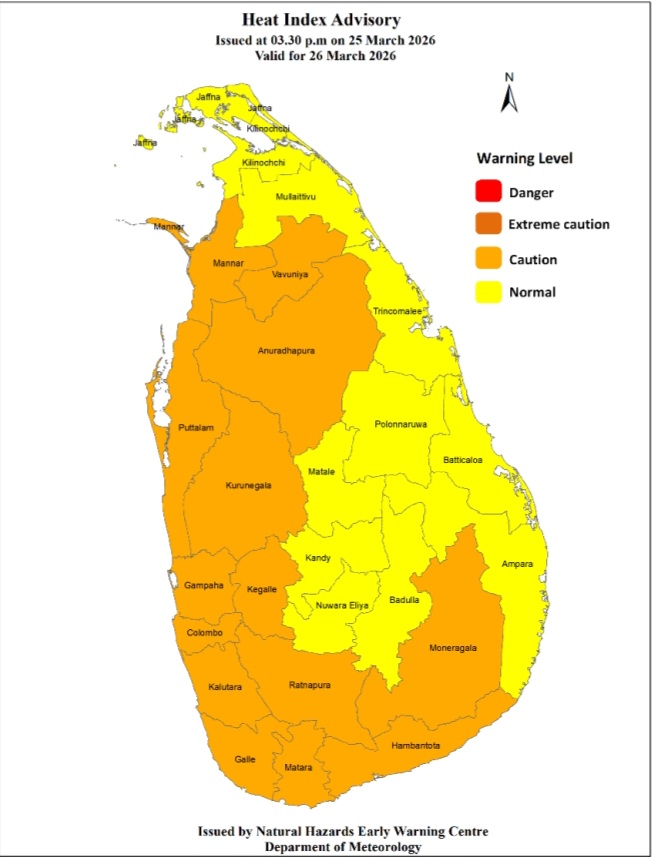
Warm Weather Advisory
Issued by the Natural Hazards Early Warning Centre of the Department of Meteorology
at 3.30 p.m. on 25 March 2026, valid for 26 March 2026.
The Heat index, the temperature felt on human body is likely to increase up to ‘Caution level’ at some places in the Western, Sabaragamuwa, Southern and North-western provinces and in
Anuradhapura, Mannar, Vavuniya and Monaragala districts.
The Heat Index Forecast is calculated by using relative humidity and maximum temperature and this is the condition that is felt on your body. This is not the forecast of maximum temperature. It is generated by the Department of Meteorology for the next day period and prepared by using global numerical weather prediction model data.

Effect of the heat index on human body is mentioned in the above table and it is prepared on the advice of the Ministry of Health and Indigenous Medical Services.
ACTION REQUIRED
Job sites: Stay hydrated and takes breaks in the shade as often as possible.
Indoors: Check up on the elderly and the sick.
Vehicles: Never leave children unattended.
Outdoors: Limit strenuous outdoor activities, find shade and stay hydrated.
Dress: Wear lightweight and white or light-colored clothing.
Note:
In addition, please refer to advisories issued by the Disaster Preparedness & Response Division, Ministry
of Health in this regard as well. For further clarifications please contact 011-7446491.
By Shamindra Ferdinando
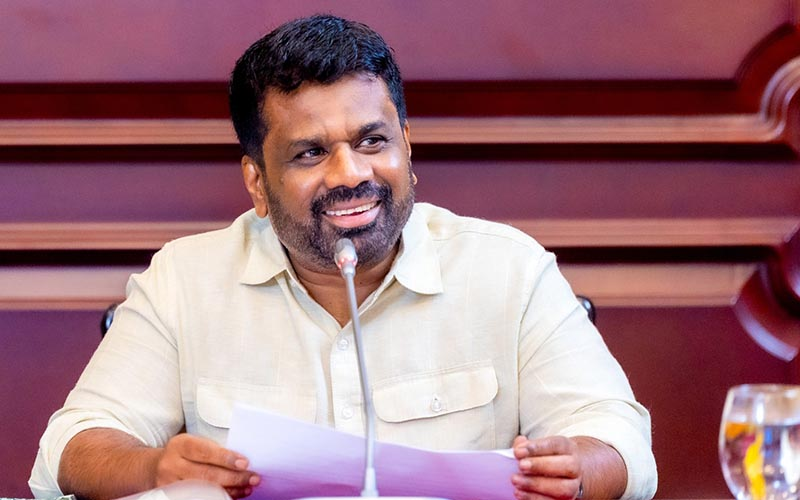
A spokesperson for the US Embassy in Colombo declared that the United States and Sri Lanka maintain a long-standing defence partnership, grounded in transparency, mutual respect, and shared interests.
The official said so in response to The Island query regarding President Anura Kumara Dissanayake’s recent bombshell disclosure, in Parliament, that his government declined to allow the US Air Force to use the Mattala Rajapaksa International Airport, following the eruption of the latest West Asia war.
We sought views of the US on President Dissanayake’s claim against the backdrop of Sri Lanka being a party to the Acquisition and Cross-Servicing Agreement (ACSA) since 2007. Sri Lanka extended the ACSA in 2017, for another 10-year period, and its extension comes up next year.
The President revealed that the US had requested permission to use Mattala, between 04 and 08 March.
Claiming that the request had been made on 26 February, two days before the war began, President Dissanayake said that the US had sought to land two aircraft, carrying eight anti-ship missiles, but that the request had been turned down to maintain Sri Lanka’s neutrality. The President revealed that the aircraft were to come from a US base in Djibouti.
The US embassy pokesperson explained that questions related to operational movements, including ‘Operation Epic Fury’, should be directed to the Department of War (DOW) in Washington.
Camp Lemonnier is the primary base of operations for US Africa Command in the Horn of Africa. China, too, has its only overseas military base in Djibouti in the vicinity.
Military sources said whatever various interested parties said about US-Sri Lanka relations, the former provided significant intelligence support during last phase of the conflict that enabled the Navy to hunt down floating LTTE arsenals in international waters. Of the eight LTTE vessels sunk, the US backed four hits with specific intelligence, sources said.
News
No decrease in remittances from workers due to Gulf conflict, but significant drop in tourist arrivals – CB Governor

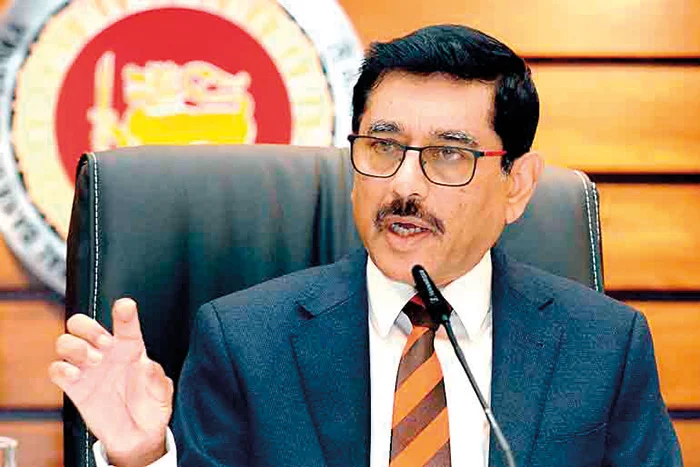
Sri Lanka’s worker remittances had not seen a decrease despite the ongoing conflict in West Asia, Central Bank (CBSL) Governor, Dr. Nandalal Weerasinghe said yesterday.
“Based on currently available data, they have not seen a decline in remittances. In fact, according to that we have observed, is a slight increase in remittances in the past few days, ” the Governor said at a media conference held at the Central Bank head office in Colombo.
Governor Weerasinghe also mentioned that he had not seen any reports about Sri Lankans returning to the country from the Middle East due to the ongoing conflict.
The Central Bank Governor, however, acknowledged that there had been a decrease in tourist arrivals. He confirmed that tourist arrivals had decreased by around 17 percent due to the current volatile situation in the Middle East.
Meanwhile, the Central Bank of Sri Lanka has decided to maintain the Overnight Policy Rate (OPR) at the current level of 7.75%, following its latest Monetary Policy Board meeting.
By Hiran H Senewiratne

UN votes to recognise enslavement of Africans as ‘gravest crime against humanity’

Meta and YouTube found liable in landmark social media addiction trial

Showers expected in the Western and Sabaragamuwa provinces and in Galle and Matara districts after 2.00 pm.

Heat Index at ‘Caution level’ in the Western, Sabaragamuwa, Southern and North-western provinces and in Anuradhapura, Mannar, Vavuniya and Monaragala districts

US dodges question on AKD’s claim SL denied permission for military aircraft to land

No decrease in remittances from workers due to Gulf conflict, but significant drop in tourist arrivals – CB Governor

‘Dates have the highest sugar content to fight Coronavirus’

Sunday Island 27 December – Headlines

#SundayIsland 17th December – Headlines

Sunday Island – 28th March

Sunday Island Headlines – 21 March

Sunday Island – 21st February – Headlines
-

 Features3 days ago
Trincomalee oil tank farm: An engineering marvel
-

 News6 days ago
CIABOC tells court Kapila gave Rs 60 mn to MR and Rs. 20 mn to Priyankara
-
 Features6 days ago
Science and diplomacy in a changing world
-

 Features3 days ago
The scientist who was finally heard
-
 News1 day ago
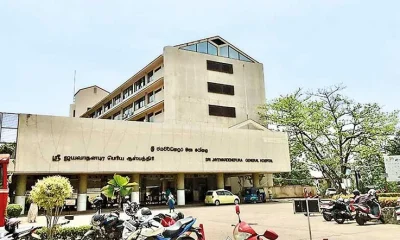
Japanese boost to Sri J’pura Hospital, an outright gift from Tokyo during JRJ rule
-

 News1 day ago
Senior citizens above 70 years to receive March allowances on Thursday (26)
-

 News5 days ago
Colombo, Oslo steps up efforts to strengthen bilateral cooperation in key environmental priority areas
-

 News3 days ago
Substandard coal deepens energy crisis, warns former CEB Chief