
News
People’s Bank remains firmly committed to the nation’s progress

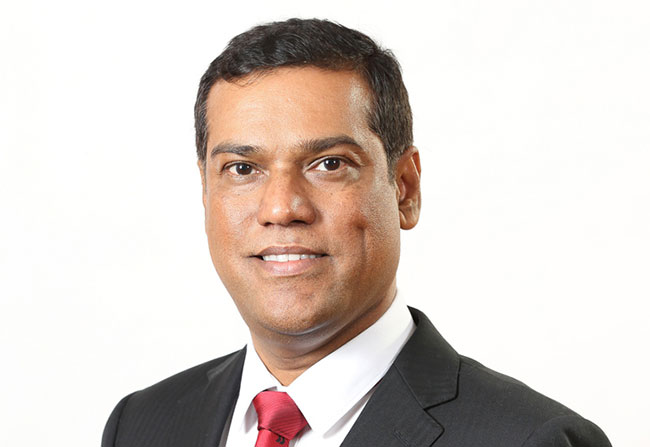
The People’s Bank is known for its commitment towards the betterment of the country. As one of the largest financial services providers in Sri Lanka, the Bank has been continuously featured in the 1000 Best Banks in the world by the world renowned ‘The Banker Magazine’ in the years of 2018, 2019, 2020 and 2021.
CEO/GM of the People’s Bank Ranjith Kodituwakku recently spoke to the media about the bank’s journey so far, and its present and future vision.
Could you share some insight about the present progress and stability of the People’s Bank?
People’s Bank was mainly initiated for the purpose of making banking facilities accessible to the general public. At present we have the country’s largest customer base of over 14 million and largest branch network of 742.
Our total assets have grown to Rs.2.6 trillion, and our deposits exceed Rs. 2.0 trillion. Our loans and receivables have exceeded Rs. 1.9 trillion. We are happy to announce that we also received the highest pre-tax profit of Rs. 30.4 billion and Rs. 23.7 billion pre-tax profit during the year 2021.
* People’s Bank has introduced a number of new innovations to the local financial sector, how are they faring?
People’s Bank became the first commercial bank to work in Sinhala and Tamil. It pioneered the act of printing cheque books in Sinhala and Tamil which were only printed in English earlier.
People’s Bank also introduced the Gold Mortgage Loan Service in 1962. Through this, we were able to free people who were caught in the clutches of money lenders.
On World Women’s Day in 1993, a branded ladies account “Vanitha Vasana” was launched, and to build future security for our student population, the “SisuUdana” account was launched coinciding World Children’s Day in 1996.As of today, most students deposit their savings at People’s Bank.
People’s Bank also was the first bank in the country to implement a complete digital transformation for the entire operating model, covering all aspects from the lowest to the highest levels of the Bank.
The bank’s Self Banking Units (SBUs) are a pioneering introduction to our digitalization programme of which there are over 265 islandwide. With ATMs, CDMs and bill payment machines (KIOSK) installed herein, you can experience convenient and efficient banking which operates 24 hours a day, seven days a week, 365 days a year, all year round.
All of our branches now have instant access to People’s Wiz which enables quick account opening. Over a million people are registered with the People’s Wave app, which allows you to bank from anywhere. People’s Bank also launched the People’s Pay Mobile App in support of the Central Bank’s efforts to promote digital transactions without the use of cash. In addition, the People’s Website offers online banking and People’s Wiz Credit provides personal loans within 24 hours. We have won numerous local and international awards for digital banking.
* People’s Bank was established to boost local agriculture, rural economy, upgrade small and medium-scale entrepreneurs by assisting every level of ordinary people with the bank. What are the contributions given by People’s Bank to those sectors?
Since the inception, People’s Bank’s main focus was on developing the rural banking system and uplifting the people. Even today, this focus remains unchanged within the bank. If you take the last year, People’s Bank granted loan facilities to SME businesses to the tune of Rs. 63.0 billion.
Also the bank introduced an agriculture-based Harvest Loan Scheme to create a self-sufficient country and granted loans of Rs.2.3 billion over a period of 15 months ending 31 December 2021 alone. The ‘Made in Sri Lanka’ loan scheme was introduced to promote local industries and ‘Saarabhoomi’ to encourage local production of fertilisers, pesticides, herbicides. ‘Vanitha Saviya’ loan scheme was launched to empower women entrepreneurs and ‘Business Power’ to uplift small and medium enterprises.
People’s Bank also launched the People’s Spark Entrepreneurship Development Programme with the aim of empowering Sri Lankan youth who are passionate about running their own business.
* What are the facilities given to customers when remitting money to Sri Lanka?
Sri Lankans working in foreign countries or any other person can send money to their loved ones and this money can be withdrawn conveniently from our 742 island wide network.
In order to recognise and encourage expatriate workers remitting money from abroad, the Bank launched a promotion called ‘Vaasi Kotiyai bonanza early this year. Under this promotion the Grand Draw winner who will be selected at the year-end will be presented with a Grand Prize of Rs.10 million. Additionally, Rs.1 Million Monthly winners will be selected every month, 22K gold sovereign weekly winners will be selected 48 times, while 10,000 daily cash prize winners will be selected 334 times until 31st December 2022.
In addition to that, we also provide loan facilities for those who seek foreign employment and to those who are already working abroad. We have also planned to introduce a special benefits package for Sri Lankan working abroad which includes insurance benefits and loans at concessionary interest rates.
* What’s your opinion about the stability of the banking system and what benefits are gained by transacting with a government bank and benefits receive by the society?
In addition to having a strong capital base, our banking system is closely monitored by the Central Bank and all local banks are run in compliance with the highest standards in the world.
State Banks specifically have the largest capital bases in the country and due to the government ownership, they enjoy extraordinary stability which in turn provides maximum security for customer deposits.
In addition, due to the large branch network and superior digital banking capabilities, customers can transact conveniently with People’s Bank.
Last but not least, the profits made by state banks are channeled back towards the development of the country which ultimately benefits customers.
* Finally, what is the contribution given by the People’s Bank through import and export trades?
People’s Bank works successfully with over 900 banks worldwide to facilitate import and export trades by issuing Letters of Credit to private and State owned enterprises. This function is invaluable to sustain normal lives of general public as it enables importation of essential items such as fuel, medicine, food and gas.
As I mentioned earlier, People’s Bank is driven by objectives that extend beyond mere profits. We work for the betterment of people and the country. As a Bank that is firmly committed to the wellbeing of the nation, we will continue to fulfill our responsibilities in this manner in the future.

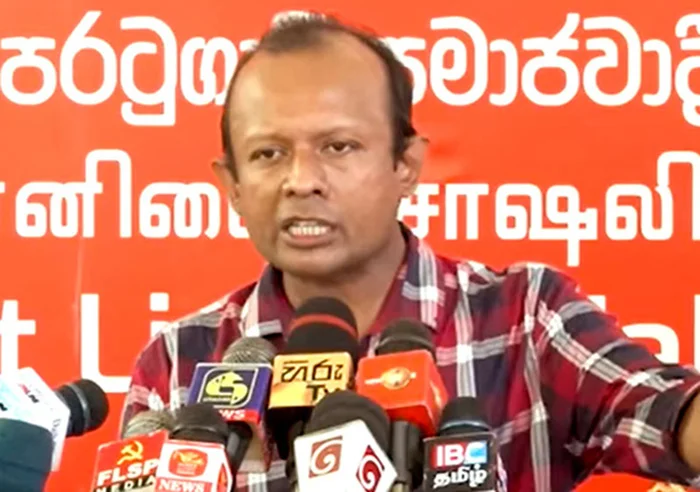
The Frontline Socialist Party (FSP) yesterday accused the government of seeking to use the proposed Protection of the State from Terrorism Act (PSTA) to suppress popular political activity, claiming that some of its provisions were more repressive than those of the Prevention of Terrorism Act (PTA).
FSP Education Secretary Pubudu Jayagoda told a media briefing, in Nugegoda, that the definition of terrorism in the Bill was so broad that it could be used to label almost any form of popular political activity as terrorism.
He said the Bill’s approach to defining terrorism was based largely on attempts to compel a government, or an international organisation, to do, or refrain from doing something, rather than on internationally recognised criteria, such as killings, causing serious bodily harm, kidnapping or acts intended to spread terror among the public.
Jayagoda also alleged that the Bill transferred substantial powers from the judiciary to the executive, while extending powers of arrest, investigation and detention to the armed forces, in addition to the police.
He claimed that the government had sought to portray the Bill as a replacement for the PTA while retaining or introducing provisions that could facilitate political victimisation and repression.
The FSP also questioned the government’s decision to proceed with the Bill, despite having previously sought public views on an earlier draft.
Jayagoda said a draft had been published earlier this year, with the period for public submissions ending on February 28, but the Bill subsequently gazetted was essentially the same draft with some provisions rearranged.
Jayagoda also referred to a letter reportedly sent by Attorney-at-Law Saliya Peiris, a member of a Committee, chaired by President’s Counsel Rienzie Arsecularatne, that had been appointed to draft the legislation. He said Peiris had stated, in the October 06 letter, that changes had been made to the draft prepared by the Committee.
“This means that even the Committee, appointed to prepare the Bill, was a deception,” Jayagoda alleged.
He said that the PSTA was fundamentally similar to the Anti-Terrorism Bill introduced by the previous government, in 2023, which the National People’s Power (NPP) opposed and challenged in court.
“If the NPP opposed that Bill then and is now bringing the same legislation before Parliament, the government must explain its position,” he said.
Jayagoda called on NPP MPs to oppose the PSTA in Parliament and urged trade unions and other groups to build a broad public movement against the legislation.
He challenged the government to an open debate on the Bill.
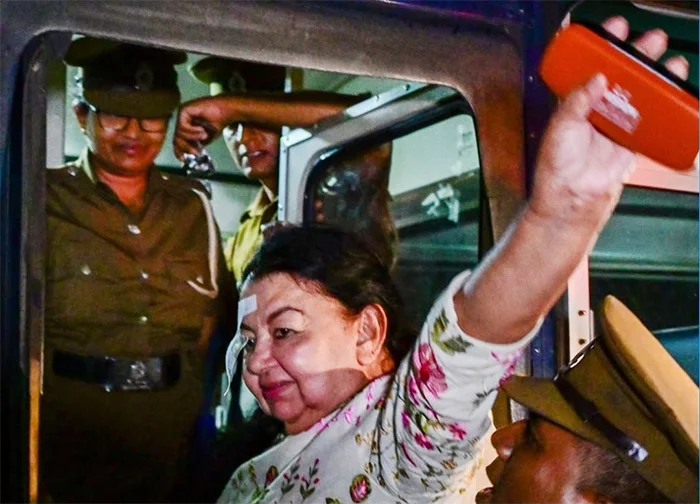
Former First Lady Shiranthi Rajapaksa was yesterday remanded until 13 October after being produced before the Colombo Magistrate’s Court following her arrest by the Commission to Investigate Allegations of Bribery or Corruption (CIABOC).
Shiranthi, wife of former President Mahinda Rajapaksa, was arrested at her residence on Poorwarama Road, Kirulapone, after CIABOC officers recorded a statement from her for nearly two hours.
According to the CIABOC, the arrest was made over allegations that Rs. 10 million obtained from the National Savings Bank through the Siriliya Saviya organisation was misappropriated.
The money was allegedly obtained to provide a Computed Tomography (CT) scanner to the children’s hospital. Investigators allege that the scanner was not provided and that the funds were instead unlawfully used.
CIABOC is investigating alleged offences under the Public Property Act and corruption-related provisions in connection with the transaction and other financial activities involving Siriliya Saviya, which was headed by Rajapaksa.
Rajapaksa returned to Sri Lanka on Monday night on a flight from Malaysia after travelling overseas for medical treatment. She left for Singapore on 16 September after being admitted to a private hospital in Colombo on 15 September following an illness.
She had been due to appear before the Financial Crimes Investigation Division (FCID) on 13 October in connection with its investigation into the financial affairs of Siriliya Saviya.
Meanwhile, her lawyers filed an anticipatory bail application before the Maligakanda Magistrate’s Court on Monday, seeking an order preventing her arrest in connection with the FCID investigation.
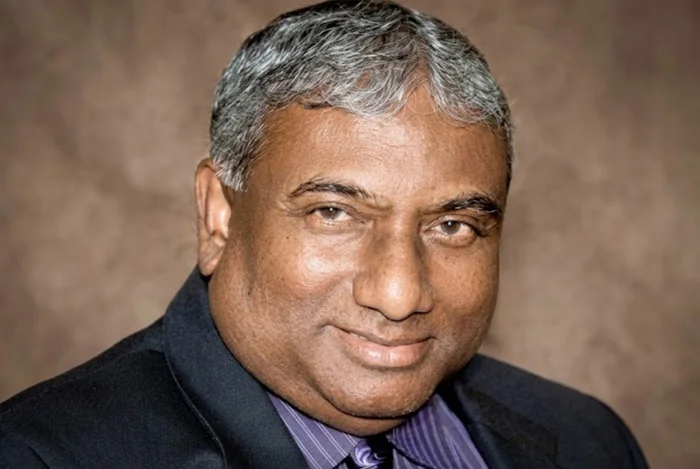
Former National Savings Bank (NSB) Chairman Pradeep Kariyawasam was yesterday granted bail by the Colombo Magistrate’s Court following his arrest by the Commission to Investigate Allegations of Bribery or Corruption (CIABOC).
Kariyawasam, husband of former Chief Justice Shirani Bandaranayake, was arrested in connection with the Bribery Commission’s investigation into the ‘Siriliya Saviya’ account linked to former First Lady Shiranthi Rajapaksa.
The investigation concerns financial activities involving the Siriliya Saviya initiative, which was headed by Rajapaksa, wife of former President Mahinda Rajapaksa.
CIABOC is continuing investigations into the alleged financial irregularities relating to the account.

Showers above 100 mm are likely at some places in the Western, Sabaragamuwa, Central, Uva and Southern provinces and in Anuradhapura district

PSTA worse than PTA: FSP

Shiranthi R remanded until 13 Oct.

Former NSB Chairman Kariyawasam granted bail

Katchatheevu row: India SC urges fishermen to avoid Sri Lankan waters

Remembering Juvenal, Coke, Acton and Machiavelli

‘Dates have the highest sugar content to fight Coronavirus’

Sunday Island 27 December – Headlines

#SundayIsland 17th December – Headlines

Sunday Island – 28th March

Sunday Island Headlines – 21 March

Sunday Island – 21st February – Headlines
-

 Editorial7 days ago
Colombo Port drug bust: The plot thickens
-

 Features5 days ago
The first woman in the foreign service or Ceylon Overseas Service it was then called
-

 Editorial6 days ago
Fuelling discontent and protest
-

 News4 days ago
Geneva takes up Sallay’s case and govt. ignores opportunity to answer accusations
-

 Foreign News5 days ago
Ten injured after car crashes into rugby supporters in Australia
-

 Latest News6 days ago
Tharindu Rathnayake, bowlers secure Asian Games Bronze for Sri Lanka
-

 News5 days ago
Nearly 20 Iranian tankers stranded off Lanka amid US sanctions
-

 Features4 days ago
Sri Lanka Cricket Bill: Governance reform is not yet a cricket strategy