
News
NTJ threatened Chief Incumbent of Nelligala IBC


by Rathindra Kuruwita
National Thowheed Jamaat (NTJ) had sent a threatening letter to Chief Incumbent of the Nelligala International Buddhist Centre (NIBC), Ven. Wathurukumbure Dhammaratana Thera, a few weeks after the Easter Sunday attacks, the Thera told on Saturday to the Presidential Commission of Inquiry (PCoI) investigating the Easter Sunday attacks.
The Thera said that Zahran had come to see him on several occasions. On 4 February, 2014, a group of Muslims had come with a local businessman where the NIBC is currently located. It was about an unused state land and the Muslims had begun the construction of a place of worship without the necessary approval.
The Thera was informed of this development by the villagers and on 5 February, he visited the site with some youth and demolished the unauthorised construction. He had then acquired the same land, following the proper process, on a 30-year lease and the construction of the NIBC had commenced with the approval of Department of Buddhist Affairs and other relevant institutions in August, 2014. The witness said that several lands adjoining the site had been purchased and the facilities of the NIBC upgraded.
Asked by a Senior State Counsel (SSC) whether any incident had taken place during the construction of a building in the NIBC premises in June 2016, the witness said that a group of five persons had come and said that they hoped to purchase a plot of land nearby. The witness said that Zahran Hashim, the leader of NTJ had been among the group.
Zaharan had inquired from the witness whether he had any objections to them purchasing the nearby land for the construction of a ‘Centre’, which would not be a Mosque.
“I informed them that I did not like such a development as that would lead to unwanted issues in the future. Zahran spoke Sinhala fluently, better than any ordinary Muslim. Zahran told me that they and we could work together and I realised that he really wanted to buy a land near by Nelligala.”
The witness said that Zahran had returned to the NIBC in March 2017, in a bus with around 50 youth. The Thera said that the youth were dressed in identical clothes and it looked like that they were undergoing a training at some institution.
“Zahran requested some tea saying he and his team had travelled a long distances and I then offered them some tea,” the witness said, adding that Zahran had discussed Buddhism, Catholicism and Islam with him.
“It became clear to me that he was a fundamentalist. He spoke very critically about ordinary Muslims and said that if the estate workers had supported Prabhakaran, they would not have suffered. In August 2017, Zahran again came to the NIBC and discussed various issues with me. He was highly critical of ordinary Muslims, their beliefs, the Maulavis and the All Ceylon Jamiyyathul Ulama (ACJU). He also criticised certain rituals by Muslims such as worshipping tombstones at Mosques.”
According to the witness, during another meeting Zaharan had blamed Muslims for the clashes between the Sinhalese and the Muslims in Digana area. Zahran had also found fault with the Thera for intervening and conciliating.
“From what he said, I felt that Zahran liked these clashes. It allowed him to attract Muslim youth to his extremist activities,” the Thera said.
He said that he had also recorded discussions with Tawfiq Ahmed of the Sri Lanka Thowheed Jama’at (SLTJ) and Abdul Razik, General Secretary of the Ceylon Thowheed Jama’at (CTJ) about Islamist extremist activities and those had been circulating on social media. The witness said Zahran had phoned him and threatened him to remove those videos from social media platforms.
Zahran also blamed Razik since he was critical of Sharia law, Islamic banking and the burqa during the discussions with him, the Thera said.
Although Zahran had never visited the NIBC premises after that meeting, the NTJ leader had spoken to him on the phone on several occasions, the witness said. Zaharan had told him that he was in areas like Mawanella, Nuwara-Eliya and Kattankudi during those conversations, the Thera said.
Asked by the Attorney General’s Department representative when he had last received a telephone call from Zahran, the Thera said the last call from Zahran had come on 23 February, 2019.
“On that day, he spoke in a very aggressive manner and told me that I had no right to comment on matters such as Arabisation.
The witness said Zahran had told him, “You are not like Gnanasara Thera. You are a very cunning man and acquiring Muslims’ lands.”
The Thera said that and event related to the traditional New Year had been organised at the NIBC premises on 21 April, 2019 and he had been shocked about the Easter Sunday attacks and Zahran’s involvement in it. He had also taken steps to remove nearly 2,000 devotees who were at the premises within 20 minutes.
Thereafter, he had informed the then Chief of Staff of the Sri Lankan Army General Shavendra Silva, the Army Commander General Mahesh Senanayake and the Inspector General of Police (IGP) Pujith Jayasundara that Zaharan had visited the NIBC on several occasions and after eight military personnel had been assigned to protect the NIBC.
The Thera said that a few weeks after the bombings, on 14 May, 2019, he received an anonymous letter on a NTJ letterhead warning that he would be assassinated. Certain things that Zahran had told him over the phone had also included in the letter, the witness said.
“Copies of the letter were handed over to the then Army Commander and the Secretary to the Ministry of Defence. Relevant institutions, however, did not pay due attention to it. They did not record a statement from me or conduct an inquiry into the matter.”
The Thera also submitted a set of proposals on actions to be taken in order to eradicate extremist activities to the PCoI.
Noting that Ven. Dhammaratana Thera’s life could be in danger due to the testimony, the PCoI ordered the National Authority for the Protection of Victims of Crime and Witnesses (NAPVCW) to provide him with adequate security.


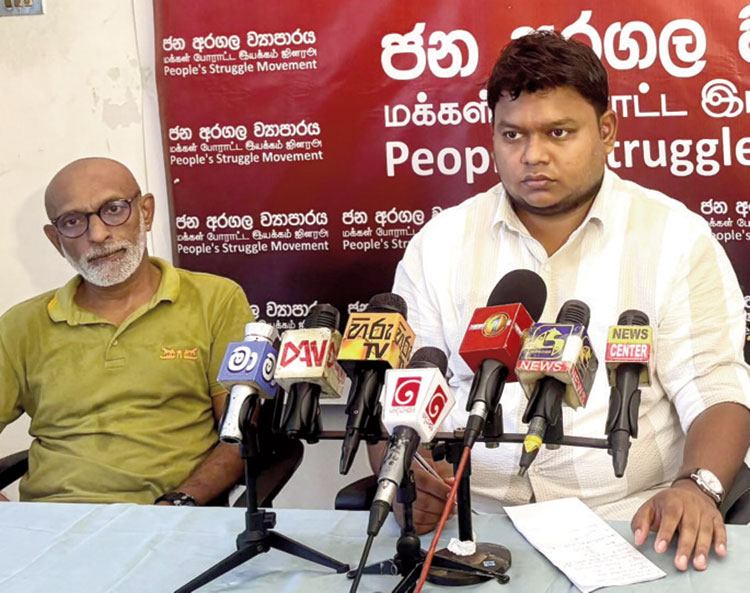
The Frontline Socialist Party-backed People’s Struggle Movement is set to stage a protest march in Colombo today (03) against what it describes as the growing tax burden on the public and the rising cost of living.
The organisers are due to commence the “Colombo March Against Unjust Taxes” at noon from Campbell Park, Borella. The FSP has also been mobilising support for the protest in Colombo and its suburbs in the run-up to the event.
People’s Struggle Movement National Executive Council member Wasantha Mudalige, speaking at a media briefing in Nugegoda yesterday (02), called on the public to join the protest, saying the movement intended to bring the tax burden faced by ordinary people to the forefront.
Mudalige alleged that successive tax measures had placed an excessive burden on households, particularly through taxes on food and educational items. He also criticised the Government over what he described as the high cost of basic food items and the difficulties faced by parents in meeting their children’s educational expenses.
He accused the Opposition of failing to adequately address the issue, claiming that opposition parties raised such concerns, mainly during election periods.
Mudalige also criticised the Government for what he described as a departure from promises made before the 2024 presidential election regarding taxes on educational equipment.
He questioned the tax burden on food items, citing figures of Rs. 100 per kilogramme on dried sprats, Rs. 310 per kilogramme on chicken and Rs. 11 per egg.
He further alleged that while ordinary people were bearing a heavy tax burden, wealthy groups were receiving tax concessions. He also criticised the Government’s economic programme and its implementation of measures associated with the International Monetary Fund (IMF).
The movement has framed today’s protest as part of a broader campaign over the cost of living and taxation. The People’s Struggle Alliance has separately announced that the Campbell Park demonstration will be the first in a series of public actions, with further protests planned in November.
Mudalige said the movement would continue to take the issue to the streets and urged the public to participate in today’s demonstration.
People’s Struggle Movement National Executive Council member Jayantha Amarasinghe also addressed the press.
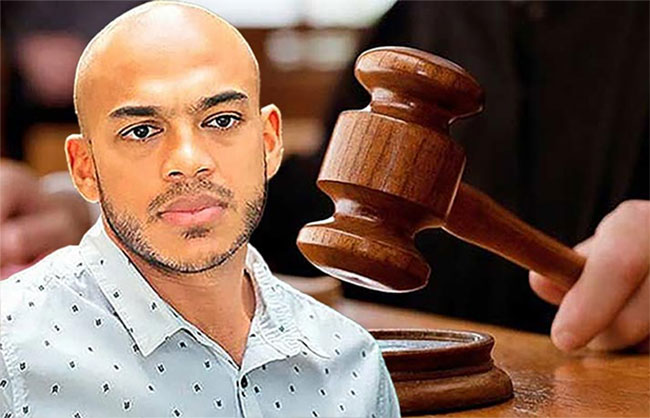
The Colombo High Court yesterday postponed the trial in the case filed under the Prevention of Money Laundering Act against Yoshitha Rajapaksa, son of former President Mahinda Rajapaksa.
The case was taken up before Colombo High Court Judge Udesh Ranatunga, with Yoshitha Rajapaksa, who is currently out on bail, appearing in court.
The trial was postponed as the President’s Counsel appearing for the defence was indisposed.
The Attorney General has filed the case against Rajapaksa, alleging that he committed an offence under the Prevention of Money Laundering Act by purchasing five plots of land in Dehiwala and Ratmalana, worth more than Rs. 73 million.
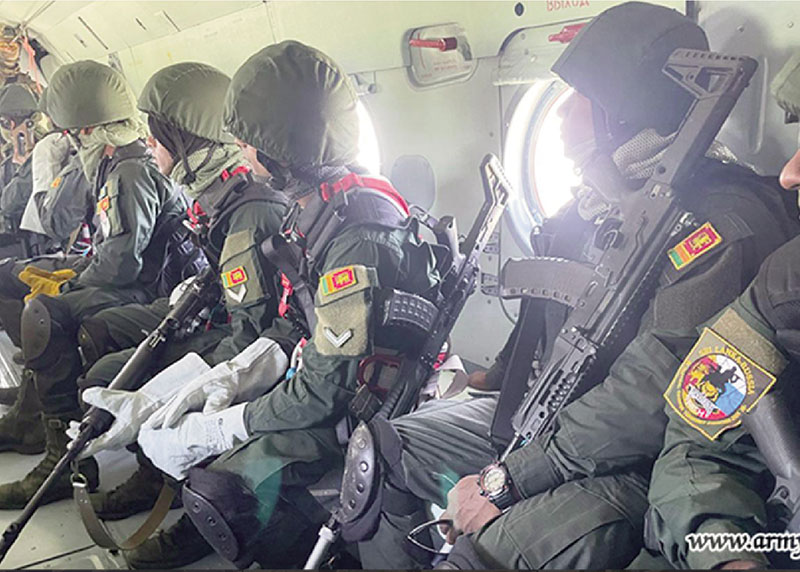
A contingent of the Sri Lanka Army, comprising 20 officers and 55 other ranks, participated in the combined military exercise ‘Wolverine Path II–2026’, conducted with the Armed Forces of the Russian Federation in Vladivostok, Russia, from September 18 to 25.
According to the Ministry of Defence, the exercise primarily focused on counter-terrorism operations and provided participating troops with training in a challenging combined operational environment.
The exercise included a range of tactical activities, including heli-rappelling, close-quarters battle (CQB), ambush operations, sniper firing, drone operations, buggy training and combat medical support.
The Ministry said the training enabled Sri Lankan troops to further develop their combat skills, tactical coordination and operational readiness.
It also provided an opportunity for the two militaries to exchange professional knowledge, operational experience and tactical expertise. Sri Lankan personnel gained exposure to training methodologies, tactical approaches and operational practices adopted by the Russian Armed Forces, the Ministry said.
The participation also enabled the Sri Lankan contingent to identify lessons from the joint training and share its own experiences with the Russian military.
The Sri Lankan contingent returned to the country following the exercise and arrived at Mattala Rajapaksa International Airport on September 28.
The Ministry said participation in the exercise contributed to enhancing the professional knowledge, tactical awareness and operational preparedness of Army personnel while promoting military-to-military cooperation, mutual understanding and professional relations between Sri Lanka and Russia.

G7 to release 100 million barrels of oil and diesel after Trump export ban threat

Showers above 75 mm are likely at some places in the Central, Sabaragamuwa, Western, Uva, North-western, Southern and North-central provinces and in Mannar district.

All set for Colombo rally against govt.’s tax policies

Yoshitha R money laundering trial postponed

Lankan troops test mettle in Russian war games

Tax burden drives thousands of doctors out of country: GMOA

‘Dates have the highest sugar content to fight Coronavirus’

Sunday Island 27 December – Headlines

#SundayIsland 17th December – Headlines

Sunday Island – 28th March

Sunday Island Headlines – 21 March

Sunday Island – 21st February – Headlines
-

 News5 days ago
Police remove Thileepan statue in Jaffna
-

 Features5 days ago
The 22nd Amendment, constitutional recovery and illiberal slippage
-

 Features5 days ago
Of foreigners as CEOs of Lankan ventures
-

 Latest News3 days ago
Gold winner Tharanga gets brand-new Honda Vezel from SLAAJ
-

 News5 days ago
Sajith rejects Jt. Opp. protest sabotage claim; SJB TU chief demands remedial action
-

 Features4 days ago
Thailand’s biggest new global star …
-

 Features3 days ago
Why Sri Lanka needs an Inclusive Civic Nationalism – urgently
-
 News4 days ago
First cases taken up by SC after enactment of 22A dismissed