
News
NPP can’t sidestep Anti-Corruption Act:Ex-Justice Minister


Former Justice Minister Dr. Wijeyadasa Rajapakshe, PC, says the National People’s Power (NPP) government cannot sidestep Anti-Corruption Act No 09 of 2023.
The former parliamentarian said that the Act made it mandatory for the Commission to Investigate Allegations of Bribery or Corruption (CIABOC) to disclose the asset declarations of all, regardless of their standing.
The disclosure of NPP Minister Wasantha Samarasinghe having assets worth Rs 275 mn wouldn’t have happened if not for the new Anti-Corruption Act approved by Parliament on July 19, 2023, Rajapakshe said.
The ex-Minister said that the main Opposition Samagi Jana Balawegaya (SJB) had, in writing, already requested the CIABOC to ascertain how several NPPers amassed so much wealth. According to the SJB letter, addressed to Director General of CIABOC, Ranga Dissanayake, they had named Ministers Wasantha Samarasinghe, Sunil Handunetti, Bimal Rathnayake, Nalinda Jayatissa and Punyasiri Jayakody and Deputy Minister Sunil Watagala. “The NPP will have to live with it. CIABOC will also have to ensure that all are treated alike”
Asked to explain the circumstances the Wickremesinghe-Rajapaksa government introduced that Act, Rajapakshe said that in spite of opposition within the parliamentary group, Wickremesinghe gave him the go ahead to introduce three new Acts, namely the Anti-Corruption Act, Regulation of Election Expenditure Act and the Proceeds of Crime Act.
“We have to discuss the enactment of those Acts, taking into account the pathetic state of the economy and the persistent accusations that the executive and the legislature caused the economic crisis against the backdrop of the failure on the part of the Central Bank at that time,” Rajapakshe said. Th proposed new laws facilitated our talks with the International Monetary Fund (IMF) as the latter emphasised the responsibility on our part to instill financial discipline across board, Rajapakshe said, adding that they decided to first introduce the Regulation of Election Expenditure Act.
All political parties, regardless of whatever differences they had with regard to other issues at hand, could have unanimously approved the Regulation of Election Expenditure Bill, Rajapakshe said. But, consensus among political parties couldn’t be achieved, the ex-Minister said, adding that finally only 97 voted for the Bill whereas 36 voted against when it was taken up on 19 January, 2023. Among those who opposed that vital piece of legislation were NPP parliamentary group leader Anura Kumara Dissanayake, SJB leader Sajith Premadasa and veteran politician Lakshman Kiriella.
The former Minister pointed out a staggering 92 lawmakers skipped that important vote. Then, the Parliament, on 19 July, without a vote, approved the Anti-Corruption Act but, regardless of determined efforts, the Proceeds of Crime Bill couldn’t be enacted during Wickremesinghe tenure as the President.
Rajapakse appreciated the NPP after having won both presidential and parliamentary polls in 2024 enacted the Proceeds of Crime Bill on April 8, 2025. Responding to another query, the PC said that the three laws could make significant and fundamental changes in the political scene.
The former Minister said that the UNDP has got involved in the anti-corruption fight here with an unprecedented USD 2.5 mn Japanese funding made available for the high profile project, whereas the CIABOC held talks with the World Bank on how the latter could support Sri Lanka’s efforts with the focus on action taken in line with the Proceeds of Crime Act.
Rajapakshe said that Sri Lanka initiated, during President Chandrika Bandaranaike Kumaratunga’s presidency in 2004, and signed and ratified the United Nations Convention Against Corruption (UNCAC). According to Rajapakshe, in terms of the UNCAC, Sri Lanka had to introduce an Anti-Corruption Act but with the change of government in 2005, that initiative was discarded. Rajapakshe said that following the change of government in 2015, an effort was made to take tangible measures in this regard but the project suffered again when he lost the Justice Ministry portfolio over his opposition to the deal on Hambantota port.”
Rajapakshe said that the Anti-Corruption Act may never have been enacted if not for the Aragalaya that brought Wickremesinghe to power in July 2022.
Former Minister Rajapakshe emphasised the importance of the enactment of 21st Amendment to the Constitution on 21 Oct., 2022, before the passage of three previously discussed Acts. The 21st Amendment received 179 votes in favour and one against while 45 abstained, Rajapakshe recalled declaring that it was aimed at restoring and strengthening the balance of powers among the executive, legislature, and judiciary, sharply eroded by the enactment of the 20th Amendment that expanded the powers of the presidency.
Rajapakshe alleged that the then Premier Dinesh Gunawardena made a last minute bid to put off the vote by compelling Wickremesinghe to come to Parliament for a meeting. “I steadfastly refused to join that meeting,” Rajapakshe said, asserting that whatever the shortcomings and faults of the post-Gotabaya administration, it enacted critically important laws that had brought immense pressure on those in power today.
By Shamindra Ferdinando

Latest News
Flood warning issued to the Divisional Secretariat Divisions of Ganga Ihala Korale, Udapalatha, Doluwa, Udunuwara, Yatinuwara, Gangawata Korale, Harispattuwa, and Pathadumbara


Due to heavy rainfall received in the upper catchment areas of the Mahaweli River over the past few hours, there is a risk of minor flooding in the low-lying areas surrounding the Mahaweli River within the Divisional Secretariat Divisions of Ganga Ihala Korale, Udapalatha, Doluwa, Udunuwara, Yatinuwara, Gangawata Korale, Harispattuwa, and Pathadumbara.Residents living in the above mentioned areas and motorists using roads passing through these areas are urged to exercise extreme caution and remain highly vigilant regarding the prevailing situation.
Furthermore, residents living in close proximity to the Mahaweli River in these areas are advised to remain highly alert to the situation and take all necessary precautions to protect themselves from any potential flooding.The relevant disaster management authorities are requested to take all necessary measures in response to this situation.

The National Building Research Organisation [NBRO] has issued landslide Red Alerts to the districts of Kandy, Kegalle and Nuwara Eliya effective from 14:00 hrs on 20.09.2026 To 14:00 hrs on 21.09.2026
Accordingly,
LEVEL III [RED] Land Slide early warnings have been issued to the Divisional Secretaries Divisions and surrounding areas of Pasbage Korale in the Kandy district, Dehiowita, Aranayake, Deraniyagala, Mawanella and Yatiyanthota in the Kegalle district and Kothmale West, Kotmale East, Ambagamuwa and Norwood in the Nuwara Eliya district
LEVEL II [AMBER] Land Slide early warnings have been issued to the Divisional Secretaries Divisions and surrounding areas of Padukka in the Colombo district, Nagoda, Thawalama and Neluwa in the Galle district, Bulathsinhala, Palindanuwara, Walallawita and Agalawatta in the Kalutara district, Ganga Ihala Korale in the Kandy district, Bulathkohupitiya and Kegalle in the Kegalle district, Akuressa and Pitabeddara in the Matara district, Thalawakele in the Nuwara Eliya district and Pelmadulla, Ratnapura, Ayagama, Kuruwita and Ratnapura in the Ratnapura district.
LEVEL I [YELLOW] Land Slide early warnings have been issued to the Divisional Secretaries Divisions and surrounding areas of Seethawaka in the Colombo district, Niyagama and Baddegama in the Galle district, Mirigama in the Gampaha district, Ingiriya in the Kalutara district, Udapalatha and Yatinuwara in the Kandy district, Galigamuwa, Warakapola and Ruwanwella in the Kegalle district, Kotapola, Pasgoda and Athuraliya in the Matara district, and Eheliyagoda, Kalawana and Elapatha in the Ratnapura district.
News
Development projects can deliver results to the people more quickly when the political authority and the public service work together towards a common goal – PM
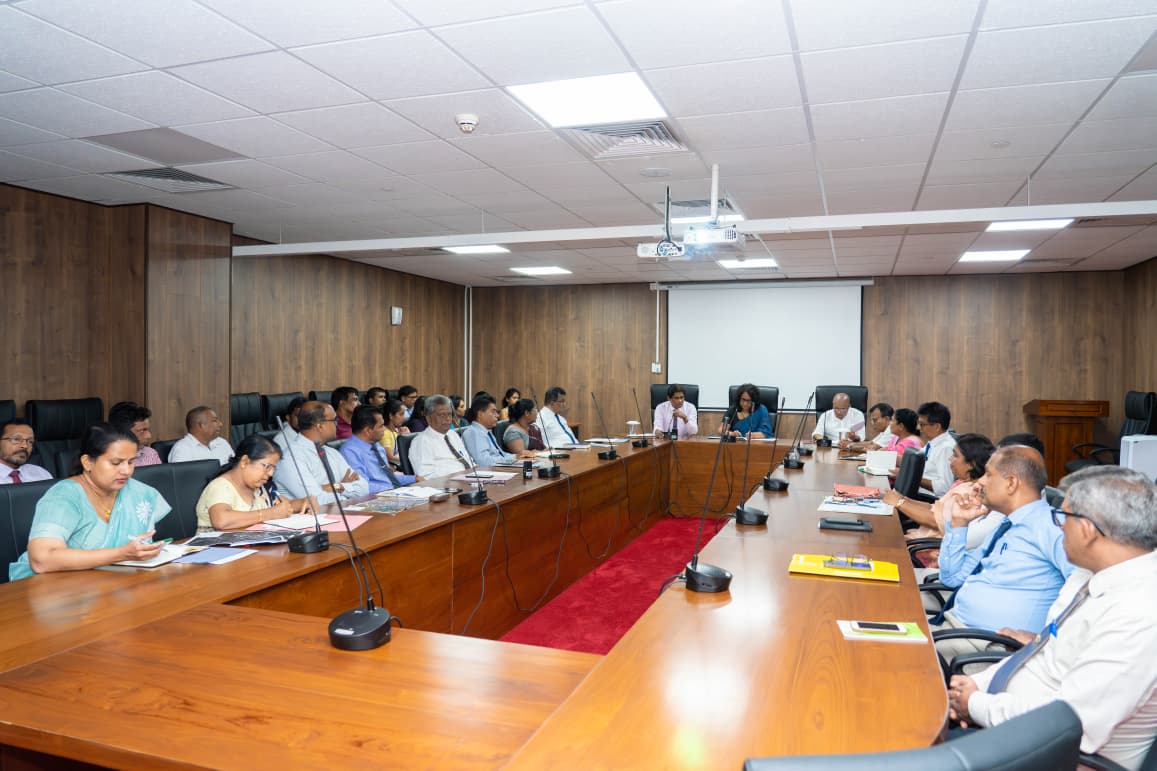
Prime Minister Dr. Harini Amarasuriya stated that development projects can deliver results to the people more quickly when the political authority and the public service work together towards a common, people-oriented objective.
The Prime Minister made these remarks while participating in a discussion held on Friday [September 18] at the Western Province Council Auditorium to review the progress of the development project to rehabilitate Rathmalana Kandawala Road and the drainage system on either side of the road, within the Dehiwala–Mount Lavinia Municipal Council limits in the Colombo District.
The project, which commenced on September 10, 2026, is scheduled to be completed before June 30, 2027. Implemented by the Provincial Road Development Authority (PRDA), the project includes the construction of a bridge at a cost of Rs. 64 million, the rehabilitation of the drainage system at a cost of Rs. 930 million, and the rehabilitation of the road at a cost of Rs. 115 million.
The Prime Minister also paid special attention to the progress of the responsibilities assigned to the Western Province Council, the Irrigation Department and the Ratmalana Divisional Secretariat in accordance with decisions taken at the previous committee meeting. Attention was also given to the current status of the plans being carried out by the Sri Lanka Land Development Corporation (SLLRDC), as well as the construction and maintenance activities being undertaken by the Provincial Road Development Authority (PRDA).
Commending the expedite and commendable progress of the project, the Prime Minister particularly appreciated the commitment demonstrated by officials of the relevant government institutions to work in close coordination with one another and in collaboration with the political authority.
The Prime Minister also emphasised the importance of taking measures well in advance to control flooding and minimise its impact on Colombo and several other districts in view of the rainy weather that may affect the Western Province during the latter part of this year.
The meeting was attended by the Chairman of the Colombo District Coordinating Committee and Member of Parliament Lakshman Nipuna Arachchi, Chairperson of the Ratmalana Divisional Coordinating Committee and Member of Parliament Samanmalee Gunasinghe, Chairman of the Roads Sub-Committee of the Colombo District Coordinating Committee Dewananda Suraweera, Mayor of the Dehiwala–Mount Lavinia Municipal Council Parakum Shantha, Chief Secretary of the Western Province K.G. Pradeep Pushpakumara, along with a number of government officials.
[Prime Minister’s Media Division]

Flood warning issued to the Divisional Secretariat Divisions of Ganga Ihala Korale, Udapalatha, Doluwa, Udunuwara, Yatinuwara, Gangawata Korale, Harispattuwa, and Pathadumbara

Landslide Red Alerts issued to the districts of Kandy, Kegalle and Nuwara Eliya

Shafali dazzles with 49-ball unbeaten 100 and India march into Asian Games final

Development projects can deliver results to the people more quickly when the political authority and the public service work together towards a common goal – PM

Landslide Early Warnings issued to the Districts of Colombo, Galle, Kalutara, Kandy, Kegalle, Matara, Nuwara Eliya and Ratnapura

Chamari Athapaththu’s unbeaten 83 leads Sri Lanka into final

‘Dates have the highest sugar content to fight Coronavirus’

Sunday Island 27 December – Headlines

#SundayIsland 17th December – Headlines

Sunday Island – 28th March

Sunday Island Headlines – 21 March

Sunday Island – 21st February – Headlines
-

 Opinion7 days ago
From Galkissa (Mount Lavinia) to Tambuttegama
-

 News4 days ago
US embassy won’t comment on IGP’s probe into joint drug raid
-

 Features6 days ago
The emptying university: why are academics leaving?
-

 Features7 days ago
Sri Lanka’s university crisis: Brain drain and union action demand urgent reform
-

 News3 days ago
Bid for Basil’s extradition nears final stage: Police
-

 Opinion7 days ago
Ashraff: From the SLMC towards the National Unity Alliance
-

 Business4 days ago
All-new Bolero MaXX unveiled in Sri Lanka
-

 Editorial7 days ago
Muscle flexing, astroturfing and dog-and-pony shows