
Foreign News
Nobel Prize-winning activist sentenced to 10 years in jail

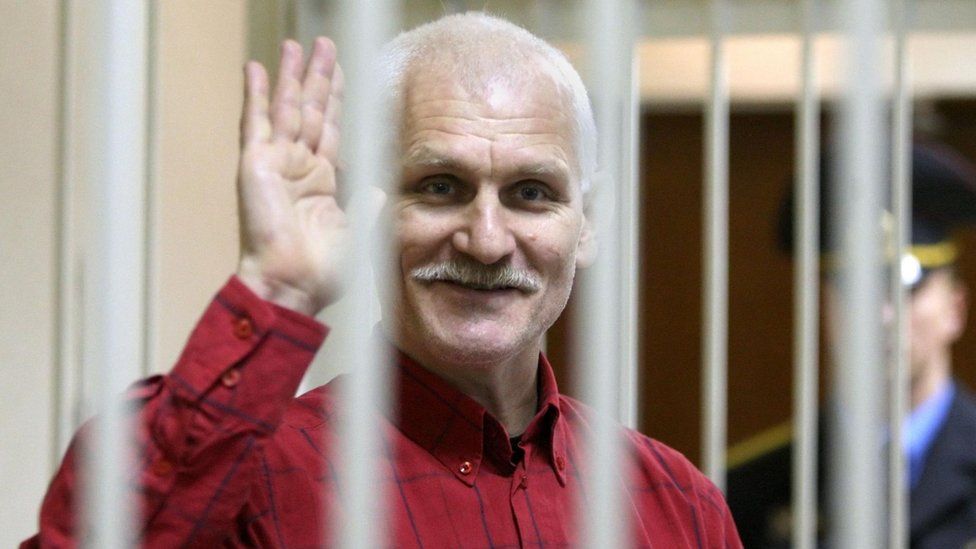
BBC reported that a court in Belarus has sentenced Nobel Peace Prize winner Ales Bialiatski to 10 years in prison.
He was arrested in 2021 and convicted of smuggling and financing “actions grossly violating public order”, the Viasna human rights group said.
Supporters of Bialiatski, 60, say the authoritarian regime of Belarusian leader Alexander Lukashenko is trying to silence him.
Bialiatski was one of three winners of the 2022 Nobel Peace Prize.


A powerful magnitude 7.8 earthquak struck the southern Philippines off the island of Mindanao, prompting tsunami risks in several countries. At least 15 people were feared dead as a result of the tremors.
Here is all we know about the earthquake and its immediate aftermath:
The quake hit early in the morning, shortly before 7:40am local time on Monday (23:40 GMT Sunday), according to the United States Geological Survey.
The epicentre was offshore, 32km (20 miles) west of Maasim in Sarangani province on the southern tip of the Philippines’ Mindanao island. The earthquake occurred at an estimated depth of 33km (21 miles).
Schools were reopening in the Philippines after a long break, and the tremors were felt strongly in a dozen provinces as far from the epicentre as 420km (261 miles) in the city of Manado on the Indonesian island of Sulawesi.
By late morning local time, the Philippine Institute of Volcanology and Seismology had reported 138 aftershocks, the highest at a magnitude 6.7.
Philippine authorities were assessing the damage from the quake, with the office of civil defence seeking to verify initial reports that 15 people had been killed and 129 injured, mostly from falling debris.
The full extent of the damage is yet unclear.
Tsunami alerts were issued in the southern Philippines, northern Indonesia and the Malaysian state of Sabah on Borneo island. Japan’s meteorological agency issued an advisory and said a tsunami of 0.2 metres (8in) or lower had been observed, with some disruption to ferries and precautionary beach closures.
The US Tsunami Warning System said multiple countries could be affected and Australia too initially warned of potential tsunami waves on its northern coasts.
Witnesses in Indonesia’s Manado said they felt the quake strongly. Only minor damage was reported, according to Abdul Muhari, spokesperson for Indonesia’s disaster mitigation agency.
A tsunami with a wave height up to 0.75 metres (2.5ft) was detected in some regions in North Sulawesi, Indonesia, where people started moving to safer areas, including residents of the remote Sangihe Islands, among the closest to the Philippines.
“They are now evacuating to the higher ground… away from the coast, to avoid the potential tsunami,” resident Jufry Dalita said, according to state news agency Antara.
Philippine President Ferdinand Marcos Jr ordered an immediate disaster response in Mindanao, an island the size of South Korea, with agencies directed to prepare relief supplies and evacuation centres and be ready for possible rescue operations.
“The national government is moving and we will not leave Mindanao behind,” he said in a statement.
Video shared by the local government in Mindanao’s General Santos, a city of about 700,000 people, showed the collapse of a building housing a fast food restaurant, with panicked onlookers fleeing as a cloud of dust spread quickly through the air.
One General Santos hospital was evacuated due to concerns about cracks on higher floors, while one of the buildings at the city’s Notre Dame of Dadiangas University collapsed, but no one was inside.
“I had to duck and shelter myself under the table. And it was very long and strong,” the university’s President Manuel de Leon told broadcaster DZMM.
Images from authorities in Sarangani province showed damaged shop fronts with collapsed signs, smashed windows and piles of rocks from crumbled concrete.
The Philippine military said its disaster response units had been deployed to affected areas.
A video shared by a local school the moment the quake struck showed a large group of children sitting on the floor swaying rapidly from side to side, some hugging teachers, before fleeing en masse as a makeshift shelter collapsed behind them.
Benjie Ancheta, police chief of Sarangani’s Alabel town, said the quake occurred during a police flag-raising ceremony, causing some people to faint.
“This is the strongest earthquake we’ve experienced,” Ancheta said by phone.
Malaysian Prime Minister Anwar Ibrahim said his government was ready to assist the Philippines.
(Aljazeera)
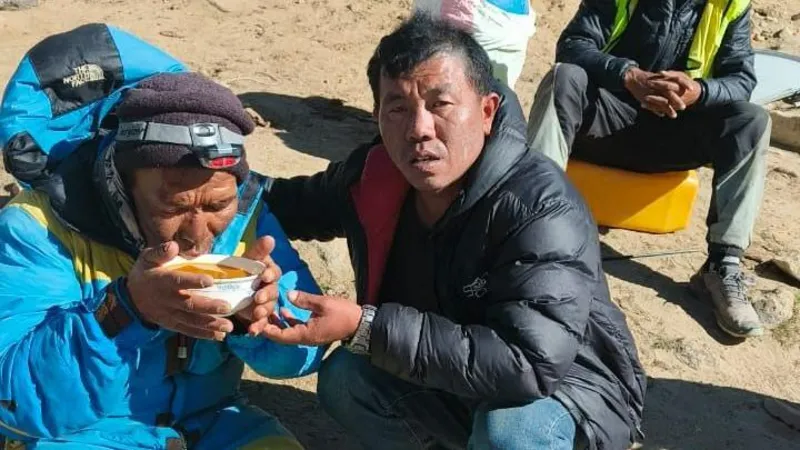
The Nepali guide discovered crawling down Everest six days after he was last seen alive has told the BBC he survived by “chewing ice” and eating a few chocolates he found in his pocket.
Dawa Sherpa was adamant he did not “go missing” on the descent down, but instead was forced to “stay behind” after his oxygen ran out.
It had been assumed Dawa Sherpa had perished on the mountain, with his family back in Nepal’s capital Kathmandu starting to perform last rites before he was spotted by a clean up team “sliding” down the mountain towards Base Camp.
He was airlifted to hospital in Kathmandu, where he spoke to the BBC while receiving treatment for dehydration, frostbite and a fractured bone.
“I didn’t think I would be alive,” he told BBC Nepali on Friday. “I thought I would perish this way.”
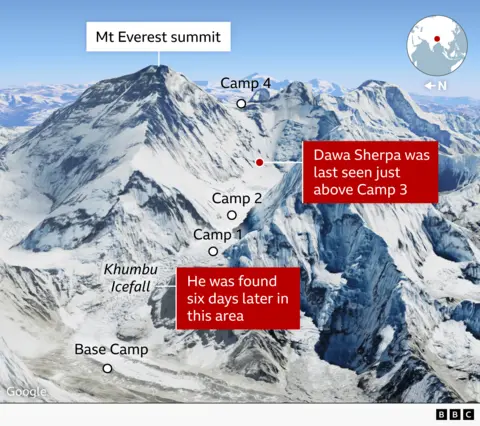
Climber Chris Thrall was the last person known to have seen Dawa Sherpa alive before he was rescued near the Khumbu Icefall on Thursday.
The former British soldier said the 57-year-old was sitting on his backpack just above Camp 3 – around 7,500m (24,600ft) – “as he had done hundreds of times before to take a short rest”.
Thrall continued to descend alone for what he estimated to be about 50-100m before he came across another member of their group, a “Polish climber with no oxygen, battling fairly severe frostbite”.
“So immediately my attention turned to the weakest member of the trio. And that was that,” he told the BBC’s Newshour programme.
“As I look back up the mountain, as I helped this guy descend, Hillary Dawa didn’t appear to have moved, and certainly wasn’t descending, because we would have seen his head torch.”
Up above, Dawa Sherpa told the BBC he had found himself in trouble.
“As the oxygen ran out, I couldn’t walk,” he explained.
“I didn’t eat anything for the first two days. Then I began chewing ice. It pained my teeth. I chewed the ice hard.”
Then he discovered some chocolates in his pocket, and managed to get some melted ice to drink.
He made his way down slowly – only to fall into a crevasse, according to two different people who spoke to Dawa Sherpa about his ordeal.
For two-and-a-half days he was trapped, they said, unable to find a way out.
Then an avalanche sent snow tumbling into the crevasse – and gave him the first hope he had had in days.
“Stepping on the snow, I stood up and looked above… It felt I could get out from there,” he told the BBC.
Once he had scrambled out, he found ropes nearby which helped his manoeuvre further down the world’s tallest mountain.
Another avalanche threatened his progress, but he was determined to keep going.
“I got through the snow and moved downwards. I walked throughout that night.
“Then, I came close to the base camp.”
It was there he saw the first people he had seen in almost a week.
“Its boys were going up to collect the waste. I met them. They carried me down.”
News of his survival was met with shock and delight by the wider sherpa community, the climbers he had been with, and his own family.
Five people have died during this year’s climbing season, with more than 300 dying since records began in the 1920s.
Pemba Sherpa, executive director of 8K Expeditions which was overseeing search efforts, called it a “true self-rescue”.
“Dawa managed to survive against all odds for days. It’s nothing short of a miracle,” he said.
When Thrall first saw comments on social media saying Dawa Sherpa, also known as Hillary Dawa Sherpa after famed mountaineer Edmund Hillary, had been found alive, he said he thought it was “spam”.
“It’s kind of crazy one minute to be fighting back tears with his daughter, and then the next minute to see him crawling into town,” Thrall told BBC’s Newshour. “It’s absolutely amazing, beyond words.”
His wife, Damu Sherpa, told news agency AFP she had given up hope, until seeing a picture of her husband.
“We thought he was no more, and had already begun his last rites,” she said as she waited to meet him at the hospital.
“I was so surprised when I saw the photos and recognised him – he was still wearing a cap I knitted for him.”
“He recognised me … is good and speaks,” his daughter Mhendo Lhamo Sherpa told Reuters news agency later, after visiting him. “We are happy.”
Doctors at Kathmandu’s HAMS Hospital say Dawa Sherpa has been “receiving comprehensive medical care in the intensive care unit”, but is stable and his “dehydration is showing significant improvement”.
More than 1,000 have summited Everest summit this season, making it the busiest on record.
[BBC]
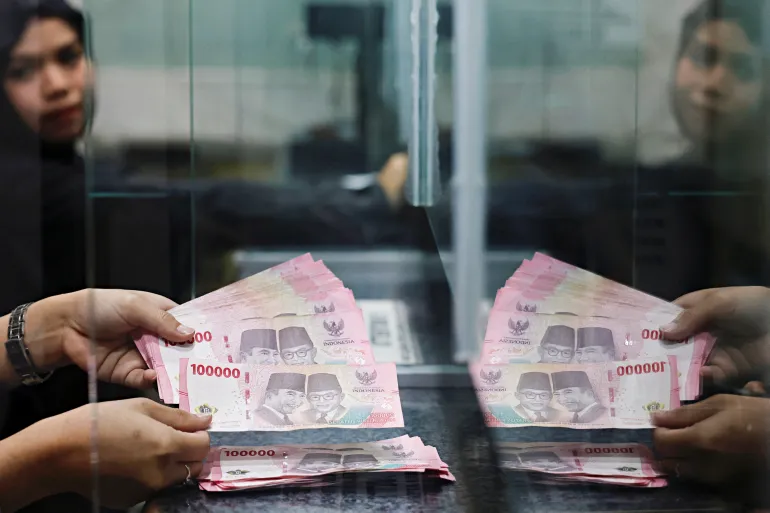
Indonesia’s rupiah has hit its weakest level ever against the US dollar, breaching the psychological 18,000 threshold amid surging energy costs.
The currency hit 18,028 against the greenback on Thursday, despite recent central bank efforts to provide support.
The energy shock driven by the US-Israel war on Iran has placed a significant strain on energy-importing Southeast Asian economies, particularly Indonesia and the Philippines.
The resulting pressure on trade balances has contributed to capital outflows and weaker currencies.
Gulf hostilities flared again on Wednesday, sending oil prices up more than 1 percent.
Adding to regional uncertainty, the United States has proposed additional import duties of 10 percent or 12.5 percent on goods from 60 economies, including Indonesia, Malaysia and Singapore, over alleged forced labour failures.
Permata Bank chief economist Josua Pardede said that an exchange rate of 18,000 was a “psychological threshold” for market investors.
The weakening, he told the AFP news agency, was fuelled by high dollar demand caused by the spike in oil prices and a narrowing trade surplus.
Indonesia is a net oil importer and is particularly affected by the rising crude costs, though the government insists it will leave subsidised fuel prices unchanged.
The country’s trade surplus has been hammered, narrowing to just $89m in April, from $3.3bn a month before, further reducing dollar supply in the Indonesian market, Josua said.
“Dollar supply from goods trade is dwindling, while dollar needs for energy imports, raw materials, dividends, foreign debt payments and seasonality needs remain significant,” he said.
“This is why the increase in the BI [Bank Indonesia] lending rate and intervention is not enough to reverse the rupiah’s [depreciation].”
The central bank hiked rates by 0.5 basis points to 5.25 percent last month – the first increase in two years – as it looked to stabilise the rupiah and keep inflation in check.
The central bank’s spokesman, Ramdan Denny Prakoso, said on Wednesday that it continued to use “all available policy instruments” to “maintain adequate foreign exchange liquidity”.
Bank Indonesia also tightened rules for dollar purchases.
Since May, buyers of more than $25,000 in a given month have been required to provide supporting documents to justify their need for US currency.
[Aljazeera]

Confident Bangladesh pose Australia a fresh challenge after 15-year wait for an ODI series

Tehran calls off attacks on Israel; warns not to hit Lebanon

Philippines earthquake kills 15, prompts tsunami fears:

T20 World Cup: Heavyweights, hopefuls and a debutant headline Group 1

Showers in the Western, Sabaragamuwa and North-western provinces and in Galle, Matara, Kandy and Nuwara-Eliya districts

Diesel replacement costs up to Rs. 4.5 bn in April

‘Dates have the highest sugar content to fight Coronavirus’

Sunday Island 27 December – Headlines

#SundayIsland 17th December – Headlines

Sunday Island – 28th March

Sunday Island Headlines – 21 March

Sunday Island – 21st February – Headlines
-

 News7 days ago
Lankan duo emerge winners in Latin dance championship held in Blackpool, UK
-
 Latest News5 days ago
Kusal Mendis, Pathum Nissanka, bowlers put Sri Lanka 1-0 up
-
 News5 days ago
New US tariffs proposed on 60 countries, including Sri Lanka
-

 News7 days ago
Sri Lankan teen killed in Chennai clash; three arrested
-
 Features4 days ago
Power crept into the Sangha and is now tearing it apart
-

 Features4 days ago
Kondachchi wind farm and battery storage project to boost energy security, says Power Ministry Secretary
-

 Features4 days ago
Saudi Arabia sets new benchmark in Hajj management as 1.7 million pilgrims complete sacred journey
-

 News3 days ago
Asst. Manager, security officer arrested over Rs 30 mn snatch at Horana PB branch