
News
Lanka’s draft ‘Rehabilitation Law’ would spur abuse – HRW

The Sri Lankan government should withdraw a draft law that would give the authorities broad powers to detain people in military-run “rehabilitation” centers, placing them at great risk of abuse, Human Rights Watch said yesterday (17).
The Bureau of Rehabilitation Bill, submitted to parliament on September 23, 2022, would allow the compulsory detention in centers of “drug dependant persons, ex-combatants, members of violent extremist groups and any other group of persons.”
The Bureau of Rehabilitation Bill would establish a new administrative structure controlled by the Defense Ministry to operate “rehabilitation” centers staffed by military personnel. The proposed law, which human rights advocates have already challenged in the Supreme Court, does not describe the basis for being sent for “rehabilitation,” but other recent government policies provide vague and arbitrary powers to forcibly “rehabilitate” people who have not been convicted of any crime.
“The Sri Lankan government’s proposed ‘rehabilitation’ efforts appear to be nothing more than a new form of abusive detention without charge,” said Meenakshi Ganguly, South Asia director at Human Rights Watch. “The Rehabilitation Bill would open the door widely to more torture, mistreatment, and endless detention.”
The Sri Lankan government has previously used coercive “rehabilitation” centers to enable arbitrary detention and torture. Following the civil war, which ended in 2009, thousands of people whom the government identified as members of the defeated separatist Liberation Tigers of Tamil Eelam were detained in military-run “rehabilitation” centers, where some were allegedly tortured and subjected to other abuses, including sexual violence. The current bill seeks once again to “rehabilitate” “ex-combatants” 13 years after the war ended.
The Rehabilitation Bill is the latest measure in a long history of laws, such as the Prevention of Terrorism Act (PTA), that authorize arbitrary detention and torture in Sri Lanka. The law could be used to target minority communities or anti-government protesters whom President Ranil Wickremesinghe has labeled “extremists.”
Under the Rehabilitation Bill, which would allow prolonged detention without judicial oversight, government officials would be protected from criminal liability for their actions if they act “in good faith.” The bill also empowers officials to use undefined “minimum force” to “compel obedience” from detainees. Another provision provides that an official who “without reasonable cause” strikes, wounds, ill-treats, or willfully neglects anyone under rehabilitation can be punished by up to 18 months in prison, suggesting that there might be a “reasonable cause” to harm detainees. International law absolutely prohibits torture, and other cruel, inhuman or degrading treatment or punishment.
A separate bill to amend Sri Lanka’s Poisons, Opium and Dangerous Drugs Ordinance, which was presented to parliament on September 9, provides for the compulsory rehabilitation of alleged drug users. The legislation would worsen already abusive laws and practices under Sri Lanka’s “war on drugs,” which Sri Lankan military officers have repeatedly compared to the “war on terror.”
Sri Lanka already has a system of forced “rehabilitation” for alleged drug users, which is run by the armed forces at two sites previously used to “rehabilitate” former combatants. There have been allegations of forced labor and ill-treatment, including the collective punishment of inmates, who are denied access to medically appropriate treatment for drug dependency while undergoing coercive “de-addiction.” The death of an inmate at the Kandakadu rehabilitation center in June led to the arrest of four army and air force sergeants acting as “therapists.”
International standards for the treatment of addiction maintain that treatment should always be voluntary and addiction regarded primarily as a health condition. The abstinence-based “rehabilitation” programs operated by the military are not based on scientific evidence and provide no harm reduction services.
In 2017, the United Nations Working Group on Arbitrary Detention expressed concern at the involvement of the Sri Lankan military in drug treatment and at the lack of medical care, as well as irregularities in the judicial process. The detention of alleged drug users for coercive “rehabilitation” is incompatible with medically appropriate drug dependency treatment and contravenes international law, Human Rights Watch said.
The proposed amendment to the drug law contains provisions to weaken evidentiary standards and deny bail to suspects in some criminal cases related to the possession of drugs. Sri Lanka continues to impose the death penalty for some drug offenses, contrary to international law standards and despite a national moratorium on executions since 1976.
The Rehabilitation Bureau Bill and the proposed amendment to anti-narcotics legislation are only the latest measures in President Wickremesinghe’s assault on fundamental rights, Human Rights Watch said. An attempt to use the Official Secrets Act to restrict public gatherings in the capital, Colombo, was withdrawn earlier in October amid widespread objections that the action was unlawful.
On October 6, the United Nations Human Rights Council adopted a resolution expressing concern at the human rights situation in Sri Lanka and mandating enhanced UN monitoring, as well as renewing a mandate for the UN to collect and analyze evidence of past human rights violations for use in future prosecutions.
“President Wickremesinghe is pursuing abusive and repressive policies that make it difficult for Sri Lanka’s international partners to wholeheartedly back desperately needed economic measures,” Ganguly said. “Foreign governments should make clear that they will support the urgent needs of the Sri Lankan people, but they will also take action through targeted sanctions and other measures against those committing serious human rights violations.”





A group of Tamil Progressive Alliance (TPA) members, including its Leader Mano Ganesan, met President Anura Kumara Dissanayake on Thursday (02) morning at the Presidential Secretariat.
Extensive discussions were held on the issues faced by the Malayagam communities, particularly in relation to education, housing and land, as well as on the urgent measures required to address these concerns. The President paid special attention to all these matters.
Attention was also drawn to the recruitment of qualified Tamil-medium teachers to address the teacher shortage in estate sector schools and this too was discussed at length.
Members of Parliament P. Digambaram and V. Radhakrishnan, along with several other party members, were present at the meeting.

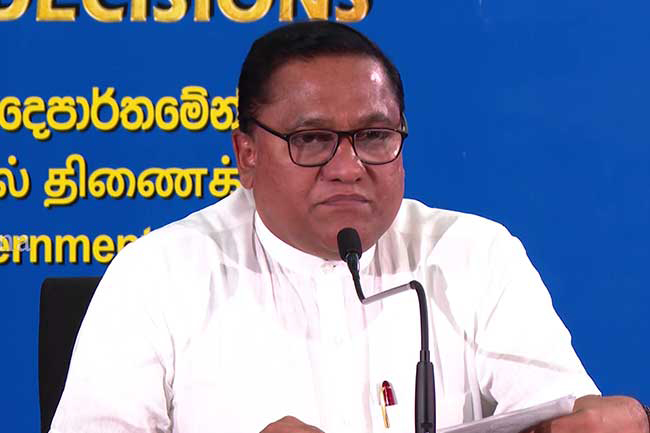
Minister of Foreign Affairs, Vijitha Herath, held talks with Deputy Foreign Minister of Russia Andrey Rudenko at the Foreign Ministry, in Colombo, on Thursday (02), with both sides reaffirming their commitment to strengthening bilateral relations.
The Sri Lanka Ministry of Foreign Affairs said the visiting Russian Deputy Minister noted that Russia regarded Sri Lanka as a long-standing friend.
Rudenko assured that Russia stood ready to support Sri Lanka when required, including in the swift supply of Russian oil to help address the current energy challenges, encouraging Russian investors to explore new opportunities in the country and promoting increased tourist arrivals.
He also expressed Russia’s readiness to provide compensation for Sri Lankan war veterans who had lost their lives in the ongoing conflict between Russia and Ukraine.
Minister Herath welcomed Russia’s willingness to assist, emphasising that Sri Lanka valued the support extended by its “old friend”, particularly at a time when the country was facing pressing energy needs.
He noted that the two countries shared nearly seven decades of diplomatic relations and said the present moment provided an opportunity to further strengthen ties, including through long-term trade agreements.
The discussions focused on enhancing cooperation in the fields of energy, investment, tourism and diplomacy, with both sides reiterating their commitment to further deepen the longstanding friendship between Sri Lanka and Russia.

Police yesterday arrested 157 foreign nationals in connection with an alleged organised online financial scam, conducted from a hotel in the Iranawila area in Chilaw.
The suspects were taken into custody during a raid carried out by the Police while they were staying at the hotel in Iranawila.
Police said the arrested group included 143 nationals from China, 13 from Bangladesh and one from Vietnam.
Investigators suspect the group had been involved in a coordinated online financial scam, targeting victims through digital platforms.
The suspects are being detained for further questioning while investigations are continuing to determine the full extent of the operation and whether additional individuals were involved.Police said further inquiries are underway.
By Norman Palihawadane

Breakdown of the teams and groups of the FIFA World Cup in Canada, Mexico and the US after the final playoffs

365 US service members injured since start of Iran war – Pentagon

World Cup 2026: Italy’s football chief resigns after qualifying failure

Iran says it downed two US jets as search for one pilot continues

Showers above75 mm are likely at some places in the Central, Sabaragamuwa, Uva, North-central and Eastern provinces after 1.00 p.m.

Artemis II crew take ‘spectacular’ image of Earth

‘Dates have the highest sugar content to fight Coronavirus’

Sunday Island 27 December – Headlines

#SundayIsland 17th December – Headlines

Sunday Island – 28th March

Sunday Island Headlines – 21 March

Sunday Island – 21st February – Headlines
-

 News2 days ago
2025 GCE AL: 62% qualify for Uni entrance; results of 111 suspended
-

 News4 days ago
Tariff shock from 01 April as power costs climb across the board
-
 News5 days ago
Inquiry into female employee’s complaint: Retired HC Judge’s recommendations ignored
-
 Features6 days ago
When seabed goes dark: The Persian Gulf, cable sabotage, and race for space-based monopoly
-
 Features5 days ago
New arithmetic of conflict: How the drone revolution is inverting economics of war
-

 Business3 days ago
Hour of reckoning comes for SL’s power sector
-

 Editorial2 days ago
Search for Easter Sunday terror mastermind
-

 Sports5 days ago
Sri Lanka’s 1996 World Cup heroes to play exhibition match in Kuala Lumpur