
Latest News
Artemis II crew take ‘spectacular’ image of Earth


Nasa has shared the first high-resolution images of the Earth taken by the Artemis II crew as they head on their trip around the Moon.
The mission’s commander, Reid Wiseman, took the “spectacular” images, Nasa says, after the crew completed a final engine burn that set them on a trajectory towards our closest celestial neighbour.
The first image, called Hello, World, shows the vast expanse of blue that is the Atlantic Ocean, framed by a thin glow of the atmosphere as the Earth eclipses the Sun and green auroras at either pole.
The Earth appears to us as upside down, with the western Sahara and Iberian peninsula visible to the left and the eastern portion of South America to the right.
Nasa identified the bright planet to the bottom right as Venus.
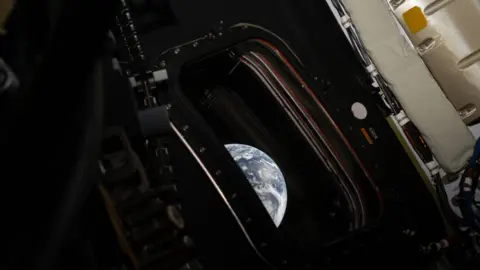
The images were taken after the crew successfully completed a trans-lunar injection burn in the early hours of Friday.
The burn took the Orion spacecraft out of Earth orbit as the four astronauts aboard aim to travel the more than 200,000 miles to the Moon.
Artemis II is now on a looping path that will carry the crew around the far side of the Moon and back again. It is the first time since 1972 that humans have travelled outside of the Earth’s orbit.
The crew should pass around the far side of the Moon on 6 April and return to Earth on 10 April.
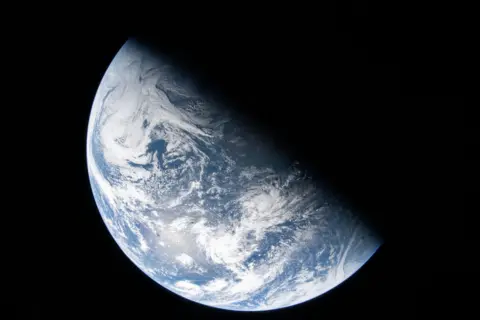
After the burn was completed, the crew were “glued to the windows” taking pictures, mission specialist Jeremy Hansen told mission control in Houston.
“We are getting a beautiful view of the dark side of the Earth, lit by the Moon,” he said.
Wiseman later called back down to mission control in Houston to ask how to clean the windows, as the astronauts’ enthusiasm to see into space had left them dirty.
The commander had initially found it difficult to take pictures of our planet from the spacecraft, saying taking photos at such a distance made it hard to adjust exposure settings.
“It’s like walking out back at your house, trying to take a picture of the moon,” he told mission control. “That’s what it feels like right now.”
But that is no longer an issue.
Another view captured by Wiseman shows the Earth divided by night and day. That frontier between light and darkness is known as the terminator.

Later, Nasa published another image showing the Earth in near-complete darkness, with the electric lights of humankind twinkling in the nighttime.
It also produced a side-by-side comparison of 2026’s view of the Earth and a similar one taken by the Apollo 17 team in 1972 – the last time humans set foot on the Moon.
“We’ve come so far in the last 54 years, but one thing hasn’t changed: our home looks gorgeous from space!” it wrote.

[BBC]


Will the Women’s T20 Asia Cup semi-final against Sri Lanka be a full-circle moment for Pakistan ?
Sri Lanka beat Pakistan in the semi final 9f the 2024 edition to qualify for their first Asia Cup final since 2008. Now Pakistan enter this contest having not been at an Asia Cup final since 2016. Moreover, the two teams played a bilateral series only last month. So there is enough familiarity.
Sri Lanka are unbeaten in this tournament, notching up easy wins over UAE and Indonesia before being pushed hard by Bangladesh.Chamari Athapaththu has topped the wickets tally, this time, her seven-for against Indonesia providing a reminder of what she can do in spin-friendly conditions at the Dubai International Cricket Stadium. Her pairing with Imesha Dulani at the top of the batting order has given Sri Lanka a close-to-ideal combination. Nilakshika Silva’s half-century from a tricky spot against Indonesia, and Harshitha Samarawickrama’s composure in a tight chase against Bangladesh have instilled confidence in their batting order.
Pakistan, on the other hand, are slightly short on batting confidence. They posted 119/9 against Thailand and were bowled out for 55 against India. It was only thanks to their bowlers that they could brush Tailand aside. Pakistan also lost the three-match bilateral series against Sri Lanka last month, though they did not have Fatima Sana’s services then.
Shawaal Zulfiqar’s presence at the top allows them to start at a higher gear, and Muneeba Ali’s experience only adds to the heft. Both are yet to fire together in this tournament, and Pakistan would hope it comes in the semi-final in order to end their finals drought.
Being Sri Lanka’s trailblazer, there is so much focus on Athapaththu that it is easy to miss that Harshitha Samarawickrema, still only 28, has already completed a decade in international cricket. She is the vice-captain, and almost the captain-in-waiting when Athapaththu decides to relinquish the role. Samarawickrama has grown in consistently winning games for Sri Lanka. Her unbeaten 48 off 37 against Bangladesh on Sunday is a case in point. Moreover, that knock has also highlighted her versatility. Primarily a top-order bat, she was moved down to No. 5 in order to accommodate Vishmi Gunaratne in the middle-order. She batted in that spot at home against Pakistan last month and finished the chase. Expect Samarawickrama to sit easy under the spotlight against Pakistan in a win-or-go-home contest.
Fatima Sana’s 407 T20I runs in 2026 have come at a strike rate of 150.74, the fourth best this year (minimum 300 runs). There were calls for her to bat higher up than her usual Nos. 7 and 8. Add to it, she has picked up 23 wickets, the most for Pakistan. While she has taken five wickets in the Asia Cup thus far, she is yet to show off her batting might. That is partly down to the surfaces in Dubai. Sri Lanka, though, would be a little wary of her considering she can bash spin, and strikes at 143.24 against them.
Team news
With both teams coming off wins, they are likely to go in with the same teams. Sri Lanka might be tempted to play slinger Mithali Ayodhya since it is a knockout match
Sri Lanka (probable): Imesha Dulani, Chamari Athapaththu (capt), Sanjana Kavindi, Vishmi Gunaratne, Harsthitha Samarawickrama, Kavisha Dilhari, Nilakshika Silva, Kaushini Nuthyangana (wk), Sugandika Kumari, Chethana Vimukthi/Mithali Ayodhya, Chamudi Praboda
Pakistan (probable): Muneeba Ali (wk), Shawaal Zulfiqar, Gull Feroza, Ayesha Zafar, Sadaf Shamas, Fatima Sana (capt), Umm-e-Hani, Eyman Fatima, Tuba Hassan, Nashra Sandhu, Sadia Iqbal
(Cricinfo)

US President Donald Trump says he would offer every adult American a $5,000 (£3,700) payout if Republicans win both chambers of Congress in November’s midterm elections – a plan that would cost more than a trillion dollars.
The offer was made in a speech at the party’s first-ever convention in the middle of a US presidential term.
He gave no details on how it would work or be funded – saying only that the money would have to be spent in the US. Vice-President JD Vance has linked the plan to the revenue that Trump has raised for the US government using tariffs.
Democrats labelled it an “empty promise” and others questioned whether such a pledge was legal or feasible.
It may be the first time a US president offered such a payout to Americans, in the context of an election year plea to get out and vote.
The idea drew raucous applause at the convention and Trump seemed to relish the moment.
There are nearly 270 million American adults, meaning a $5,000 payout would cost the US government some $1.3 trillion.
Questions have begun to be raised about whether his plan is feasible – especially as prices rise in the US, partially as a result of the war that the US and Israel started with Iran in February.
Iran’s retaliation has included attacks against US bases and allies in the Gulf – but crucially it has largely closed the Strait of Hormuz, through which about a fifth of the world’s oil and liquefied natural gas used to transit.
The blockage has caused fluctuations in oil prices worldwide and Trump has faced pressure from his party to end the war.
On Wednesday, the US president warned his supporters that the war would not end until after the midterms and that oil prices would not come down until then.
He made the comments ahead of his speech in Texas, repeating it at the convention where he argued that short-term economic pain was worth it to prevent Tehran from developing nuclear weapons.
Trump’s long speech at the Republican convention in Dallas, Texas, touched on the core of the conflict – the impact on Americans’ standard of living. His pledge to increase their spending power drew raucous applause in the hall.
“If the Republicans win the House of Representatives and the United States Senate, both of them,” Trump said, “I will issue a dividend to every adult citizen in the United States of America for $5,000.”
“We don’t want you going to Canada to spend the money,” he said.
“We don’t want you going to China, to Germany. You got to spend the money in the United States of America.” It is not clear how the spending would be monitored.
The BBC has asked the White House for further clarification on how Trump’s plan would work.
One former Republican strategist and pollster said the promise should be firmly seen in the context of an election that is now less than two months away.
“It is an extraordinary promise, and I’m not sure where that money is going to come from – but it is campaign season,” Robert Moran told the BBC World Service’s Newsday programme.
Moran described it as a “novel solution to an interesting problem”, noting that the historical tendency was for the party of the president to lose seats in Congress during the midterm elections.
It is not the first time that Trump promised such payouts – he has previously proposed $2,000 cheques to be funded by tariff revenues.
Vice-President JD Vance indicated that these post-election payments could similarly be made possible by the money Trump has raised using his wide-ranging tariff programme.
“What the president is talking about is fundamentally a dividend for American workers,” Vance told Fox News.
“We’re taking in an extraordinary amount of revenue because the president of the United States is actually standing up to both foreign companies but also foreign countries who’ve been taking advantage of America’s workers.”
Vance went on to say: “I don’t think it’s a controversial idea.”
Other US politicians in the past have also promised economic rewards in return for electoral success.
For instance, Democrats in Georgia promised $2,000 relief payments if their party took control of the Senate at the height of the Covid-19 pandemic.
In the US, Congress authorises spending. The midterm elections, which will be contested on 3 November, will ultimately decide whether or not Trump’s Republican Party keeps its hold over both the House and Senate.
During his speech in Dallas, the president did not say whether he planned to ask Congress for such approval for the payments – which he dubbed “Trump Dividends”.
However, in addition to the overall cost to the US treasury, the latest proposal from the US president may raise legal questions.
Federal laws prohibit payments that are intended to influence voting.
The issue came to the fore ahead of the 2024 presidential election, during which billionaire Trump supporter Elon Musk offered cash incentives to registered voters in seven swing states who signed a certain petition.
However, some experts say the promise made by Trump during Wednesday’s speech may be seen as a pledge to cut taxes, which is legal.
John Day, a lawyer in New Mexico, said the plan would indeed be legal. It constituted a promise made to all adult citizens of the US during a campaign, rather than a “payment to individuals to try to get them to vote in a particular way”, he told the Associated Press.
Meanwhile, an election law expert who spoke to the New York Times said Trump’s promise would also be covered by the free-speech protection guaranteed under the First Amendment of the US Constitution.
[BBC]
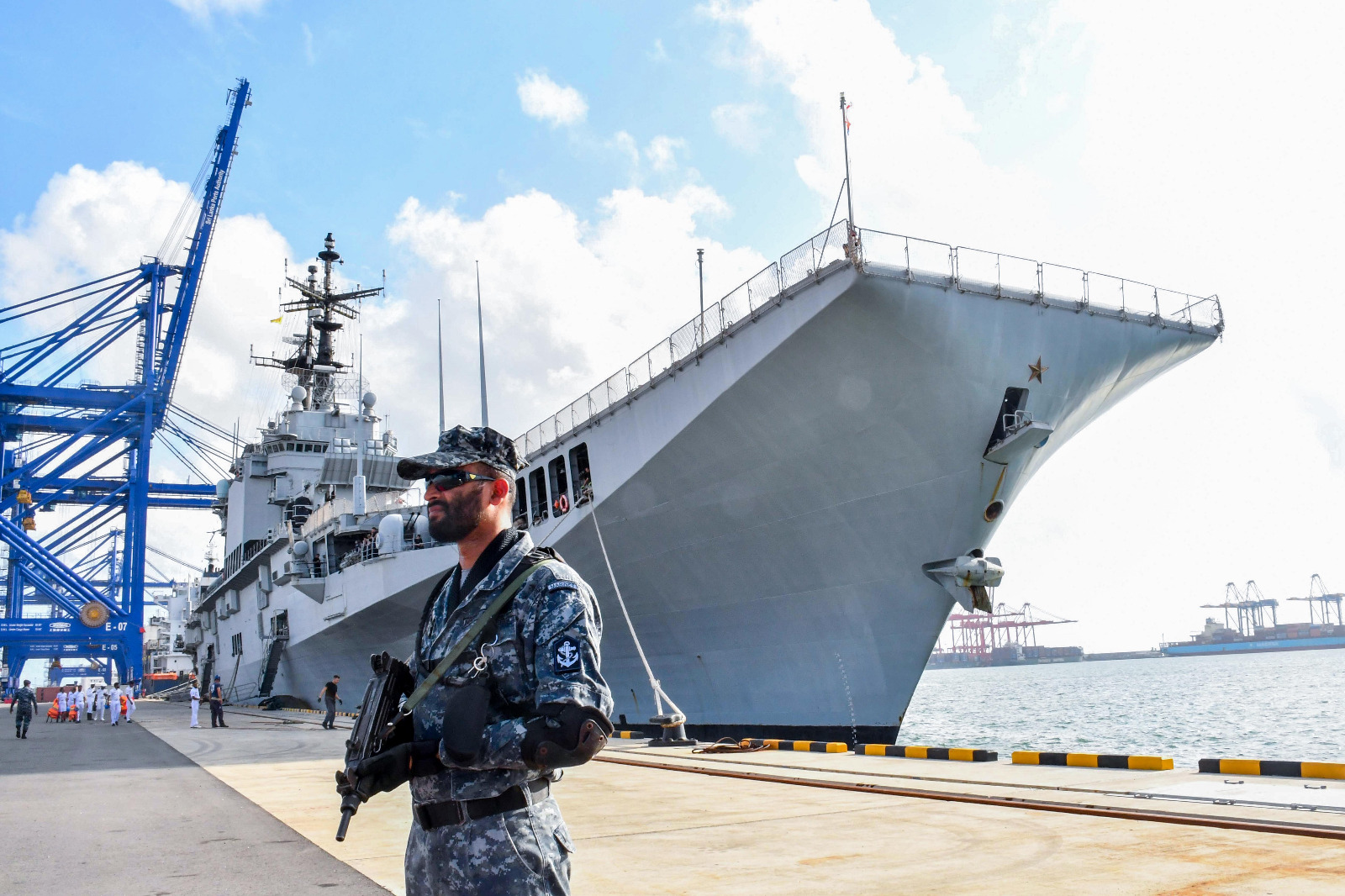
The Italian Naval Vessel ‘ITS Giuseppe Garibaldi’ arrived in Sri Lanka today, 9 September 2026, on a replenishment visit.
The Sri Lanka Navy welcomed the visiting ship in accordance with naval traditions at the port of Colombo.
‘ITS Giuseppe Garibaldi’ is a 180m long Landing Helicopter Aircraft Vessel commanded by Captain Marco GUERRIERO.
During the ship’s stay in Sri Lanka, the Commanding Officer of ‘ITS Giuseppe Garibaldi’ is scheduled to call on the Commander Western Naval Area.

Sri Lanka faces new grid challenge as rooftop solar surges: former CEB GM

SC rules President Sirisena’s pardon of Gnanasara thera invalid

Duminda, another indicted in gold-plated T-56 case

‘Commissions paid to aircraft buyers standard practice’: Ex-AASL Board Member

Catholic bishops call for impartial probe into Chemmani mass grave

Ex-‘VVIP’ astrologer makes statement to Bribery sleuths

‘Dates have the highest sugar content to fight Coronavirus’

Sunday Island 27 December – Headlines

#SundayIsland 17th December – Headlines

Sunday Island – 28th March

Sunday Island Headlines – 21 March

Sunday Island – 21st February – Headlines
-

 News6 days ago
Namal remanded until Sept. 18 over Airbus deal investigation
-

 Latest News5 days ago
Tharanga creates history with Diamond League crown in Brussels
-

 News5 days ago
Dispute which triggered listed company director being detained at BIA resolved
-

 Features4 days ago
After the parade: What a traffic OIC’s walk-out tells us
-

 Editorial6 days ago
Power vs Equality
-
Editorial4 days ago
Arrests as theatre
-

 Latest News4 days ago
Harshitha’s composed knock seals Sri Lanka’s semi-final berth
-

 Latest News7 days ago
SLPP MP Namal Rajapaksa arrested by CIABOC