
News
Julie’s exit gladdens Udaya’s heart


Leader of the Pivithuru Hela Urumaya (PHU), Udaya Gammanpila, yesterday launched a scathing attack on outgoing United States Ambassador to Sri Lanka Julie Chung, accusing her of interfering in Sri Lanka’s internal affairs and exerting undue influence over recent political developments.
Addressing a press conference in Colombo, Gammanpila said Chung’s departure, after a four-year tenure, marked a “day of national relief,” claiming her presence had been harmful to the country.
He said patriots marked the occasion by sharing kiribath (milk rice), which he described as a symbolic celebration.
Gammanpila alleged that Ambassador Chung had remained in Sri Lanka longer than the customary three-year diplomatic term because of, what he described as, her success in bringing the country under American influence. Drawing comparisons with past foreign diplomats, he claimed that Chung was the most influential envoy since Indian High Commissioner J.N. Dixit in the 1980s. He alleged that successive Sri Lankan governments had failed to challenge what he described as interference by the envoy.
The PHU leader accused Chung of playing a behind-the-scenes role in the 2022 protest movement, commonly known as the Aragalaya, claiming it was orchestrated to destabilise the country. He alleged that young protesters were unknowingly “acting out a foreign script” under the guise of patriotism.
Gammanpila also alleged that Chung played a key role in elevating the National People’s Power (NPP), which he referred to as the “Malimawa” movement, into a governing force in 2024. He claimed the movement had been transformed from its earlier ideological roots into, what he described as, a pro-Western political project, asserting that President Anura Kumara Dissanayake had come to power with foreign backing. He cited a photograph shared on Chung’s social media account of her visit to the NPP headquarters as evidence of what he termed political proximity.
According to Gammanpila, Ambassador Chung’s public criticism of governance issues sharply declined following the change of government. He alleged that while she had frequently commented on incidents under previous administrations, she had remained silent on alleged corruption and governance failures over the past 14 months.
Turning to the future, Gammanpila urged caution regarding the incoming US Ambassador, Eric Meyer, stating that any engagement on religious or cultural matters should be viewed carefully. He called on President Dissanayake to pursue an independent foreign policy, free of external influence.
Gammanpila also criticised the government over, what he described as, repeated “policy blunders,” particularly in relation to issues affecting children and social values. He cited several instances, including proposals to promote Sri Lanka as a destination for same-sex couples, educational material controversies, and a recent People’s Bank advertisement that he claimed subtly promoted same-sex symbolism. While stating that he held no animosity towards the LGBTQ community, Gammanpila said he opposed, what he described as, attempts to influence children through state institutions.
In addition, the PHU leader condemned legal action taken by the Coast Conservation Department against nine individuals, including four Buddhist monks, for installing a Buddha statue within a coastal conservation zone in Trincomalee. He described the arrests as discriminatory, alleging that similar structures belonging to other religions and commercial entities had been overlooked.
Calling the current administration “anti-Buddhist,” Gammanpila urged authorities to apply the law equally and not just in words, and “not to turn legal frameworks into instruments against Buddhism.” He also accused members of the government of ingratitude, alleging that many had once sought refuge in temples during periods of political violence.
By Anuradha Hiripitiyage



News
Establishment of an Institutional Framework to Inagurate Upper Hydro Catchment Areas Management Authority

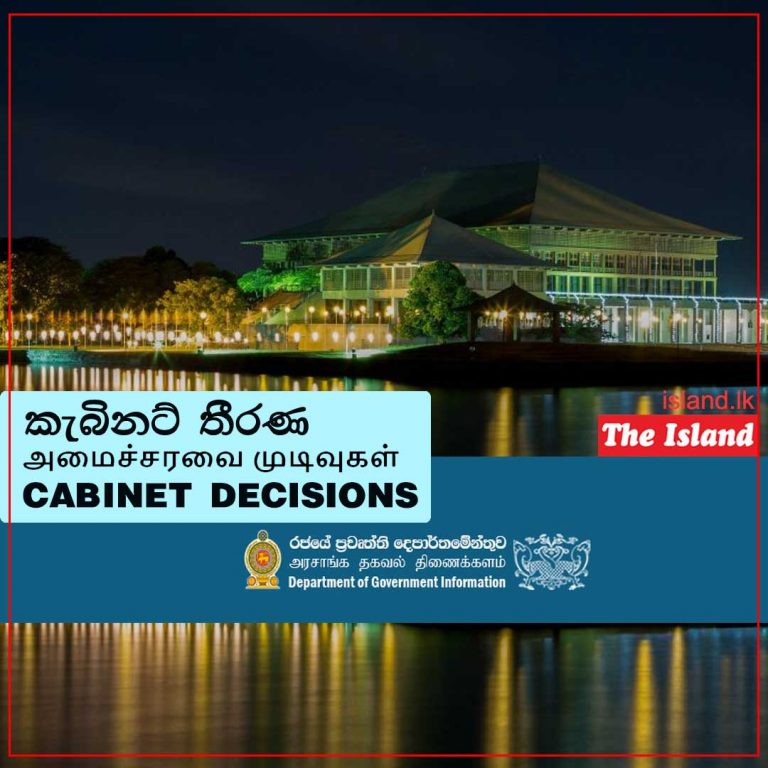
Policy approval of the Cabinet of Ministers was granted at their meeting held on 08.06.2026 to establish the Upper Hydro Catchment Areas Management Authority for identification and
execution of a formal and long – lasting remedy to secure the central hills including the upper hydro catchment areas enabling them to sustain amidst extreme weather conditions
due to natural calamities and human activities as well as to be used for the sustainable development of the country.
Accordingly, a concept paper has been prepared including
institutional structure, activities, powers, active subject area as well as administrative and coordination mechanism for the proposed authority by an expert technical committee appointed by the Secretary to the President.
Based on the said concept paper, the Cabinet of Ministers granted approval to the resolution furnished by the President to instruct the Legal Draftsman to prepare a draft bill including legal provisions required for the establishment of Upper Hydro Catchment Areas Management Authority.
News
Introduction of Flora and Fauna (Regulation of actions of the Indigenous Community within the nominated areas) Regulations
With the objective of securing the traditional livelihood and the eco system of the indigenous community, it has been recognized the necessity of introducing a formal regulation methodology to secure their engagement in livelihood activities by being more sensitive to the existing laws.
Thereby, the Fauna and Flora (regularizing) regulations under the Fauna and Flora Protection Ordinance (Authority 469) have been prepared so that nominated activities within the prescribed area to a member of the indigenous community
who has been registered for securing the rights acquired from law or custom or usage or traditional stance to execute an act within a certain state land that is fundamental to the survival of the indigenous community permission can be granted
Accordingly, the Cabinet of Ministers granted approval to the resolution furnished by the Minister of Environment to publish the said regulations in the government gazette notification and thereby submit to the Parliament for its concurrence.
Latest News
M. M. D. J. Senarathne, appointed Director General of the Department of National Botanical Gardens
The Cabinet of Ministers approved the resolution furnished by the Minister of Environment to appoint M. M. D. J. Senarathne, who is the senior most officer in Grade I of Sri Lanka Scientific Service se

Establishment of an Institutional Framework to Inagurate Upper Hydro Catchment Areas Management Authority
Introduction of Flora and Fauna (Regulation of actions of the Indigenous Community within the nominated areas) Regulations
M. M. D. J. Senarathne, appointed Director General of the Department of National Botanical Gardens

Harmanpreet Kaur steps down as India captain

Turkiye, Pakistan agree Saudi Arabia military deployment under Mecca pact

Rumesh Tharanga among nominees announced for World Athlete of the Year 2026

‘Dates have the highest sugar content to fight Coronavirus’

Sunday Island 27 December – Headlines

#SundayIsland 17th December – Headlines

Sunday Island – 28th March

Sunday Island Headlines – 21 March

Sunday Island – 21st February – Headlines
-

 Latest News7 days ago
Gold winner Tharanga gets brand-new Honda Vezel from SLAAJ
-

 News6 days ago
US-assisted ‘Ice’ detection: NPC to examine IGP’s move to transfer drug-busting team
-

 Features7 days ago
Why Sri Lanka needs an Inclusive Civic Nationalism – urgently
-

 Editorial5 days ago
Colombo Port drug bust: The plot thickens
-

 News7 days ago
Civil society activist accuses govt. of favouring Ven. Gnanasara
-
 Midweek Review7 days ago
Dappula’s Easter Sunday ‘grand conspiracy’ claim demolished
-

 Editorial7 days ago
When crime bosses rise above law and shrines
-
Editorial6 days ago
Drug busting, transfers and trust deficit