
News
Indo-Lanka MoUs unlikely to be tabled in Parliament any time soon

…of seven SOCs only one constituted so far
Sri Lanka’s controversial MoU on Defence Cooperation with India was unlikely to be taken up any time soon in Parliament in spite of the House Sectoral Oversight Committee (SOC) on Governance, Justice and Civil Protection that has been assigned defence, authoritative sources told The Island.
Of the seven SOCs only one was activated with the recent election of Dr. Najith Indika, MP, as the Chairman of the Sectoral Oversight Committee on Governance, Justice, and Civil Protection of the Tenth Parliament.
The inaugural meeting of the current parliament was held on 21 Nov., 2024.
Sources said that the parliament had met for the last time yesterday (10) before the Sinhala and Tamil New Year holiday. It is scheduled to meet again on May 8.
The UNDP that has financially backed the establishment of the SOC system to help strengthen the role of the parliament recently reached a consensus with the government to reduce the number of SCOCs from 17 to seven. The Island, in writing, asked for the UNDP’s reaction to the operation of SOCs but had not received a response at the time this edition went to press.
The SOCs have the power to examine any Bill, except the Bills defined in Article 152 of the Constitution, Treaty, Reports including the Annual and Performance Reports relating to the institutions coming under its purview or any other matter referred to the Committee by Parliament or any Committee or a Minister relating to the subjects and functions within their jurisdiction.
Sources said that out of the seven SOCs only one had been activated during the past five months though the government and the Opposition agreed to share the leadership of them.
Accordingly, it was agreed that the government would appoint chairpersons to four SOCs –– Economic Development and International Relations, Health, Media and Women’s Empowerment, Science, Technology and Digital Transformation and Governance, Justice and Civil Protection .
It was also agreed that the Opposition would appoint chairpersons to the SOCs on Infrastructure and Strategic Development, Education, Manpower and Human Capital, and Environment, Agriculture and Resource Sustainability to the Opposition.
India and Sri Lanka on April 5 signed six MoUs on HVDC interconnection for import/export of power, cooperation in the field of sharing successful digital solutions implemented at population scale for digital transformation, defence cooperation, multi sectoral grant assistance for Eastern province, health and medicine and pharmacopoeia cooperation. In addition to them, India, Sri Lanka and UAE signed a tripartite MoU cooperation in development of Trincomalee as an energy hub.
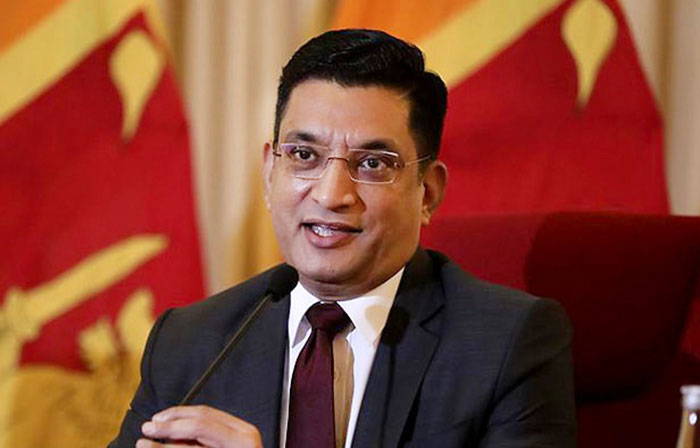
The Island asked Ali Sabry, PC, who served as foreign minister during Ranil Wickremesinghe’s tenure as the President (July 2022 to Sept 2024) whether the seven MoUs had been discussed during that period. We also asked him whether those MoUs should have been discussed at SOCs before finalisation.
Sabry said: “Most of the MOU to my knowledge were discussed except the one on Defence Cooperation, which I am unaware of. General procedure is the relevant line ministry prepares the initial draft and gets the input from the Foreign Ministry and goes for stakeholder consultation of all ministries and agencies involved. Then the President’s Office grants its sanction and with the approval of the AG, it goes before the cabinet of ministers. With Cabinet approval, the government could sign the MOU.”
Sabry said that he was of the opinion that once the government signed a particular MoU, it should be placed before the parliament. “MOU’s are generally not legally binding and only signify the desire to work together. If the signed MoUs were to be implemented, then they have to be followed by agreements or laws.”
He emphasised the pivotal importance of transparency in the whole process. The ex-minister said: “I think transparency is crucial in these matters. Concealment leads to speculation and assumption of the worst. The MOUs should be tabled in Parliament for public information. Discussion at the relevant SOCs would have been helpful. There are growing fears fueled by lack of information in the public domain. This is a private comment, not to be attributed to me.
Asked whether MoUs, particularly the ones on defence and energy had to be approved by the Attorney General, the former minister said that the AG has to advise the MoUs compatibility with the Constitution. “But Article 157 of the Constitution does not apply; the 2/3 majority stipulated there envisages only investment treaties.” Foreign Minister Vijitha Herath assured Parliament on April 8 that the AG had cleared all seven MoUs and none of them were inimical to the country.
By Shamindra Ferdinando





President Anura Kumara Dissanayake has appointed Air Chief Marshal Kolitha A. Gunathilake (Retd.) as the new Chancellor of General Sir John Kotelawala Defence University.
The letter of appointment was presented to Air Chief Marshal Kolitha A. Gunathilake (Retd.) by Secretary to the President Dr Nandika Sanath Kumanayake at the Presidential Secretariat on Monday (05) afternoon.
Air Chief Marshal Kolitha A. Gunathilake(Retd.) has served as Commander of the Sri Lanka Air Force and as Chief of Defence Staff.
(PMD)

By Shamindra Ferdinando
The government is coming under pressure from civil society organisations to formulate a clear ‘mechanism’ to deal with requests for presidential pardons.
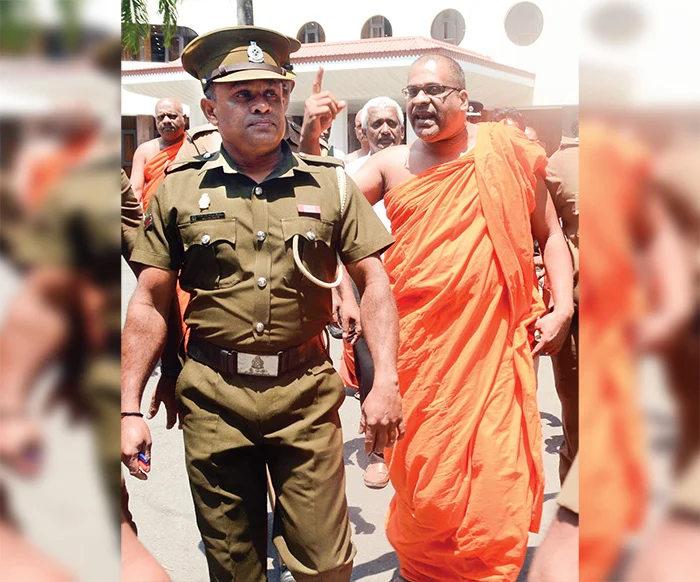
Representing civil society organisations, Gamini Viyangoda yesterday flayed the NPP government for the delay in taking action against Ven. Galagoda Aththe Gnanasara Thera, after the Supreme Court declared the 2019 presidential pardon granted to him by President Maithripala Sirisena null and void. He said successive Presidents had abused their executive power to release convicted persons from prison.
Purawesi Balaya activist Viyangoda pointed out that the Supreme Court ruled that President Sirisena had acted arbitrarily and failed to independently consider the relevant materials before exercising his executive power.
The Court of Appeal, in August 2018, sentenced Gnanasara Thera, General Secretary of the Bodu Bala Sena (BBS), to six years rigorous imprisonment for contempt of court over his conduct during proceedings concerning missing journalist Prageeth Ekneligoda. Viyangoda said that those who had been affected by the monk’s conduct have the right to know on what basis the President released him, in May 2019.
The Court of Appeal yesterday (05) ordered the relevant authorities to enforce the remaining period of imprisonment imposed on the Thera.
Gnanasara Thera, who had been subject to an open warrant for his arrest, was produced before the Court of Appeal, today, by prison officials.
Having considered the submissions made before it, the Court of Appeal directed the Commissioner General of Prisons to take the necessary steps to enforce the remaining period of the sentence imposed on Gnanasara Thera. Police on Saturday (03) apprehended the monk at a forest monastery in Kalutara. The Colombo Magistrate’s Court on Sunday (04) ordered the Thera to be remanded in custody till Monday.
Appearing for Gnanasara Thera, Attorney-at-Law Iresh Seneviratne, together with Attorney-at-Law Pasan Karunaratne, told the court yesterday that his client had been experiencing severe mental distress and had therefore gone to an ‘Aranya Senasanaya’, where he had been staying.
Viyangoda said that examination of presidential pardons, executed over the years, would reveal how successive leaders exploited the executive power to appease their own. Responding to The Island queries, Viyangoda said that Sirisena, in Sept. 2019, just two months before the presidential election, granted Jude Shramantha Jayamaha a Presidential pardon.
Jude Shramantha Jayamaha was sentenced to 12 years by the High Court, but the Court of Appeal revised that sentence to death, in July 2012, which the Supreme Court later upheld. Viyangoda said that though the Supreme Court, in June 2024, declared that the particular Presidential action was illegal and arbitrary, law enoforcement authorities were yet to take tangible measures to enforce the court directive.
Viyangoda stressed that no President should exercise the right to pardon a convicted on his or her own without following laid out procedures. According to him, Sirisena appeared to have simply ordered the monk, and the convicted murderer, released in response to appeals received by him. A comprehensive investigation could identify those who had been involved in these wrongdoings.
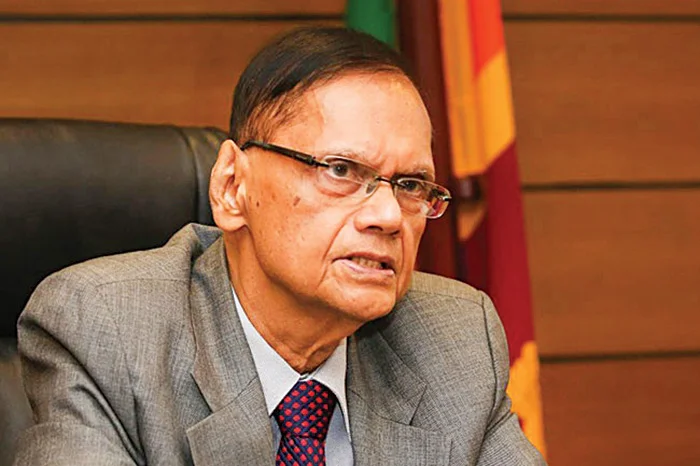
Convenor of Janathawadi Joint Opposition, Prof. G. L. Peiris, yesterday (05) emphasised the responsibility on the part of the government and others to act cautiously when making representations in respect of Sivarasa Anojan facing death sentence in Saudi Arabia over a controversial social media post.
Addressing the media at former President Ranil Wickremesinghe’s Flower Road Office, Prof. Peiris emphasised that whatever representations should be made through the Foreign Ministry.
The one-time External Affairs Minister warned of dire consequences of political party leaders, members of Parliament and civil society making direct representations and trying to get in touch with various Saudi authorities over the phone.
Prof. Peiris said that those who intervened on behalf of Anojan should keep in mind that Sri Lanka should be mindful of the Saudi way of governance and sensitivities.
The former Minister questioned the circumstances Sri Lanka was left out of the recent BRICS summit held in New Delhi. He recalled how former President Wickremesinghe discussed Sri Lanka’s entry into BRICS with Russian President Putin and received an invitation for the Summit there but as a result of the change of government, in Sept. 2024, Sri Lanka ignored that invitation.
That resulted in Sri Lanka being left out from the New Delhi summit, Prof. Peris said.
Prof. Peiris pointed out the absurdity in sending the Foreign Secretary to the BRICS Summit in Russia instead of the President, PM or the Foreign Minister to represent the country.
Referring to the forthcoming conclusion of the current IMF programme, initiated during Wickremesinghe’s time, Prof. Peiris said that Sri Lanka lost a great opportunity to benefit from BRICS by failing to represent the country at a higher level at the Russian summit.
The BRICS nations established the New Development Bank (NDB), originally called the BRICS Development Bank, Prof. Peiris said.
Dismissing NPP government’s explanation regarding Iranian ships awaiting necessary supplies but deprived by US imposed restrictions, the former Minister strongly criticised the administration’s response. According to him, this government responded in a similar manner when the US sank an unarmed Iranian frigate just outside Sri Lankan territorial waters in March this year.
Prof. Peiris declared that the government’s assertion that the US restrictions weren’t only directed at Sri Lanka but all Iranian vessels in other regions as well was not acceptable (SF)

Harmanpreet Kaur steps down as India captain

Turkiye, Pakistan agree Saudi Arabia military deployment under Mecca pact

Rumesh Tharanga among nominees announced for World Athlete of the Year 2026
New Chancellor appointed to General Sir John Kotelawala Defence University

Yemen government forces claim recapturing Mocha from Houthis

Showers above 75 mm are likely at some places in the Western, Sabaragamuwa, Central, and Southern provinces after 1.00 pm

‘Dates have the highest sugar content to fight Coronavirus’

Sunday Island 27 December – Headlines

#SundayIsland 17th December – Headlines

Sunday Island – 28th March

Sunday Island Headlines – 21 March

Sunday Island – 21st February – Headlines
-

 Latest News6 days ago
Gold winner Tharanga gets brand-new Honda Vezel from SLAAJ
-

 News6 days ago
US-assisted ‘Ice’ detection: NPC to examine IGP’s move to transfer drug-busting team
-

 Features7 days ago
Why Sri Lanka needs an Inclusive Civic Nationalism – urgently
-

 Editorial5 days ago
Colombo Port drug bust: The plot thickens
-

 News7 days ago
Civil society activist accuses govt. of favouring Ven. Gnanasara
-
 Midweek Review7 days ago
Dappula’s Easter Sunday ‘grand conspiracy’ claim demolished
-

 Editorial7 days ago
When crime bosses rise above law and shrines
-
Editorial6 days ago
Drug busting, transfers and trust deficit