
Foreign News
Indigenous Australians call for ‘week of silence’ after referendum failure


Indigenous Australians have called for a “week of silence” and mourning after a referendum on giving them more political representation was rejected by the country’s white majority.
With more than 70 percent of ballots counted on Sunday, about 61 percent of Australians said “no” when asked if the country’s 1901 constitution should be changed to recognise the country’s original inhabitants. Less than 4 percent of Australia’s 26 million people are Indigenous.
By voting no, Australians also voted against creating a new consultative body – a “Voice” to Parliament – that could have had a say on issues related to Indigenous affairs in Australia.
Indigenous supporters of the Voice said it was “a bitter irony” that “people who have only been on this continent for 235 years would refuse to recognise those whose home this land has been for 60,000” years.
Prime Minister Anthony Albanese, whose centre-left Labor Party championed the referendum, said “sharing this continent with the oldest continuous culture” was a “source of pride” for Australians. But Albanese looked visibly distressed as he spoke to the nation on Saturday night and called for “a spirit of unity and healing”.
For many Indigenous people, the election was a source of additional distress.
Indigenous SenatorLinda Thorpe, who opposed the referendum and campaigned for people to vote no, said the nationwide election had “caused nothing but harm to First Peoples”.
The National Aboriginal Community Controlled Health Organisation (NACCHO), an Indigenous-run health organisation, shared information on mental health resources for people experiencing “increased anxiety and depression” in the wake of the “no” vote.
Mental health is one of many areas where Indigenous people in Australia experience disadvantage, adding to a more than seven-year difference in life expectancy between Indigenous and non-Indigenous Australians.
Supporters of the failed vote had highlighted the large number of Indigenous and non-Indigenous volunteers who supported the campaign.
Thomas Mayo, a prominent Indigenous supporter of the Voice, thanked the “many thousands” of volunteers who joined the campaign in the lead-up to the election.
“You were part of an unprecedented movement that will continue on towards justice for First Nations people,” he said.
The Greens, a minor party in Australian politics, said in a statement that “corrosive” disinformation spread during the election showed Australia needed to introduce a truth and justice commission.
“Many people across the country have no idea of the truth of what happened to First Nations people during colonisation,” Dorinda Cox, a Greens senator and Yamatji–Noongar woman, said in support of the proposal.
Thorpe has long called for a truth-telling process and split from the Greens as their positions on the referendum diverged.
Countries that have held truth-telling commissions include South Africa, Canada and New Zealand.
In 2021, the Australian state of Victoria created the Yoorrook Justice Commission, becoming the first and only Australian state so far to undergo the truth-telling process around colonisation and treatment of the country’s Indigenous communities.
(Aljazeera)



An eight-year-old Queensland girl has been killed after she was seriously injured in a snowmobile accident at a Japanese ski resort.
Chloe Jeffries, from the Gold Coast, was riding on a snowmobile with her mother in Hakuba Valley, Nagano prefecture, on Saturday when it overturned, trapping her underneath. She was airlifted to hospital but later died.
In a tribute from her netball club, Jeffries was remembered for her “beautiful nature” and “her cheeky, infectious smile”.
Tour operator Hakuba Lion Adventure said the vehicle flipped after going up an embankment along a forest road and that police were investigating. Jeffries is the fourth Australian to have died at a Japanese ski resort this year.

Prosecutors in Norway have charged the son of Norway’s crown princess with reckless behaviour and violating a restraining order a month after he went on trial for rape and dozens of other alleged offences.
Marius Borg Høiby was arrested the day before his trial began at the start of February, on suspicion of threats and violence against a woman in his flat in Oslo. Police remanded him in custody for the first four weeks of the trial.
Although allegations of bodily harm and knife threats have been dropped, prosecutors say the 29-year-old has admitted reckless behaviour and violating a restraining order.
He now faces a total of 40 charges and denies the most serious allegations.
Marius Borg Høiby is the son of Crown Princess Mette-Marit and grew up in the royal family, but he is not a member of Norway’s royal house. He was four when his mother married Crown-Prince Haakon in 2001.
He has admitted some of the 40 charges against him, but denies four counts of rape which all involve a woman who was either asleep or incapacitated after they had had intercourse.
The latest charges against him relate to a woman from the upmarket Frogner area of Oslo, who he was banned from contacting at the time.
He already admitted violating a restraining order relating to the same woman at the start of the trial and partially admits other allegations that date back to 2024.
Marius Borg Høiby was first arrested after a violent incident at the woman’s Frogner flat, and spoke at the time of suffering from mental issues for years.
Although it is unusual for further charges to be added during a trial, state prosecutor Sturla Henriksbø explained that this was possible if the defendant admitted the offences. Reckless behaviour can command a jail term of up to two years in prison.
By Tuesday the trial at Oslo District Court was 17 days into the 28 days allocated for the case, which is taking place amid tight restrictions requiring no images of either the defendant or the four women he is alleged to have raped.
The only woman who can be identified is a former girlfriend, Nora Haukland, who he denies abusing. She has already given evidence to the court that he kicked, punched and choked her during their relationship between 2022-23.
Last week an audio recording was played to the court of an argument in which Marius Borg Høiby could be heard hurling abuse at Ms Haukland, a Norwegian influencer with more than 100,000 followers on Instagram.
He denies being violent and his defence counsel says his ex-girlfriend did not in any way “live in a regime of fear”.
During Tuesday’s proceedings, the court heard from Nora Haukland’s former boyfriends, including one who spoke of their “peaceful break-up” and his respect for her, and another who described their relationship as turbulent.
If found guilty of the more serious charges he could spend at least 10 years in jail.
[BBC]

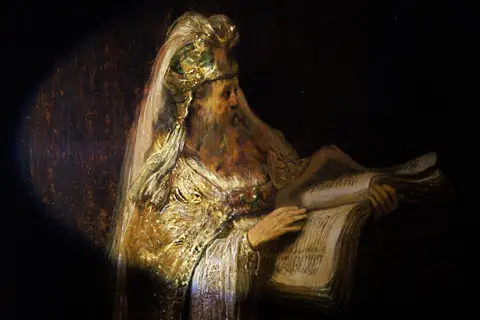
A long lost painting by Rembrandt has been rediscovered and authenticated by experts, after its whereabouts were unknown for decades.
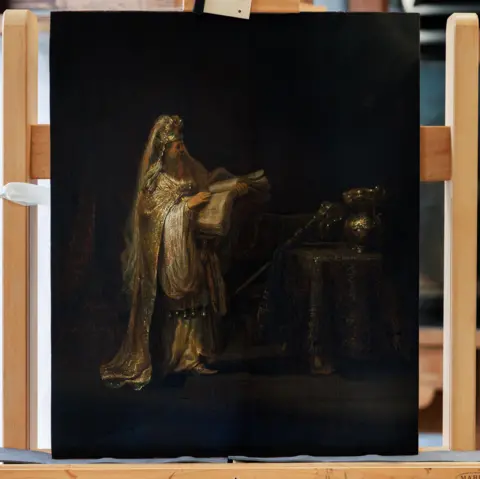
Rembrandt’s Vision of Zacharias in the Temple, from 1633, was excluded from a list of the Dutch master’s works in 1960, and disappeared after being sold to a private collector the following year.
But it resurfaced when its owners presented it for tests at the Rijksmuseum in Amsterdam, which undertook a two-year examination.
“When I saw it in our studio when it was restored, I was immediately struck by the incredible power it has,” Rijksmuseum director Taco Dibbits said.
The Rijksmuseum receives many emails from people asking for information about paintings they have inherited or bought, Dibbits said. In this case, they knew it could be something special.
“It came to us via email and one of our curators thought, this is really an interesting image, we’ve known about the painting for over 100 years but we’ve never seen it.”
The museum confirmed the authenticity after studying the paints, which fit with those used by Rembrandt during that period, and the painting technique and build-up of layers, which are also comparable with his other early works.
The signature is original and the wooden panel dates from the correct period, the researchers said.
“Materials analysis, stylistic and thematic similarities, alterations made by Rembrandt, and the overall quality of the painting all support the conclusion that this painting is a genuine work,” the gallery said.
The painting has all the hallmarks of Rembrandt at the “peak” of the early part of his career, Dibbits said.
“It’s very high quality. Sometimes with Rembrandt’s portraits you feel that he’s producing in quantity, but with this painting you really feel that he dedicated his soul to it.”
The museum will put the painting on public view from Wednesday.
Its value is not known, but the world record auction price for a Rembrandt painting is £20m, set in 2009.
Other Rembrandt paintings to be sold in recent years include one for £8.6m in 2019, a self-portrait for £12.6m in 2020, and another once-lost Rembrandt work for £11m in 2023.
In 2015, a Rembrandt painting was given a price tag of £35m by the UK government after being sold privately.
Last month, a drawing of a lion by the artist sold for $18m (£13m).
[BBC]
Rembrandt was 27 when he created the painting, which depicts the Biblical scene when priest Zacharias is told by the Archangel Gabriel that despite their age, he and his wife will have a son, John the Baptist.
The museum said Rembrandt had given the Biblical story an innovative twist. Instead of depicting the Archangel Gabriel visibly, he only suggested his presence. In doing so, he departed from established visual traditions and introduced a new way of representing this subject.
Rembrandt deliberately chose the decisive moment, just before Gabriel reveals his true identity.
It is one of the few history paintings Rembrandt created during this period. At the time, he was primarily producing portraits, which were highly lucrative.
[BBC]

New Zealand elect to bowl first at Eden Gardens

Cabinet approves import of Maize to meet shortfall

Cabinet nod for the removal of Cess tax imposed on imported good

Around 140 people missing after Iranian navy ship sinks off coast of Sri Lanka

South Africa strong favourites as quest for elusive silverware hots up

Australian girl, 8, killed in snowmobile accident in Japan

‘Dates have the highest sugar content to fight Coronavirus’

Sunday Island 27 December – Headlines

#SundayIsland 17th December – Headlines

Sunday Island – 28th March

Sunday Island Headlines – 21 March

Sunday Island – 21st February – Headlines
-

 Opinion6 days ago
Jamming and re-setting the world: What is the role of Donald Trump?
-
 Features3 days ago
Brilliant Navy officer no more
-

 Features6 days ago
An innocent bystander or a passive onlooker?
-

 Features7 days ago
Ratmalana Airport: The Truth, The Whole Truth, And Nothing But The Truth
-
 Opinion3 days ago
Sri Lanka – world’s worst facilities for cricket fans
-
 Business7 days ago
IRCSL transforms Sri Lanka’s insurance industry with first-ever Centralized Insurance Data Repository
-

 Business6 days ago
An efficacious strategy to boost exports of Sri Lanka in medium term
-
 Features4 days ago
Overseas visits to drum up foreign assistance for Sri Lanka