
News
HRW urges President AKD to fulfill and expand on election campaign promises


The government of President Anura Kumara Dissanayake, which took office on September 23, 2024, has promised to address longstanding human rights issues that have plunged Sri Lanka into repeated crises, Human Rights Watch said in its World Report 2025. Dissanayake has pledged to introduce more equitable economic policies and to repeal the notoriously abusive Prevention of Terrorism Act, but he has not backed accountability for widespread rights violations during Sri Lanka’s 1983-2009 civil war between the government and the separatist Liberation Tigers of Tamil Eelam (LTTE).
For the 546-page world report, in its 35th edition, Human Rights Watch reviewed human rights practices in more than 100 countries. In much of the world, Executive Director Tirana Hassan writes in her introductory essay, governments cracked down and wrongfully arrested and imprisoned political opponents, activists, and journalists. Armed groups and government forces unlawfully killed civilians, drove many from their homes, and blocked access to humanitarian aid. In many of the more than 70 national elections in 2024, authoritarian leaders gained ground with their discriminatory rhetoric and policies.
“Sri Lanka’s multiple crises are connected by entrenched impunity for rights violations, discrimination against minority communities, and laws and institutions that seek to silence critics,” said Meenakshi Ganguly, Deputy Asia Director at Human Rights Watch. “President Dissanayake has an opportunity to make real progress on rights if he carries out his campaign pledges, but he also needs to address the legacy of past conflicts and continuing abuses against Tamils, Muslims, and others on which he has been troublingly silent.”
While an International Monetary Fund (IMF) bailout helped stem the immediate crisis after the Sri Lankan government defaulted on its foreign debt in 2022, the United Nations estimated that a quarter of households were suffering food insecurity in 2024.
Policies pursued by the outgoing administration of President Ramil Wickremesinghe under the IMF program shifted the burden of recovery largely onto people with low incomes. The Dissanayake government has pledged to combat corruption and create more equitable economic policies.
Police and other security agencies harassed and threatened activists and human rights defenders with impunity during 2024, particularly in predominantly Tamil areas in the North and East, including undue restrictions and interference in the financing of civil society organizations.
In May, the UN human rights office issued a report calling for the international community to undertake prosecutions and other accountability measures to address thousands of unresolved cases of enforced disappearance that occurred over decades during the Janatha Vimukthi Peramuna (JVP) uprisings, and the LTTE armed conflict. The UN Human Rights Council has extended a mandate to monitor human rights violations and collect evidence of crimes during the civil war.
President Dissanayake should begin to address Sri Lanka’s many human rights problems by fulfilling and building upon the pledges he made during his party’s election campaigns.

Latest News
Heat Index at ‘Caution level’ in the Western, Sabaragamuwa, Southern and North-western provinces and in Anuradhapura, Mannar, Vavuniya and Monaragala districts

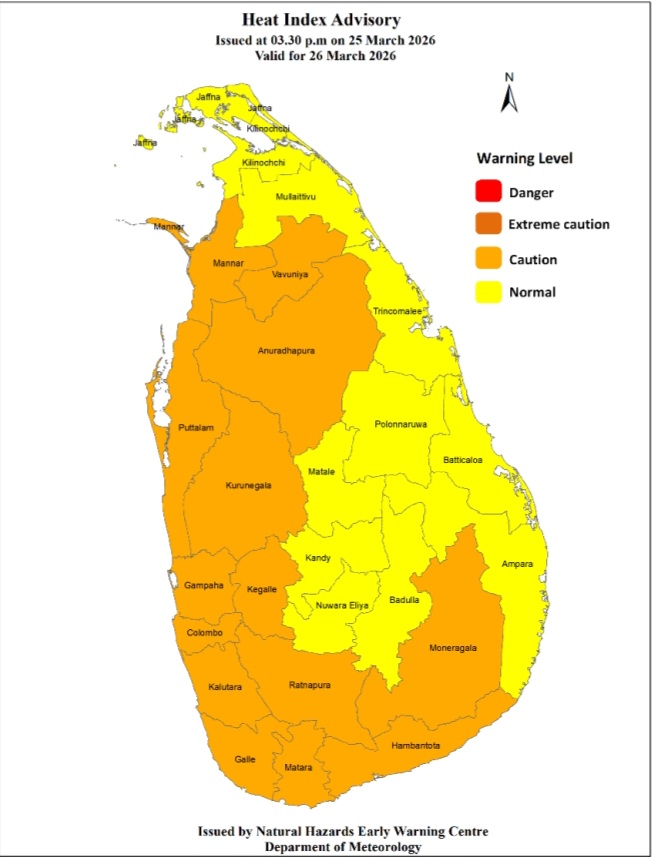
Warm Weather Advisory
Issued by the Natural Hazards Early Warning Centre of the Department of Meteorology
at 3.30 p.m. on 25 March 2026, valid for 26 March 2026.
The Heat index, the temperature felt on human body is likely to increase up to ‘Caution level’ at some places in the Western, Sabaragamuwa, Southern and North-western provinces and in
Anuradhapura, Mannar, Vavuniya and Monaragala districts.
The Heat Index Forecast is calculated by using relative humidity and maximum temperature and this is the condition that is felt on your body. This is not the forecast of maximum temperature. It is generated by the Department of Meteorology for the next day period and prepared by using global numerical weather prediction model data.

Effect of the heat index on human body is mentioned in the above table and it is prepared on the advice of the Ministry of Health and Indigenous Medical Services.
ACTION REQUIRED
Job sites: Stay hydrated and takes breaks in the shade as often as possible.
Indoors: Check up on the elderly and the sick.
Vehicles: Never leave children unattended.
Outdoors: Limit strenuous outdoor activities, find shade and stay hydrated.
Dress: Wear lightweight and white or light-colored clothing.
Note:
In addition, please refer to advisories issued by the Disaster Preparedness & Response Division, Ministry
of Health in this regard as well. For further clarifications please contact 011-7446491.
By Shamindra Ferdinando
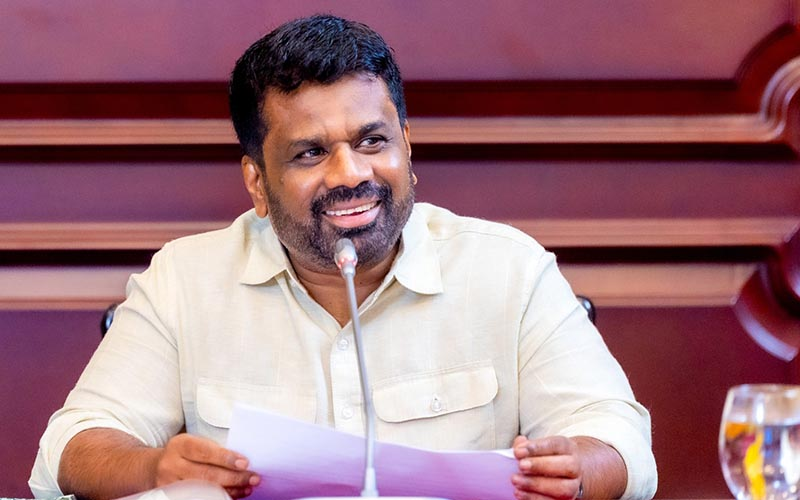
A spokesperson for the US Embassy in Colombo declared that the United States and Sri Lanka maintain a long-standing defence partnership, grounded in transparency, mutual respect, and shared interests.
The official said so in response to The Island query regarding President Anura Kumara Dissanayake’s recent bombshell disclosure, in Parliament, that his government declined to allow the US Air Force to use the Mattala Rajapaksa International Airport, following the eruption of the latest West Asia war.
We sought views of the US on President Dissanayake’s claim against the backdrop of Sri Lanka being a party to the Acquisition and Cross-Servicing Agreement (ACSA) since 2007. Sri Lanka extended the ACSA in 2017, for another 10-year period, and its extension comes up next year.
The President revealed that the US had requested permission to use Mattala, between 04 and 08 March.
Claiming that the request had been made on 26 February, two days before the war began, President Dissanayake said that the US had sought to land two aircraft, carrying eight anti-ship missiles, but that the request had been turned down to maintain Sri Lanka’s neutrality. The President revealed that the aircraft were to come from a US base in Djibouti.
The US embassy pokesperson explained that questions related to operational movements, including ‘Operation Epic Fury’, should be directed to the Department of War (DOW) in Washington.
Camp Lemonnier is the primary base of operations for US Africa Command in the Horn of Africa. China, too, has its only overseas military base in Djibouti in the vicinity.
Military sources said whatever various interested parties said about US-Sri Lanka relations, the former provided significant intelligence support during last phase of the conflict that enabled the Navy to hunt down floating LTTE arsenals in international waters. Of the eight LTTE vessels sunk, the US backed four hits with specific intelligence, sources said.
News
No decrease in remittances from workers due to Gulf conflict, but significant drop in tourist arrivals – CB Governor

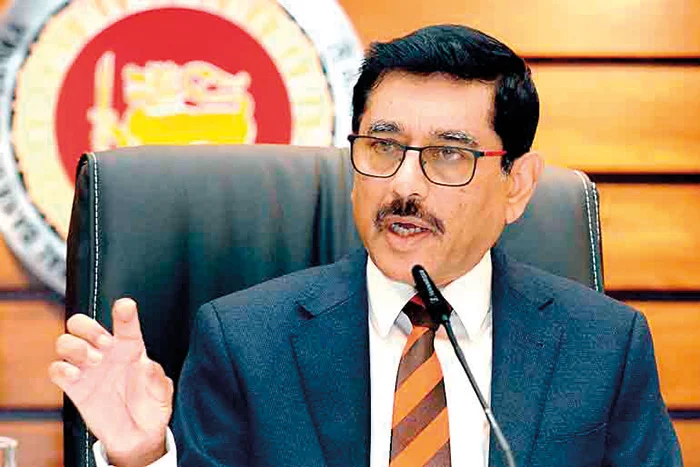
Sri Lanka’s worker remittances had not seen a decrease despite the ongoing conflict in West Asia, Central Bank (CBSL) Governor, Dr. Nandalal Weerasinghe said yesterday.
“Based on currently available data, they have not seen a decline in remittances. In fact, according to that we have observed, is a slight increase in remittances in the past few days, ” the Governor said at a media conference held at the Central Bank head office in Colombo.
Governor Weerasinghe also mentioned that he had not seen any reports about Sri Lankans returning to the country from the Middle East due to the ongoing conflict.
The Central Bank Governor, however, acknowledged that there had been a decrease in tourist arrivals. He confirmed that tourist arrivals had decreased by around 17 percent due to the current volatile situation in the Middle East.
Meanwhile, the Central Bank of Sri Lanka has decided to maintain the Overnight Policy Rate (OPR) at the current level of 7.75%, following its latest Monetary Policy Board meeting.
By Hiran H Senewiratne

UN votes to recognise enslavement of Africans as ‘gravest crime against humanity’

Meta and YouTube found liable in landmark social media addiction trial

Showers expected in the Western and Sabaragamuwa provinces and in Galle and Matara districts after 2.00 pm.

Heat Index at ‘Caution level’ in the Western, Sabaragamuwa, Southern and North-western provinces and in Anuradhapura, Mannar, Vavuniya and Monaragala districts

US dodges question on AKD’s claim SL denied permission for military aircraft to land

No decrease in remittances from workers due to Gulf conflict, but significant drop in tourist arrivals – CB Governor

‘Dates have the highest sugar content to fight Coronavirus’

Sunday Island 27 December – Headlines

#SundayIsland 17th December – Headlines

Sunday Island – 28th March

Sunday Island Headlines – 21 March

Sunday Island – 21st February – Headlines
-

 Features3 days ago
Trincomalee oil tank farm: An engineering marvel
-

 News6 days ago
CIABOC tells court Kapila gave Rs 60 mn to MR and Rs. 20 mn to Priyankara
-
 Features6 days ago
Science and diplomacy in a changing world
-

 Features3 days ago
The scientist who was finally heard
-

 News1 day ago
Senior citizens above 70 years to receive March allowances on Thursday (26)
-
 News1 day ago
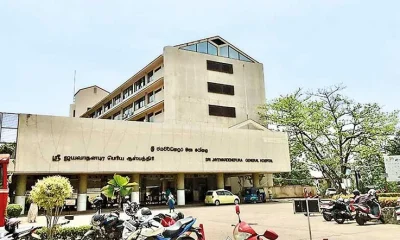
Japanese boost to Sri J’pura Hospital, an outright gift from Tokyo during JRJ rule
-

 News5 days ago
Colombo, Oslo steps up efforts to strengthen bilateral cooperation in key environmental priority areas
-

 News1 day ago
CEB Engineers warn public to be prepared for power cuts after New Year