
Business
How to pay more than Rs. 1,000 per day to tea estate workers


by Remy Jayasekere, Chartered Engineer
In the recent past there have been several articles written opposing the government decision to increase the wages of tea estate workers. On November 21, the Island newspaper published an article titled “Tea industry experts willing to learn the magic formula …” written by a spokesman for the Planters’ Association. Its theme was that under the present conditions it is not possible to increase wages.
There is a 1,000 acre tea plantation called Nerada in far north Queensland in Australia (neradatea.com.au). It produces 6.6 million kg of leaf and 1.6 million kg of made tea annually. Total labour force is less than 50 and the factory is manned by four people in a shift. The minimum hourly wage in Australia is about AUD 20 or around SLR 2,500 which works out to SLR 20,000 for an eight-hour day. Nerada pays above minimum wages so that they can retain talent.
Leaf plucking is done by one machine for the whole plantation – therefore there is only one tea plucker at any time and plucking is a 24-hour operation. The plantation is family-owned and they have developed all the technology themselves – no Tea Research Institutes or Tea Boards.
If Nerada can pay SLR 20,000 per person per day why can’t Sri Lanka pay SLR 1,000 per day? The answer is simple – at Nerada 50 people produce 1.6 million kg of made tea annually which works out to 32,000 kg per person annually. This is worth about AUD 150,000. Pay the worker AUD 50,000 per year and the company has AUD 100,000 per person per year for other things.
This has been achieved through innovation which has resulted in mechanisation and automation of processes. SL has not innovated, continuing to do things the way they have been done for ages. This could be the net result of many decisions taken in the past such as nationalisation of the plantations, regional plantation companies (RPC) not owning the plantations, therefore milking them rather than developing them and general backwardness of the country in developing and employing modern technology.
RPCs have managed the plantations for more than 25 years and if they are interested in developing the plantations, they had ample time to do so. However, they have chosen to remain in the dark ages without any innovative thinking and actions and now are arguing against wage increases. SLR 1,000 is around USD six per day which is not much higher than the extreme poverty level defined by the UN. The actions of the government, the plantation companies and the planters have made sure the workers remained in poverty during the past and now want to ensure that continues into the future.
In the 1980s Singapore had the problem of being turned into a large garment manufacturing centre which they did not want. The government increased the wages of garment factory workers – the message was innovate and produce more per worker or close down. History shows they all closed down and engaged in other pursuits. The Sri Lankan government should be congratulated for taking this bold step of increasing wages – the message is clear, innovate or we will change the agreements. How can you let the RPCs hold a large proportion of the population as well as the economy of the country hostage.
What is stopping us from using a company such as Nerada as the benchmark and trying to achieve what they have achieved. Let me list a few steps.
1. Green leaf – Nerada produces 6600 kg per acre per year. Considering it is one plantation, as a country can we aim for at least half of that. I am sure everyone knows what to do – the list is long. Definition of innovation – 5% is knowing what to do and 95% is doing it.
2. Plucking – This possibly is the highest cost item in the production of tea in Sri Lanka. Two excuses are given for not mechanising plucking – the terrain does not allow for mechanised plucking and mechanised plucking reduces the yield. New replanting areas should have the terrain modified to enable mechanised plucking. The myth of reduced yield does not stand against evidence from Nerada
3. Factory – There are more than 700 tea factories in Sri Lanka employing large numbers of people. Factories in some areas cannot find enough people to man them. Most of these people are used for transporting material from one process or machine to another and in some cases to watch and operate machines. At Nerada all these operations are automated and only four people are required in a shift. Why not scrap the existing factories and build new ones – the payback will be very quick. One of the big problems in the past was trying to modify existing factories which limits possibilities. Do not think outside the box. Think there is no box.
4. Then there are other minor things that go beyond what Nerada has done – using solar energy for the driers and using dehumidified air for withering. Nerada has no need for producing dehumidified air as the humidity in that area is very low.
5. The workers cannot do anything about these. The government, RPCs and management have to take the initiative to improve our plantations. There are no bad soldiers – only bad officers
I believe I have made a case for increasing wages of plantation workers and hope the RPCs will look at this in a positive manner.






Business
SEC Sri Lanka eases Minimum Public Holding Rules for listings via introductions to boost market flexibility


The Securities and Exchange Commission of Sri Lanka (SEC) has approved amendments to the Colombo Stock Exchange (CSE) Listing Rules to provide greater flexibility regarding the Minimum Public Holding (MPH) requirement for companies listing through the Introduction method.
These revisions were proposed and deliberated under Project 6 – New Listings (Public and Private), one of 12 key strategic initiatives launched by the SEC to strengthen Sri Lanka’s capital market framework. Project 6 aims to drive national capital formation, promote listings by highlighting benefits and opportunities for listed entities, and attract large-scale corporates to enhance market depth, liquidity, and investor confidence.
The amendments reflect a joint effort by the SEC and CSE, underscoring strong collaboration between the regulator and the Exchange to address evolving market needs while maintaining market integrity, transparency, and investor protection.
The salient features of the amendments to the CSE listing Rules are as follows;
Entities seeking listing by way of an Introduction on the Main Board or Diri Savi Board that are unable to meet the MPH requirement at the time of submitting the initial listing application, may now be granted a listing, subject to certain conditions on compliance.
Non-public shareholders who have held their shares for a minimum period of eighteen months prior to the date of the initial listing application may divest up to a maximum 2% of their shares each month during the six months commencing from the date of listing, and simultaneously, be subject to a lock-in requirement of 30% of their respective shareholdings as at the date of listing, until MPH compliance or 18 months from the date of listing, whichever occurs first.
A phased MPH compliance framework has been introduced requiring a minimum 50% compliance with MPH requirement within 12 months and full compliance within 18 months from the date of listing.
Entities should include clear disclosures in the Introductory Document confirming their obligation to meet MPH requirements within the prescribed timelines.
In the event of non-compliance with the MPH requirement, certain enforcement actions have also been introduced.
The revised framework is expected to encourage more companies to consider listing via Introduction, thereby broadening market participation, improving liquidity, and contributing to the overall development of Sri Lanka’s capital market. Issuers, investors, and market intermediaries will benefit from a more enabling yet well-regulated listing environment.

Stock market activities were positive yesterday, mainly driven by manufacturing sector counters, especially Sierra Cables, Royal Ceramics and ACL Cables. Further, there was some investor confidence in construction sector counters as well.
Amid those developments both indices moved upwards. The All Share Price Index went up by 150.54 points, while the S and P SL20 rose by 41.5 points. Turnover stood at Rs 4.65 billion with six crossings.
Those crossings were reported in Royal Ceramics which crossed 3.8 million shares to the tune of Rs 174.3 million; its share s traded at Rs 45.20, VallibelOne 1.4 million shares crossed to the tune of Rs 138.6 million; its shares traded at Rs 99, Melstacorp 500,000 shares crossed for Rs 87.24 million; its shares traded at Rs 174.50, Sierra Cables two million shares crossed for Rs 68.2 million, its shares sold at Rs 34.30, Kingsbury 1.5 million shares crossed for Rs 31.8 million; its shares traded at Rs 21.20.
In the retail market companies that mainly contributed to the turnover were; Sierra Cables Rs 418 million (20 million shares traded), Royal Ceramics Rs 363 million (eight million shares traded), Colombo Dockyards Rs 323 million (1.7 million shares traded), ACL Rs 311 million (3.5 million shares traded), Renuka Agri Rs 149 million (12.3 million shares traded), Sampath Bank Rs 94.7 million (648,000 shares traded) and Bogala Graphite Rs 86.4 million (529,000 shares traded). During the day 122.8 million shares volumes changed hands in 34453 transactions.
Yesterday the rupee opened at Rs 310.00/25 to the US dollar in the spot market, weaker from Rs 310.00/310.20 the previous day, dealers said, while bond yields were broadly steady.
By Hiran H Senewiratne
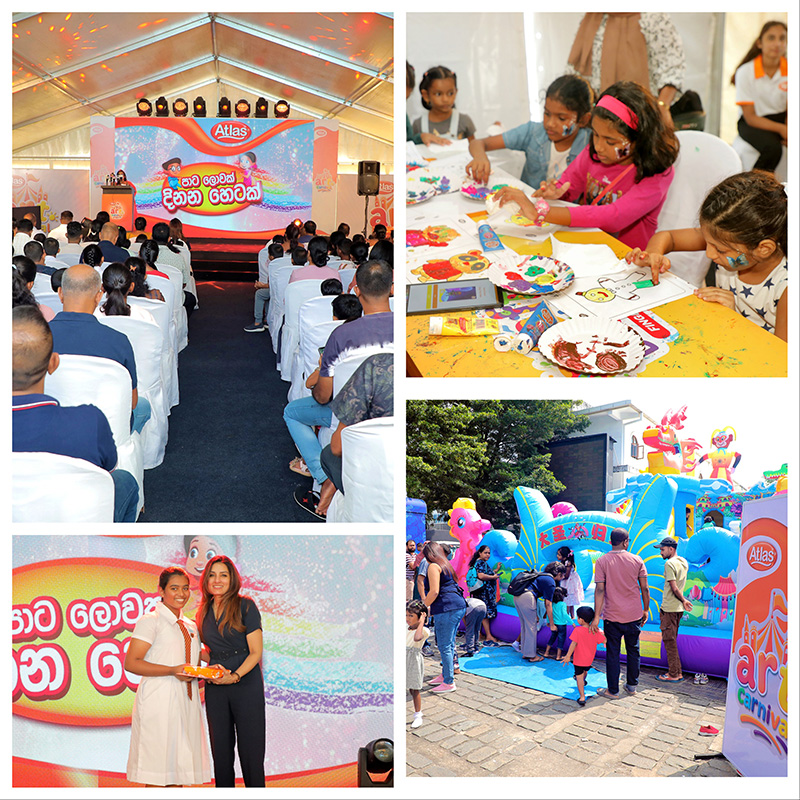
Atlas, Sri Lanka’s leading learning brand, reaffirmed its purpose of making learning fun and enjoyable through the Atlas All-Island Art Competition 2025, which concluded with a gifting ceremony held recently at Arcade Independence Square under the theme ‘Atlas paata lowak dinana hetak’. Students from Preschool to Grade 11 showcased their talents across five categories, with all island winners receiving cash prizes, certificates, and gift packs. Additionally, merit winners in each category were also recognized. The event brought together students, parents, and educators, highlighting Sri Lanka’s cultural diversity, nurturing young talent, and reinforcing Atlas’s long-standing commitment to education, creativity, and building confidence among schoolchildren. The event concluded with the ‘Atlas Art Carnival’, which brought children and parents together through games and creative art activities in a fun and lively atmosphere.

Machu Picchu train crash leaves one dead and dozens injured

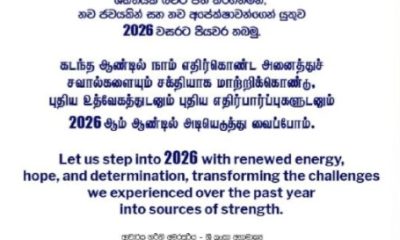
I invite you to step into 2026 with renewed energy, hope, and determination – PM

Fairly heavy showers about 75 mm are likely at some places in the Central and Uva provinces and in Batticaloa and Ampara districts

National Audit Office reveals NHSL lapses

NPP’s CMC budget passed after four Opp. members switch allegiance

600MW hit to national grid as two Norochcholai units go offline

‘Dates have the highest sugar content to fight Coronavirus’

Sunday Island 27 December – Headlines

#SundayIsland 17th December – Headlines

Sunday Island – 28th March

Sunday Island Headlines – 21 March

Sunday Island – 21st February – Headlines
-
 News6 days ago
Street vendors banned from Kandy City
-

 Sports3 days ago
Gurusinha’s Boxing Day hundred celebrated in Melbourne
-

 News6 days ago
Lankan aircrew fly daring UN Medevac in hostile conditions in Africa
-
 News1 day ago
Leading the Nation’s Connectivity Recovery Amid Unprecedented Challenges
-

 Sports4 days ago
Time to close the Dickwella chapter
-

 Features6 days ago
Rethinking post-disaster urban planning: Lessons from Peradeniya
-

 Features2 days ago
It’s all over for Maxi Rozairo
-

 Opinion6 days ago
Are we reading the sky wrong?