
Features
How television came to Sri Lanka

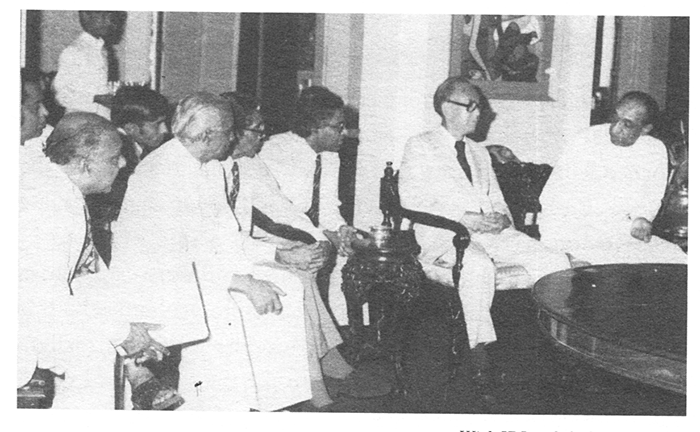
JRJ, Anandatissa and Upali Wijewardene were among key players
When JRJ was the Minister of State in the Dudley cabinet of 1965 he advocated the introduction of Television to the country. This was typical of his bold thinking and awareness of what was going on around us in the world, which was not a great characteristic of the Dudley cabinet. His suggestion was shot down by Dudley’s media advisors led by Neville Jayaweera who went on to describe the offer of TV as ‘A gift of a Rhinoceros’.
Soon after that JR’s powers over the media were withdrawn by Dudley and he decided to bide his time. One of his earliest acts as Prime Minister in 1977 was to initiate action on introducing TV. Since colour television is today the main media outlet in the country let me narrate how Jayaweera’s ‘brute’ came to be installed.
It began when JRJ called Minster Wijetunga and me to his office and told us that Anandatissa de Alwis, who was then Speaker, had informed him that Upali Wijewardene was talking to the Japanese about introducing TV as one of his investments. JRJ wanted us all to to put our heads together and bring in TV as a national venture since the SLBC was the monopoly radio broadcaster at that time and the subject had been assigned to our Ministry.
The following day the Speaker Ananda invited my minister, Upali and me to his chambers in the old Parliament to discuss JRJs order. Fortunately the three main protagonists – my minister, Ananda and Upali were all friends from much earlier and the discussion was very fruitful apart from the fact that we knew the PM was taking a personal interest in the matter.
There was a strong bond of friendship between Ananda and Upali. The latter had begun his business in a small way by taking over a failed business which belonged to his wealthy maternal uncle Sarath Wijesinghe. This was a small scale business of making sweets under the Delta brand. However the UK returned Upali knew that demographically this group of consumers were bound to grow with the youth segment in our population increasing exponentially.
He turned to the leading advertising agency of that time J Walter Thompson of which Ananda was the managing director. At that time most businessmen did not look to advertising as a necessary ingredient of marketing. Ananda was an advertising genius who had first branded the UNP Youth League as a progressive and fashionable offshoot of the Grand Old Party.
At that time there were only three advertising specialists in the country. They were Ananda, Reggie Candappa and Tim Horshington. Their main media outlets were Lake House, Times and Radio Ceylon. All three had good contacts in these offices having worked there earlier as journalist, layout artist and announcer respectively. They were also Bohemians and irreverent types who knew everybody and could see the sun go down in congenial company.Later all three befriended me, especially Ananda who became my minister and Reggie who made me a member of the exclusive Colombo Club of which he was a live wire. Ananda was a magnificent speaker on the social circuit and a raconteur who knew all the inside stories of political and social life in Colombo from the time of Independence.
Lately in his career, I was considered his protege and became part of his listener’s club and many of the revelations in my autobiography owe their origins to those intimate, fabulous drinking and eating sessions usually held at Ranjit and Lucille Dahanayake’s residence in Colombo 3. Upali, whose horse racing activities were encouraged by Ranjit, who was earlier a jockey and later a gentleman rider, was a frequent visitor at the Dahanayake residence, and an equally expansive story teller.
The idea of entering the publishing business came to Upali at these conversations. As he himself acknowledged in an article I had asked Gamini Wijetunga who was the editor of ‘Desathiya’ our official magazine, to interview Upali who was then the Director General of the Greater Colombo Economic Commission [GCEC] now the Board of Investments, since many had heard about him, frequently critically, but did not really know about his background.
We published a cover story on him and ‘Desathiya’ was not only sold out but it also created a sensation because the leading politicians wanted to keep Upali out of the limelight. Immediately Premadasa and Ronnie protested through their mouthpieces, but our minister feigned ignorance knowing that the big chief was not averse to a little inhouse mischief.
Upali never forgot Gamini Wijetunga and would frequently telephone him to get his advice. Typically Premadasa wanted to do something quickly about this perceived challenge. He started his own magazine which was a carbon copy of ‘Desathiya’ but much better funded through his housing department. He recruited Gunadasa Liyanage at an attractive salary with perks, to be the editor of his magazine.
Since up to then Liyanage had been a fan of Ronnie de Mel, we suspected that he and the PM had closed ranks against our magazine and Gamini Wijetunga in particular. This encounter triggered a spate of ‘Desathiya’ clones loyal to Ronnie, Lalith, Gamini, Ranil and many others, freely using their publicity budgets.
Our canny Sinhala journalists encouraged this magazine spree because they were offered salaries and perks way beyond their newspaper emoluments. It also sparked off an undesirable tendency among ministers to set up within media enterprises their own ‘moles’ who were like agents looking after the interests of their unofficial paymasters.
Any evening visit to a minister’s residence or party headquarters would find these ‘paid hirelings’ hanging around to brief their benefactors and more often to create havoc in party circles by spreading gossip. Unfortunately that tendency has now multiplied with a permissive ‘political culture’ where moles are wined and dined and are even found carrying out errands for their newspaper owners.
Ananda’s advertising acumen made the ailing Delta toffee business to turn around and become a money spinner. Upali invented a special type of container for the toffees, held dealer conventions for boutique owners, increased the advertising budget and brought in radio jingles. He started newspaper contests and started attacking rival products like `Bulto’ toffees which had captured a major market share.
The rise of Delta created in Upali a fascination for modern advertising and publicity. Later he became a spectacular media baron who turned his personality into a great bargaining chip in negotiations with banks and other financial institutions. With Delta restored to health, Upali attacked Kandos. Kandos was a middle level company based in Kandy (hence Kandos), which used the cocoa grown in the Kundasale area to make chocolates.
Its majority shares were owned by an old world Burgher gentleman who did not have the resources to take the company to the next level. Then Upali started his trade mark investment approach by acquiring a minority shareholding. He then quietly bought up more small shares and with a strong platform launched an aggressive attack –on the main shareholder. The old man who did not have the resources to fend off this attack gave in and sold his shares to Upali.
Having acquired control of Kandos, Upali invested in good managers and another Ananda led publicity campaign. He borrowed from banks on the strength of the Kandos balance sheet and went international with his product. Seeing that his cocoa supplies from Kundasale were both insufficient and expensive he entered Malaysia at a time when it was soliciting new investments. With his Cambridge and UK credentials which impressed the Anglophile Malaysian upper class he entered the much larger consumer market in that country.
I remember visiting supermarkets in Kuala Lampur and Singapore at that time and feeling proud when Kandos products were prominently displayed in them. From buying cocoa it was a logical next step to buy cocoa estates to safeguard his supply chain. Upali then bought cocoa and tea estates in Malaysia and Sri Lanka through his well-established technique of quietly accumulating shares till he could make a pitch for controlling the company. In all this he was advised on the media side by Ananda who became one of his favourite ‘elders’.
In the last days of the Dudley administration JRJ and Ananda as his Permanent Secretary, had backed Upali when he started to link up with emerging Japanese Companies instead of trying to enter the already saturated import market from the UK. The Japanese were fast moving up in global trade while UK- the sick man of Europe – was on a downward spiral, not least because Japan was beating them at their own game.
Upali started to assemble radios with parts imported from Japan. When that became a success he started to assemble Mazda cars. With typical panache Upali donated the first three Mazdas to come off his assembly line in Homagama to his mother, JRJ and NM Perera. It is not difficult to imagine that NM Perera’s name was suggested by the mischievous JRJ – Ananda combine. To his credit NM as Finance Minister backed Upali to the hilt.
Partly because Ananda and I interested him in media Upali started a newspaper publishing house. As was his wont he wanted to start right at the top. He brought the latest printing technology. He also unhesitatingly raided the journalistic staff of other newspapers by offering them higher salaries. He brought an Englishman as a consultant following his father’s brother D.R. Wijewardene who had done the same when he established Lake House.
When Upali heard that I was leaving for Singapore we met in Ranjit Dahanayake’s house where he offered me double my Singapore salary to work for him. I refused because I was not a working journalist. Long after his death, on the invitation of the Editor of the Island newspaper I wrote the following memoir about Upali and the beginning of that landmark paper.
“While felicitating `The Sunday Island’ on its 15th anniversary, I recall the early days when Upali Wijewardene set up his newspaper group. The Ministry of State of which Anandatissa de Alwis was Minister and I was Permanent Secretary, was located in the Indian Bank building in the Fort area. We moved there because it was in close proximity to both Lake House and the Times building which housed the leading newspapers of the day.
“The Investment Promotion Board (GCEC) was housed in the fourth and fifth floors of the same building. So we would often meet Upali Wijewardene and his Media Manager Vijitha Yapa who later became the first editor of ‘The Island’. I remember that Mr. Wijesiriwardene, son of the famous Mr. D.B. Rampala, was also a member of Upali’s team that did the preliminary work in setting up the paper.
“I clearly recall the contretemps over the telecasting of a news item about the Upali Newspapers, on the first day ‘Island’ and `Divaina’ hit the streets. I asked the TV organization which came under the State Ministry to give it maximum publicity. For the first time Sri Lankan viewers could see on their small screens the giant presses rolling, newspapers being bundled and finally being sold on the street.
“We also carried interviews with readers who naturally welcomed a new fresh-looking newspaper.
This newscast raised the ire of several bigwigs including Prime Minister Premadasa who was suspicious of Upali’s moves, particularly because the latter had said in his usual provocative way that he would like to be the next President of Sri Lanka.
“There was even talk that President J.R. Jayewardene was backing Upali, which may have caused some heartburn among politicians who fancied themselves as JRJ’s successors. They all complained to I lie President regarding this alleged `abuse’ of the media. Though I heard of these moves by some ministers it did not worry me overmuch since my Minister Anandatissa de Alwis was quite satisfied with this broadcast.
“The following day I was summoned to Ward Place and the President wanted to know why we had featured the Upali Press. I was sharp enough not to bring political opponents into the picture and merely stated that Lake House people were upset by this. I replied that the launching of a new national newspaper was news and that by any standard it merited inclusion in the day’s news bulletin. President JRJ good naturedly accepted this explanation, particularly my statement that the Chairman, Lake House cannot be the arbiter of TV news selection.
“Perhaps to satisfy our critics he added sternly that in future the same high degree of sympathy should be shown to other newspapers when they came out. When I told him of this outcome, Anandatissa merrily rang up Upali and had a good laugh.
“All this goes to show that governments of all hues are apt to keep a wary eye on what newspapers do. There are many reasons for this. Perhaps the most important is the government’s desire to set and dominate the agenda of public discussion. They are very happy when newspapers, particularly the state media, adopts the governmental agenda. Equally they are most dismayed when newspapers, particularly those like 1he Island which have strong opinions, begin to set the agenda.
“What we need now therefore is the emergence of a political culture which recognizes the role of dissent. It is a culture which is difficult to establish. Nevertheless, we have to persevere since it is the bedrock of democracy”.
First Steps for Television
This was the background to the first meeting on introducing TV which was held in the Speaker’s room in early 1978, attended by Ananda, Wijetunga, Upali and me. Upali, with his Japanese connections, had already contacted the Nippon Electrical Company [NEC]. He suggested that we go for the Japanese product as it was based on ‘state of the art’ technology.
The following day the Minister and I met JRJ in office. The PM said that he wanted TV to be a state venture supervised by the Media Ministry. He agreed that we should look to Japan for TV technology. Accordingly, I was asked to negotiate with the Japanese Embassy in Colombo and also speak to the Finance Ministry for budgetary provision to procure the equipment.
At about the same time, when there was public discussions about introducing TV, two young men were also investigating the possibility of setting up a private TV station. They were Anil Wijewardene, son of Sivali who was D.R. Wijewardene’s eldest son and Shan Wickremesinghe son of Nalini, the eldest daughter of D.R. Wijewardene. They were both therefore the nephews of JRJ who was happy that this duo were planning to set up their own TV station.
From time to time he would ask Minister Wijetunga for a progress report on their project, but I knew that he was being regularly briefed by the young men who had easy access to him. In fairness it must be said that they did not cut corners and were diligently seeking the several approvals necessary for the project.
Since Wijetunga was keen to get the goodwill of his boss I kept an eye on their progress. This was not difficult because Shan at that time was my immediate neighbor in Siripa road, where many of the immediate relatives of the Wijewardene’s had their imposing residences.At this stage we had a stroke of luck. The Japanese Ambassador here was Ochi who had been earlier an official of the Japanese Finance Ministry. Before that he had been an executive of the Nippon Electrical Company. It is well known that Japanese Ambassadors have close ties with their corporate world. Ochi was a quintessential ‘Economic Club’ man and was very positive about Japanese involvement in bringing TV to Sri Lanka.
By this time the German and French Ambassadors were also making overtures through their local agents, to be the suppliers. I could use these offers to leverage concessions from the Japanese. Then Ochi, who was determined to win the contract, dropped it bombshell. In order to secure the project for his friends in NEC he said that he will get the whole project for us free of charge. It will come as an outright grant.
I realized the value of his offer and quickly informed JRJ about it. At first he refused to believe that this was possible. A grant of this magnitude was quite extraordinary. But he was pleased when I told him that they were giving it in appreciation of his contribution at the San Francisco peace conference. Before this offer was nailed down the Ambassador and I had to indulge in some obfuscation.
The grant could be given according to Japanese law only of it served a public purpose and a commercial TV station would not pass that test. So we prepared a request for a TV station for the promotion of education. Even now the original agreement carries that objective, even though it has been observed in the breach from the beginning of transmissions. One of the studios in Rupavahini is specially designed to facilitate the making of educational programs and we did start broadcasting lessons in English and Mathematics which won awards at international competitions.
After he was convinced that we were getting the latest type of TV station as a grant, JRJ summoned us and the Japanese Ambassador to President’s House for a final announcement and a celebratory meal. A photograph taken at this historic meeting is reproduced in this book. In it, with the President is Minister Wijetunga, Ambassador Ochi, Sivali Wijewardene [representing his son Anil] Shan Wickremesinghe, Eamon Kariyakarawana [representing SLBC] and me.
After that official meeting it was all systems go and we started working on the project in earnest. I liaised with my friend Akiel Mohammed, Director of External Resources of the Finance Ministry, to finalize details of the grant which was to be announced in the forthcoming budget. In the meanwhile we had to take some urgent decisions. The first was to get the land adjoining SLBC released for the proposed TV station.
At that time it was used as their playground by the Ladies Hockey Club of Colombo. Hidden on a side was an illegal ‘hooch’ bar which was patronized by the artistes and officials of the SLBC. They were not amused when their favourite ‘water hole’ was given a quit notice. However they soon relocated in a place even closer to the studios and there was satisfaction all round.
A more serious problem arose regarding building the main office and the studios. Normally even in our foreign funded projects the practice was for the local side to provide the land and buildings. I knew that if our PWD was to be given this task there would be inevitable delays and the opening would have to be postponed. That was our experience with other projects.
So I requested the Japanese side to include the design and construction of the TV premises in the grant aid. After some discussion the Japanese agreed and we were spared the necessity of asking for supplementary estimates and work plans from our officials. I was happy with the success of my negotiations, and we began the project without delay.
Reshuffle
At this stage JRJ decided to reconstitute his Cabinet. This was partly because Ranjan Wijeratne, who as Secretary to the Ministry of Agriculture, had complained that his Minister EL Senanayake who was a senior in the Cabinet, was inefficient and perhaps somewhat lacking in rectitude. There was a talk of lack of transparency in tenders for the purchase of fertilizer.Anyway the President’s plans for rapid agricultural growth which he signaled by appointing Wijeratne, who was an agriculturist of high repute, was not being realized. So he made EL the Speaker, a post which had much prestige and no tenders. At the same time he had to respond to the tourist trade which was complaining of a lack of cooperation from the Minister of Tourism Mrs. Kannangara who was constantly fighting with her Secretary Balasuriya who was a senior CCS officer.
In a smart move he brought in Anandatissa de Alwis to the Cabinet as Minister of State and assigned the subject of tourism to that Ministry. He transferred Wijetunga to the important Ministry of Posts and Telecommunications which showed that he appreciated our role in promoting TV. Wijetunga was keen that I accompany him as Secretary to his new Ministry. But the President decreed that I should remain in the media ministry with Ananda and continue with the TV project.
He added the portfolio of tourism to our Ministry, because Ananda had presided over that subject as Secretary to JRJ in the Dudley Cabinet. Mrs. Kannangara’s Ministry was abolished. Since Balasuriya was my neighbor at Siripa road this was an embarrassment to me especially since my two daughters were taking piano lessons from Mrs. Balasuriya who was a well-known teacher. Among the other children who were Mrs. Balasuriya’s proteges was Sajin Vass Gunawardena who was something of a musical prodigy then. As the mischievous son of our University friend Abey Vass Gunawardena, Sajin was in and out of our house in Siripa Road.

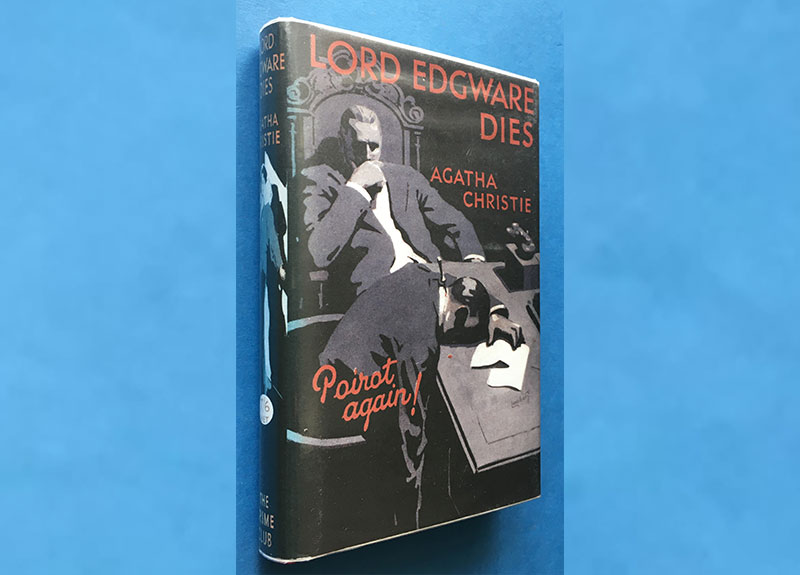
It has been some time since I read an Agatha Christie, the plot of which I cannot remember. So, I was delighted to find on the shelves of a friend Lord Edgware Dies, which I had a vague memory of, but no certainty about who had done it.
When I read it, I found that my memory of who was probably the killer was correct, but I could not be certain and the red herrings Christie threw in were so diverting that until almost the very end I wondered if I had been wrong.
The plot is very simple. Jane Wilkinson, who is married to Lord Edgware, tells him that she is desperate for a divorce since she is in love with a very proper Anglo-Catholic peer, Lord Melton, but Edgware refuses to divorce her. She asks Poirot to talk to him, which he does, and is surprised to find that Edgware has told Jane he is prepared to give her a divorce. This was, after he had categorically refused, through a letter, which Jane said she had not received.
That night Edgware is murdered, after Jane had been to see him, or so the butler said, and also Edgware’s secretary. But Jane had been that evening at a grand dinner many miles away, where a dozen fellow guests could swear to her presence.
There was a solution however to the mystery of two Jane Wilkinsons, namely a skilful impersonator called Carlotta Adams who, in the opening chapter had impersonated Jane Wilkinson, who had also been at the performance. But when Poirot goes to see her, he finds that she had been found dead on the morning after Edgware had been killed, of an overdose. And in her bag was a gold case, with a strange inscription, that contained the drug, along with a pair of pince-nez.
Her maid said she had written a letter to her sister in America and posted it the previous night. Poirot asks Inspector Japp to get the letter, and a transcript is received from America, and in it the name of Edgware’s nephew Ronald Marsh is mentioned; he had taken Carlotta to dinner after her performance, with which the book opens, and had then set her a challenge. Japp arrests Marsh, but Poirot is not happy and asks for the original of the letter, which the sister sends him. That shows that a page is missing, and the tear is obvious, though that raises the question as to why it had not simply been cut.
Matters are further complicated by the fact that Marsh had gone in a taxi to the Edgware house, along with Edgware’s daughter Geraldine, in the interval of an opera which had previously seemed to provide them with cast iron alibis. Geraldine had gone in to fetch her pearls so that Marsh could raise money he needed, and thus had an opportunity to kill Edgware, as did Marsh, for the driver said he had got out of the taxi while waiting and gone into the house.
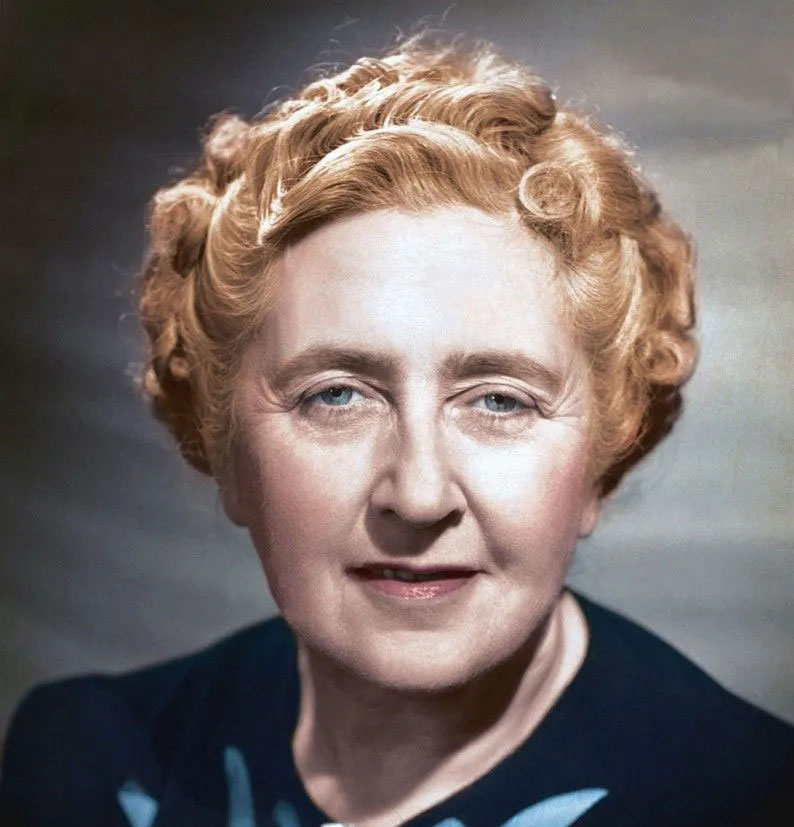
Agatha Christie
Marsh explained why he had gone to the house on the night of the murder as having followed Bryan Martin, an American actor, who had been in love with Jane, whom he saw go into the house with a key. But there was no one visible when he entered, and Geraldine almost immediately came down and they left together. And Martin too has become an object of suspicion to Poirot, for he had been to see him before the murders were discovered with a story of being followed by a man with a gold tooth – a story Poirot immediately realized was false when he was asked how old the man was, and was told he was young, for young people did not have gold teeth.
A heap of French money Edgware had got for a trip to Paris was missing, but since Marsh had no need for it after his cousin’s offer of help, Poirot deduces that it must have been taken by the butler, who has disappeared. Christie has stressed that he is astonishingly handsome, unusual in a butler, and Poirot notes a resemblance to Martin, so he thinks the mysterious man going into the house must have been him.
Incidentally, later Poirot assumes that Edgware’s change of mind was because he was involved in some scandal, and I believe Christie intends us to see the cause of this in his handsome butler, though this is not specified.
Meanwhile, Poirot has asked Japp to find out the provenance of the case found in Carlotta’s handbag, and it turns out to have been made in Paris, specially commissioned, and collected by a woman with pince-nez.
But then another murder occurs—that of another guest at the grand dinner, which provided Jane with her alibi. The victim is an actor who had been bemused when Jane, at a lunch, thought the Judgment of Paris referred to the city. He told Hastings he wanted to see Poirot, but was killed before he could get to the appointment. Poirot had rushed there when told about his request, but it was too late.
Meanwhile, Poirot has tried out the pince-nez on Edgware’s secretary, but she could not see through these. It was only a chance remark heard outside the theatre that led him to try them out on Wilkinson’s maid Ellis, a spare pair that had been appropriated for the night of the murders.
Poirot then lays things out, having summoned Martin and told him that he probably suppressed Edgware’s letter, as he had been dropped by then and he did not want Jane to marry another. But after teasing Martin, Poirot says that Jane was in fact the murderer, and she got Carlotta to impersonate her at the dinner while she went to the house and killed her husband. After meeting Carlotta later and checking with her through a call that she had not been rumbled, Jane had gone ahead with the murder – she put veronal into her drink and the case with veronal into the handbag. She forgot to take out the pince-nez she had used earlier to imitate an American. Carlotta had registered as the American in a hotel and Jane had gone to see her, and there they exchanged identities. After seen the letter, she made use of it by tearing off the page that referred to her, and the S of She, so that the person who had challenged Carlotta to impersonate her seemed to be a man.
There is a coda in which Jane, condemned to death, writes to Hastings, still full of pride at her ingenuity hoping she will be remembered.
by Prof. O. A. Ileperuma
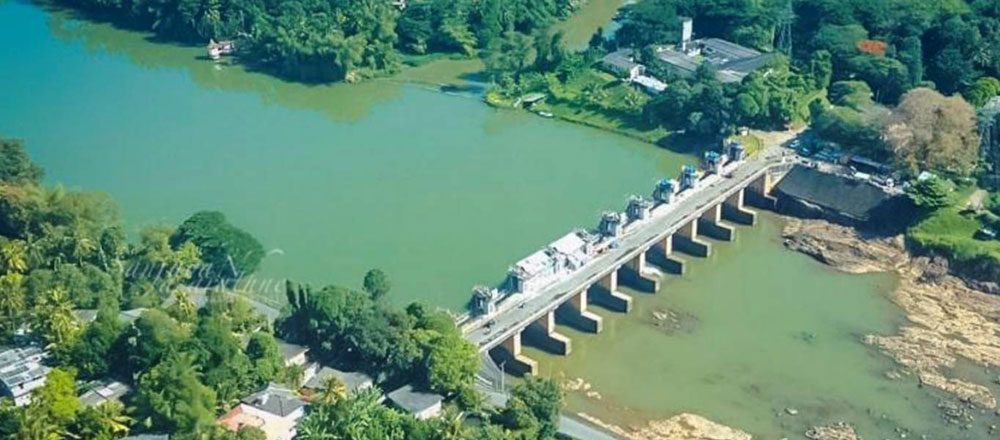
Silting of reservoirs is a major problem today affecting our hydropower production and irrigation systems. The main Mahaweli reservoirs are silted to a considerable extent reducing the water holding capacity of them. Due to poor soil management practices, floodwaters deposit large amounts of silt in these reservoirs. When the Polgolla reservoir was fully drained about two years back, one could see mountains of silt in the lower reaches of the reservoir. A rough estimate is that 50% of the total capacity of these reservoirs has been lost to siltation. This is a serious issue which affects not only power and agriculture but also flood control.
Our ancient irrigation systems ensured that desilting of reservoirs took place under royal decree where all users of the reservoirs were ordered to carry out desilting of reservoirs during the dry season. The clay thus collected was used in making bricks for the construction of great stupas which dot the landscape of our ancient kingdoms. This ensured that the reservoirs had their full capacity filled with water for the next cultivating season. Our ancient kings were clever enough not to construct reservoirs by blocking main rivers such as the Mahaweli. A classic example is the Minipe left canal where they tapped only the surface water of Mahaweli. Even the bigger tanks such as Nuwara Wewa and Parakrama Samudraya were fed with minor rivulets. There were also other ingenious features in the cascade irrigation systems built by the ancient kings, such as mud sluice canals and forest reservations between the reservoirs in the cascade system. These reservations helped trap silt and remove excess nutrients, which could otherwise contribute to increasing salinity as water flowed from one reservoir to another.
-

- Parakrama Samudraya
-
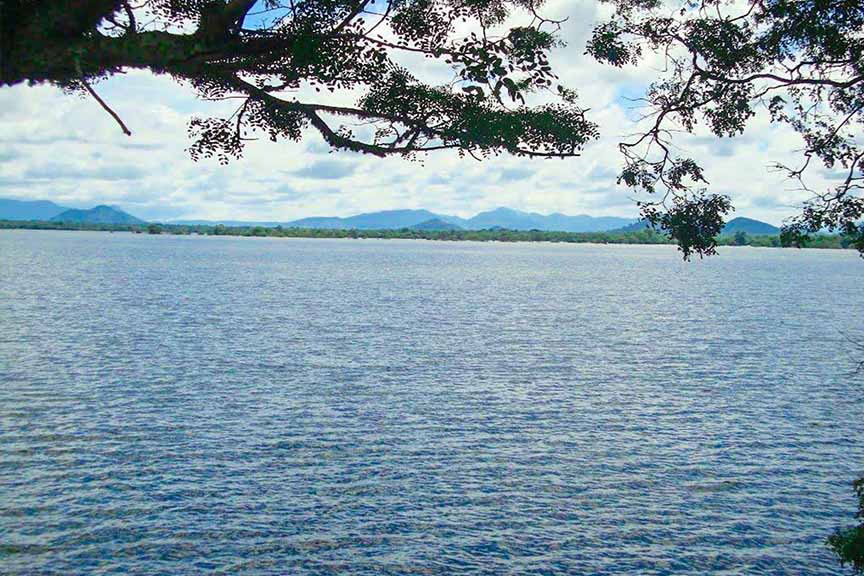
- Kalawewa
-
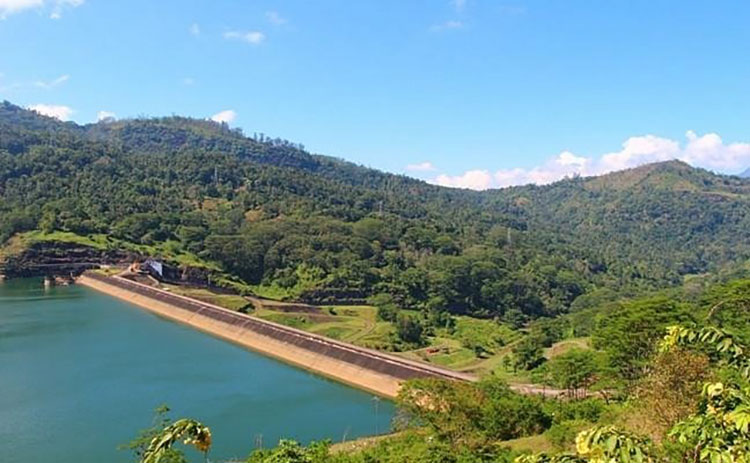
- Kotmale

Victoria
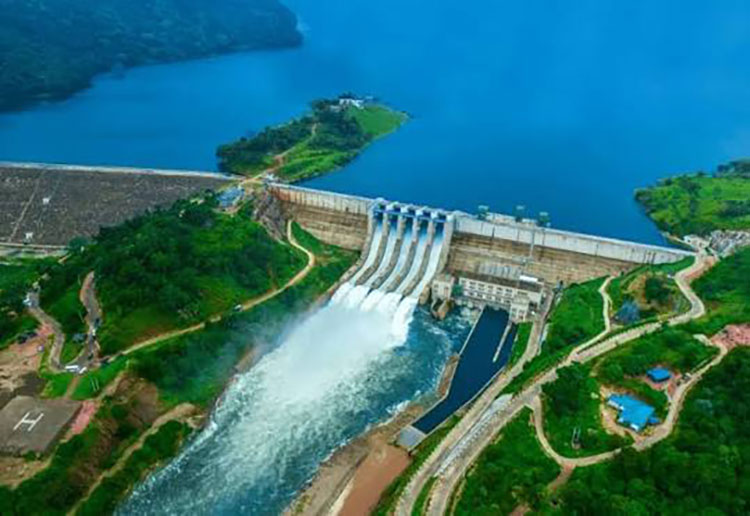
Moragahakanda
A classic engineering marvel is the former Yoda Ela, which carries water from Kalawewa to Nuwara Wewa and Tissa Wewa. It is 87 km long although the straight distance between these points is only about 40 km. The gradient of this canal is about 10 cm per km or 6 inches per mile. Yodha Ela functions as a moving reservoir and feeds about 4,600 hectares of paddy lands. It is a winding canal with about 120 smaller reservoirs on its way. It was constructed during the reign of King Dhatusena around 459 AD and later expanded by King Parakramabahu by connecting more reservoirs to the network. Unfortunately, during the Mahaweli project our modern-day engineers constructed a concrete canal replacing the winding path of this Yoda Ela also called Jaya Ganga. This effectively removed the ability of the old Yoda Ela to remove silt and nutrients. The bank of this Ela has wet zone trees such as jak and areca nut growing well. They take up the nutrients from the flowing stream making the water suitable for irrigation later.
Ancient Mesopotamian civilisations depended on dams constructed along the two main rivers, Euphrates and Tigris. After continuous irrigation of their fields over several thousand years, salinity of the irrigated lands increased making them unsuitable for agriculture. People died due to famine and this clearly illustrates the danger of blocking main rivers for agriculture. There is scientific evidence that the salinity of paddy soils in the Mahaweli C area is increasing.
We saw the devastation caused by Cyclone Ditwah. The sluice gates of the Kotmale Reservoir were opened, and Kandy and Peradeniya were flooded. If the reservoir had had greater storage capacity, couldn’t the opening of the gates have been delayed? This may not be an argument that modern-day engineers would readily accept, and I am not an irrigation expert. These ideas may well be naïve. But most of us tend to think of reservoirs mainly in terms of hydropower generation and irrigation, while their role in flood control receives much less attention. The question therefore deserves serious consideration. Could restoring lost reservoir capacity through desilting help improve our ability to manage extreme rainfall and reduce flood risks?
Desilting our reservoirs should be considered a national priority.
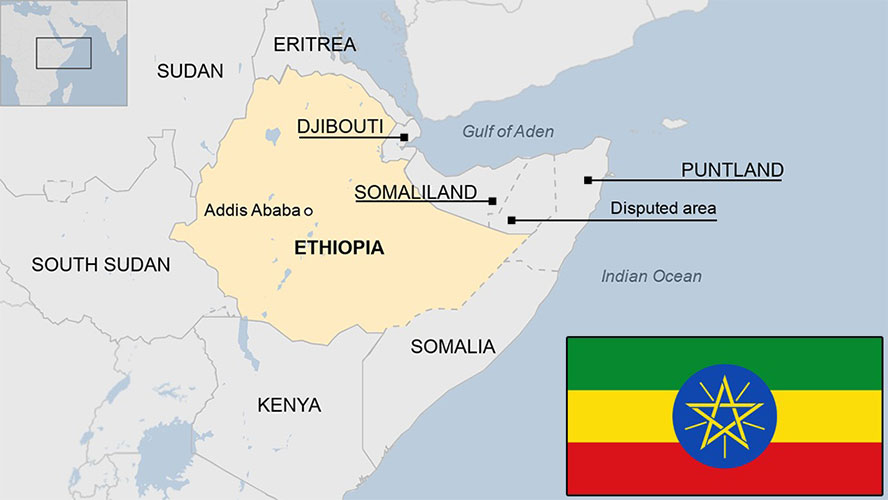
Export diversification – Missing the wood for the trees – Part III
by Gomi Senadhira
In Sri Lanka, the word “Ethiopia” is often used as disparaging slang to describe individuals or areas experiencing extreme poverty, starvation, or severe economic hardship. This linguistic habit originated in the 1980s with the Western media coverage of the devastating Ethiopian famine of 1983-85. That media coverage shocked the world but also left an outdated and offensive global stereotype that the country is permanently starving. Much has changed since then. By now, with an annual growth rate of around 9%, it is the fastest-growing economy in sub-Saharan Africa. Ethiopia has also emerged as a highly competitive exporter and is challenging not only its competitors in the region but also countries like Sri Lanka. This article is on how Sri Lanka has lost ground to Ethiopia (and a few other countries) in the GCC markets for agricultural and floricultural products.
Sri Lanka – A Pioneer in the Agriculture and Floricultural Market in the GCC
As discussed in Part II of this article, by the mid-1980s Sri Lanka had established a strong foothold in the GCC’s fruit, vegetable, and floricultural market. Geographical proximity and well-established shipping and air links gave Sri Lanka a strong comparative advantage over Southeast Asian and African nations. Thailand, Vietnam, and Kenya were not even in the market. At that time, Ethiopia was experiencing (as BBC news reports described) “a biblical famine”.
The market was not very large, but it was lucrative and growing. Trade Minister Lalith Athulathmudali as well as the Chairman of the Export Development Board, Victor Santiapillai, who visited Kuwait (and the GCC countries), recognised the market potential for these products and encouraged us to continue with our work. The minister was particularly keen to further develop links between the market for these products, exporters, and his Export Production Villages (EPVs). So, it was becoming a successful case not only for export diversification but also for transferring gains from exports directly to rural households.
From Trailblazer to Tailender
As a result, even by the beginning of this century Sri Lanka had a larger market share than most of its competitors from Asia or Africa. But since then, our competitiveness has weakened significantly. The tables below provide a comparative snapshot of Sri Lanka’s performance vis-à-vis Thailand, Vietnam, Kenya and Ethiopia in the GCC market for vegetables, fruits and floricultural products. As illustrated therein, in 2001 Sri Lanka was ahead of Thailand, Kenya and Ethiopia in this small but rapidly growing market. Since then, we have fallen behind Thailand, Kenya and many other countries in that lucrative market. If this trend continues, Sri Lanka will fall behind Ethiopia within the next few years. (See Table 1)
In the GCC market for vegetables (covered in HS chapter 07), Sri Lanka was ahead of most other competitors in 2001. As illustrated in Table 1 , Sri Lanka had failed to develop this market, while Thailand, Kenya, and even Ethiopia had very efficiently increased their market shares. The GCC is a market to which Sri Lanka can supply some vegetables, like cabbages, by sea. It appears Sri Lanka had also failed to exploit this mode of supply.
We can see a similar trend in the market for fruits. Vietnam, Kenya, and Thailand have emerged as major players, while exports from Sri Lanka have staggered on slowly. In this segment, Vietnam has emerged as a leading player during the last twenty years and the GCC imports from Viet Nam have shot up from US$44 thousand in 2001 to US$346 million by 2024. In part one of these articles, I discussed the remarkable increase of jackfruit exports from Vietnam “…just $3 million in 2015 to an impressive $236.8 million in 2023” while most of our jackfruit production rots under the trees. This explains how countries develop their markets, geographically and product-wise. (See Table 2)
Sri Lanka’s performance has been weakest in the market for floricultural products (HS Chapter 06), which groups live trees, cut flowers, and ornamental foliage. When we first entered the market in the 1980s, the market was dominated by the Netherlands, and Kenya and Ethiopia were not even in the market. At that time, we identified the Gulf states as a market where Sri Lanka could have a dominant presence due to geographical proximity. Even in 2001, Sri Lanka was ahead of Kenya, Ethiopia, and Thailand. But by now, Kenya has emerged as the dominant supplier. Ethiopia is also expanding its market share and is the third-largest exporter. (See Table 3)
Missing the Wood for the Trees
In the mid-1980s, Sri Lanka first established its foothold in the GCC market. Since then, Thailand, Vietnam, Kenya, and even Ethiopia have moved well ahead of us and have become leading players. Why did we lag behind in our export diversification efforts in general and, more particularly, in the GCC market?
The reasons are very clear. After the initial attempts in the 1980s and early 1990s, Sri Lanka has not been proactively involved in identifying, developing, and promoting new products and markets, or protecting and further developing new markets already established. The focus has simply been on traditional exports: tea, coconut, cinnamon, and garments, while other products were almost ignored. In essence, we have been and continue to focus intensely on a narrow group of products and markets, and we have lost sight of the bigger picture.
(The writer can be reached at senadhiragomi@gmail.com)

ITS Giuseppe Garibaldi’ departs Colombo

Green Climate Fund (GCF) Regional Dialogue for East and South Asia will be held from 14 to 17 September 2026 at Cinnamon Life at City of Dreams Hotel, Colombo

Showers will occur in the Western, North-western and Sabaragamuwa provinces and in Kandy, Nuwara-Eliya, Galle and Matara districts

Prof. Pieris says Buddha Dhamma recognised as source of law under Constitution

GR leaves FCID after making statement over MiG deal

Dengue cases top 97,000 in 2026

‘Dates have the highest sugar content to fight Coronavirus’

Sunday Island 27 December – Headlines

#SundayIsland 17th December – Headlines

Sunday Island – 28th March

Sunday Island Headlines – 21 March

Sunday Island – 21st February – Headlines
-

 Sports2 days ago
DDS set to lose Test captaincy
-

 Latest News7 days ago
Tharanga creates history with Diamond League crown in Brussels
-

 Features6 days ago
After the parade: What a traffic OIC’s walk-out tells us
-

 News7 days ago
Dispute which triggered listed company director being detained at BIA resolved
-

 Editorial6 days ago
Arrests as theatre
-

 News5 days ago
Thailand shuts door on undesirables from Sri Lanka
-

 Latest News6 days ago
Harshitha’s composed knock seals Sri Lanka’s semi-final berth
-

 News6 days ago
‘Choka Malli’ slips out of country before travel ban