
News
Govt. MP moves SC to cancel SLIIT deal, action against ex-Minister et al

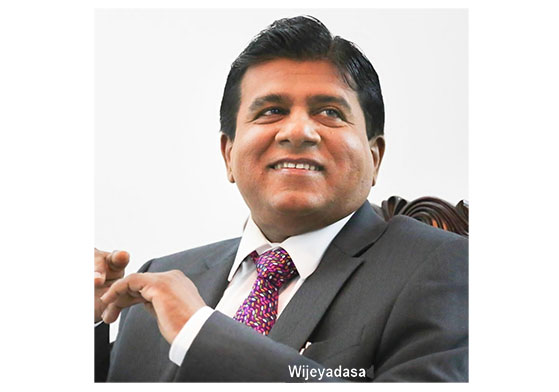
“CIABOC slept on my complaint regarding loss of Rs 23 bn’
SLPP Colombo District lawmaker Dr. Wijeyadasa Rajapakshe, PC, has moved the Supreme Court in terms of the Article 126 and Article 17 of the Constitution requesting the cancellation of agreements between the Mahapola Higher Education Scholarship Trust Fund and Sri Lanka Institute of Information Technology (SLIIT).
Former Justice Minister and also the former President of the Bar Association of Sri Lanka (BASL), having named Cabinet of ministers, including the PM, Members of the Commission to Investigate Allegations of Bribery or Corruption, IGP, Attorney General, members of the SLIIT and the Mahapola Higher Education Scholarship Trust Fund as respondents, asked for issuing of notices to them and most importantly an order directing Attorney-General to charge and indict Gamini Jayawickrama Perera, Dr. Wickrama Weerasooriya (deceased), Anil Rajakaruna, Prof. Lalith R. Gamage, Prof. Luxman Rathnayaka and Manjula Sagara Ellepola in line with the recommendations made by a Presidential Commission that inquired into the matter.
MP Rajapakshe has also requested the SC to direct the CIABOC to initiate legal action and indict Gamini Jayawickrama Perera, Dr. Wickrama Weerasooriya (deceased), Anil Rajakaruna, Prof. Lalith R. Gamage, Prof. Luxman Rathnayaka and Manjula Sagara Ellepola
The President’s Counsel in his petition said that those responsible should be charged and prosecuted under Sections 452, 454, 388 and 389 of the Penal Code and also prosecuted for the offence punishable under section 70 of the Bribery Commission Act.
Appearing before the SC in person, MP Rajapakshe said that the Attorney-General had been made a party to represent the President in terms of Article 35(1) of the Constitution.
MP Rajapakshe moved SC in the wake of parliamentary watchdog committee COPE (Committee on Public Enterprises) calling for government intervention to take back SLIIT.
The petitioner stated that on examination of relevant documents it was revealed that Prof. Laxman Ratnayake (34th Respondent) and Prof. Lalith R. Gamage (35thRespondent) received appointment as directors of said company in their capacity as employees of the Moratuwa University, and the 35th Respondent has been appointed in view of the fact that he is the son-in-law of late Kingsly Wickremaratne, who was the Minister in Charge of the Mahapola Trust Fund at that time.
The petitioner stated that he found that the Prof. Laxman
Ratnayake and Prof. Lalith R. Gamage had surreptitiously, gradually and fraudulently got the non-State actors appointed as directors whenever vacancies occurred due to retirement of the ex-officio directors and finally it was ended up with all the directors being non-State actors who were not holding any public office.
The petitioner alleged Prof. Laxman Ratnayake and Prof. Lalith R. Gamage (had acted in collusion with late Dr. Wickrama Weerasuriya, who was a newly appointed member of the Mahapola Trust Fund, and upon being questioned and convinced about the fraud committed the petitioner, in his capacity as the Higher Education Minister ordered him to resign from the trusteeship of the Mahapola Trust Fund and also from the membership of the University Grant Commission forthwith and accordingly he resigned.
The Petitioner stated that the Auditor General’s Department after having a special investigation into the issue at hand in a report dated 07.09.2018 asserted that the trustees of the Mahapola Trust Fund were responsible for causing a loss to the fund amounting to over Rs. 1,645,494,237 by handing over ownership to another party.
The petitioner alleged that though he made a complaint to the CIABOC on 25 February 2019 that the loss caused to Sliit as a result of the corrupt transaction at that time was about Rs. 23,000,000,000. (Rs. 23 billion), the outfit did nothing except for recording statements from him twice. (SF)

Latest News
Heat Index at Caution Level in the Northern, North-central, North-western, Western, Sabaragamuwa, Eastern and Southern provinces and in Monaragala district


Warm Weather Advisory
Issued by the Natural Hazards Early Warning Centre
Issued at 3.30 p.m. on 15 April 2026, valid for 16 April 2026.
The Heat index, the temperature felt on human body is likely to increase up to ‘Caution level’ at some places in the Northern, North-central, North-western, Western, Sabaragamuwa, Eastern
and Southern provinces and in Monaragala district.
The Heat Index Forecast is calculated by using relative humidity and maximum temperature and this is the condition that is felt on your body. This is not the forecast of maximum temperature. It is generated by the Department of Meteorology for the next day period and prepared by using global numerical weather prediction model data.
Effect of the heat index on human body is mentioned in the above table and it is prepared on the advice of the Ministry of Health and Indigenous Medical Services.
ACTION REQUIRED
Job sites: Stay hydrated and takes breaks in the shade as often as possible.
Indoors: Check up on the elderly and the sick.
Vehicles: Never leave children unattended.
Outdoors: Limit strenuous outdoor activities, find shade and stay hydrated.
Dress: Wear lightweight and white or light-colored clothing.
Note:
In addition, please refer to advisories issued by the Disaster Preparedness & Response Division, Ministry of Health in this regard as well. For further clarifications please contact 011-7446491

The Indonesian Navy Sailing Ship KRI BIMA SUCI – 945 arrived at the Port of Colombo on a goodwill visit on 15 Apr 2026 and was welcomed by the Sri Lanka Navy (SLN) in compliance with time-honoured naval traditions.
The vessel’s arrival is a key highlight of the ASEAN Plus Cadet Sail (APCS) – 2026 programme , accompanying a diverse contingent of Navy cadets from 26 different nations alongside their Indonesian counterparts.
The ship is commanded by Commander SUGENG HARIYANTO. Meanwhile, Officer Under-trainees of the Sri Lanka Navy are expected to participate in various programmes aboard the
ship and naval personnel observe its operational functions during its stay in the island.
Furthermore, the ship’s crew is scheduled to take part in programmes organized by the Sri Lanka Navy to enhance camaraderie between the two navies, as well as visit several tourist attractions in the country.
News
PM initiates children into learning at the auspicious time while observing New Year traditional customs and rituals

The Sinhala and Tamil New Year cultural festival, organized by the Ministry of Buddha Sasana, Religious and Cultural Affairs, was held on Tuesday (14) in Gampaha under the patronage of Prime Minister Dr. Harini Amarasuriya, with the performance of traditional auspicious customs and rituals.
In accordance with tradition, during the Punya Kalaya (inauspicious time), the Prime Minister visited the Medagama Sri Sunandarama Viharaya in Gampaha and participated in religious observances and received blessings from Venerable Thunmodara Samitha Thero, a member of the Karaka Sangha Sabha of the Sri Lanka Ramanna Maha Nikaya and the Chief Incumbent of the Medagama Sri Sunandarama Dharmaduta Piriven Viharaya.
The traditional observances of the Sinhala and Tamil New Year cultural festival were held at the residence of Darshana Weerasinghe in Gampaha. Marking the auspicious time for commencing work, and upon the invitation of the host family, the Prime Minister planted a sapling within the premises. Concurrently, Minister of Buddha Sasana, Religious and Cultural Affairs, Dr. Hiniduma Sunil Senevi, and Minister of Foreign Affairs and Tourism, Vijitha Herath, joined the PM.
Subsequently, the Prime Minister joined children in engaging in traditional folk games.
At the auspicious time for engaging work and educational activities, the PM participated with children in reading and writing, guiding them and symbolically marking the commitment to advancing the educational development of the nation’s children.
Thereafter, the Prime Minister and other distinguished guests observed the traditional customs of exchanging greetings, transactions and gifts with the host family, and joined them to partake in the customary New Year meal.
Extending New Year greetings to all citizens, the Prime Minister expressed her gratitude to all Sri Lankans, both at home and abroad, for their contributions in overcoming and effectively managing the various challenges faced by the country.
Speaking at the occasion, Minister Dr. Hiniduma Sunil Senevi stated that the Sinhala and Tamil New Year festival symbolizes renewal and purity, and reflects the energy of the sun. He also conveyed his wishes for a peaceful and prosperous New Year for all.
The occasion was attended by the Deputy Minister of Finance and Planning and Minister of Labour, Dr. Anil Jayantha; Deputy Minister of Labour, Mahinda Jayasinghe; Member of Parliament for the Gampaha District, Ruwan Mapalagama; along with the Gampaha District Secretary, Mayor, Divisional Secretaries, and a large number of government officials.
(Prime Minister’s Media Division)

Heat Index at Caution Level in the Northern, North-central, North-western, Western, Sabaragamuwa, Eastern and Southern provinces and in Monaragala district

Pakistani army chief in Tehran amid bid to restart US talks

Sri Lanka repatriates 238 Iranian sailors stranded after US torpedo attack

Indonesian Navy Sailing Ship KRI BIMA SUCI – 945 makes port call in Colombo

PM initiates children into learning at the auspicious time while observing New Year traditional customs and rituals

Navy seize an Indian fishing boat poaching in seas north of Mannar

‘Dates have the highest sugar content to fight Coronavirus’

Sunday Island 27 December – Headlines

#SundayIsland 17th December – Headlines

Sunday Island – 28th March

Sunday Island Headlines – 21 March

Sunday Island – 21st February – Headlines
-

 News4 days ago
CEB orders temporary shutdown of large rooftop solar systems
-

 News7 days ago
AG: Coal procurement full of irregularities
-
 Features4 days ago
From Royal College Platoon to National Cadet Corps: 145 years of discipline, leadership, and modern challenges
-

 Business6 days ago
Israeli attack on Lebanon triggers local stock market volatility
-

 Business7 days ago
Hayleys Mobility introduces Premium OMODA C9 PHEV
-

 Business6 days ago
HNB Assurance marks 25 years with strategic transformation to ‘HNB Life’
-

 Latest News3 days ago
PNS TAIMUR & ASLAT arrive in Colombo
-

 Sports7 days ago
DS to face St. Anthony’s in ‘Bridges of Brotherhood’ cricket encounter