
News
Govt. MP moves SC to cancel SLIIT deal, action against ex-Minister et al

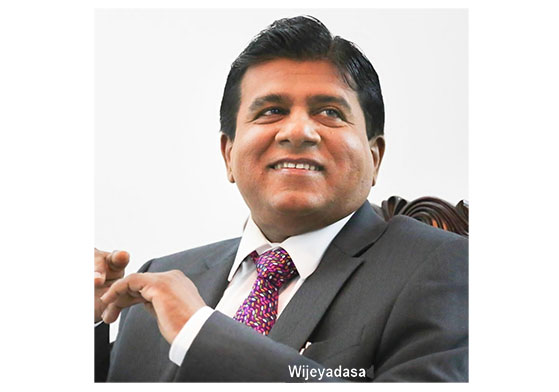
“CIABOC slept on my complaint regarding loss of Rs 23 bn’
SLPP Colombo District lawmaker Dr. Wijeyadasa Rajapakshe, PC, has moved the Supreme Court in terms of the Article 126 and Article 17 of the Constitution requesting the cancellation of agreements between the Mahapola Higher Education Scholarship Trust Fund and Sri Lanka Institute of Information Technology (SLIIT).
Former Justice Minister and also the former President of the Bar Association of Sri Lanka (BASL), having named Cabinet of ministers, including the PM, Members of the Commission to Investigate Allegations of Bribery or Corruption, IGP, Attorney General, members of the SLIIT and the Mahapola Higher Education Scholarship Trust Fund as respondents, asked for issuing of notices to them and most importantly an order directing Attorney-General to charge and indict Gamini Jayawickrama Perera, Dr. Wickrama Weerasooriya (deceased), Anil Rajakaruna, Prof. Lalith R. Gamage, Prof. Luxman Rathnayaka and Manjula Sagara Ellepola in line with the recommendations made by a Presidential Commission that inquired into the matter.
MP Rajapakshe has also requested the SC to direct the CIABOC to initiate legal action and indict Gamini Jayawickrama Perera, Dr. Wickrama Weerasooriya (deceased), Anil Rajakaruna, Prof. Lalith R. Gamage, Prof. Luxman Rathnayaka and Manjula Sagara Ellepola
The President’s Counsel in his petition said that those responsible should be charged and prosecuted under Sections 452, 454, 388 and 389 of the Penal Code and also prosecuted for the offence punishable under section 70 of the Bribery Commission Act.
Appearing before the SC in person, MP Rajapakshe said that the Attorney-General had been made a party to represent the President in terms of Article 35(1) of the Constitution.
MP Rajapakshe moved SC in the wake of parliamentary watchdog committee COPE (Committee on Public Enterprises) calling for government intervention to take back SLIIT.
The petitioner stated that on examination of relevant documents it was revealed that Prof. Laxman Ratnayake (34th Respondent) and Prof. Lalith R. Gamage (35thRespondent) received appointment as directors of said company in their capacity as employees of the Moratuwa University, and the 35th Respondent has been appointed in view of the fact that he is the son-in-law of late Kingsly Wickremaratne, who was the Minister in Charge of the Mahapola Trust Fund at that time.
The petitioner stated that he found that the Prof. Laxman
Ratnayake and Prof. Lalith R. Gamage had surreptitiously, gradually and fraudulently got the non-State actors appointed as directors whenever vacancies occurred due to retirement of the ex-officio directors and finally it was ended up with all the directors being non-State actors who were not holding any public office.
The petitioner alleged Prof. Laxman Ratnayake and Prof. Lalith R. Gamage (had acted in collusion with late Dr. Wickrama Weerasuriya, who was a newly appointed member of the Mahapola Trust Fund, and upon being questioned and convinced about the fraud committed the petitioner, in his capacity as the Higher Education Minister ordered him to resign from the trusteeship of the Mahapola Trust Fund and also from the membership of the University Grant Commission forthwith and accordingly he resigned.
The Petitioner stated that the Auditor General’s Department after having a special investigation into the issue at hand in a report dated 07.09.2018 asserted that the trustees of the Mahapola Trust Fund were responsible for causing a loss to the fund amounting to over Rs. 1,645,494,237 by handing over ownership to another party.
The petitioner alleged that though he made a complaint to the CIABOC on 25 February 2019 that the loss caused to Sliit as a result of the corrupt transaction at that time was about Rs. 23,000,000,000. (Rs. 23 billion), the outfit did nothing except for recording statements from him twice. (SF)


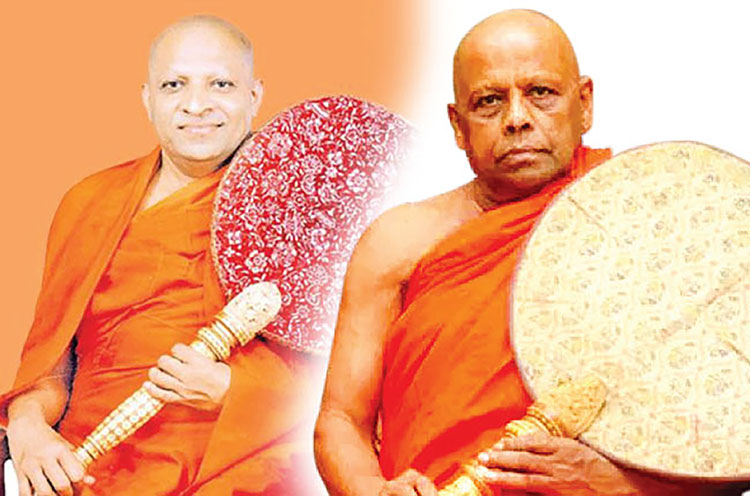
MONETABRIEF– Sri Lanka’s two most senior Buddhist chapters, Malwatte and Asgiriya, demanded special concessions for monks serving prison sentences, following the disrobing of convicted monk Ven. Galagodaatte Gnanasara in line with established procedures.
The chief prelate of the Asgiriya chapter, Most Venerable Warakagoda Sri Gnanarathana, told Prisons Commissioner Senaka Palletenna that Ven. Gnanasara, who is serving a six-year sentence for contempt of court, must be released immediately.
Prison authorities have no power to release or pardon convicts, but Palletenna told the monk in Kandy on Friday that he would convey his request to the relevant government authorities.
“There is no point in talking about this and that… The entire country has been shaken (??????? ) . He must be released,” the Asgiriya chief prelate said.
The Malwatte chief prelate, Most Venerable Thibbatuwawe Sri Siddhartha Sumangala, appeared to accept the court verdict against Ven. Gnanasara, but asked the prisons chief whether a separate section could be established for convicted monks.
Palletenna noted that a special ward for the clergy already existed at Welikada Prison.
At least 63 convicted Buddhist monks are currently incarcerated within Sri Lanka’s criminal justice system.
Meanwhile, a group of 34 Buddhist monks named in a Colombo Fort Magistrate’s Court order to vacate the vicinity of the Presidential Secretariat ended their protest and dispersed after lunch on Friday.The monks are demanding an unconditional pardon for Ven. Gnanasara, who has previously been imprisoned, making him a reconvicted prisoner.
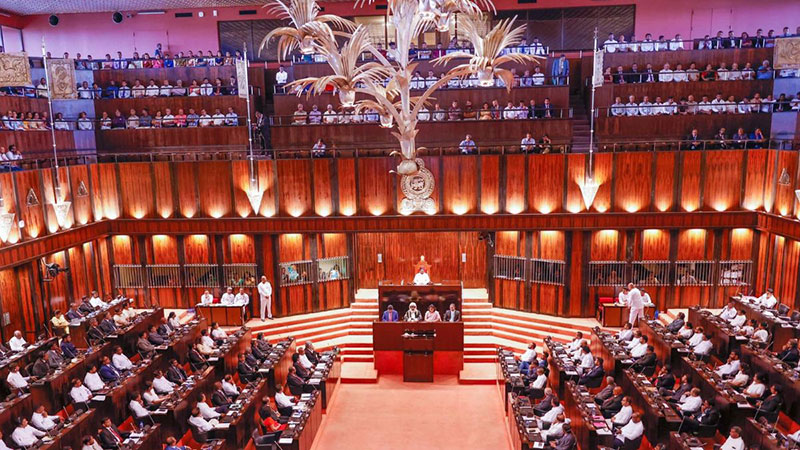
The debate on the no-confidence motion against Speaker Dr. Jagath Wickramaratne, submitted by the Samagi Jana Balawegaya (SJB), has been postponed indefinitely pending the Attorney General’s opinion on certain technical issues in the motion.
Government representatives raised the matter at a meeting of the Committee on Parliamentary Business, pointing out that several provisions of the motion required clarification and that the Attorney General’s advice should be obtained.
As obtaining the opinion would take time, the debate could not be scheduled for the next parliamentary week, parliamentary sources said.
Chief Opposition Whip Gayantha Karunatilaka said a date for the debate would be decided after the Attorney General’s advice was received.
Meanwhile, Parliament is scheduled to meet from October 20 to 23, Secretary General of Parliament Kushani Rohanadeera announced.
The parliamentary business for the week was finalised at a meeting of the Committee on Parliamentary Business held on Friday (16) under the chairmanship of Deputy Speaker Dr. Rizvie Salih.
On each sitting day, the period from 9.30 a.m. to 10 a.m. will be allocated for parliamentary business under Items 1 to 6 of Standing Order 22. Questions for Oral Answers will be taken up from 10 a.m. to 11 a.m., followed by questions under Standing Order 27(2) from 11 a.m. to 11.30 a.m.
On Tuesday, October 20, an Opposition-sponsored Adjournment Motion will be debated from 11.30 a.m. to 5.30 p.m.
On Wednesday, October 21, a resolution under the Public Debt Management Act and a Supplementary Estimate will be taken up for debate and approval from 11.30 a.m. to 5 p.m. The annual reports of five statutory institutions will subsequently be presented for approval without debate, while questions at the Adjournment Time will be taken up from 5 p.m. to 5.30 p.m.
On Thursday, October 22, the Second Reading debates on two Bills to amend the Poisons, Opium and Dangerous Drugs Ordinance (Bills Nos. 79 and 80) will be held from 11.30 a.m. to 5 p.m.
The annual reports of five statutory institutions will then be taken up for approval without debate, followed by an Opposition-sponsored Adjournment Motion from 5 p.m. to 5.30 p.m.
On Friday, October 23, the Second Reading debate on the Elimination of Rabies and Registration of Dogs Bill will be held from 11.30 a.m. to 5 p.m. A Government-sponsored Adjournment Motion will be debated during the final half-hour of the sitting.

Former Navy Commander Admiral Wasantha Karannagoda had, by letter dated May 19, 2014, requested the Secretary to the Ministry of Defence to approve the funds required for former Navy Lieutenant Yoshitha Rajapaksa, son of former President Mahinda Rajapaksa, to attend the Royal Navy Young Officers Course at the Royal Navy Training College in the United Kingdom, the Colombo High Court was told on Thursday (15).
The court was informed that £24,536 in public funds had been spent on the training programme. The details emerged during testimony by a Navy representative appearing on behalf of former Navy Commander Admiral Travis Sinniah before Colombo High Court Judge Udesh Ranatunga, when the money laundering case against Rajapaksa was taken up for hearing.
Responding to questions during cross-examination, the witness explained that payments for Navy officers attending overseas training programmes were generally made in foreign currencies, including US dollars and British pounds.
Meanwhile, Navy Captain Nuwan Thushara Arangala, testifying for the prosecution, told court that Rajapaksa had received a total of Rs. 5,159,626.37 in salaries and allowances during his nine years of service in the Navy.
The court was informed that Rajapaksa had served as a Navy Lieutenant from December 14, 2006, to February 28, 2017, although his service had been suspended on February 28, 2016.
According to the testimony, his monthly gross salary was Rs. 16,390, in addition to allowances for food, uniforms, housing and special duties.
The witness clarified that these allowances did not include payments made for overseas training programmes or participation in sporting events while representing the Navy.
During the proceedings, the prosecution also submitted Rajapaksa’s annual declarations of assets and liabilities for the period from 2009 to 2015.
A National Savings Bank official also testified regarding savings accounts and fixed deposits maintained by Rajapaksa, stating that no withdrawals had been made from the accounts since they were opened.
Rajapaksa is facing charges under the Prevention of Money Laundering Act over his alleged failure to explain the source of nearly Rs. 735 million acquired between August 1, 2012, and August 29, 2013, in Rajagiriya and Bambalapitiya.
The prosecution alleges that funds suspected to have been derived from unlawful activities were deposited in bank accounts and fixed deposits.
The court also heard testimony concerning the appointment of a guardian for Daisy Forrest, the second defendant in the case, and matters relating to the clearance of an imported outside broadcasting (OB) truck associated with CSN television.
Further examination of witnesses was scheduled for October 30, with the court directing 11 prosecution witnesses to appear on that date.

Showers or thundershowers will occur in most parts of the island after 1.00 p.m.

Buddhist hierarchy demands prison perks for monk convicts

Debate on NCM against Speaker postponed indefinitely

Karannagoda pushed for £24,536 for Yoshitha’s UK training, Court told

Flu cases surge across Lanka

Lankan rubies among treasures of London’s Cheapside Hoard

‘Dates have the highest sugar content to fight Coronavirus’

Sunday Island 27 December – Headlines

#SundayIsland 17th December – Headlines

Sunday Island – 28th March

Sunday Island Headlines – 21 March

Sunday Island – 21st February – Headlines
-

 Latest News6 days ago
Farhan and Sadaqat help Pakistan seal series in style
-

 Latest News5 days ago
Nissanka’s return headlines Sri Lanka’s Test squad against Pakistan
-
 Features6 days ago
Intake 16: 45 years of duty and honour
-
 News6 days ago
Malwathu Chapter issues statement on talks with President over Gnanasara Thera’s robes
-
 News6 days ago
CP alleges NPP has taken the blame for illegal US sanctions on Iranian vessels
-

 News4 days ago
Sri Lanka, India caught in US-Iran ship crisis
-

 Opinion6 days ago
How long can Sri Lanka remain silent on its demographic crisis?
-

 Latest News4 days ago
Kusal Mendis’ unbeaten 87 hands Sri Lanka consolation win