
Features
GALLE AND ST. ALOYSIUS’ COLLEGE


CHAPTER IV
So my life from rags to riches, from elementary education to self-acquired knowledge, from shattering adversity to rewarding accomplishment, is an epitome of the determination, the tenacity, the purposefulness, and, above all, the cultural values, inculcated in me, as a Buddhist, by the teaching and the example of the Christian Fathers and Teachers who moulded my up-bringing in the impressionable age of my youth. I then learnt never to take no for an answer!
(N.U. Jayawardena, The Aloysian 1915-1990 Diamond Souvenir, p.256)
The picturesque town of Galle, with its sea front, harbour, Dutch ramparts and walled city in the Fort, figured prominently in NU’s life in the early 1920s. During Portuguese and Dutch occupation, Galle had been the main port of the island, since it possessed an excellent natural harbour, with trade and commerce with Europe and Asia conducted from there. In the 19th century, Galle continued to be a busy entrepôt and commercial hub, and was the main port of Sri Lanka up to the 1880s. Compared to Tangalle, Hambantota and Matara, Galle was a bustling town, with a variety of ethnic and religious communities – Sinhalese, Tamil, Muslim, South Indian Chettiar, European, and Burghers of Portuguese and Dutch descent – with their temples, kovils, mosques and churches. Galle had several large girls’ and boys’ schools run by Christian missions or by theBuddhist Theosophical Society.
There were government and mercantile offices, banks, hotels, cinemas, and shops. Among the important foreign mercantile establishments in Galle were: E. Coates & Co., Charles P. Hayley & Co., Volkart Bros., and the engineering firm of Walkers. Main Street had several large shops – The Galle Stores, National Stores, Modern Drapery Stores, Abdul Rahims, and Lakmini Jewellers, among others.

St. Aloysius’ teachers residence and college hall (c.1910)
Norah Roberts (1993, pp.10-13) recalls the popularity of Galle’s first cinema hall, the Britannica Picture Palace (later called Queen’s), which opened in 1924 showing Charlie Chaplin’s The Truant. Norah Roberts (the daughter of civil servant T.W. Roberts from Barbados and his British wife Florence Tarrent) was the librarian of the Galle Library from 1940 to 1982. In her book on Galle, she notes the changes in Galle in the 19th and early 20th centuries:
Galle port won international fame. Galle town gained Municipal status. Galle Main Street was built up and the shops sold all kinds of imported groceries, textiles, crockery, cutlery, medicines, iron and steel goods, roads linked villages with the town and with each other and railroads, motor cars, lorries and buses… carried people from Galle to Colombo. (Roberts, 1993, p.115)
At the age of 12, NU was enrolled at St. Aloysius’ College and lived, as mentioned earlier, with his eldest sister Charlotte (1903-90) and her husband, Thevis Nanayakkara (1893-1976) at Mihiripenna, a village near Talpe, 6 miles south of Galle along the coast.
Nanayakkara was the District Sales Manager of the US Singer Company, the largest sewing-machine company in the world, which had stores in Colombo, Kandy, Galle and Jaffna. NU recalled attending their wedding in 1919, going there in a bullock cart. Charlotte and her husband looked after NU and his brothers Peter and David throughout the period of their education at St. Aloysius’ in the 1920s. Charlotte, who was five years older than NU, married at the age of 16.
During the time NU lodged with her, she gave birth to her first two children, Eugene in 1921, and Newton in 1923; she had seven more children, which was not unusual at the time. In fact, NU’s mother had her last two children in the same years that Charlotte had her first two. In later life, Charlotte’s daughter Madeleine recalled how NU would study with a book in one hand while holding a baby on his shoulder with the other (Chandrani Jayawardena, personal communication).
When NU went home for school holidays there were even more babies to look after, as his three younger sisters were born between 1919 and 1923. In 1927 his older sister, Rosalind, married Edwin Wijeyewickrema of Weraduwa, Matara, who was employed in the Postal Department. Edwin had been a student at St. Servatius’ during NU’s time, and according to Rosalind’s daughter Chandrani, it was NU who proposed that his sister Rosalind marry his former schoolmate.
Among the Jesuits
St. Aloysius’, a Catholic school founded by Jesuits in 1895, was situated on an elevated site called Mount Calvary in the northern part of Galle near the railway station. There were many other good schools in Galle, notably Richmond College started by Methodists in 1876, and Mahinda College, the leading English-medium Buddhist boys’ school in Galle founded by the Buddhist Theosophical Society (BTS) in 1892. To such schools, bright male students came from around the Southern Province. The parallel girls’ schools in Galle were the Sacred Heart Convent started by the Catholic Sisters of Charity in 1896, Southlands founded by Methodists in 1885, and Sangamitta School opened by Buddhists in 1919. In the early decades of all these schools, whether Christian or Buddhist, the principals and teachers included Burghers and Europeans with high educational qualifications.

Galle businesses advertising inThe Aloysian
The Jayawardena sisters Charlotte and Rosalind left school at around the age of 12; NU’s three younger sisters, Wimala, Sita and Hilda attended Christ Church school in Tangalle, a Protestant school which taught in the English medium. NU’s family, it seems, preferred an English-medium education, and valued the prestige and reputed academic excellence of Christian schools. One son of a maternal cousin of NU’s was Professor Jothiya Dheerasekera (now Bhikku Dhammavihari), who lived next to NU’s father’s house in Tangalle and attended Christ Church School, accompanying NU’s younger sisters to school. NU was at that time at St. Aloysius’, and on his vacations in Tangalle he used to bring books by British poets and writers and even an atlas to share with the other children (Bhikku Dhammavihari, 2006, interview with K. Jayawardena). Walking daily from the Galle railway station to St. Aloysius’, along Kaluwella High Street, NU would have passed through a busy area where there were several kittangi, or business houses of South Indian Chettiars who were moneylenders and pawnbrokers – the best known at the time being Letchiman Chettiar. Also along this road were jewellery shops, grocery stores, and small shops (kadey) and kiosks, and near the school were also the usual street vendors selling fruits, sweets and snacks. It is likely that NU, as he walked to school, would have observed and absorbed the commercial activity around him.
St. Aloysius’ came under the direct supervision of the Jesuit clergy, who arrived in Sri Lanka in 1893. Jesuits were mainly concerned with education, and establishing their schools in the colonies, especially in China, India, Indonesia and Japan. St. Francis Xavier was among the early Jesuit missionaries of the 16th century to work in India, and by the 19th century Jesuits were starting high schools and universities in South Asia. In all their educational ventures, the Jesuits abided by the “Loyolan principles,” which promoted excellence in all areas of activity.

Fruit Vendors
Many Jesuit schools throughout the world were named in honour of St. Aloysius Gonzaga (1568-91) the Catholic patron saint of youth. (St. Aloysius Gonzaga (1568-91) was born into nobility, and at the age of 18 joined the Jesuit Order. He was afflicted by illness from childhood and devoted his short life to caring for the sick, serving in a hospital during an outbreak of the plague of 1587. He died at the age of 23, after contracting the disease.) It is said that he was inspired to join the Jesuit order after having read a book about their missionary work in India. There is also a school named after St. Aloysius in Mangalore, India, which was founded around the same time as St. Aloysius’ College, Galle. It is also situated on top of a hill and is similar in its architecture.
Catholic schools developed fairly rapidly, and by 1892 the Catholics in Sri Lanka had the largest number of schools teaching in Sinhala and Tamil (209), as well as 14 English-medium high schools (Boudens, 1979, p.170). This hierarchy of schools was class-based. The small free schools teaching in Sinhala or Tamil catered to the urban and rural poor, while the more-prestigious English-medium schools were for the aspiring middle and lower-middle classes of the country.
In 1893 five Catholic dioceses – Colombo, Jaffna, Kandy, Trincomalee and Galle – were established. The Galle diocese included the districts of Galle, Matara, Ratnapura and Hambantota. In this carving up into religious ‘spheres of influence,’ the Galle diocese was allocated to the Jesuits. There were few Catholics in the Southern Province diocese, but many Buddhist children attended Catholic schools. A high proportion of the teachers and heads of these schools were Italian, Belgian, Irish and French priests. NU may have been enrolled at St. Aloysius’ College through contacts with Catholic clergy in his two earlier schools, St. Mary’s (Hambantota) and St. Servatius’ College (Matara). In February 1920, NU aged 12 entered St. Aloysius’ in Form 1, and studied at this school up to January 1925. St. Aloysius’ College provided a good education and training, which enabled boys to obtain positions in the colonial administration and in mercantile establishments. The levying of fees shut out children from poorer homes, but the families who could afford it, or managed to raise the money, found the expense a good investment, which could bring them status. The curricula of these schools, their methods of teaching, and extracurricular activities, were modelled on the lines of the public schools in Britain.
Studying in the Train
NU’s life was heavily regulated by train schedules from Talpe, where he lived with his sister Charlotte, to Galle. He described his train journey to school:
My period in College was in the aftermath of World War I and the ensuing depression. I travelled by train to Galle and back from Talpe. Trains were invariably late, particularly the Colombo-Matara Express scheduled to arrive in Galle at 7:30 p.m., but [which] usually made it by 9 p.m. to 10 p.m. So, I arrived home rather late in the night. (The Aloysian 1915-1990, p.255)

Galle Ramparts
NU would talk with emotion of his experiences and the hardships he endured, travelling between his home and school:
I used to get three cents as pocket money, which at that time was enough for a tea, a bun and a plantain. However, though I had the opportunity of travelling to school by train, it was yet a very tedious journey. Once again I would get up at about five in the morning and walk to reach the (Talpe) railway station, for the train arrived any time between 7:00 and 7:30. I reached school by 8:00 or 8:30. On my return journey there was only one train, which was usually delayed, and invariably, I would get home at about 9:00 in the night or sometimes as late as midnight. However, this travelling did help me in my schoolwork. (interview by Manel Abhayaratne)

St. Aloysius de Gonzaga
NU frequently recalled, with some pride, how he spent the time while waiting for trains:
All my reading and homework was done at the railway station in Galle. Perhaps, that is what helped me in developing the formats of grammar and spelling and even the pronunciation of words. At that time the people in rural areas were not very conversant in English. In fact, many of them did not even speak the language, and so the dictionary was my teacher and companion. (interview by Manel Abhayaratne)
He utilized the hours spent in the train and station waiting-room, which became his ‘study’ for reading and memorizing, while his brothers played cricket on the platform of the station. The many accumulated hours of study paid dividends in later life. As his daughterNeiliya Perera writes:
His language and versatility of writing, even at the age of 94 years when he died, was something unbelievable! He impressed on us the need for education and reminded us that when he had to stand on the way back home as the train was invariably crowded, he would stand under a light with an Oxford Pocket Dictionary in his hand and memorize the words and their meanings.
NU epitomized the Victorian slogan of ‘Self-help,’ popularized by a best-selling book of that name by Samuel Smiles, about the virtue and rewards of hard work and individual enterprise. This book in later years had pride of place in NU’s library.

Drawing of vendors by an Aloysian schoolboy
The Rail-Bus Phenomenon
The excitement of train travel for schoolchildren, including NU and his younger brothers, is reflected in an article in the school magazine written by NU in 1922. (The article was signed: “D.U. Jayawardena (Form 6)” – an obvious mistake. Reading this interesting essay in the school magazine, the ideas, flow of writing and content flag the article as having been written by NU, who would have been in Form 6, and not his younger brother DU, who would have been only 12 at the time.) The amusing and surprisingly perceptive essay lends some historical insight into the introduction of an interesting mode of rail transport, the ‘rail bus.’ It is also significant as probably the earliest article with an economic angle published by NU, aged 14 – and his next known article would not appear until 12 years later.
In the school article, NU explains how the creation of the ‘rail bus’ occurred after the motorbus – a more economical and comfortable form of travel – was introduced into Sri Lanka. NU describes the ‘rail bus’ as:
… a long bogie carriage which can go either way like a centipede. It runs on the ordinary rails, and is driven by steam. The carriage is lit with electricity and it has even electric fans.
According to the article, while in theory it may have been a good idea, in reality the rail bus was often overcrowded, and frequently broke down, resulting in delays and inconvenience for its passengers. He concluded the article by questioning the logic of running
the rail bus, pointing out that “an ordinary train run at the same time and at the same rates would give the same return at less cost” (The Aloysian, 1924, pp.315-16).
(Excerpted from N.U. JAYAWARDENA The first five decades)
By Kumari Jayawardena and Jennifer Moragoda
To be continued


The Preamble to Sri Lanka’s Constitution states: “The PEOPLE of SRI LANKA having by their Mandate … entrusted and empowered their Representatives … to draft, adopt and operate a new Republican Constitution in order to achieve the goals of a DEMOCRATIC SOCIALIST REPUBLIC, whilst ratifying the immutable republican principles of REPRESENTATIVE DEMOCRATIC”.
The intent of this exercise is to ascertain whether the practices as adopted by successive Governments to elect the People’s representatives are in keeping with the “immutable principles of Representative Democracy”.
According to Article 3 of the Constitution: “Sovereignty includes the powers of government, fundamental rights and the franchisee”. Furthermore, Article 3 is an entrenched article – Article 83. According to Chapter XIV, titled “The Franchise And Elections”, Article 88 states: “Every person shall, unless disqualified….be qualified to be an elector at the election of the President and of the Members of Parliament or to vote at a Referendum”. Therefore, it is the electors in the Electoral Districts, as determined by the Delimitation Commission (DC), that elect the President and Members of Parliament.
EXISTING INCONSISTENCIIES
= The first relates to Article 96 (1). This states: “The (DC) shall divide into not less than twenty and not more than twenty-four electoral districts…”. The reason for the upper limit for Electoral Districts is perhaps because Sri Lanka was originally divided into twenty-for Administrative Districts (now 25), and 96 (3) establishes a relationship between Electoral Districts and Administrative Districts when it states: “Where a Province is divided into a number of electoral districts the Delimitation Commission shall have regard to the existing administrative districts so as to ensure as far as practicable that each electoral district shall be an administrative district or a combination of two or more administrative districts or more electoral districts together constitute an administrative district”
Despite the fact that the Constitutional direction to the DC was that the Electoral District was to “have regard to the existing Administrative District”, the number of Electoral Districts established by the DC is twenty-two (22) while the number of Administrative Districts are now twenty-five (25). Although the provision to combine Administrative Districts into one Electoral District exists, the reason for the difference is reportedly because the DC decided to factor in issues, such as land which is extraneous to franchise thus compromising the sanctity of franchise and the sovereignty of the electors. On the other hand, if the Electoral District is coterminous with the Administrative District, not only would it protect the elector’s Franchise but also enable the elected members to address the administrative interests of the electors. Would such an opportunity not give substance to the “immutable republican principle of Representative Democracy”?
= The second inconsistency relates to Article 96 (4). This states: “The electoral districts of each Province shall together be entitled to return four members, (independently of the numbers which they are entitled to return by reference to the number of electors whose names appear in the registers of electors of such electoral districts), and the Delimitation Commission shall apportion such entitlement equitably among such electoral districts”.
Consequently, the four members to be returned from each of the nine Provinces amounts to thirty-six additional members, shall be apportioned equitably by the DC among the twenty-two (22) Electoral Districts together with the one hundred and sixty members from the electoral registers, thus making a total of one hundred and ninety-six members being elected through the franchise of the electors. The balance twenty-nine through the National List nominated by Political Parties is also elected by the electors, thus making a total of two hundred and twenty-five (225) Members of Parliament elected through Electoral Districts.
The irony however, is that although Members of Parliament are elected through Electoral Districts, all Executive Powers of the Line Ministries of the Central Government are implemented by the District Secretaries in the twenty-five Administrative Districts. The present convoluted process of appointing a Parliament through Electoral Districts and administering its functions through Administrative Districts cannot be justified. What would be more meaningful is to make Administrative Districts also perform Electoral functions such as appointing the Members of Parliament.
= The third inconsistency relates to the election of Members for Provincial Councils. According to the Provincials Councils Act: “Every administrative district in a Province shall for the purposes of elections to the Provincial Council established for that province, constitute an electoral area”
This is a departure from the practice adopted to elect Members to Parliament since they are based on outcomes from twenty-two (22) Electoral Districts. Therefore, it is worth exploring why Members to Parliament and Provincial Councils cannot be elected using the existing 25 Administrative Districts.
RECOMMENDATIONS
The intention is for an arrangement where Administrative Districts are also assigned electoral functions, so that both Members to Parliament and Provincial Councils could be elected by a single unit. The advantage would be that Administrative Districts could carry out Central Government functions under a District Secretary as at present, a parallel unit within the Administrative District could be set up to implement devolved powers in each of the Administrative Districts, while retaining the existing structural arrangements of Provincial Councils. This would facilitate the coordination of devolved powers with Central Government activities, thus improving productivity of each.
CONCLUSION
The current practice is that while representative of the Government of Sri Lanka is elected by Electoral Districts as stated above, Provincial Councils in the periphery with less powers than the Government are elected by electors in Administrative Districts of each Province. If elections to Parliament and to Provincial Councils are elected by electors in each of the twenty-five Administrative Districts, perhaps one election could elect Members to both bodies.
In view of the significant cost savings involved, it is imperative that serious consideration is given to equip Administrative Districts to serve as Electoral Districts for Parliamentary Elections as well as for Provincial Council Elections, since such an arrangement would further fortify the “immutable republican principle of Representative Democracy”. Furthermore, since such an arrangement would be closer to the People, services to them would be better served.
By Neville Ladduwahetty
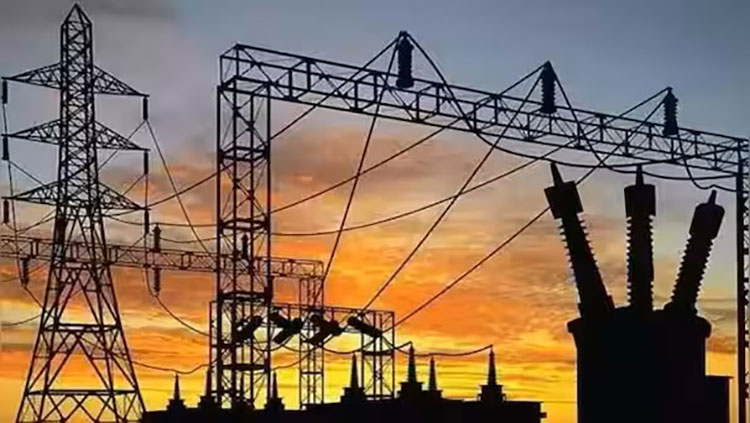
The much-dreaded power cuts are already here though not declared as such. The tragedy is that the power cuts are not due to inadequate electricity supply, but the inability of the power and energy authorities to use the abundant solar and wind power installed without any financial or economic burden on the state. They ought to admit their lack of wisdom to be mindful of the rapid changes in the sector and the need to be equipped.
Fuel Prices have been increased again up to the 2022 levels. Therefore another Electricity tariff hike is inevitable. Perhaps, the government may hold it back until September, when the next tariff revision is due. An appeal has been made to “prosumers” to switch off their solar PV system in the fear of grid stability being affected. While there is excess solar power, which they are unable to manage, even when the demand is below the installed capacity and high contribution of hydro, solar and wind. May 31 (Sunday) energy mix indicated substantial use of oil in CEB-owned power plants and those belonging to the Independent Power Producers (IPPs) . What is the rationale? One would believe that even the hydro reservoir water can be saved for use during the night, without curtailing solar and wind power. It will be said that the system is very complex and beyond the understanding of mere mortals like ordinary “prosumers”, who have added over 2300 MW to the grid, entirely at their expense and at rates well below the average cost of generation. (See Image 1)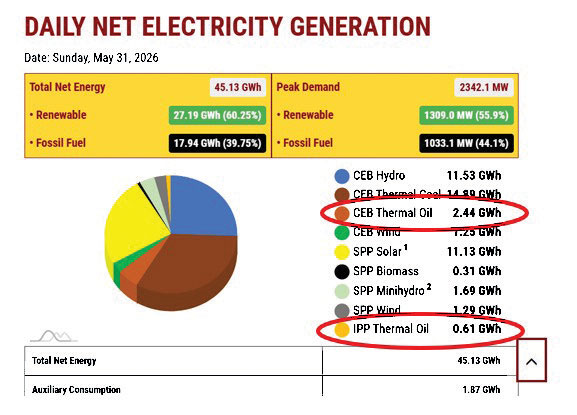
Storage Batteries and Renewable Transition
The fact that the growing need for storage batteries to optimise the utilisation of variable renewable energy (VRE) has been felt for the last decade or more, and nothing was done about it, is never mentioned in their laments.
However, there is a glimmer of hope due to the initiatives taken by the Public Utilities Commission of Sri Lanka (PUCSL). An increase in the demand due to a general GDP growth will have to be met using renewable resources. It has been clearly noted that such alternatives must be developed while curtailing the use of oil and ensuring the uninterrupted power to the consumers.
Recognising this need and the fact that fastest intervention is possible by promoting BESS (Battery Energy Storage Systems) to be added to all existing renewable energy sources, the PUCSL has initiated stakeholder consultation to determine the feed-in tariff payable for each type of BESS. A detailed methodology for determining the FIT has been circulated. The identified types of BESS discussed were as follows”
1. Power Plants
a. Mini -Hydro
b. Mini – Hydro-Local: mini hydro plants that at least use locally manufactured turbines
c. Wind
d. Wind – Local: Wind plants that at least use locally manufactured turbine blades
e. Biomass – Dendro – Biomass plants that use sustainably grown fuel wood
f. Biomass – Agricultural/Industrial Waste; Biomass fired plants use byproducts, like paddy husk, sawdust, sugar cane bagasse, etc.
g. Municipal Solid Waste
h. Waste Heat Recovery
i. Ground Mounted Solar PV
j. Floating Solar PV
2. Prosumers
a. Roof Top Solar PV
b. Rooftop Solar PV with Battery Energy Storage System (BESS)
c. Prosumers with behind the meter Battery Energy Storage System (BESS)
3. Power Plants with BESS
We mentioned in an earlier article that the PUCSL proposed a scheme whereby we can get rid of use of oil for power generation in stages, commencing with elimination of the diesel use by 2027 and all imported oils by 2030.
Stakeholder Meeting & Feed In Tariff( FIT)
The PUCSL has been empowered by the new Electricity Act No 36 (as amended), which came into full force on 09 March, 2026, with responsibility for calculating and announcing all FIT schemes, both for purchase and sale of electricity to consumers.
A well-represented stakeholder meeting was held recently, when the proposed methodology for determining the FIT of each type of BESS was given to them to provide further specific inputs. It is, therefore, realistic to expect such a FIT to be declared by the end of June, 2026.
While this is a welcome and progressive step unlike the ad hoc process adopted hitherto. But the fact remains that the responsibility for the effective use of FIT to attract investors to add the BESS at different scales, lies with the one or more of the newly appointed companies to take over the functions of the former Ceylon Electricity Board (CEB).
Government Recognition of Fossil Fuel Risks
The current government has reportedly recognised the danger of overdependence on imported fossil fuels, which we have absolutely no control over. This is something we have been stressing for a long time. However, better late than never. As a matter of interest, we show the degree of fossil fuel dependence and its adverse impact on the economy. (See Graph 1)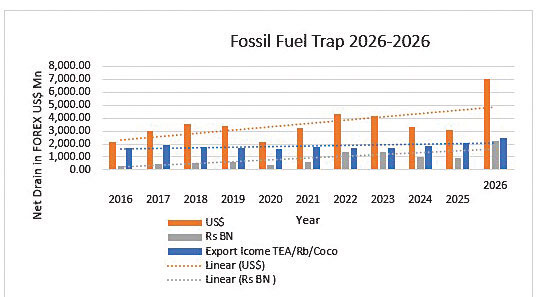
It is to be noted that earnings from our traditional exports of tea, rubber and coconuts fail to meet the ever-increasing cost of importing fossil fuels. Time was when earnings from these exports barely helped meet the cost of import of fuels which was back in 2010. The rupee cost of imports is shown in Billions to keep the data columns within the bounds of the chart. This is the factor which affects you and me directly.
However, we earnestly urge the government to direct the electricity companies to take immediate action to prepare the grid which costs only a fraction of the values predicted by the CEB to institute their schemes which are not in line with the ground reality to accept the BESS system once the FIT is announced. Reasonable BESS and FIT will help attract investors with the assurance of short-term and long-term improvement, at no cost to the state.
Solar PV & BESS Proposal
We proposed some time back of the opportunity for those “prosumers” using 300 units per month, for installing solar PV with adequately sized batteries, which is more economical than drawing power from the grid, and to gain the happy situation, to be insulated from the danger of power cuts and further increases in consumer tariff.
The PUCSL intervention to declare a BESS tariff will add a great impetus to those who are willing to adopt the above proposal. They will be encouraged to increase the capacity of their installations as well as the battery capacity so that the excess can be exported to the grid during peak hours, when firm economic power is most needed. Such additional features would enhance their financial returns and would enable rapid elimination of the use of diesel during peak hours. In recent months with the depreciation of the rupee, coupled with the increase of costs of solar panels, inverters and batteries, our original analysis of financial viability of this interevention was facing some uncertainties. As such, we welcome this move by the PUCSL, whereby the consumers would have a steady revenue in addition to the savings on their monthly electricity bills. It is likely that the level of FIT and the permitted number of exports will be adequate to work with the increased costs, as shown. (See Table 1)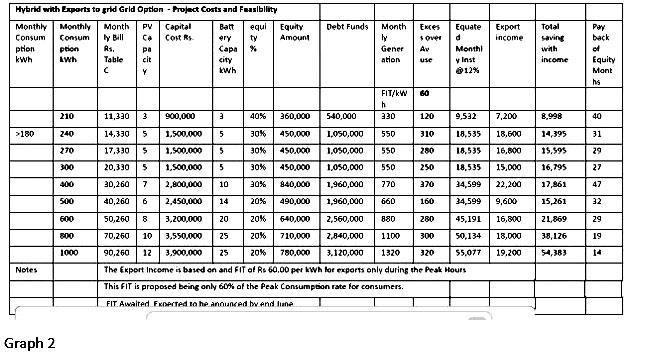
It must be noted that the cost values are highly volatile ,and some variations are to be expected. FIT for export on energy is stated as 60% of the current peak time energy charge of Rs 106/kWh.
This revolution is well within the means of the over 200,000 potential “Prosumers” who consume over 250 units per month. While they would fulfil their own goal of being immune to any power cuts as well as being insulated from future tariff increases, they would be serving the country by progressively eliminating the need for any fossil fuels for power generation. For example, if 50,000 of them add 10 kWh of battery capacity, the peak power demand can be reduced by 500 MW, thereby obviating the need for using the most expensive diesel during the peak period. Very special advantages can be derived by those also purchasing EVs instead of petrol and diesel vehicles. It will be possible to save on LPG, which costs Rs 4,700.00 per cylinder at present. Thus, the excuse for demanding ever increasing consumer tariff in the future will not be available. As such this move would help all consumers down to the lowest level of consumers.
It is hoped that the energy authorities recognise this reality and support the PUCSL proposals by approving the BESS FIT system and directing all Utility companies to adopt the same and urgently initiate action to install the simple infrastructure additions to accept the BESS energy, as proposed. If they care to review this proposal having discarded biases and any other agendas, they, too, will benefit.
Conclusion
The inescapable conclusion one can derive from the above is that the solution to the crisis is available from the consumers themselves in a manner that is attractive and profitabe to them. It would also be of major assistance for the Utility to manage the sector effectively and efficiently. In addition, all consumers will benefit by gradually weaning themselves away from the grid an use of oil for power generation. This would obviate any more demands for consumer tariff increases by the National System Operator. The PUCSL has taken an essential first step with its intention to declare a BESS FIT. It is up to the government to ensure that the Ministry and the Utility companies adopt the correct stance and make a commitment to ensure the success of this scheme as soon as possible.
by Eng Parakrama Jayasinghe
Past President and Council Member
Bio Energy Association of Sri Lanka
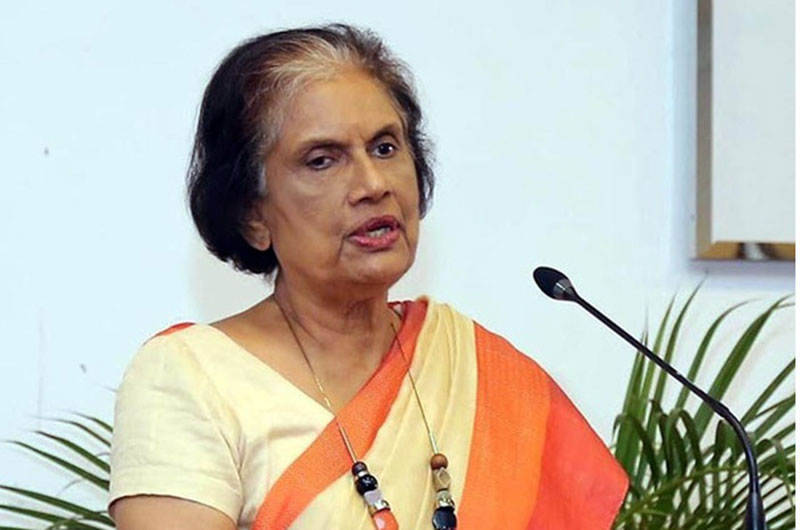
The JVP General Secretary Tilvin Silva’s recent remarks at a news conference in Jaffna where he ruled out the possibility of holding provincial council elections this year has been widely reported and widely criticized. About the same time there was another media event in Jaffna that went largely unnoticed and unreported outside Jaffna. What was said at the second media event may carry far more political implications than Tilvin Silva’s election timing talk. A veteran Tamil political participant made the startling yet not implausible statement that the prospect of having political devolution under the JVP-NPP government is becoming “a daydream”. The statement was made by Dr. K. Vigneswaran, who served as Provincial Secretary to the only North-East Provincial Council Government that was elected under the auspices of the Thirteenth Amendment.
Dr. Vigneswaran is a Professional Civil Engineer who studied at Royal College, graduated with First Class Honours in Engineering in 1964, and went on to complete a pioneering PhD at the university of Waterloo, Canada, applying the finite element method (FEM) in the field of Geotechnical Engineering. His engineering career has always been at the Irrigation Department where he rose to a Deputy Director. That was when the department was in its golden years, and Vigneswaran was known for his technical mentorship, meticulous administrative skills, and for knowing the fine print of everything. While at the Irrigation Department, Vigneswaran married Ramya de Silva, a fellow irrigation Engineer. After 1983, Vigneswaran became a fulltime political activist and a powerful resource in Tamil politics, but with unwavering commitment to nonviolence, democracy and federalism. The family moved first to India and then Canada, and Vigneswaran has been shuttling between Canada and Sri Lanka.
Devolution: Tortuous Trajectory
Since 1987, the Indo-Sri Lanka Agreement, and the 13th Amendment, Vigneswaran has been a permanent fixture in all the politics and institutional dynamic of implementing 13A and establishing provincial councils. He served as Secretary to the only elected Provincial Government for the Northern and Eastern Provinces. After 1994 and the election of Chandrika Kumaratunga as President, Vigneswaran became a key participant in all the civil society efforts and government initiatives to restore the PCs and implement 13A, both during the Kumaratunga presidency and the succeeding administrations of Mahinda Rajapaksa and the Sirisena-Wickremesinghe duo.
Devolution efforts stalled after the election of Gotabaya Rajapaksa, who in so many words declared that he had no time for 13A or PCs in his presidential agenda, whatever it was. Only that his whole agenda turned out to be a wholesale disaster for the country. Already by then, all the nine Provincial Councils had fallen into abeyance with the cancellation of the 1988 PC elections by the Sirisena-Wickremesinghe duo, with the TNA standing by. The abeyance continues under the JVP-NPP government with no apparent end in sight after Tilvin de Silva’s statement in Jaffna.
I say all this to provide the proper context for Vigneswaran’s statement in Jaffna that the prospects for power devolution under the JVP-NPP government are becoming a political daydream. He said something else as well: that of all the government leaders he has encountered over the years, the only leader who has been genuinely sincere about power devolution is former President Chandrika Kumaratunga, and no one else. I am constrained to add that the insincere category would include Ranil Wickremesinghe, who for all his handsome promises, never matched any of them with experiential sincerity. The present JVP-NPP government still has time to show that they are not an insincere lot.
It is not my purpose to agree with or question Dr. Vigneswaran’s assertions, but to use them as cue and context to comment on the widening mismatch between the JVP-NPP government’s promises and its practices on the matter of power devolution and the restoration of the PC system. With a stalling economy, rising prices and external shocks, it is obvious that the government has all the economic matters to worry about, but that does not mean that it can ignore all the other government responsibilities. No government is put in power to solve a single problem or address a single issue. It is in the nature of governments to deal with multiple problems with varying priorities. Otherwise you could have a single cabinet minister to deal with one problem at a time. That is never going to be the case.
The economy is of course the top of mind priority for the government even as it is a top of mind concern for the people. Even on the economic front, the government is holding steady but is showing little progress. And there are other government initiatives where political accountability will call for answers: to wit, the catchall Clean Sri Lanka programme, ambitious educational reforms, contentious energy sector reforms and, yes, power devolution as well as the overpromised constitutional reforms. Not to mention the sprawling unforced errors over substandard coal imports, foreign exchange fraud, and the chronic neglect of developing the renewable energy sector. Correcting these fields of errors may require a separate ministry for each.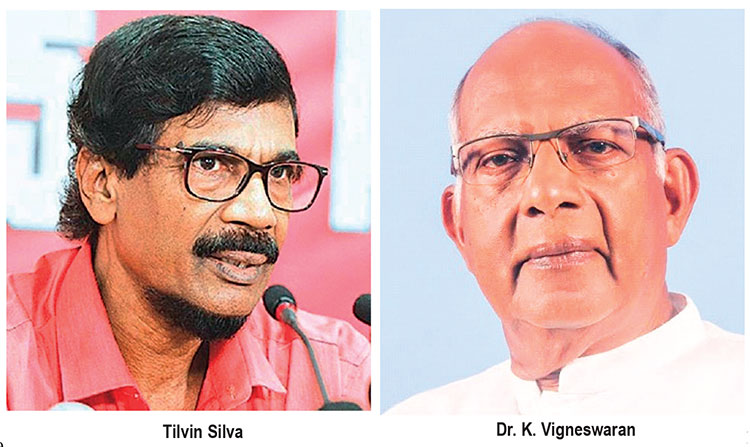
Devolution: Daydream or Deliverable
On the PC system and constitutional reform, there has been scant progress in spite of handsome promises. On both, the government is inadvertently deepening the holes that it had dug itself into through indifference, inaction or procrastination, or all of them and more. In the matter of devolution and provincial councils, the government can simply defuse the situation by directing the Election Commission to conduct elections at the earliest opportunity that is logistically possible. Making his statement in Jaffna, Mr. Tilvin Silva alluded to funding shortfall and legal complications as reasons for the necessity to postpone PC elections until next year. Neither reason holds water.
The funding question would seem to have been put to rest by the statement of Health Minister and Cabinet Spokesman Nalinda Jayatissa, presumably reflecting cabinet consensus, that there are no funding issues and if needed additional funds could be arranged through supplementary allocations. It is also disingenuous to cite legal complications as a reason. The so called legal complications arose because of the collective stupidity of the Sirisena-Wickremesinghe parliament that included the then miniscule NPP and the politically-lost TNA. The JVP-NPP has now ballooned from a handful MPs to a two-thirds majority and it can expedite any legislation that it wants to enable the PC elections to be held without delays.
Alternatively, the elections can be held under the old arrangement of proportional representation with assurance by political parties to honour their commitment to fielding more female candidates. Already at a gathering of all political parties, including the NPP (but not the JVP), and civil society groups, convened by People’s Action For Free & Fair Elections (PAFFREL), the political parties jointly committed to a 25% quota for women and youth under the old electoral system. The ongoing parliamentary committee exercise studying the legal matter, headed by the overstretched Foreign Minister Vijitha Herath, is also an unnecessary red herring. The Election Commission is ready to go under whatever law or electoral system that is before it. So, there is no reason to hide behind legal complications to further delay the PC elections.
Somewhat amusingly, Public and Parliamentary Affairs Minister Ananda Wijepala has trotted out the argument that the NPP government has already conducted two nationwide elections during the one and a half years it has been in office, and that unlike the Ranil Wickremesinghe government the JVP-NPP is not in the business “to delay elections for our personal benefit” – whatever that means. Unfortunately, the good minister is missing the point. The question is not how many elections can the JVP-NPP hold in how many years, but how many years do people in the provinces have to wait before they vote in another provincial election? How many more years? That really is the question.
We know the current situation in the provinces. There are provincial governments but no elected provincial councils. The government administration in every province is being run by the President of the Republic through his handpicked governors and unelected government officials. This is a travesty of democracy and the euthanizing of the PC system. Already under 13A, the office of the provincial governors has been constitutionally and legally compared to the office of the Governors of old Ceylon who represented the monarch in what was then a crown colony. The irony is that a JVP-NPP President may have inadvertently positioned himself as the monarch of all he provincially surveys, courtesy of the Thirteenth Amendment!
The JVP was in the forefront of the litigation that caused the demerger of the Northern and Eastern Provinces. If Dr. Vigneswaran’s assertion were to prove correct, a potential dissolution of the provincial system under the JVP-NPP government would be the consummation of the JVP’s original opposition to the introduction of the provincial council system itself. The whole system may not be eradicated, but it could be devoured of its democratic essence while preserving the administrative shell as the medium for the country’s president to overreach into the provinces. That would be worse than a daydream, a real nightmare.
by Rajan Philips ✍️

Showers in the Western, Sabaragamuwa and North-western provinces and in Galle, Matara, Kandy and Nuwara-Eliya districts

Diesel replacement costs up to Rs. 4.5 bn in April

Sallay on hunger strike: Counsel warns CID

Opp. questions why Rs 10 bn meant for Ditwah victims held in Treasury account

‘Samurdhi Bank operates without dedicated audit framework’

Constitutional inconsistencies relating to franchise

‘Dates have the highest sugar content to fight Coronavirus’

Sunday Island 27 December – Headlines

#SundayIsland 17th December – Headlines

Sunday Island – 28th March

Sunday Island Headlines – 21 March

Sunday Island – 21st February – Headlines
-

 News6 days ago
Lankan duo emerge winners in Latin dance championship held in Blackpool, UK
-

 Latest News4 days ago
Kusal Mendis, Pathum Nissanka, bowlers put Sri Lanka 1-0 up
-
 News4 days ago
New US tariffs proposed on 60 countries, including Sri Lanka
-
 Features3 days ago
Power crept into the Sangha and is now tearing it apart
-

 News6 days ago
Sri Lankan teen killed in Chennai clash; three arrested
-
 Features3 days ago
Kondachchi wind farm and battery storage project to boost energy security, says Power Ministry Secretary
-
 Features3 days ago
Saudi Arabia sets new benchmark in Hajj management as 1.7 million pilgrims complete sacred journey
-

 News2 days ago
Asst. Manager, security officer arrested over Rs 30 mn snatch at Horana PB branch