
Business
Food Fight: Sri Lanka’s Battle for Food Security

By Lakshila Wanigasinghe
 World Food Day is observed on 16 October to promote awareness and action to ensure regular access to nutritious food for all. The blog examines Sri Lanka’s struggle to safeguard food and nutrition security amidst the ongoing economic crisis and outlines policy steps to tackle the challenge.
Sri Lanka’s economic crisis continues to affect the lives and livelihoods of its people, with the burden being highest on the poor and vulnerable. The situation has progressed from bad to worse, with debt problems spiralling down to impact every aspect of the economy adversely.
Sri Lanka’s Food Crisis
Global disruptions including COVID-19, the climate crisis and Russia’s invasion of Ukraine earlier this year, have impacted food supplies worldwide. However, Sri Lanka’s food insecurity is largely a result of the prevailing economic crisis coupled with short-sighted policies enforced by local policymakers. The overnight ban on chemical fertiliser imports has been costly and generated a lower harvest. Although the ban has since been reversed, it continues to have ripple effects on the food system.
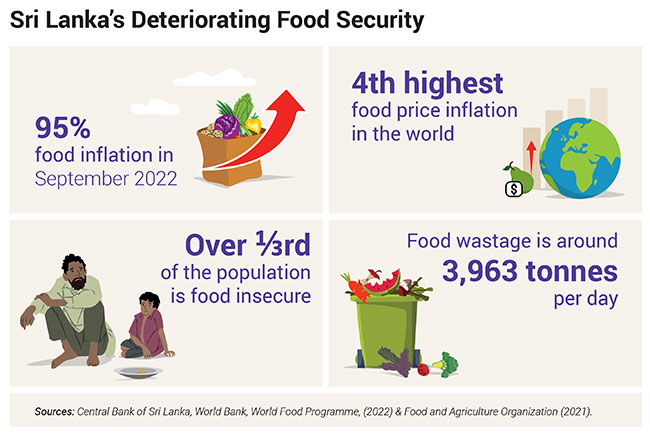
The drastic drop in domestic yield has driven policymakers to spend more money importing necessary commodities previously produced locally, including staples like rice. This move has been detrimental at a time when foreign reserves are lacking. Additionally, import controls imposed by the government have led to certain food items becoming scarce. These supply shortages have led to increases in the prices of essential foods. With food inflation reaching 95% in September, Sri Lanka ranks among the top five countries with the highest food price inflation.
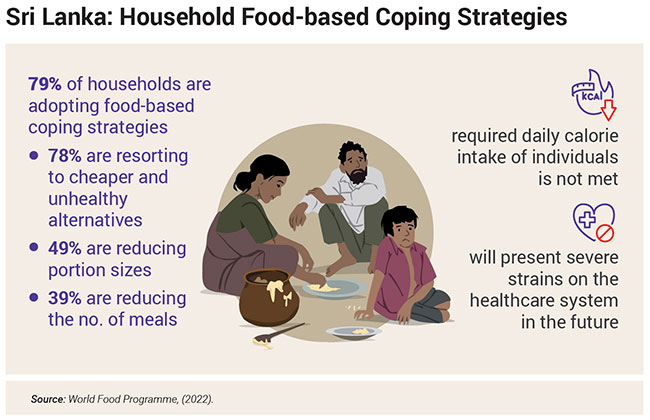
As food becomes scarce and prices continue to rise, more people – the poor in particular – cannot afford proper meals. Adding to the problem are inflationary pressures, the inability of wages to keep up with inflation and income losses induced by the economic crisis. Thus, households are left in a predicament to reduce expenses, including cutting down on consumption expenditure. A World Food Programme (WFP) survey reveals that 79% of households are adopting food-based coping strategies to deal with the crisis.
This affects both the quality and quantity of food consumed. Families are likely to resort to cheaper and unhealthy alternatives (78% of families) due to the inability to afford high-quality, nutritious food. They are also likely to reduce portion sizes (49%) or skip meals entirely (39%), resulting in individuals not meeting their required daily calorie intake. For children, eating less directly impacts growth and contributes to increasing the already high rates of child malnutrition in the country. For adults – considering the rapidly ageing population in Sri Lanka – undernourishment implies severe strains on the healthcare system in the future.
Government Action to Combat
Food Insecurity
 The interim Budget proposed to allocate LKR 46,600 million for crisis-related initiatives, including providing LKR 10,000 per food-insecure family and an additional monthly allowance of LKR 2,500 for pregnant mothers for four months respectively. A further LKR 400 million was allocated for the Department of Agriculture to provide farmers with seeds/planting material urgently and LKR 40 billion for fertiliser for paddy cultivation for the 2022/2023 ‘Maha’ season. Additionally, the government recently initiated a National Food Security Programme. The interim Budget also proposed establishing youth agriculture companies, writing off paddy farmers’ outstanding loans, etc. While the success of these initiatives is yet to be realised, it will depend entirely on the effectiveness of implementation. However, the pressure for timely success is high and critical for combating food insecurity.
Overcoming Hunger and Achieving
Food Security
While long-term strategies are needed to counter the underlying causes of food insecurity and ensure sustainable domestic production, swift action must be taken to tackle the challenge of ensuring people do not go hungry at present. Supporting immediate food needs amid the prevailing economic crisis requires a twofold effort: protecting the (1) poor and (2) farming community. In this regard, targeted measures to support the poor and near-poor through policy interventions and strengthened social safety nets are vital. The government has already allocated funds in this regard; however, successful implementation depends on accurately identifying groups at risk of starvation and providing them with immediate food assistance through subsidised products or cash transfers.
Attention should also be directed towards middle-income earners, who often get left behind in aid processes but may be in dire need of support given Sri Lanka’s current economic standing. Measures should also be taken to guarantee food availability across all parts of the country, thus ensuring equitable access. Protecting farmers’ livelihoods require adequate fertiliser availability at reasonable prices. More efficient use of fertiliser and high-quality seeds also play a role in ensuring limited supplies last longer. This will secure a harvest that can better support domestic demand next season. The government can also repurpose idle land for crop production and encourage small-scale farming.
Given the debt crisis, although import restrictions on certain foods are needed, they tend to be counterproductive. As evident from the global food crisis in 2008, trade restrictions drove up food prices rather than subsidising them. Moreover, stricter regulations should be in place to ensure consumers are not overcharged for high-demand items, as was evident for milk powder and fuel earlier this year. Minimising the high levels of food wastage (approximately 3,963 tonnes per day) also plays a crucial role in satisfying immediate food needs. Not stockpiling food, purchasing homegrown products, and consuming leftovers at a later stage/restaurants donating leftovers to the poor are ways households and businesses can contribute to combating food insecurity.
A food crisis during an economic crisis is a catastrophic scenario. Given that over one-third of the population is presently food insecure, it is imperative that Sri Lanka promptly takes corrective action. While several measures have been introduced in this regard, they must be subject to timely revaluations to gauge effectiveness. Given the prevailing resource constraints, it is natural for government support to target the poor and vulnerable solely. However, working towards acquiring international assistance to support immediate food needs, especially targeting those just above the poverty line and groups traditionally excluded from aid programmes, may also be required. These actions must be coupled with medium- to long-term initiatives that ensure sustainable food production in the future. Moreover, policymakers must be willing to be flexible and change their course of action if needed, given the volatility of the current situation. The consequences of not doing so will leave lasting impacts on the lives and livelihoods of the people.
Link to original blog:
Lakshila Wanigasinghe is a Research Officer at the IPS with research interests in poverty, social welfare, development, education, and health. She holds an MSc in Economics with a concentration in Development Economics and a BA in Economics with concentrations in International, Financial and Law and Economics from Southern Illinois University Carbondale (SIUC), US. (lakshila@ips.lk)


SLT‑MOBITEL Mobile, in collaboration with Fintelex (Pvt) Ltd, has launched ‘Yaya Agro’, an exclusive all‑in‑one smart agriculture app designed to empower Sri Lankan farmers with the tools they need to grow smarter, safer, and more sustainably.
Yaya Agro represents a new era of digital farming in Sri Lanka combining technology, expert knowledge, and community empowerment to provide farmers the confidence to make smarter decisions, improve productivity, and build a sustainable future.
Developed with support from GIZ and Hatch and validated by leading academic and professional institutions including the University of Colombo, Institute for Agrotechnology and Rural Sciences, and the Sri Lanka Red Cross Society, Yaya Agro combines agricultural expertise, real‑time weather updates, first aid support, and AI‑powered assistance into a single, easy‑to‑use platform.
The launch of Yaya Agro positions SLT‑MOBITEL as an innovative, inclusive, and collaborative technology leader. Partnering technology and academic institutions, the company extends its role outside the sector into agriculture, empowering farmers with AI‑driven tools, multilingual access, and market connectivity. The initiative also strengthens SLT‑MOBITEL’s image as a champion of digital empowerment and sustainable development in Sri Lanka.
Functioning as a comprehensive digital companion, Yaya Agro is positioned as a digital farming companion, bringing precision agriculture, real‑time support, and market access to the fingertips of every Sri Lankan farmer.
Whether managing a small home garden or a large commercial farm, the app equips farmers with vital insights to improve crop yield, reduce risks, and connect directly with buyers through the integrated online marketplace.
Yaya Agro offers farmers daily crop information with expert tips on management, pest control, and best practices, all validated by the University of Colombo. It provides accurate, location‑based weather forecasts to help plan farming activities more effectively. The app also delivers life‑saving first aid tutorials and safety information verified by the Sri Lanka Red Cross Society, ensuring farmers are prepared for emergencies. With the AI chatbot assistant, farmers can access instant, personalized advice around the clock, with smart notifications delivering timely alerts and reminders tailored to crop cycles.
To make learning inclusive and accessible, Yaya Agro is available in Sinhala, Tamil, and English, offering interactive educational content such as videos, voice guides, and infographics. The app also integrates an online marketplace, developed in partnership with GIZ and Hatch, enabling farmers to connect directly with buyers and expand their reach. (SLT‑MOBITEL )
Business
Kegalle sets up District Planning Committee to rein-in development spending under IMF-backed reforms

As Sri Lanka presses ahead with IMF-backed fiscal and governance reforms, the Kegalle District Planning Committee (DPC) was formally established yesterday as a standing sub-committee of the District Coordinating Committee (DCC), in a move aimed at tightening control over public investment, reducing duplication and strengthening monitoring at district level.
The committee was constituted under Home Affairs Circular No. 03/2025 issued by the Ministry of Public Administration, Provincial Councils and Local Government, and was inaugurated at the Kegalle District Secretariat auditorium under the leadership of Environment Minister and DCC Co-Chair Dr. Dhammika Patabendi and District Secretary H.M.J.M. Herath.
Addressing officials, Dr. Patabendi said the new structure directly responds to long-standing weaknesses in public investment management that have come under scrutiny during Sri Lanka’s engagement with the International Monetary Fund.
“Under the IMF programme, we cannot afford fragmented planning, overlapping projects or weak monitoring. This committee is about discipline—ensuring that limited public funds are allocated according to national priorities and deliver measurable outcomes,” Dr. Patabendi said.
He stressed that district-level planning must now align with national fiscal consolidation goals, with a stronger emphasis on value-for-money, results-based implementation and accountability.
The District Planning Committee will function as a permanent sub-committee of the DCC, chaired by the district’s Cabinet Minister, with the District Secretary serving as Secretary and the Director of Planning as Convener. Members include officials from district-level price and food committees and heads of government institutions or their nominees.
A central mandate of the committee is the preparation of an Annual Integrated District Development Plan, covering all funding sources—including foreign-funded and donor-supported projects—for approval by the District Coordinating Committee.
Officials said this would help rationalise project selection, prioritise urgent district needs and prevent the duplication of monitoring and evaluation systems, a key concern raised in public investment reviews under the IMF programme.
Dr. Patabendi noted that better coordination of state, private and non-state sector investments at district level would also support macro-level reform objectives by improving spending efficiency without increasing fiscal pressure.
“Fiscal adjustment does not mean stopping development. It means doing development better—through planning, coordination and proper evaluation,” he said.
The committee will oversee the operational rollout of DCC-approved projects, provide advisory support to implementing agencies, and monitor whether projects are delivered within approved timeframes and achieve stated targets.
Progress reports will be submitted to the Presidential Secretariat, Ministry of Public Administration, Ministry of Finance and the District Coordinating Committee, strengthening upward accountability.
At yesterday’s meeting, officials reviewed development proposals linked to the 2026 Budget, with focus on education, health, agriculture, infrastructure, industry, environment and tourism—sectors seen as critical for growth and social protection during the reform period.
Implementation challenges faced by projects carried out in 2025 across several Divisional Secretariat areas were also examined, with discussions centred on resolving bottlenecks early in 2026 and aligning future investments with the district’s five-year development plan.
Senior provincial and district officials, Members of Parliament from Kegalle, local authority heads and divisional secretaries attended the meeting.
Dr. Patabendi said the establishment of the District Planning Committee marked an important step towards embedding IMF-aligned public financial management reforms at the grassroots level, ensuring that development spending contributes to economic recovery while safeguarding fiscal sustainability.
By Ifham Nizam
Business
Allianz commits €200,000 for post flood recovery in Sri Lanka, part of €600,000 regional relief for Southeast Asia

Allianz SE (Headquartered in Munich, Germany) announced that it is donating €200,000 to support disaster relief efforts in Sri Lanka. In addition, Allianz SE is also extending its support to Thailand and Indonesia, contributing a further €400,000 to aid disaster relief across Southeast Asia. Torrential rainfalls have triggered severe flooding and landslides across Southeast Asia, leaving more than 1,100 people dead in a week of devastation and complicating rescue efforts for hundreds still missing. Allianz is deeply rooted with local entities in the three countries and serving millions of customers across Asia. By supporting the affected people and communities, Allianz acts on its promise to secure the future of its stakeholders in times of need.
Allianz SE will allocate €100,000 to the Sri Lanka Red Cross Society (SLRCS) to deliver immediate assistance to those most affected and €100,000 will also be provided for post-disaster support, implemented in collaboration with Allianz Insurance Lanka Limited and selected local partners, focusing on disaster prevention and climate resilience, helping communities rebuild and strengthen their preparedness against future events.
Renate Wagner, Member of the Board of Management of Allianz SE, responsible for Asia Pacific, Mergers & Acquisitions, People and Cultures says:
“At Allianz, we stand with the people and communities affected by the severe floods and landslides across Southeast Asia. Through immediate relief and long-term resilience support, we aim to help families recover, strengthen local communities, and better prepare for future climate-related events.”
Anusha Thavarajah, Regional Chief Executive Officer, Allianz Asia Pacific adds:
“Across Indonesia, Thailand and Sri Lanka, many families and communities are facing significant loss and disruption. In moments like these, Allianz stands alongside them. Asia Pacific is home to our people, our customers, and the communities we serve, and we remain deeply committed to the region. Our immediate focus is on providing relief where it is most needed, while also supporting communities to rebuild and strengthen resilience, so those most affected can move forward with confidence.”
Allianz is fully dedicated to Asia and its people. It represents a strategic growth region for Allianz Group, which already has established strong market positions throughout Southeast Asia. Besides Indonesia, Thailand and Sri Lanka, Allianz is present with various business segments in China, India, Malaysia and Singapore, among others.

Another crane collapses in Thailand, killing two, after 32 die previous day

India shuts Kashmir medical college – after Muslims earned most admissions

Singapore’s opposition leader stripped of title after conviction for lying

BCB issues show cause notice to Nazmul Islam but Bangladesh players firm on boycott

From behind bars, Aung San Suu Kyi casts a long shadow over Myanmar

Senegal beat Egypt 1-0 in AFCON semifinal as Sadio Mane scores late

‘Dates have the highest sugar content to fight Coronavirus’

Sunday Island 27 December – Headlines

#SundayIsland 17th December – Headlines

Sunday Island – 28th March

Sunday Island Headlines – 21 March

Sunday Island – 21st February – Headlines
-

 Business4 days ago
Dialog and UnionPay International Join Forces to Elevate Sri Lanka’s Digital Payment Landscape
-

 News4 days ago
Sajith: Ashoka Chakra replaces Dharmachakra in Buddhism textbook
-

 Features4 days ago
The Paradox of Trump Power: Contested Authoritarian at Home, Uncontested Bully Abroad
-

 Features4 days ago
Subject:Whatever happened to (my) three million dollars?
-

 News4 days ago
Level I landslide early warnings issued to the Districts of Badulla, Kandy, Matale and Nuwara-Eliya extended
-

 Business1 day ago
New policy framework for stock market deposits seen as a boon for companies
-

 Business11 hours ago
Koaloo.Fi and Stredge forge strategic partnership to offer businesses sustainable supply chain solutions
-

 Opinion6 days ago
The minstrel monk and Rafiki, the old mandrill in The Lion King – II