
Business
Food Fight: Sri Lanka’s Battle for Food Security

By Lakshila Wanigasinghe
 World Food Day is observed on 16 October to promote awareness and action to ensure regular access to nutritious food for all. The blog examines Sri Lanka’s struggle to safeguard food and nutrition security amidst the ongoing economic crisis and outlines policy steps to tackle the challenge.
Sri Lanka’s economic crisis continues to affect the lives and livelihoods of its people, with the burden being highest on the poor and vulnerable. The situation has progressed from bad to worse, with debt problems spiralling down to impact every aspect of the economy adversely.
Sri Lanka’s Food Crisis
Global disruptions including COVID-19, the climate crisis and Russia’s invasion of Ukraine earlier this year, have impacted food supplies worldwide. However, Sri Lanka’s food insecurity is largely a result of the prevailing economic crisis coupled with short-sighted policies enforced by local policymakers. The overnight ban on chemical fertiliser imports has been costly and generated a lower harvest. Although the ban has since been reversed, it continues to have ripple effects on the food system.
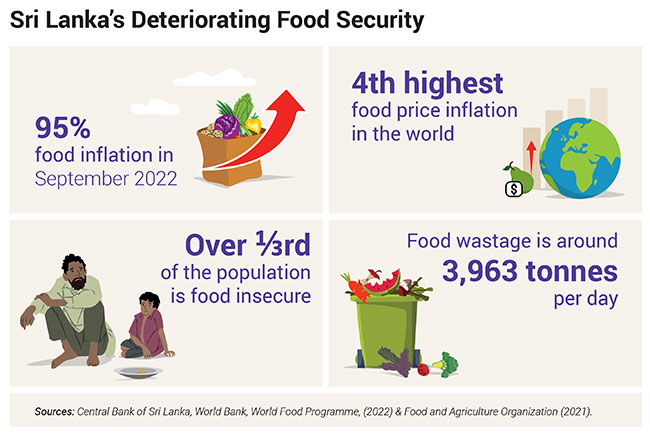
The drastic drop in domestic yield has driven policymakers to spend more money importing necessary commodities previously produced locally, including staples like rice. This move has been detrimental at a time when foreign reserves are lacking. Additionally, import controls imposed by the government have led to certain food items becoming scarce. These supply shortages have led to increases in the prices of essential foods. With food inflation reaching 95% in September, Sri Lanka ranks among the top five countries with the highest food price inflation.
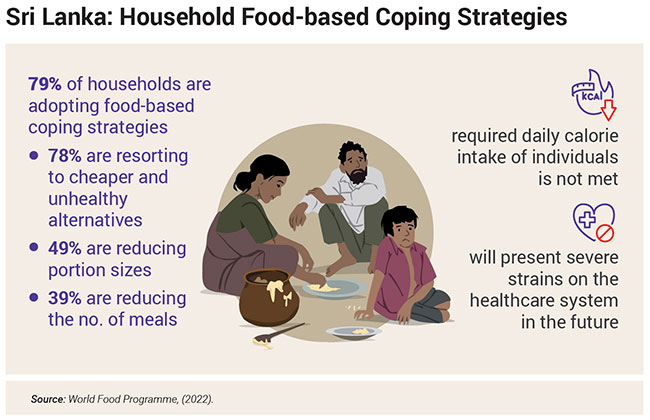
As food becomes scarce and prices continue to rise, more people – the poor in particular – cannot afford proper meals. Adding to the problem are inflationary pressures, the inability of wages to keep up with inflation and income losses induced by the economic crisis. Thus, households are left in a predicament to reduce expenses, including cutting down on consumption expenditure. A World Food Programme (WFP) survey reveals that 79% of households are adopting food-based coping strategies to deal with the crisis.
This affects both the quality and quantity of food consumed. Families are likely to resort to cheaper and unhealthy alternatives (78% of families) due to the inability to afford high-quality, nutritious food. They are also likely to reduce portion sizes (49%) or skip meals entirely (39%), resulting in individuals not meeting their required daily calorie intake. For children, eating less directly impacts growth and contributes to increasing the already high rates of child malnutrition in the country. For adults – considering the rapidly ageing population in Sri Lanka – undernourishment implies severe strains on the healthcare system in the future.
Government Action to Combat
Food Insecurity
 The interim Budget proposed to allocate LKR 46,600 million for crisis-related initiatives, including providing LKR 10,000 per food-insecure family and an additional monthly allowance of LKR 2,500 for pregnant mothers for four months respectively. A further LKR 400 million was allocated for the Department of Agriculture to provide farmers with seeds/planting material urgently and LKR 40 billion for fertiliser for paddy cultivation for the 2022/2023 ‘Maha’ season. Additionally, the government recently initiated a National Food Security Programme. The interim Budget also proposed establishing youth agriculture companies, writing off paddy farmers’ outstanding loans, etc. While the success of these initiatives is yet to be realised, it will depend entirely on the effectiveness of implementation. However, the pressure for timely success is high and critical for combating food insecurity.
Overcoming Hunger and Achieving
Food Security
While long-term strategies are needed to counter the underlying causes of food insecurity and ensure sustainable domestic production, swift action must be taken to tackle the challenge of ensuring people do not go hungry at present. Supporting immediate food needs amid the prevailing economic crisis requires a twofold effort: protecting the (1) poor and (2) farming community. In this regard, targeted measures to support the poor and near-poor through policy interventions and strengthened social safety nets are vital. The government has already allocated funds in this regard; however, successful implementation depends on accurately identifying groups at risk of starvation and providing them with immediate food assistance through subsidised products or cash transfers.
Attention should also be directed towards middle-income earners, who often get left behind in aid processes but may be in dire need of support given Sri Lanka’s current economic standing. Measures should also be taken to guarantee food availability across all parts of the country, thus ensuring equitable access. Protecting farmers’ livelihoods require adequate fertiliser availability at reasonable prices. More efficient use of fertiliser and high-quality seeds also play a role in ensuring limited supplies last longer. This will secure a harvest that can better support domestic demand next season. The government can also repurpose idle land for crop production and encourage small-scale farming.
Given the debt crisis, although import restrictions on certain foods are needed, they tend to be counterproductive. As evident from the global food crisis in 2008, trade restrictions drove up food prices rather than subsidising them. Moreover, stricter regulations should be in place to ensure consumers are not overcharged for high-demand items, as was evident for milk powder and fuel earlier this year. Minimising the high levels of food wastage (approximately 3,963 tonnes per day) also plays a crucial role in satisfying immediate food needs. Not stockpiling food, purchasing homegrown products, and consuming leftovers at a later stage/restaurants donating leftovers to the poor are ways households and businesses can contribute to combating food insecurity.
A food crisis during an economic crisis is a catastrophic scenario. Given that over one-third of the population is presently food insecure, it is imperative that Sri Lanka promptly takes corrective action. While several measures have been introduced in this regard, they must be subject to timely revaluations to gauge effectiveness. Given the prevailing resource constraints, it is natural for government support to target the poor and vulnerable solely. However, working towards acquiring international assistance to support immediate food needs, especially targeting those just above the poverty line and groups traditionally excluded from aid programmes, may also be required. These actions must be coupled with medium- to long-term initiatives that ensure sustainable food production in the future. Moreover, policymakers must be willing to be flexible and change their course of action if needed, given the volatility of the current situation. The consequences of not doing so will leave lasting impacts on the lives and livelihoods of the people.
Link to original blog:
Lakshila Wanigasinghe is a Research Officer at the IPS with research interests in poverty, social welfare, development, education, and health. She holds an MSc in Economics with a concentration in Development Economics and a BA in Economics with concentrations in International, Financial and Law and Economics from Southern Illinois University Carbondale (SIUC), US. (lakshila@ips.lk)



Nine awards, including two Golds, across disciplines recognise business-driven creativity
Ogilvy Group Sri Lanka delivered a standout performance at the recently concluded Dragons of Sri Lanka 2026 Awards, securing a total of nine awards comprising two Gold Dragons, one Silver Dragon and six Black Dragons, among the festival’s highest overall award tallies, a company news release said.
Gold Dragon wins for Phoenix Ogilvy and Ogilvy Digital, together with the seven additional recognitions across multiple categories, highlighted Ogilvy’s ability to combine creativity, strategic thinking and commercial effectiveness to deliver business results.
Organised by the 4As Sri Lanka, the third edition of Dragons of Sri Lanka shortlisted more than 50 agencies and corporates, making it one of the country’s most competitive marketing communications awards. These local awards, along with the chapters in Malaysia and Pakistan are part of the Dragons of Asia platform, one of the region’s leading programmes for marketing communications effectiveness, with entries being judged on strategy, originality, execution and measurable results.
Ogilvy Digital accounted for eight awards in total, including a Gold Dragon in the Business & Trade Marketing category, and a Silver Dragon in the Innovative Idea or Concept category. The Agency additionally received six Black Dragons across the categories of Innovative Idea or Concept, Business & Trade Marketing, Content Creation, Small Budget, Event or Experiential, and Brand Trial or Sales Generation.
Commenting on the achievement, Sajith Weerasinghe, Chief Operating Officer of Ogilvy Digital, said, “These recognitions reflect the breadth of capabilities we’ve built across strategy, creative, content, experience design, technology and performance marketing. The fact that the work was recognised across so many different disciplines demonstrates our ability to apply creativity to a wide range of business challenges and objectives. We’re proud that this achievement spans multiple clients, categories and types of work, reflecting both the versatility of our people and our commitment to delivering results.”
The Ogilvy Group’s second Gold Dragon win was Phoenix Ogilvy’s recognition in the Product Launch or Re-Launch category for the relaunch of American Premium Water. It was a multi-dimensional campaign which refreshed the identity and rejuvenated the positioning of one of Sri Lanka’s pioneering bottled drinking water brands, bolstering its 30-year heritage while connecting with a new generation of consumers.
Commenting on the win, Siddhartha Roy, Chief Operating Officer at Phoenix Ogilvy, said, “There’s always something special about reimagining a brand with a rich heritage. American Premium Water has been a trusted name in Sri Lanka for more than three decades, but the challenge was to make it relevant and compelling for a new generation of consumers. We created a new blueprint for growth for the brand’s positioning, proposition and visual identity, and manifested it through design, packaging and storytelling. To see that transformation recognised with a Gold Dragon, and more importantly reflected in the brand’s renewed momentum in the market, makes this a particularly rewarding achievement.”
The Ogilvy Group Sri Lanka operates across multiple marketing communication disciplines and comprises over 290 staff in creative, strategy, digital, media, public relations and integrated communications. As part of the global Ogilvy network, the Group partners with leading local and international brands to create integrated campaigns that build brands, influence behaviour and drive business growth.

A musical tribute celebrating the life and legacy of Rev. Fr. Marcelline Jayakody, OMI, renowned for his contribution to Sri Lankan arts, music, culture and religious harmony, was held in California with the participation of a large gathering of Sri Lankans.
Titled “Sri Lanka Rani Maniye,” the event was organised by the Sri Lankan Catholic Community in California (SLCCC) under the guidance of Rev. Fr. Rashmi M. Fernando, S.J.

Shalika Perera singing at the event
The programme honoured Fr. Jayakody, affectionately known as “Pansale Piyathuma” (The Priest of the Temple), for his efforts to promote Buddhist-Catholic understanding, interfaith dialogue and a shared Sri Lankan identity.
The event brought together members of the Maha Sangha, the Consul General of Sri Lanka in Los Angeles, musicians, singers, donors, parents, children and members of the Sri Lankan community from Los Angeles and other parts of Southern California.
Music, song and Sri Lankan cultural traditions featured prominently, with organisers placing particular emphasis on introducing the country’s artistic and cultural heritage to younger generations of Sri Lankans growing up overseas.
The programme also highlighted the importance of community unity, religious harmony and mutual respect among Sri Lankans living abroad.
Rev. Fr. Fernando told the gathering that the event marked only the beginning of efforts that could achieve more through unity “for the pride and greater good of our motherland, Sri Lanka.”
The organisers thanked the performers, volunteers, donors and well-wishers who contributed to the event, which concluded as a celebration of Fr. Jayakody’s enduring cultural legacy and the Sri Lankan diaspora’s continuing connection with its homeland.
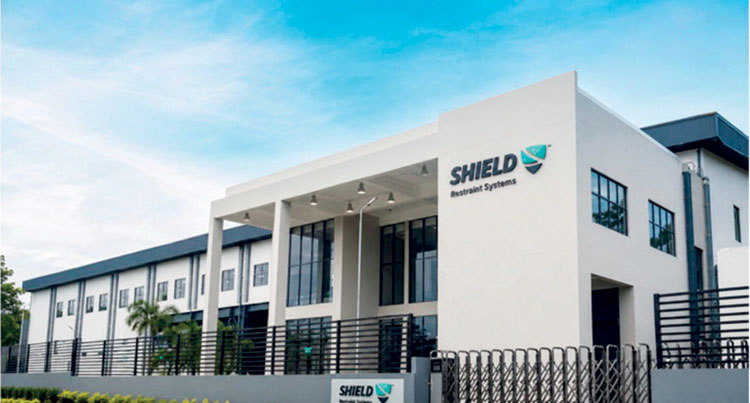
Hayleys Fentons Limited has completed construction of a state-of-the-art manufacturing facility for Shield Restraint Systems (Pvt) Ltd at the Wathupitiwala Export Processing Zone, with the project completed on schedule within approximately 14 months.
The project, valued at more than Rs. 1 billion, commenced with the laying of the foundation stone on January 7, 2025. It was undertaken by the project arm of Hayleys Fentons, with Design Consortium International (Pvt) Ltd serving as the principal design consultant.
The facility has been designed to meet international industry standards and incorporates advanced safety and energy-efficiency features. A pre-engineered building structural system was used to facilitate faster construction and optimise project costs.
The new facility will manufacture safety restraint systems for the international automotive industry through Shield Restraint Systems.
Hayleys Fentons Deputy Managing Director – Projects Sujith De Alwis said the timely completion of the project demonstrated the company’s engineering and project management capabilities and the ability of Sri Lankan construction expertise to meet stringent international standards.
Hayleys Mobility Executive Director Roshani Dharmaratne said the project required detailed planning, quality management and coordination across multiple disciplines.

Sujith De Alwis, Deputy Managing Director – Projects of Hayleys Fentons Limited and Roshani Dharmaratne, Executive Director of Hayleys Mobility Limited
Chairman Design Consortium Migara Alwis said the project further strengthens its portfolio in specialised industrial construction and supports investment linked to Sri Lanka’s participation in the global automotive supply chain.

Tharanga creates history with Diamond League crown in Brussels

UN welcomes Lanka’s anti-graft drive, seeks end to impunity

Dispute which triggered listed company director being detained at BIA resolved

IRES to examine MPs’ asset declarations and election campaign finances

Namal remanded, Johnston granted bail in separate CIABOC cases

Tourism gets a World Bank powered boost

‘Dates have the highest sugar content to fight Coronavirus’

Sunday Island 27 December – Headlines

#SundayIsland 17th December – Headlines

Sunday Island – 28th March

Sunday Island Headlines – 21 March

Sunday Island – 21st February – Headlines
-

 Features6 days ago
When Sri Lankan stories find their own voice
-

 News6 days ago
BASL takes exception to Justice Ganepola being denied a place in SC
-

 News3 days ago
Denied of promotion to SC despite vacancies, justice Gurusinghe retires
-

 Latest News4 days ago
Grade 5 scholarship exam results released
-

 News3 days ago
22A: SC urged to suspend hearing, appoint full bench
-

 Midweek Review4 days ago
The local and global dynamics of Sri Lanka’s 22nd Amendment
-

 News4 days ago
Ai-CHA expands Lankan footprint with new Negombo outlet
-

 Business6 days ago
ADB-funded Thalaiyadi plant serves as blueprint for vulnerable dry zones in Sri Lanka