
News
FM regrets EU adopting one-sided resolution on Sri Lanka

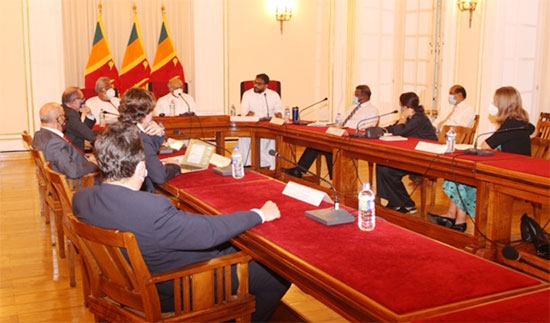
Foreign Minister Dinesh Gunawardena briefing Chargé d’Affaires of the Delegation of the European Union in Colombo Thorsten Bargfrede, and EU Ambassadors / Chargé d’Affaires from France, Italy, Romania, Germany and the Netherlands at a meeting at the Foreign Ministry on Monday. Minister of Fisheries Douglas Devananda, State Minister for Regional Cooperation Tharaka Balasuriya, and Foreign Secretary Admiral Prof. Jayanath Colombage also participated in the meeting.
The Foreign Ministry yesterday expressed its regrets at the adoption of a resolution on Sri Lanka in the European Parliament on 10 June 2021.
The resolution titled “The Situation in Sri Lanka, in particular the arrests under the Prevention of Terrorism Act”, contains factual inaccuracies, and does not take cognizance of the multifaceted progress made by Sri Lanka in reconciliation and development, the Ministry said in a statement.
The FM statement: “At the outset, the Ministry wishes to state that provisions of the Prevention of Terrorism Act have been invoked to address heinous acts of terrorism committed on its people. In this context, it is recalled that the Easter Sunday terrorist attacks of 2019 resulted in significant loss of life, including of several EU nationals.
“It is important to underscore that the Government of Sri Lanka maintains a regular, vibrant and cordial dialogue with the European Union (EU), covering all aspects of bilateral relations. The engagement is sustained through the close and cordial dialogue maintained with the European Commission, the Council and the Parliament by the Sri Lanka Mission in Brussels; and with the EU delegation and EU Ambassadors in Colombo by senior interlocutors of the Government.
“As part of this process, Sri Lanka has constructive engagement with the European Commission on the review of its EU GSP + compliance with the 27 core International Conventions. Towards this end, the Third Cycle of Review of the EU GSP + Monitoring Process for 2020-2021 is ongoing.
“Sri Lanka apprised the EU on progress with regard to its wide range of cooperation at the annual EU-Sri Lanka Joint Commission, the 23rd session of which was convened in January 2021. Further updates are provided through the relevant Working Groups and Committees functioning under the purview of the Joint Commission.
“With regard to salient points referred to in the resolution, the Ministry wishes to submit the following observations with a view to correction.
“The Government has, in accordance with its constitutional mandate and international obligations, taken steps to protect the rights of all its citizens. Specific provision in terms of Article 12 (1) of Sri Lanka’s Constitution ensures that all persons are equal before the law and are entitled to the equal protection of the law. Article 12 (2) of the Constitution prohibits discrimination based on race, religion, language, caste, sex, political opinion, place of birth or any such grounds.
“The government is in the process of revisiting provisions of the Prevention of Terrorism Act, in keeping with its commitments, as has been communicated to the EU. Towards this endeavour, the Government is studying existing legislation to propose necessary amendments, and will also draw on international best practices adopted by other jurisdictions. The Government rejects the claim that the PTA has been systematically used for arbitrary arrests and the detention of Muslim or other minority groups in Sri Lanka.
“It is observed that the 20th Amendment was enacted in full compliance with the procedure set out in the Constitution with a two-thirds majority of the Members of Parliament voting in its favour. With regard to such legislation, a number of in-built safeguards relating to transparency and judicial review aimed at preventing the passage of bills that are inconsistent with the Constitution, including its Fundamental Rights chapter, have been adhered to.
“The government has regularly updated the Human Rights Council as well as EU interlocutors on the measures undertaken to address issues of accountability, and to achieve continued progress in reconciliation. Mechanisms in place in this regard include the Presidential Commission of Inquiry headed by a Justice of the Supreme Court; the Office of Missing Persons; the Office of Reparations, the Office of National Unity and Reconciliation; the Human Rights Commission of Sri Lanka; and related institutional reforms aimed at non-recurrence and other confidence building measures. With regard to sustainable development, the Inter-Ministerial Committee headed by the Prime Minister to steer SDG implementation is of significance.
“Sri Lanka’s labour rights, including health and safety conditions, are in compliance with ILO standards. Sri Lanka’s high labour standards maintained in production, have led to better quality products, and high value added exports, as reflected in the apparel sector. The higher demand for ‘ethical’ products from Sri Lanka has led to increased production, subsequent investment, and improvement of the human capital in Sri Lanka. The EU GSP + concessions have contributed significantly towards this process, thus benefiting the Sri Lankan economy, as well as the EU market. Similarly, the fishery sector is a notable growth sector which has benefited from EU GSP + concessions.
“Sri Lanka, as one of the oldest parliamentary democracies in Asia, has a longstanding vibrant democracy. The country’s robust foreign policy is based on the principles of neutrality, non-alignment and friendship. The Government is committed to further strengthening its democratic institutions. As asserted by the Spokesperson of the 06th EU Election Observation Mission to Sri Lanka in November 2019, which comprised Members of the EU Parliament, the peaceful environment in which the election unfolded ‘confirms the stability of the [country’s] democratic institutions.’ These remarks remain valid.
“The COVID-19 pandemic continues to have a devastating impact globally, placing drastic limitations upon the right to safety, health, economic security, and even the right to life of millions of people across the globe. Sri Lanka continues to face challenges in spite of consistent and concerted efforts by the Government to safeguard its entire population against the pandemic, and to provide equitable access to vaccines. In this backdrop, the Government appreciates the commitment of global multilateral institutions and UN agencies to uphold the economic, social and cultural rights of all peoples, which are intrinsically linked to civil and political rights. Sri Lanka’s commitment to upholding human rights continues in tandem with its current priorities of inoculating its targeted population, providing healthcare and economic revival.
“In these critical times, Sri Lanka should be supported in safeguarding the rights of its people, while taking cognizance of demonstrated progress on the ground. The Government of Sri Lanka looks forward to continuing its partnership with the EU on a broad range of issues, and reassures the EU of its continued commitment to engage proactively and productively on areas of mutual interest.
“Foreign Minister Dinesh Gunawardena briefed Chargé d’Affaires of the Delegation of the European Union in Colombo Thorsten Bargfrede, as well Colombo-based EU Ambassadors / Chargé d’Affaires from France, Italy, Romania, Germany and the Netherlands, on the Sri Lanka Government’s position as detailed above, at a meeting convened at the Foreign Ministry on Monday 14 June 2021. The Minister of Fisheries Douglas Devananda, State Minister for Regional Cooperation Tharaka Balasuriya, and Foreign Secretary Admiral Prof. Jayanath Colombage also participated in the meeting.”


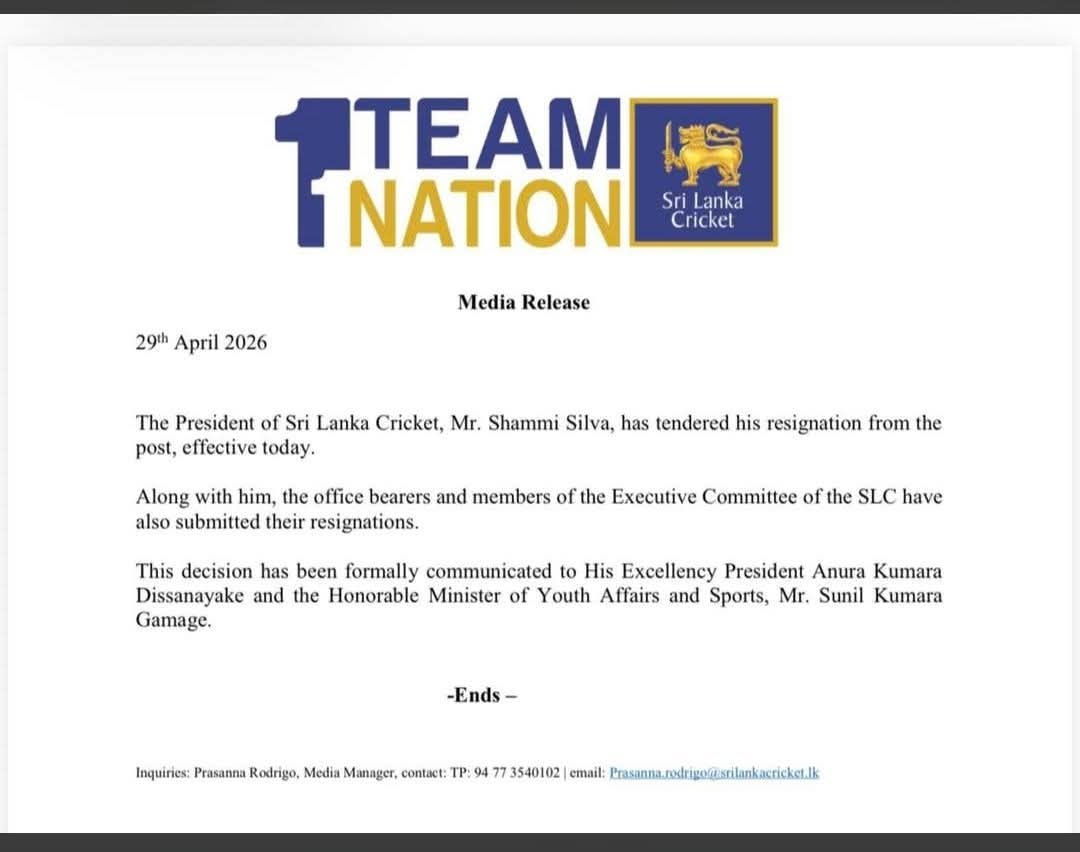
Sri Lanka Cricket has announced today (29) that the President of Sri Lanka Cricket and members of the Executive Committee have tendered their resignations.
The decision has been formaly communicated to President Anura Kumara Dissanayake and the Minister of Youth Affairs and Sports.
Latest News
Heat Index at Caution Level in the Northern, North-central and North-western provinces and in Kegalle, Trincomalee and Batticaloa districts during the day time

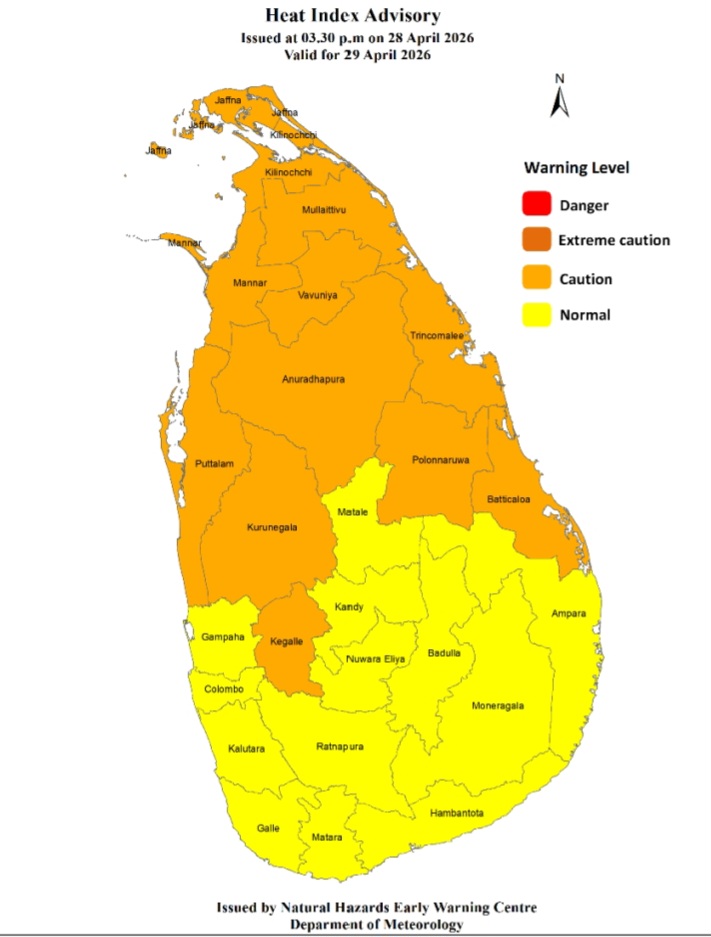
Warm Weather Advisory
Issued by the Natural Hazards Early Warning Centre
Issued at 3.30 p.m. on 28 April 2026, valid for 29 April 2026.
The Heat index, the temperature felt on human body is likely to increase up to ‘Caution level’ at some places in the Northern, North-central and North-western provinces and in Kegalle,
Trincomalee and Batticaloa districts during the day time.
The Heat Index Forecast is calculated by using relative humidity and maximum temperature and this is the condition that is felt on your body. This is not the forecast of maximum temperature. It is generated by the Department of Meteorology for the next day period and prepared by using global numerical weather prediction model data.

Effect of the heat index on human body is mentioned in the above table and it is prepared on the advice of the Ministry of Health and Indigenous Medical Services.
ACTION REQUIRED
Job sites: Stay hydrated and takes breaks in the shade as often as possible.
Indoors: Check up on the elderly and the sick.
Vehicles: Never leave children unattended.
Outdoors: Limit strenuous outdoor activities, find shade and stay hydrated.
Dress: Wear lightweight and white or light-colored clothing.
Note:
In addition, please refer to advisories issued by the Disaster Preparedness & Response Division, Ministry of Health in this regard as well. For further clarifications please contact 011-7446491.
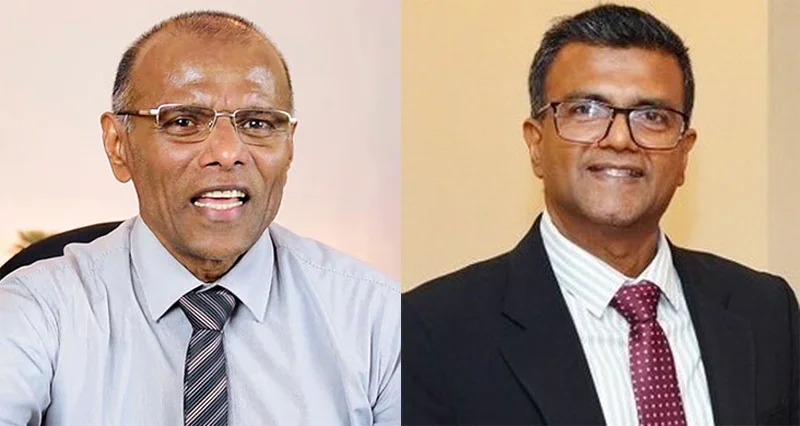
New controversy erupts over missing USD 2.5 mn:
Public interest activist Nagananda Kodituwakku has sought citizenship details of Finance Ministry Secretary Harshana Suriyapperuma from the Department of Home Affairs, Australia.
According to a letter dated 28 April, addressed to the relevant department, Solicitor England and Wales Kodituwakku sought the required information in terms of Section 15 of the Freedom of Information Act No 3 of 1982 of Australia. Suriyapperuma is also the Secretary to the Treasury.
The former Deputy Minister of Finance and Planning Suriyapperuma (from November 2024 to June 2025) is embroiled in a deepening controversy over the theft of USD 2.5 mn from the Treasury.
The leader of the Vinivida Foundation said that he intended to move court against Suriyapperuma for entering Parliament through the NPP National List in violation of the country’s Constitution (Article 91(1)(d)(xiiii).
Kodituwakku said: “This is clearly an accountability and integrity issue and violation of the Constitution of Sri Lanka and also this act contravenes the law of a member in the Commonwealth.”
USD 2.5 mn paid to a third party was meant to be an instalment of a loan taken from Australia. Suriyapperuma neither responded to an SMS nor answered his hand phone.
Geetha Kumarasinghe (UPFA/Galle District) and Diana Gamage (SJB National List) lost their seats in 2017 and 2024, respectively, over citizenship issues.
Meanwhile, public interest group ‘Free Lawyers’ that exposed the theft of Treasury funds questioned the failure on the part of Dr. Harsha de Silva, Chairman of Committee on Public Finance (CoPF), to pressure President Anura Kumara Dissanayake to temporarily remove Suriyapperuma to facilitate unhindered investigations.
On behalf of ‘Free Lawyers’, Rajith Keerthi Tennakoon yesterday expressed concern over the way the CoPF, under SJBer de Silva’s leadership, handled the issue at hand. Issuing an open letter, Tennakoon, urged the CoPF chief to explain his stand on a spate of vital issues which needed to be addressed without any further delay.
By Shamindra Ferdinando

President and Exco of Sri Lanka Cricket step down

Ferreira, Shubham, Rajasthan Royals openers hand Punjab Kings their first defeat

Dulani and Samarawickrama set up Sri Lanka’s victory in T20I series opener

Heat Index at Caution Level in the Northern, North-central and North-western provinces and in Kegalle, Trincomalee and Batticaloa districts during the day time

Showers or thundershowers will occur in most parts of the island after 1.00 pm

Treasury chief’s citizenship details sought from Australia

‘Dates have the highest sugar content to fight Coronavirus’

Sunday Island 27 December – Headlines

#SundayIsland 17th December – Headlines

Sunday Island – 28th March

Sunday Island Headlines – 21 March

Sunday Island – 21st February – Headlines
-

 News6 days ago
Lanka faces crisis of conscience over fate of animals: Call for compassion, law reform, and ethical responsibility
-
 News5 days ago
Whistleblowers ask Treasury Chief to resign over theft of USD 2.5 mn
-

 News5 days ago
No cyber hack: Fintech expert exposes shocking legacy flaws that led to $2.5 million theft
-

 News2 days ago
BIA drug bust: 25 monks including three masterminds arrested
-

 Business3 days ago
Nestlé Lanka Announces Change in Leadership
-

 News2 days ago
Banks alert customers to phishing attacks
-
 News3 days ago
Hackers steal $3.2 Mn from Finance Ministry
-
 News6 days ago
USD 2 mn bribe: CID ordered to arrest Shasheendra R, warrant issued against ex-SriLankan CEO’s wife