
News
FM regrets EU adopting one-sided resolution on Sri Lanka

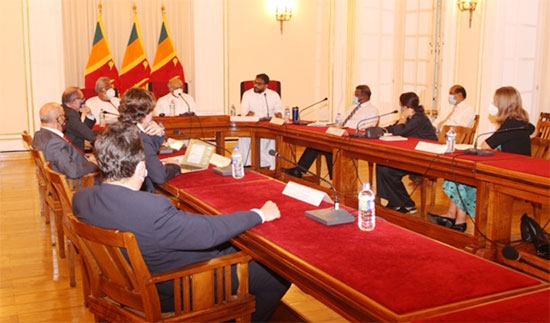
Foreign Minister Dinesh Gunawardena briefing Chargé d’Affaires of the Delegation of the European Union in Colombo Thorsten Bargfrede, and EU Ambassadors / Chargé d’Affaires from France, Italy, Romania, Germany and the Netherlands at a meeting at the Foreign Ministry on Monday. Minister of Fisheries Douglas Devananda, State Minister for Regional Cooperation Tharaka Balasuriya, and Foreign Secretary Admiral Prof. Jayanath Colombage also participated in the meeting.
The Foreign Ministry yesterday expressed its regrets at the adoption of a resolution on Sri Lanka in the European Parliament on 10 June 2021.
The resolution titled “The Situation in Sri Lanka, in particular the arrests under the Prevention of Terrorism Act”, contains factual inaccuracies, and does not take cognizance of the multifaceted progress made by Sri Lanka in reconciliation and development, the Ministry said in a statement.
The FM statement: “At the outset, the Ministry wishes to state that provisions of the Prevention of Terrorism Act have been invoked to address heinous acts of terrorism committed on its people. In this context, it is recalled that the Easter Sunday terrorist attacks of 2019 resulted in significant loss of life, including of several EU nationals.
“It is important to underscore that the Government of Sri Lanka maintains a regular, vibrant and cordial dialogue with the European Union (EU), covering all aspects of bilateral relations. The engagement is sustained through the close and cordial dialogue maintained with the European Commission, the Council and the Parliament by the Sri Lanka Mission in Brussels; and with the EU delegation and EU Ambassadors in Colombo by senior interlocutors of the Government.
“As part of this process, Sri Lanka has constructive engagement with the European Commission on the review of its EU GSP + compliance with the 27 core International Conventions. Towards this end, the Third Cycle of Review of the EU GSP + Monitoring Process for 2020-2021 is ongoing.
“Sri Lanka apprised the EU on progress with regard to its wide range of cooperation at the annual EU-Sri Lanka Joint Commission, the 23rd session of which was convened in January 2021. Further updates are provided through the relevant Working Groups and Committees functioning under the purview of the Joint Commission.
“With regard to salient points referred to in the resolution, the Ministry wishes to submit the following observations with a view to correction.
“The Government has, in accordance with its constitutional mandate and international obligations, taken steps to protect the rights of all its citizens. Specific provision in terms of Article 12 (1) of Sri Lanka’s Constitution ensures that all persons are equal before the law and are entitled to the equal protection of the law. Article 12 (2) of the Constitution prohibits discrimination based on race, religion, language, caste, sex, political opinion, place of birth or any such grounds.
“The government is in the process of revisiting provisions of the Prevention of Terrorism Act, in keeping with its commitments, as has been communicated to the EU. Towards this endeavour, the Government is studying existing legislation to propose necessary amendments, and will also draw on international best practices adopted by other jurisdictions. The Government rejects the claim that the PTA has been systematically used for arbitrary arrests and the detention of Muslim or other minority groups in Sri Lanka.
“It is observed that the 20th Amendment was enacted in full compliance with the procedure set out in the Constitution with a two-thirds majority of the Members of Parliament voting in its favour. With regard to such legislation, a number of in-built safeguards relating to transparency and judicial review aimed at preventing the passage of bills that are inconsistent with the Constitution, including its Fundamental Rights chapter, have been adhered to.
“The government has regularly updated the Human Rights Council as well as EU interlocutors on the measures undertaken to address issues of accountability, and to achieve continued progress in reconciliation. Mechanisms in place in this regard include the Presidential Commission of Inquiry headed by a Justice of the Supreme Court; the Office of Missing Persons; the Office of Reparations, the Office of National Unity and Reconciliation; the Human Rights Commission of Sri Lanka; and related institutional reforms aimed at non-recurrence and other confidence building measures. With regard to sustainable development, the Inter-Ministerial Committee headed by the Prime Minister to steer SDG implementation is of significance.
“Sri Lanka’s labour rights, including health and safety conditions, are in compliance with ILO standards. Sri Lanka’s high labour standards maintained in production, have led to better quality products, and high value added exports, as reflected in the apparel sector. The higher demand for ‘ethical’ products from Sri Lanka has led to increased production, subsequent investment, and improvement of the human capital in Sri Lanka. The EU GSP + concessions have contributed significantly towards this process, thus benefiting the Sri Lankan economy, as well as the EU market. Similarly, the fishery sector is a notable growth sector which has benefited from EU GSP + concessions.
“Sri Lanka, as one of the oldest parliamentary democracies in Asia, has a longstanding vibrant democracy. The country’s robust foreign policy is based on the principles of neutrality, non-alignment and friendship. The Government is committed to further strengthening its democratic institutions. As asserted by the Spokesperson of the 06th EU Election Observation Mission to Sri Lanka in November 2019, which comprised Members of the EU Parliament, the peaceful environment in which the election unfolded ‘confirms the stability of the [country’s] democratic institutions.’ These remarks remain valid.
“The COVID-19 pandemic continues to have a devastating impact globally, placing drastic limitations upon the right to safety, health, economic security, and even the right to life of millions of people across the globe. Sri Lanka continues to face challenges in spite of consistent and concerted efforts by the Government to safeguard its entire population against the pandemic, and to provide equitable access to vaccines. In this backdrop, the Government appreciates the commitment of global multilateral institutions and UN agencies to uphold the economic, social and cultural rights of all peoples, which are intrinsically linked to civil and political rights. Sri Lanka’s commitment to upholding human rights continues in tandem with its current priorities of inoculating its targeted population, providing healthcare and economic revival.
“In these critical times, Sri Lanka should be supported in safeguarding the rights of its people, while taking cognizance of demonstrated progress on the ground. The Government of Sri Lanka looks forward to continuing its partnership with the EU on a broad range of issues, and reassures the EU of its continued commitment to engage proactively and productively on areas of mutual interest.
“Foreign Minister Dinesh Gunawardena briefed Chargé d’Affaires of the Delegation of the European Union in Colombo Thorsten Bargfrede, as well Colombo-based EU Ambassadors / Chargé d’Affaires from France, Italy, Romania, Germany and the Netherlands, on the Sri Lanka Government’s position as detailed above, at a meeting convened at the Foreign Ministry on Monday 14 June 2021. The Minister of Fisheries Douglas Devananda, State Minister for Regional Cooperation Tharaka Balasuriya, and Foreign Secretary Admiral Prof. Jayanath Colombage also participated in the meeting.”


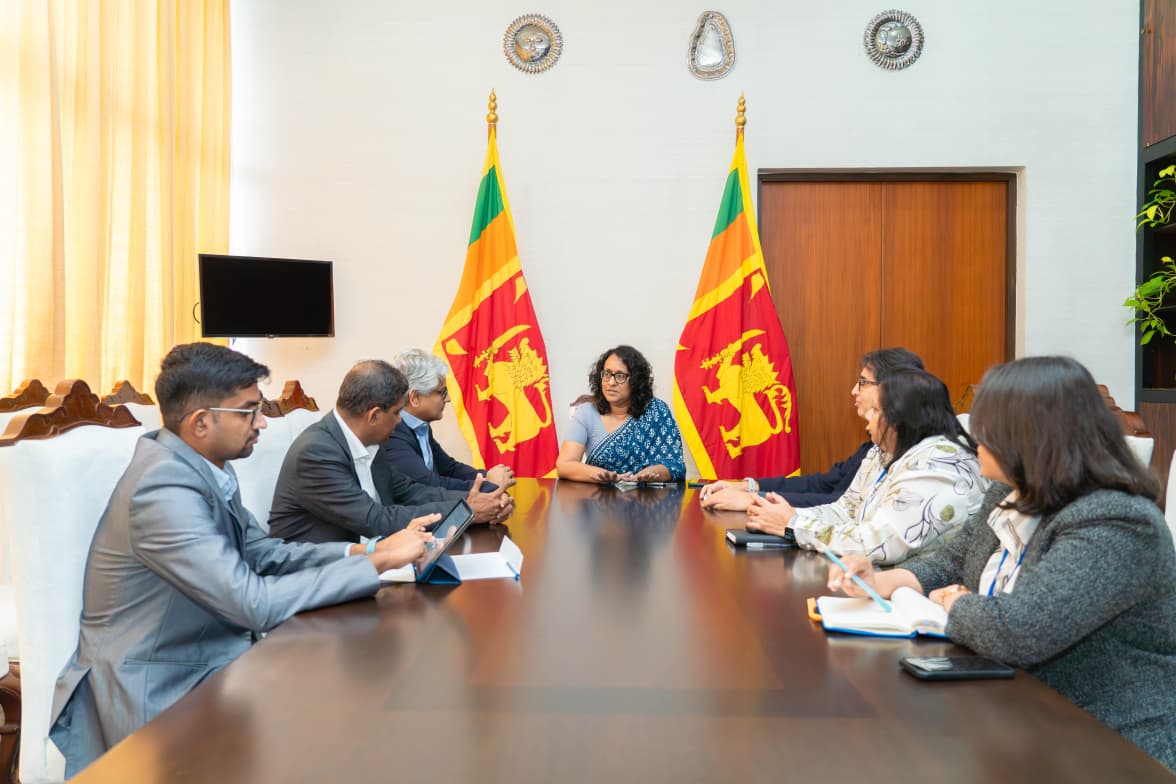
Representatives from the ’The Ceylon Chamber of Commerce’ met with Prime Minister Dr. Harini Amarasuriya on Wednesday [24th of June] at the Parliament premises.
During the meeting, discussions focused on the Sri Lanka Economic and Investment Summit 2026 (SLEIS 2026), which is scheduled to be held on 12 and 13 October 2026. Attention was also given to digitalization initiatives, the introduction of digital technologies in schools under new education reforms, and the transformative role of Artificial Intelligence (AI) in Sri Lanka’s education sector.
Representatives of the Chamber noted that the summit would serve as an important platform for encouraging both local and foreign investment, while also contributing to the shaping of the country’s future economic policies.
The meeting was attended by Krishan Balendra, Chairman of The Ceylon Chamber of Commerce; Vinod Hirdaramani, Deputy Vice Chairman; Shiran Fernando, Secretary General and Chief Executive Officer; Aliki Perera, Deputy Secretary General and Chief Operating Officer; and Anagi Rodrigo-Weerasekera, Chief Economist and Head of Economic Intelligence, along with several other representatives.
[Prime Minister’s Media Division]
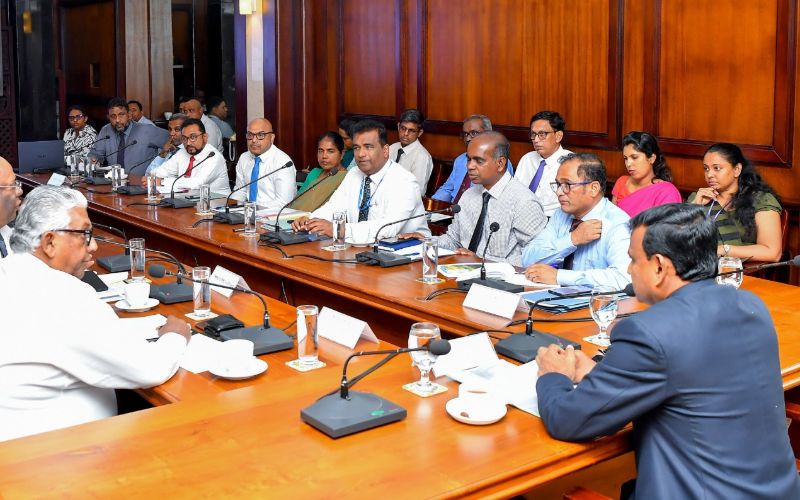
A discussion to review the progress of the housing project under which 4,700 houses are being constructed for the Malayagam community with Indian assistance was held this afternoon (24) at the Presidential Secretariat under the chairmanship of the Chief of Staff to the President, Prabath Chandrakeerthi.
Under this housing programme, 2,026 houses are to be provided to families identified by the National Building Research Institute (NBRI) as being at disaster risk. The remaining houses are expected to be allocated to eligible workers residing in the plantation sector.
Accordingly, the houses will be provided to Malayagam community families living on estates belonging to 22 Regional Plantation Companies, as well as estates under the State Plantations Corporation, Janawasama and Elkaduwa Plantations.
For the construction of each house, the Government of India has allocated Rs. 2.8 million, while the Government of Sri Lanka has contributed Rs. 400,000.
During the discussion, Chandrakeerthi instructed officials to ensure that the housing project is completed before the end of this year. He further directed that land identified for the construction of houses be released without delay and that the National Building Research Institute provide the necessary reports to identify suitable land for the project.
The housing project is being implemented jointly by the Ministry of Plantation and Community Infrastructure, the National Housing Development Authority, the State Engineering Corporation and the Plantation Human Development Trust.
Among those present were Additional Secretary (Development) of the Ministry of Plantation and Community Infrastructure, K. S. Wijayakeerthi; Director General (Engineering), N. D. N. Pushpakumara; Director General (Planning), W. A. K. S. Damayanthi; the Secretary General of the Planters’ Association; and officials from the National Housing Development Authority, the State Engineering Corporation, relevant institutions and plantation companies.
(PMD)

It has been reported that Attorney at Law Rakitha Rajapakshe, the son of former Minister of Justice Wijeyadasa Rajapakshe, has been arrested by the Commission to Investigate Allegations of Bribery or Corruption (CIABOC) over alleged links with the underworld.

Representatives from the Ceylon Chamber of Commerce meet PM

Progress of Housing Project for Malayagam Community families funded by India reviewed

South Africa stun South Korea to reach World Cup knockouts for the first time

Tremors of 7.5, 7.2 kill 32, injure hundreds in Venezuela

Former Minister Wijeyadasa Rajapakshe’s son arrested by CIABOC

Morocco come back after historic Haiti goals to reach World Cup last 32

‘Dates have the highest sugar content to fight Coronavirus’

Sunday Island 27 December – Headlines

#SundayIsland 17th December – Headlines

Sunday Island – 28th March

Sunday Island Headlines – 21 March

Sunday Island – 21st February – Headlines
-

 News6 days ago
Creditor receives USD 2.5 mn as Lankan public bears loss from theft of Treasury funds
-

 News5 days ago
Creditor not yet paid
-
 News5 days ago
Consumers bearing 22% tax burden despite 18% VAT claim: Dr. Harsha de Silva
-

 Features4 days ago
Nanda Pethiyagoda Wanasundara as three generations of family saw her
-

 Features3 days ago
Sri Lanka developing independent hydrographic capabilities
-

 Opinion6 days ago
SriLankan Airbus struck by lightning
-

 Editorial4 days ago
Fuel crisis: Beyond price debate
-

 Latest News4 days ago
Sooryavanshi thumps fastest List A fifty as India A win tri-series