
Features
Explaining the Buddha’s Hair

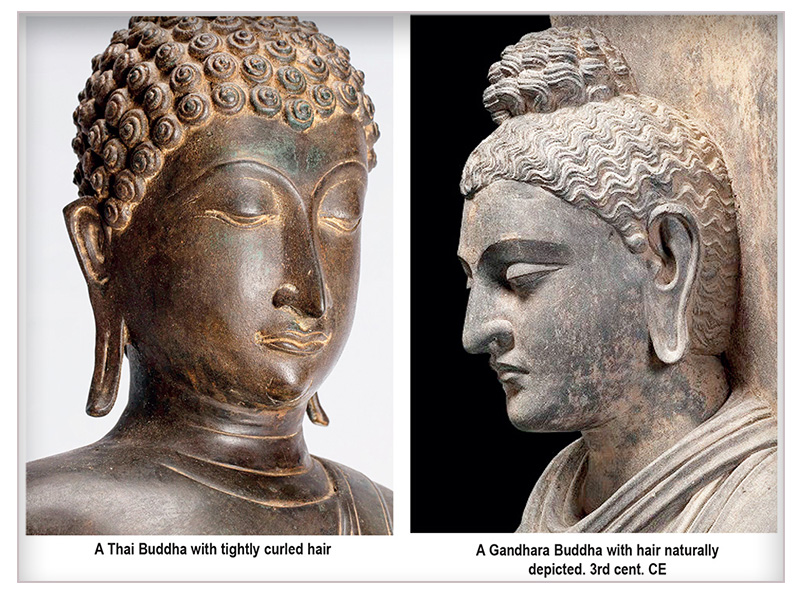
People in traditional Buddhists lands are used to seeing statues of the Buddha at least somewhere almost every day – in a road-side shrine, in a publication and they may have a statue or a picture of him on their budugey at home.
Hair is the long, slender filamentous strands that grow out of the body. In keeping with the understanding of his time, the Buddha usually made a distinction between head hair (kesa) and body hair (loma). Body hair included the eyebrows, eye lashes, nose hair, facial hair, pubic hair, and the hair in the armpits.

A Buddha from Mathura with a single curl, 2nd cent. CE
Hair has long had a social, religious, erotic and psychological significance. Sikhism teaches that men should not cut their hair or beard, while the Old Testament forbids cutting the hair on the side of the head or the edge of the beard (Leviticus 19:27) and the New Testament condemns long hair on males as unnatural (1 Corinthians 11,14). In several religions women must conceal their hair with a veil or wig. The ancient Indian tradition considered hair to be one of the five types of human beauty, and glossy black head hair and the line of soft down between the pubis and navel had a strong erotic appeal.
The coiffeur’s art was quite sophisticated by the Buddha’s time and both men and women paid a great deal of attention to their hair. Women favored parting their hair in the middle, wearing plait and applying sandal oil to it both to perfume it and to make it glisten. The courtesan Ambapali would wear her glossy-black hair curled at the ends, with flowers in it, well-parted with a comb, decorated with gold ornaments and adorned with plaits.
When Nanda left home to become a monk, he looked back and saw his girlfriend with her hair half-combed, an image that later he couldn’t get out of his mind. For men, sikhabandha consisted of twisting their long hair and a long cloth together and then tying it around the head into a turban. Boys would wear five topknots or buns called culaka and women would sometimes have a jeweled diadem attached to their hair.
Buns on the back, top or the side of the head were also popular. Bee’s wax and sometimes banyan tree sap was applied to slick the hair down. Men trimmed their beards, wore them long, grew goatees and shaped them into four points. They would also pluck out grey hairs to conceal the fact that they were ageing. Some ascetics wore dreadlocks, i.e. the hair matted into long braids and allowed it to either hang down or be tied together into various shapes. Sometimes the braids were tied into a bun on the top of the head. Some ascetics wore topknots while others shaved their heads or pulled their hair out.
The Buddha asked his monks to keep their heads and faces shaved and nuns to keep their heads shaved, probably for hygienic reasons and to discourage vanity. He said that at the time of his renunciation: “I shaved off my hair and beard,” a gesture symbolizing the leaving behind one’s former life and which was performed by most ascetic sects. He said of himself: “Dressed in my robe, I wander homeless and with my head shaved.” When disapproving brahmins would encounter him they would often express their disdain by calling him a “a miserable bald-headed monk.”
If the Buddha shaved his head, some people ask, why is he always depicted with hair, and why the curious tightly twisted spiraling curly hair? Certainly, people have come up with a range of creative, not to say crazy, answers to this second question. One is that the Buddha sat in meditation for so long that snails slid up his body and rested on his head. This theory seems to be based on the similarity between the spiraling curls and snail shells, although why snails would do this is never explained.
Another theory is that the Buddha’s hair is made up of curls each curling clockwise “to symbolize the spinning of the universe.” Others claim that it is related to sacred geometry – the sacred spiral, double helix, etc. Of late, some people have started insisting that the Buddha’s distinct hair is proof that he was actually an African and that to reject this obvious fact amounts to racism.
After this interesting sojourn into fantasy land, let us return to Earth and have a look at the evidence. Firstly, let’s be clear that questions about the Buddha’s hair are more related to iconography and art history than to Buddhist thought and practice. And secondly, the Tipitaka offers no authentic information about the Buddha’s hair other than that he shaved his head, and depictions of him with hair, is an iconographical convention without historical basis.
So where did the spiraling curls come from? The Lakkhana Sutta and several other suttas are devoted to the concept of what was called the 32 Signs of a Great Man, a rather strange concept in Brahmanism later introduced into Buddhism. Its origins probably lay in the common belief of the time that exceptional beings had distinctive marks on their bodies. One of these marks or signs pertain to the hair. The relevant passage in the Tipiṭaka reads: “His hair is black like collyrium with each strand curling upwards and to the right.” It was probably thought to curl to the right because like nearly all cultures, the ancient Indians considered the right to be more auspicious than other directions.
Being the color of collyrium is interesting. The Pali and Sanskrit word nila can mean black, blue, green or dark. Collyrium as it is used in India, is a black greasy substance made from the ash of fleabane (a plant), ghee and a few other ingredients. In Mahayana sutras the nîla gradually came to be understood as being blue.
When the first sculptors made Buddha statues, they tried to depict at least some of the 32 signs. It is thought that the first Buddha statues were made in Gandhara under Greek influence, and at around the same time in Mathura – in the first or second centuries CE. Greek or Greek-influenced sculptors in Gandhara, perhaps more rooted in reality, depicted the Buddha’s hair naturalistically, not exactly curling to the right, but waving to the right.
The first Mathura-manufactured images of the Buddha show him with a single bun spiraling to the right, something like a swirl on a Mr. Whippy ice cream. The Gandhara style never penetrated into India proper and eventually died out. The spiraling Mathura style eventually evolved into many spiraled curls and the Buddha’s hair has been depicted in that manner ever since. But as said before, this is an iconographic convention with no historical basis.
Bhante S. Dhammika of Australia ✍️


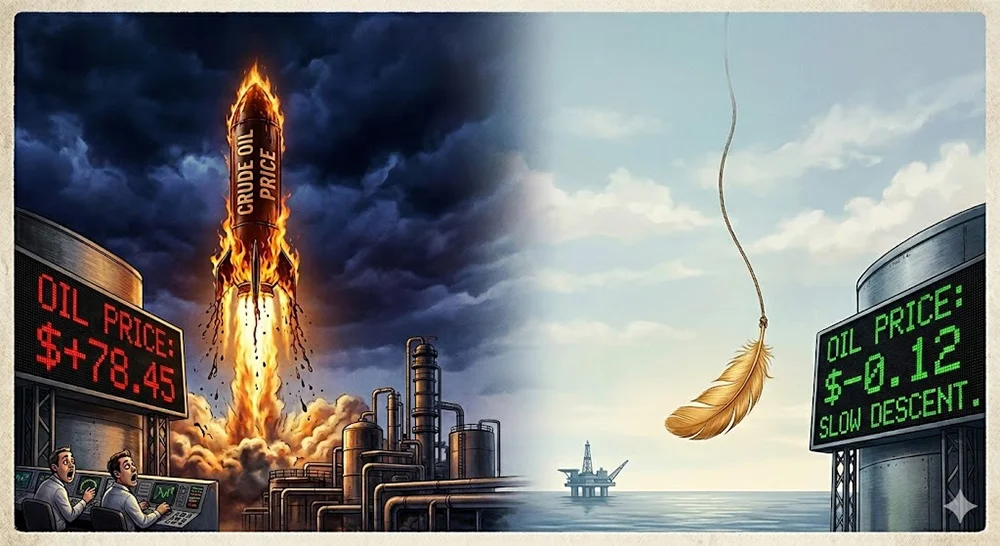
 Crude oil is the lifeblood of the global industrial economy, yet the journey from a subterranean reservoir to a litre of petrol at the forecourt involves a cascade of physical transformations, commercial transactions, and fiscal interventions that profoundly shape who bears the cost, and how much. A sudden shift in the world market price of crude, whether triggered by OPEC+ supply discipline, geopolitical disruption, or a demand shock, does not translate uniformly into consumer prices across the globe. The consequences are systematically different, depending on a country’s tax policy, exchange rate, efficiencies in refining processes, distribution processes and dependence on energy imports.
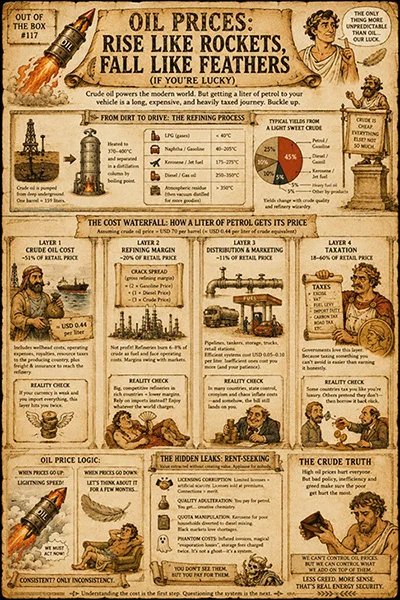
The Refining Process: From Crude to Finished Products
Crude oil is a naturally occurring mixture of hydrocarbons and its chemical composition varies by field: Heavy sour crudes from Venezuela, or Saudi Arabia, require additional processing, raising refining costs by USD 2–5 per barrel. One standard barrel contains approximately 159 litres.
Crude oil is preheated to approximately 370–400°C and the operating principle exploits differences in boiling points. The resulting fractions, collected from top to bottom, include: light petroleum gases (LPG) boiling below 40°C; naphtha and gasoline fractions in the 40–205°C range; kerosene and jet fuel between 175°C and 275°C; diesel and gas oil from 250°C to 350°C; and atmospheric residue above 350°C which is then processed in a vacuum distillation unit to recover further distillates, including lubricating oil base stocks.
Primary distillation alone is insufficient to meet market demand. Gasoline demand far exceeds the natural yield of the distillation cut. A modern complex refinery achieves the following approximate product yields from a light sweet crude: petrol/gasoline ~45%; diesel/gasoil ~25%; kerosene/jet fuel ~10%; LPG ~5%; heavy fuel oil ~10%; and other by-products ~5%. These ratios shift with crude quality and refinery configuration, and response differently to crude price changes.
The Crude Truth: How Oil Prices Punish the Poor Twice
An accounting perspective reveals a waterfall of costs, each layer added by a distinct economic actor and subject to a distinct set of market forces and regulatory interventions. A companion of the approximate cost structure for a litre of petrol at the retail level, assuming a crude oil price of USD 70 per barrel (approximately USD 0.44 per litre of crude equivalent), between advanced and emerging economies, can be explained in four layers:
Layer 1 — Crude Oil Cost (~51% of Retail Price)
The foundation of every fuel product is the crude oil acquisition cost. At USD 70/barrel, the raw material cost embedded in one litre of refined petrol is approximately USD 0.44. This figure includes wellhead lifting costs, field operating expenses, royalties, and sovereign resource taxes paid to the producing country, as well as freight and insurance for ocean tanker shipment.
For emerging economies, without domestic refining capacity, or with currencies that are not freely convertible, this layer is doubly exposed: a crude price increase is compounded by any simultaneous depreciation of the local currency.
Layer 2 — Refining Margin (~20% of Retail Price)
 The gross refining margin, measured by the industry’s standard 3-2-1 crack spread;
Crack Spread (gross refining margin) = (2×Gasoline Price) + (1×Diesel Price) − (3×Crude Price)
Critically, this gross figure must not be confused with profit. A refinery typically uses 6–8% of its own crude input as process fuel, and significant variable operating costs. This gross refining margin, the difference between the value of products produced and the cost of crude, varies considerably with market conditions.
In advanced economies with large, integrated refinery systems, these margins are moderated by competition and long-term supply contracts. In emerging economies, dependent on a single import refinery or on product imports rather than crude, refining costs are effectively set by the international product market, leaving little domestic control over this cost layer.
Layer 3 — Distribution and Marketing (~11% of Retail Price)
Refined products must travel from the refinery gate to the consumer through a distribution network involving primary pipelines or product tankers, regional storage terminals, secondary truck distribution, and retail fuel stations. In advanced economies, this infrastructure is mature, privately operated, and highly efficient, contributing a relatively stable USD 0.05–0.10 per litre to the retail price. In many emerging economies, the distribution infrastructure is fragmented, underdeveloped, or state-controlled, introducing additional costs, quality inconsistencies, and opportunities for rent-seeking. In Sri Lanka, for instance, the state-owned Ceylon Petroleum Corporation has historically cross-subsidised distribution costs, masking the true economic cost until subsidy withdrawal forced rapid price adjustments in 2022.
Rent-Seeking is extracting value without creating value; essentially corruption and inefficiency
Licensing corruption:Limited fuel station licenses create artificial scarcity; Licenses sold/traded at premiums; Political connections needed to obtain licenses
Quality adulteration: Consumers pay for “petrol” but get lower-quality mix
Quota manipulation:Subsidised kerosene (meant for poor households) diverted to diesel mixing; Creates black markets during shortages
Phantom costs:
Layer 4 — Taxation (18–60% of Retail Price)
Taxation is the most variable, politically sensitive, and analytically important layer in the cost structure. In advanced economies a high tax bases serve a dual purpose: generating substantial fiscal revenue and acting as an automatic price stabiliser. When crude rises, the absolute tax component remains constant, so the percentage of the price attributable to crude increases less than proportionately at the retail level.
In contrast, emerging economies historically imposed low fuel taxes or active subsidies, particularly for diesel, LPG, and kerosene used by low-income households. Sri Lanka’s fuel tax component, prior to the 2022 crisis, was, they claim, effectively negative in real terms due to administered pricing below cost.
The Impact of a Crude Price Increase: Advanced vs. Emerging Economies
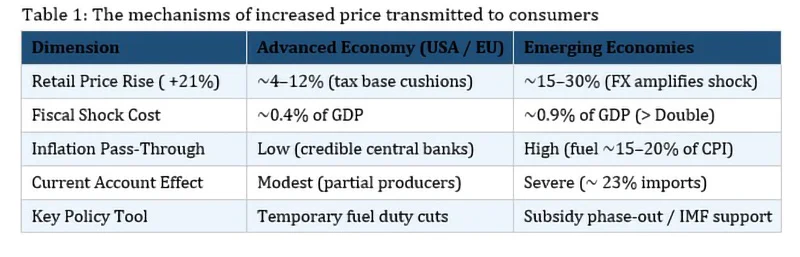
For example, if crude oil rises from USD 70 to USD 85 per barrel, an increase of approximately 21.4%. The mechanisms by which this shock is transmitted to consumers, and the capacity of economies to absorb or redistribute it, diverge dramatically along the advanced/emerging economy divide (Table 1).
Absorb shocks through tax relief
Advanced economies possess well-established fiscal frameworks that enable them to absorb temporary commodity shocks through tax relief, targeted transfers, or direct subsidies without compromising fiscal sustainability. Research by the Center for Global Development (2026) estimates the median fiscal cost of shielding consumers from the crude price increase of USD 15 scenario at approximately manageable cost of 0.4% of GDP for advanced economies.
Emerging economies face median fiscal costs of approximately 0.9% of GDP — effectively double. For Sri Lanka, entering the 2022 energy crisis with near-zero foreign reserves, even a temporary subsidy was fiscally impossible, forcing an immediate and politically destabilising pass-through of the full price increase to consumers. The lesson is stark: the ability to smooth out a commodity price shock across time is itself a function of prior fiscal strength, making the poor more vulnerable precisely because their governments are already under strain.
Inflation Pass-Through and Monetary Policy Credibility
The second transmission mechanism operates through the consumer price index and central bank behaviour. In advanced economies, fuel typically represents 3–5% of the CPI basket, and central banks enjoy high credibility in anchoring inflation expectations.
In emerging economies, fuel and food together often constitute 40–60% of CPI baskets, and central banks have historically struggled to maintain credible inflation targets. A 21% crude price increase translates into a far larger initial CPI shock. Worse, the loss of inflation credibility means that workers and businesses adjust wages and prices preemptively, generating persistent second-round inflation (> Double). To defend its inflation target, the emerging economy central bank must raise interest rates aggressively, simultaneously raising the cost of borrowing for businesses and governments, a painful policy dilemma in an economy already under stress.
Structural Current Account Vulnerability
The third and perhaps most structurally significant difference lies in the current account and foreign exchange dynamics. The advanced economies hold large reserve currencies and deep financial markets that allow them to finance import cost increases without immediate exchange rate pressure.
Sri Lanka, by contrast, allocated approximately 23% of its total import bill to petroleum products. A USD 15/barrel price increase instantly widens the current account deficit of these economies, depleting foreign exchange reserves. As reserves fall, currency markets anticipate further depreciation, precipitating speculative selling of the domestic currency. The resulting exchange rate depreciation, potentially 5–15% in a shock scenario, multiplies the cost of crude imports in local currency terms. A 21% USD price increase thus becomes a 28–39% local currency price increase at the refinery gate, before any refining, distribution, or tax component is added. This vicious cycle; crude price rise → reserve depletion → currency depreciation → amplified import cost → further reserve depletion, is a hallmark of emerging economy energy crises, and Sri Lanka’s 2022 experience illustrated it in extreme form.
Double bind when crude rises and subsidised
Countries that have historically subsidised fuel face a double bind when crude rises: the subsidy bill expands sharply (as the gap between subsidised price and market cost widens), while fiscal space contracts. The International Monetary Fund has consistently recommended subsidy reform, allowing fuel prices to reflect market cost while protecting the poor through direct cash transfers, as the fiscally sustainable path. Sri Lanka’s forced price liberalisation in 2022 (under IMF programme conditions) illustrate both the political difficulty and the macroeconomic necessity of this adjustment.
The Asymmetry of Oil Price Responses: Advanced vs. Emerging Economies
Advanced economies enjoy bidirectional flexibility in responding to oil price volatility; prices rise and fall with crude markets, leaving fiscal positions largely neutral. Emerging economies, by contrast, face a structural trap: when crude rises, subsidy bills explode, draining public finances; when crude falls, governments retain windfall savings to offset accumulated deficits rather than passing relief to consumers. Sri Lanka’s cycle from collapse to liberalisation to renewed subsidies illustrates this vividly. Underlying this is a political economy ratchet, price hikes are unavoidable, but reductions are politically captured, making permanent reform structurally elusive.
(The writer, a senior Chartered
Accountant and professional banker,
is a professor at SLIIT, Malabe. Views expressed in this article are personal.)

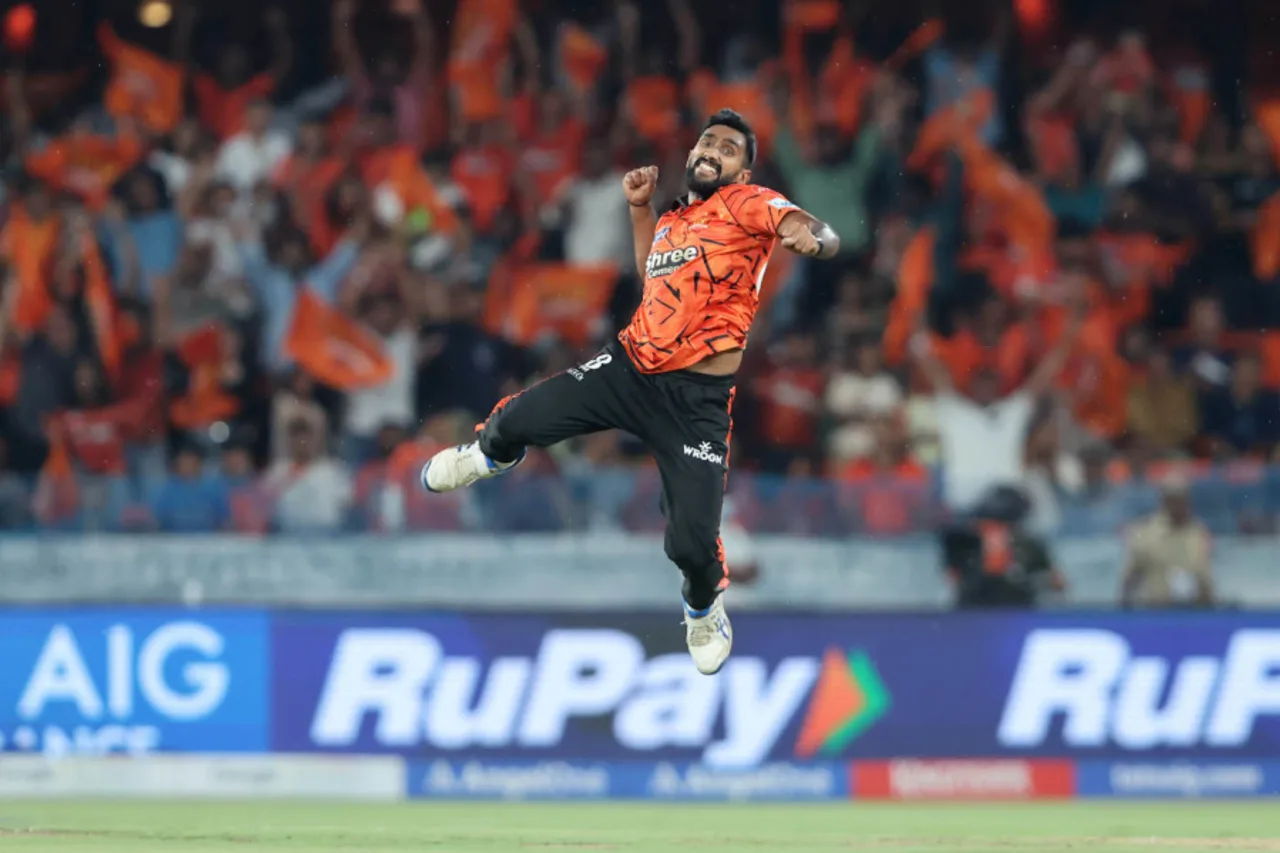
Life keeps throwing hurdles in his way, but Eshan Malinga keeps vaulting over them. Take his February from hell. For several months, Malinga had been building up to his first ever World Cup, a dream for pretty much anyone who ever picks up a cricket ball. But a week before that World Cup, Malinga dislocated his non bowling shoulder while bowling, which the team’s medical staff have since described as a freak injury they had never seen before.
“I was devastated,” Malinga says. “On top of it being my first World Cup, it was also at home and I didn’t know when I would get that chance again. There were a few days there where I did absolutely nothing.”
And yet in mid-May, here he is grinning from atop a pile of 16 IPL wickets, having developed a serious reputation as a reverse-swing operator. Sunrisers Hyderabad’s explosive batters may have seized the spotlight in this frenetic IPL, but on the bowling front, no SRH bowler has neared Malinga’s wicket haul, which is fifth best in the season overall. In a year in which they have not had Pat Cummins for seven of their 11 matches, it is Malinga who has held down the fort, particularly in the second half of the innings.
But trading difficulty for success is just what Malinga does. What he has long been doing. Go back eight years and Malinga had never played a hard-ball cricket match. On top of which his home district of Ratnapura – at the base of Sri Lanka’s central hills – was better known for its gems and waterfalls than cricket, never having produced a men’s international. Malinga, additionally, was not even actively trying to be a cricketer. He had moved from his first school in a village called Opanayake to Ratnapura’s Sivali Central College due to strong academic results, and found, almost by accident, that his new school had a hard-ball cricket team.
But what Malinga knew at that point was that he could bowl fast. That much had been obvious growing up in Opanayaka, where despite his mother’s occasional misgivings, Malinga was highly sought after by the organisers of the village softball team (Sri Lanka has a thriving village-level softball cricket ecosystem). And as had been the case with the better-known Malinga, this one was also aware he possessed a killer yorker – a prized asset in every form of cricket, with any kind of ball.
If he’d been on track to be a softball legend, Malinga found his horizons began to expand at a spectacular rate the moment he got a hard ball in his hands. First, his yorker and his pace began to reap big wickets in the Division Three schools competition for Sivali Central, whose coach had immediately hoisted him into the team upon seeing Malinga bowl at practice one day. Then in mid-2019, about a year into playing hard-ball cricket, came the day he still reflects on as the one that changed his cricketing life. Having missed a fast-bowling competition in Ratnapura because he had been playing for his school that day, Malinga travelled to the hill town of Badulla to bowl in the competition there, and clocked 127kph on the gun, which was enough to win him first place.
This was when he first became a blip, however faint and distant, on Sri Lanka Cricket’s radar. Visions of a cricketing life began to appear as wisps of opportunity began to materialise. The next few years, Covid-riddled though they were, became a crash course into the sport for Malinga. There were coaching camps in Colombo in which the best of the rural talent was trained up and funnelled into a programme at the next level up. There were trials for first-class teams, and eventually a fledgling domestic career.
“I don’t know how many times I came to Colombo from Ratnapura during those times,” he laughs now. “It was a lot! I would leave home at about 3am, and the bus journey to Colombo took about three-and-a-half hours. Then I’d train or play the match, and the bus back home always took longer because of traffic. So every day, I was on the road for more than seven hours.”
The Malinga who made these exhausting daily commutes was, as far as the Sri Lankan cricket system was concerned, a bowler of decent rather than blinding promise. His pace had propelled him to the top of the regional pool, but at the first-class level he was still adapting his yorker and slower ball (another weapon he had developed in his softball days). If he needed another gear, Malinga found it – again almost by accident – sometime in 2022.
“I was playing an Under-23 three-day tournament, and I remember that being the first time I really started reverse-swinging the ball,” he says. “Coaches had anyway told me that with my action and my pace, it should be possible. But it started almost automatically. It’s not something I had to learn.
“But it wasn’t that easy, because it was a long process to learn how to control it. To get reverse swing, you have to release the ball at a different point than a straight ball, because you want it to still hit the stumps when it is swinging. So I scuffed up a lot of balls and trained hard to get that line right.”
And so, the Malinga that emerged at the end of 2022 had sharp enough pace, an excellent yorker, a developing slower ball, mountains of homespun tenacity, and had also discovered that he can naturally reverse-swing the ball earlier in an innings than most. You could have seen where this is going, right? All the ingredients of an ace white-ball bowler were there. And Malinga was already a master of turning wisps of opportunities into tangible advances. Over the next three years, he’d land a spot in the national fast-bowling academy, use that as a trampoline to impress in an Emerging Teams three-dayer against Bangladesh, and from there bounce into a stint at the MRF Pace Academy in 2024, before on the franchise side of things parlaying a trial at Rajasthan Royals at Kumar Sangakkara’s invitation into a decent run at the SA20 for Paarl Royals.
Having leapt up to the fringes of the Sri Lanka team over the past 18 months, Malinga has at this IPL now seized another unusual chance. The square at SRH’s home stadium is among the barest and most abrasive in the league, and Malinga’s reverse swing has prospered upon it. Of his 16 wickets this season, 11 have come at home. In the second half of the innings, when the ball is most likely to reverse, Malinga’s economy rate is 8.37 at a venue where runs have been scored at 9.38 in that period this season.
Malinga had put in a robust 2025 season for SRH as well, so there is a body of work emerging there. Perhaps this is why this year, SRH’s bowling plans have tended to follow the contours of Malinga’s own game.
“After six overs the ball gets damaged here, so we needed to make use of that. When I bowled at practice, the ball reversed, so I think a plan emerged where we were going to use the scuffed up ball and take advantage of that.
“In the first powerplay the ball comes on to the bat nicely here. After that we try to get the advantage of having an older ball. We’ve got bowlers who bowl 140kph-plus, and we have Pat Cummins, who also reverses the ball. So we make sure to look after the ball in a way that will give us reverse.”
At 25, eight years into a serious cricket career, Malinga sees himself as a work in progress. He wants to work on his powerplay bowling. His variations, he thinks, still need some work. He’d like to play Tests, where his reverse swing could really stretch its legs. And, oh, he is still waiting to play that first World Cup.
Even here, his keen nose for opportunity leads him. He points out through the course of our conversation that where the three previous World Cups had been played with a new ball at either end being used right through the innings, the next World Cup, in 2027, will feature rules that seem at least partially designed to enhance reverse swing, an older ball more suited to the craft now available towards the end of the innings.
He isn’t even a sure-fire pick in Sri Lanka’s ODI XI just yet, so this is just a flicker of an opportunity for now. But having made the journey from the village of Opanayaka to the most raucous cricketing showpiece on the planet, Malinga knows just what to do with those.
[Cricinfo]
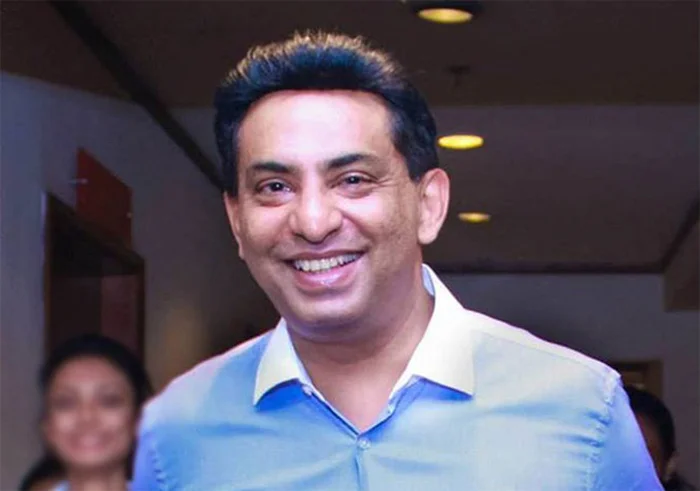
The death of the most important suspect in the Sri Lankan Airlines Airbus deal has drawn intense public speculation. Kapila Chandrasena the former CEO of the heavily loss-making national airline was found dead under circumstances that the police are still investigating.
He had recently been arrested by the Commission to Investigate Allegations of Bribery or Corruption in connection with the controversial Airbus aircraft purchase agreement signed in 2013. Police investigations are continuing into the cause of death and whether or not he committed suicide. The unresolved death brings to light the high stakes involved in accountability efforts of this nature.
The uncertainty surrounding Chandrasena’s death has revived public memories of other mysterious deaths linked to corruption investigations and public scandals. Among them is the death of Rajeewa Jayaweera, a former SriLankan Airlines executive and outspoken critic of the Airbus transaction. He was following in the tradition of his father, the late foreign service officer and public servant Stanley Jayaweera who mentored the younger generation in good governance practices and formed the group “Avadhi Lanka” along with icons such as Prof Siri Hettige. Rajeewa had written a series of articles exposing irregularities in the deal before he was found dead near Independence Square in Colombo in 2020. The CCTV cameras in that high security area were turned off. Questions raised at that time whether or not he had committed suicide were not satisfactorily resolved.
The controversy about the cause of Chandrasena’s death is diverting attention away from the massive damage done to the country by the SriLankan Airlines deal itself. The value of the aircraft agreement was close to the size of the International Monetary Fund bailout package that Sri Lanka desperately needed by 2023 in order to stabilise the economy after bankruptcy. Sri Lanka’s IMF Extended Fund Facility amounted to about USD 3 billion spread over four years. The comparison shows the scale of the losses and liabilities that irresponsible and corrupt decisions have imposed on the country and which must never happen again.
Wider Pattern
The corruption linked to the Airbus transaction came fully into the open only because of investigations conducted outside Sri Lanka. In 2020 Airbus agreed to pay record penalties of more than EUR 3.6 billion to authorities in Britain, France and the United States to settle global corruption investigations. Sri Lanka was identified as one of the countries where bribes had allegedly been paid in order to secure contracts. The Airbus deal involved the purchase of six A330 aircraft and four A350 aircraft valued at approximately USD 2.3 billion. Investigations showed that Airbus paid bribes amounting to nearly USD 16 million in order to secure the contract. According to court submissions, at least part of this money amounting to USD 2 million was transferred through a shell company registered in Brunei and routed through Singapore bank accounts linked to the late airline CEO and his wife.
The commissions involved in this deal may seem comparatively small compared to the overall value of the contracts but devastating in their consequences. But they also show that a few million dollars paid secretly to decision makers could lead to the country assuming liabilities worth hundreds of millions or even billions of dollars over decades. This is why corruption is not simply a moral issue. It is a direct economic assault on the living standards of ordinary people. Money lost through corruption is money unavailable for schools, hospitals, rural development and job creation. In the end the burden falls on ordinary citizens who are left to repay debts incurred in their name without receiving commensurate benefits in return.
The SriLankan Airlines transaction gives an indication of the wider pattern of corruption and misuse of national resources that has taken place over many years. This was not an isolated incident. There were numerous large scale infrastructure and procurement projects that imposed heavy debts on the country while enriching politically connected individuals and their associates. Other projects such as the Colombo Port City, Hambantota Harbour and highway construction reveal a similar pattern.
Less publicised but equally damaging scandals have involved fertiliser medicine and energy contracts. Investigations into medicine procurement in recent years uncovered allegations that substandard pharmaceuticals had been imported at inflated prices causing both financial losses and risks to public health.
Moral Renewal
The present government appears determined to investigate major corruption cases in a manner that no previous government has attempted. Those who ransacked and bankrupted the treasury need to be dealt with according to the law. There is considerable public support for efforts to recover stolen assets and ensure accountability.
In his May Day speech President Anura Kumara Dissanayake stated that around 14 corruption cases were nearing completion in the courts this very month and called upon the public to applaud when verdicts are delivered. Political opponents of the government claim that such comments could place pressure on the judiciary and blur the separation between political leadership and the courts. But the deeper public frustration that underlies the president’s remarks also needs to be understood.
The challenge facing Sri Lanka is twofold. The country must ensure that justice is done through due process and independent institutions. If anti corruption campaigns become politicised they can lose legitimacy. But if corruption and abuse of power continue without consequences the country will remain trapped in a cycle of economic decline and moral decay. Sri Lanka also needs to confront past abuses linked to the war period. There are allegations of kidnapping, extortion, disappearances and criminal activity in which members of the security forces have been implicated. Vulnerable sections of the population suffered greatly during those years. If political leaders turned a blind eye or actively connived in such crimes they too need to be held accountable under the law. Selective justice will not heal the country. Accountability must apply across the board regardless of political position, ethnicity or institutional power.
Sri Lanka has paid a very heavy price for corruption and impunity. The economic collapse of 2022 did not occur overnight. It was the result of years of bad governance, reckless decision making, abuse of power and the misuse of public wealth. If the country is to move forward the focus cannot be diverted by sensational speculation alone. Suspicious deaths and political intrigue may dominate headlines for a few days. But the larger issue is the system that enabled corruption to flourish without accountability for so long. The real national task is to end that system. Sri Lanka cannot build a prosperous future on a foundation of corruption and impunity. Unless those who looted public wealth are held accountable and the systems that enabled them are dismantled, the country risks repeating the same cycle again.
Jehan Perera

Complete all projects funded under the LKR. 500 bllion allocation for Ditwah within this year – President

Development projects should be carried out in line with the practical needs of the people – PM

Ayesha Zafar’s rapid ton crushes Zimbabwe

Donald Trump lands in China for high-stakes meeting with Xi Jinping

Gujarat Titans go No.1 after Rabada and Holder rout Sunrisers Hyderabad

Showers will occur in the Western, Sabaragamuwa, Central, North-western and Northern provinces and in Anuradhapura, Trincomalee, Galle and Matara districts

‘Dates have the highest sugar content to fight Coronavirus’

Sunday Island 27 December – Headlines

#SundayIsland 17th December – Headlines

Sunday Island – 28th March

Sunday Island Headlines – 21 March

Sunday Island – 21st February – Headlines
-
 News7 days ago
MIT expert warns of catastrophic consequences of USD 2.5 mn Treasury heist
-
 News4 days ago
Lanka Port City officials to meet investors in Dubai
-

 Editorial7 days ago
Clean Sri Lanka and dirty politics
-
 News14 hours ago
Ex-SriLankan CEO’s death: Controversy surrounds execution of bail bond
-
 News5 days ago
SLPP expresses concern over death of former SriLankan CEO
-

 Editorial6 days ago
The Vijay factor
-
 News5 days ago
Police inform Fort Magistrate’s Court of finding ex-CEO of SriLankan dead under suspicious circumstances
-
 Features6 days ago
Palm leaf manuscripts of Sri Lanka – 1