
Features
Election ’24: Judicial Evolution, Power Devolution, and a New Tamil Leader

by Rajan Philips
Sunday this week marks Sri Lanka’s 76th independence anniversary. By President Ranil Wickremesinghe’s reckoning another twenty four years will have to go by before Sri Lanka’s economy could fully recovery from the man made crisis it contracted two years ago. And what is immediately ahead is a “grueling recovery path.” That is the grim warning of Dushni Weerakoon, the respected Economist.
Another Economist from abroad, Prof. Mick Moore, who coined the phrase “man-made crisis” to describe Gota’s debacle, has now advised that it is time for Sri Lanka to have an “authentic finance minister” after more than 30 years. Like the UB Wanninayake’s, NM Perera’s and Ronnie de Mel’s of old. Not the tandem Executive President / Finance Minister model of today.
Can that happen with the current presidential system? That brings us back to political square one, which is the constitution. To where I left last week and to a somewhat significant political development since. Namely, the election of Sivagnanam Shiritharan as the new leader of the Ilankai Thamil Arasu Kadchi (ITAK), the old Federal Party in English, now stuck with its Tamil only version. The election of Mr. Shiritharan, and the defeat of MA Sumanthiran, eminent lawyer and parliamentarian, has triggered editorial waves in the news media.
New Equilibrium
Depending on which glass they are looking at, pundits have described the ITAK leadership election as – either not an overwhelming victory (for Shiritharan) or as a significant defeat (for Sumanthiran). Whatever it may be, the election of Mr. Shiritharan is not going to be without political implications. That much is obvious, but what needs to be borne in mind is that the significance of these implications will vary from context to context and from issue to issue.
It would be wrong to over interpret the new leader’s misgivings the 13th Amendment and use it an excuse to shelve it without implementing it. Or to see something utmost sinister in his rhetorical assertions about Tamil nationalism and his memorialization of “Eelam national liberation fighters.” As I have argued earlier, memorialization is collective therapy after a violent experience, and hollering about it or trying to stop it is futile. The other side of the coin of memorial politics is that nothing more can be done other than commemorations.
This is the crux of the new equilibrium in the dynamic between the Sri Lankan state and the Sri Lankan Tamils that has been taking shape after 1983. Unlike pre-1983,the state is highly circumscribed in what it can and cannot do vis-a-vis the Tamils, by the emergence of the Tamil diaspora and international attention. The Tamils are no less circumscribed in what they can and cannot achieve by the same international attention and the limiting ground realities at home that weigh against the dreamy aspirations among sections of the diaspora. India obviously looms large in this picture with or without Modi and his distortion of the Mahatma’s Ram Rajya. Additionally, the nationalistic coming of age of the Muslims and the plantation Tamils has created structural curtailments on at least the territorial claims of Tamil nationalism.
The task for leadership on all sides would be to find a consociational working area within the highly constrained spaces and produce meaningful action. Ideally the task of all leaders in the current situation should be to focus on the economy, and the debate about the economy should be the focus of the election. That is unfortunately not the case and there is reasonably legitimate concern that the elections are casting “a shadow of uncertainty over economic recovery” (Dushni Weerakoon, Sunday Island, January 28). But without elections there will be the double whammy of political and economic uncertainties.
Put another way, you cannot get over the crisis of one uncertainty without dealing with the crisis of the other simultaneously. There is not going to be economic recovery without political and constitutional reforms at the same time. Therein is the timeliness of the constitutional reform proposals put forward by the Collective for Democracy and Rule of Law (CDRL). Last week, I touched on the proposals for parliamentary and presidential reforms for achieving a healthy balance of powers between the different branches of the state. The proposals also address the judiciary, judicial review of legislation, cross-over MPs, and the system for power devolution.
Judicial Evolution and Power Devolution
Of all the branches of the Sri Lankan state, the judiciary is not only the oldest but also the most evolved, and more so in the matter of devolving power. The evolutionary breakthrough was the landmark Supreme Court ruling, on August 4, 2017. Three judges of the Supreme Court, then Chief Justice Priyasath Dep, Justice Upali Abeyratne and Justice Anil Gooneratne, held that advocating for a federal form of government would not be a violation of the Sri Lankan constitution.
The judges were dismissing a petition against the Ilankai Thamizh Arasu Kadchi that it was in violation of the constitution because in advocating for a federal form government the ITAK was pursuing the goal of a separate state. The judges disagreed and pointed to the 13th Amendment as an example of devolving power without violating the constitution.
The August 2017 Supreme Court ruling could be a starting point for the new ITAK leader. A much better starting point for Mr. Shiritharan than what had been for all his predecessors who were faced with court rulings that failed to stop the legislature and the executive from violating the fundamental of minorities in cases involving citizenship, language, land and even religion.
The citizenship issue is now resolved and the estate Tamils have their own political representation. After 13A, Sri Lanka has both Sinhala and Tamil as official languages, and English is recognized as a link language. There are also moves to facilitate English as a medium of instruction for everyone by providing government funds to private schools. What is missing are functioning institutions for power devolution and local democracy. And that is because there have been no provincial council elections for nearly a decade and no local government elections since February 2018.
The Constitutional proposals respond to the current state of affairs by suggesting enshrining of the right to vote at provincial and local elections in the constitutional provisions protecting the franchise right to vote at national elections. The proposals also respond to the failure of successive ‘central governments’ to facilitate the orderly and efficient functioning of provincial council and local bodies.
The contentious issues over police and land powers can never be fully addressed or agreed upon in writing without functioning provincial councils on the ground. All elections are overdue and the proposals for implementing devolution will remain proposals until provincial elections are held and determined efforts are made to make them work. What seems to be a new mechanism in the proposals is the recommendation for including safeguards against session, including suspension of a recalcitrant provincial council by presidential proclamation, which would subject to approval by both Houses of Parliament, and review by the Constitutional Court.
The proposals seek to bring back the Constitutional Court that was the most innovative feature of the First Republican Constitution and one that could have continued in the Second (and current) Republican Constitution. That is insofar as the current constitution is partly modelled on the French Constitution that provides for preview of legislations by a constitutional court. The proposals note that there is “a welcome trend” in Sri Lanka in that “more citizens and civic organisations are coming forward to challenge Bills before the Supreme Court.
The proposals allude to permitting post-enactment judicial review of laws and Provincial statutes. That would be a big change reverting to pre-1972 traditions. And involving the Constitutional Court to handle both judicial preview of and post-enactment review of laws would be worth the effort, but the challenges should not be underestimated.
My last comment is about a matter that involves the legislature, viz., cross-over MPs. The experience of cross-over MPs and the practice of inducing crossovers with cabinet positions to secure a voting majority, are seen to have been a major factor in eroding public trust in politics in Sri Lanka. A more fundamental reason could be the qualification of candidates who end up as MPs based on a system of list-based nominations. The suggested proposals to address this by providing for a member to lose her/his seat for voting against a decision of the Party seems harsh. Forcing a member to lose seat for joining another party could be a more plausible ground for vacating the seat. The proposals do include safeguards for MPs who have contested as coalition partners. And the recommendation to hold by-elections to fill a vacated constituency seat is a welcome change.
Interestingly, comparative parliamentary studies draw a distinction between old and nascent parliamentary systems in dealing with cross-over MPs. In older, i.e., western, democracies MPs do not have to vacate their seats for voting against the party line or leaving the party that she/he entered parliament with. Not so in the so called nascent, non-western, democracies. India and Bangladesh are among them, but here at home Dr NM Perera was dead set against the provisions in the current constitution for dealing with crossover MPs and vacated seats. It was not so before 1978.
When the LSSP left the United Front government in 1976, some SLFP MPs called for the resignation of NM Perera as a Member of Parliament. He responded in style and citied the example of “illustrious predecessors: SWRD Bandaranaike, who left the UNP government to create the SLFP; and SJV Chelvanayakam, who left the Tamil Congress to start new Tamil political party – the Ilankai Thamil Arasu Kadchi. That is an appropriate segue to revisit the trajectories of Tamil political leaders, past and present.









THE GREAT DIGITAL RETHINK — PART II
 Nordic countries handed tablets to toddlers and called it early childhood education. Now they’re taking the tablets back, handing out pencils, and hoping nobody noticed. Meanwhile, the Global South is still signing the tablet contracts. Someone should probably warn them.
The Tablet Arrives in Preschool
It is 2013, a government minister stands in a preschool in Stockholm, handing a shiny tablet to a four-year-old. Press cameras click. A press release announces that Sweden is building the digital classrooms of the future. The child, who until recently had been learning to hold a crayon, now swipes confidently at a screen. Innovation! Progress! The future!
Fast forward to 2023, the same Swedish government, or at least its successors, announces that preschools were wrong to make digital devices mandatory. Children’s reading comprehension is declining. Books are going back on the shelves. Pencils are making a comeback. The preschool tablets are being quietly wheeled into storage, and nobody wants to talk about the press release.
What Finland Actually Did — And Is Now Undoing
Finland has long held a special place in the global education imagination. When PISA scores are published and Finland sits at or near the top, education ministers from Seoul to São Paulo take note and wonder what they are doing wrong. Finland is the benchmark. Finland is the proof that good education is possible.
Which makes it all the more significant that Finland, in 2025, passed legislation banning mobile phones from classrooms. Not just recommending restraint. Not just issuing guidelines. Banning them, with teachers empowered to confiscate devices that disrupt learning. The law covers both primary and secondary schools. It came after years of evidence that children were distracted, and that Finland’s own PISA scores had been falling.
But the phone ban is only part of the story. The deeper shift in Finnish primary education has been a quiet reassertion of analogue fundamentals. Early literacy is being treated again as a craft that requires time, patience, practice and, crucially, a pencil.
Sweden gave tablets to toddlers. Then took them back. The pencils were in a drawer the whole time.
Sweden’s Spectacular U-Turn
Sweden’s reversal is arguably the most dramatic in recent educational history, because Sweden had gone further than most in embracing early-years digitalisation. The country had not merely allowed devices in preschool, it had in places mandated them, treating digital interaction as a developmental right alongside physical play and social learning. There was a logic to it, however misplaced: if the future is digital, surely children should encounter that future as early as possible.
The problem is that young children are not miniature adults navigating a digital workplace. They are human beings in the early stages of acquiring language, developing fine-motor-skills, building concentration and learning to regulate their own attention. These are not processes that are enhanced by a swipeable screen. Research on early childhood development is consistent on this point: young children learn language through conversation, storytelling, and physical manipulation of objects. They learn to write by writing, by the slow, muscular, tactile process of forming letters with a hand.
By 2023, Swedish education authorities had seen enough. Reading comprehension scores were down. Handwriting was deteriorating. Teachers were reporting that children were arriving in primary school unable to hold a pen properly. The policy reversed. Books came back. Cursive writing was reintroduced. The national curriculum was amended. And Sweden became, instead, a cautionary tale about what happens when you swap crayons for touchscreens before children have learned what crayons are for.
Australia: Banning Phones at Lunch
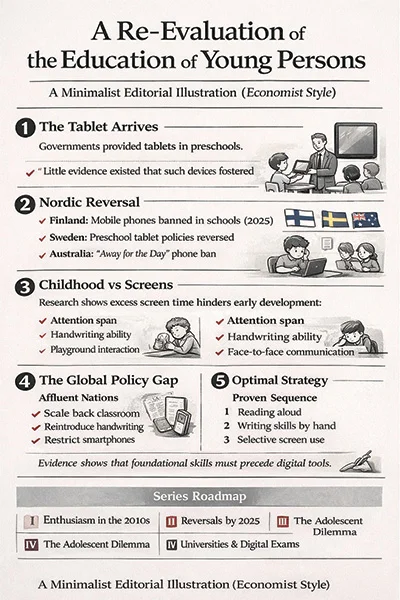 Australia’s approach to primary school digitalisation has been somewhat less ideologically charged than Scandinavia’s, and accordingly its reversal has been more pragmatic than philosophical. Australian states and territories arrived at phone bans largely through the accumulating pressure of parent complaints, teacher frustration and growing evidence that smartphones were damaging the social fabric of school life, not just in classrooms, but in playgrounds.
Queensland’s ‘away for the day’ policy, introduced in Term 1 of 2024, was notable precisely because it extended beyond lesson time to cover break times as well. This was a direct acknowledgement that the problem was not simply digital distraction during learning, it was the way that always-on connectivity was transforming childhood itself. Children who spend every break time on a phone are not playing, not resolving social conflicts face to face, not developing the unstructured social skills that primary school has always, if accidentally, taught.
The cyberbullying dimension added particular urgency in Australia, where research showed that many incidents of online harassment between primary-school children were occurring during school hours, facilitated by the phones sitting in their pockets. Banning the phone at the school gate did not solve the problem of online cruelty, but it did remove the school day as a venue for it.
The Science of the Pencil
The cognitive argument for handwriting in primary education is, it turns out, and far more interesting than the popular ‘screens bad, pencils good’ slogan suggests. The research on note-taking in university students, the finding that handwritten notes produce better conceptual understanding than typed notes, has a more fundamental parallel in primary education.
When a young child learns to write by hand, they are not merely practising a motor skill. They are encoding letters through physical movement, which activates memory systems that visual recognition alone does not reach. Studies in developmental psychology suggest that children who learn to write letters by hand recognise them faster and more accurately than those who learn through typing or tracing on screens. The hand, it appears, teaches the brain in ways the finger-swipe does not.
This does not mean that digital tools have no place in primary education, nobody sensible is arguing that children should graduate from primary school unable to use a keyboard. The question is sequencing and proportion. The emerging consensus, hard-won through a decade of failed experiments, is that foundational literacy and numeracy need to be established through analogue means before digital tools are introduced as supplements. Screens can follow pencils. Pencils, it turns out, cannot follow screens without catching up on what was missed.
The hand teaches the brain in ways the finger-swipe does not. And it took a decade of falling scores to rediscover this.
The Rest of the World Is Still Buying Tablets
Here is the uncomfortable part. While Finland legislates, Sweden reverses course and Australia bans phones from playgrounds, a large portion of the world’s primary schools are doing the opposite. Governments across South and Southeast Asia, Sub-Saharan Africa and Latin America are actively expanding device programmes in primary schools. Tablets are being distributed. Interactive whiteboards are being installed. AI tutoring apps are being piloted. The logic is identical to the logic Finland and Sweden followed 15 years ago: modernise, digitalise, equip children for the future.
The vendors selling these systems are not telling ministers about the Swedish U-turn. The development banks financing device programmes are not adjusting their models to reflect the OECD’s inverted-U curve. The international consultants advising education ministries are largely still working from a playbook written in 2010.
The lesson of the Nordic reversal is not that screens are evil, it is that screens at the wrong stage, in the wrong proportion, without the right pedagogical framework, undermine the very foundations they are supposed to build on. That lesson is available. The question is whether anyone is listening.
What Primary Schools Actually Need
Literacy and numeracy are not enhanced by early device saturation. They are built through reading aloud, through writing by hand, through mathematical reasoning with physical objects, and through the irreplaceable medium of a skilled teacher who knows their students.
Technology in primary education works best when it supplements a strong foundation, not when it substitutes for one that has not yet been built. Sweden and Finland did not fail because they used technology. They failed because they used it too extensively, and without asking what it was actually for. That question — what is this for? — is the one that every primary school system in the world should be asking before it signs another tablet contract.
SERIES ROADMAP Part I: From Ed-Tech Enthusiasm to De-Digitalisation | Part II: Phones, Pens & Early Literacy (this article) | Part III: Attention, Algorithms & Adolescents | Part IV: Universities, AI & the Handwritten Exam | Part V: A Critical Theory of Educational De-Digitalisation
(The writer, a senior Chartered Accountant and professional banker, is Professor at SLIIT, Malabe. The views and opinions expressed in this article are personal.)

Minister Bimal Rathnayake has urged all Sri Lankan refugees in India to return to Sri Lanka, stating that provision has been made for their reintegration. He called on India to grant citizenship to those who wished to stay on in India, but added that the government would welcome them back with both hands if they chose Sri Lanka. He gave due credit to the Organisation for Eelam Refugees Rehabilitation (OfERR), an NGO led by S. C. Chandrahasan, the son of S. J. V. Chelvanayakam, widely regarded as the foremost advocate of a federal solution and a historic leader of the Federal Party. OfERR has for decades assisted refugees, particularly Sri Lankan Tamils in India, with documentation, advocacy and voluntary repatriation support. Given the slow pace of resettlement of Ditwah cyclone victims, the government will need to make adequate preparations for an influx of Indian returnees for which it will need all possible assistance. The minister’s acknowledgement indicates that the government appreciates the work of NGOs when they directly assist people.
The issue of Sri Lankan refugees in India is a legacy of the three-decade long war that induced mass migration of Tamil people to foreign countries. According to widely cited estimates, the Sri Lankan Tamil diaspora today exceeds one million and is often placed between 1 and 1.5 million globally, with large communities in Canada, the United Kingdom and Australia. India, particularly Tamil Nadu, continues to host a significant refugee population. Current figures indicate that approximately 58,000 to 60,000 Sri Lankan Tamil refugees live in camps in India, with a further 30,000 to 35,000 living outside camps, bringing the total to around 90,000. These numbers have declined over time but remain one of the most visible human legacies of the conflict.
The fact that the government has chosen to make this announcement at this time indicates that it is not attempting to gloss over the human rights issues of the past that continue into the present. Those who suffered victimisation during the war may be encouraged that their concerns remain on the national agenda and have not been forgotten. Apart from those who continue to be refugees in India, there are more than 14,000 complaints of missing persons still under investigation according to the Office on Missing Persons, which has received tens of thousands of complaints since its establishment. There are also unresolved issues of land taken over by the military as high security zones, though some land has been released, and prisoners held in long term detention under the Prevention of Terrorism Act, which the government has pledged to repeal and replace.
Sequenced Response
In addressing the issue of Sri Lankan Tamil refugees in India, the government is sending a message to the Tamil people that it is not going to gloss over the past. The indications are that the government is sequencing its responses to problems arising from the past. The government faces a range of urgent challenges, some inherited from previous governments, such as war era human rights concerns, and others that have arisen more recently after it took office. The most impactful of these crises are not of its own making. Global economic instability has affected Sri Lanka significantly. The Middle East war has contributed to a shortage of essential fuels and fertilizers worldwide. Sri Lanka is particularly vulnerable to rising fuel prices. Just months prior to these global pressures, Sri Lanka faced severe climate related shocks, including being hit by a cyclone that led to floods and landslides across multiple districts and caused loss of life and extensive damage to property and livelihoods.
From the beginning of its term, the government has been compelled to prioritise economic recovery and corruption linked to the economy, which were central to its electoral mandate. As the International Monetary Fund has emphasised, Sri Lanka must continue reforms to restore macroeconomic stability, reduce debt vulnerabilities and strengthen governance. The economic problems that the government must address are urgent and affect all communities, whether in the north or south, and across Sinhalese, Tamil and Muslim populations. These problems cannot be postponed. However, issues such as dealing with the past, holding provincial council elections and reforming the constitution are not experienced as equally urgent by the majority, even though they are of deep importance to minorities. Indeed, the provincial council system was designed to address the concerns of the minorities and a solution to their problems.
Unresolved grievances tend to reappear in new forms when not addressed through political processes. Therefore, they need to be addressed sooner rather than later, even if they are not the most immediate priorities for the government. It must not be forgotten that the ethnic conflict and the three decade long war it generated was the single most destructive blow to the country, greatly diminishing its prospects for rapid economic development. Prolonged conflict reduced investment, diverted public expenditure and weakened institutions. If Sri Lanka’s early leaders had been able to negotiate peacefully and resolve their differences, the country might have fulfilled predictions that it could become the “Switzerland of the East.”
Present Opportunity
The present government has a rare opportunity to address the issues of the past in a way that ensures long term peace and justice. It has a two thirds majority in parliament, giving it the constitutional space to undertake significant reforms. It has also demonstrated a more inclusive approach to ethnic and religious minorities than many earlier governments which either mobilized ethnic nationalism for its own purposes or feared it too much to take political risks to undertake necessary reforms. Public trust in the government, as noted by international observers, remains relatively strong. During her recent visit, IMF Director General Kristalina Georgieva stated that “there is a window of opportunity for Sri Lanka,” noting that public trust in the government provides a foundation for reform.
It also appears that decades of public education on democracy, human rights and coexistence have had positive effects. This education, carried out by civil society organisations over several decades, sometimes in support of government initiatives and more often in the face of government opposition, provides a foundation for political reform aimed at justice and reconciliation. Civil society initiatives, inter-ethnic dialogue and rights-based advocacy have contributed to shaping a more informed public about controversial issues such as power-sharing, federalism and accountability for war crimes. The government would do well to expand the appreciation it has deservedly given to OfERR to other NGOs that have dedicated themselves addressing the ethnic and religious mistrust in the country and creating greater social cohesion.
The challenge for the government is to engage in reconciliation without undue delay, even as other pressures continue to grow. Sequencing is necessary, but indefinite postponement carries risks. If this opportunity for conflict resolution is not taken, it may be a long time before another presents itself. Sri Lanka may then continue to underperform economically, remaining an ethnically divided polity, not in open warfare, but constrained by unresolved tensions. The government’s recent reference to Tamil refugees in India is therefore significant. It shows that even while prioritising urgent economic and global challenges, it has not forgotten the past. Sri Lanka has a government with both the mandate and the capacity to address that past in a manner that secures a more stable and just future for all its people.
By Jehan Perera
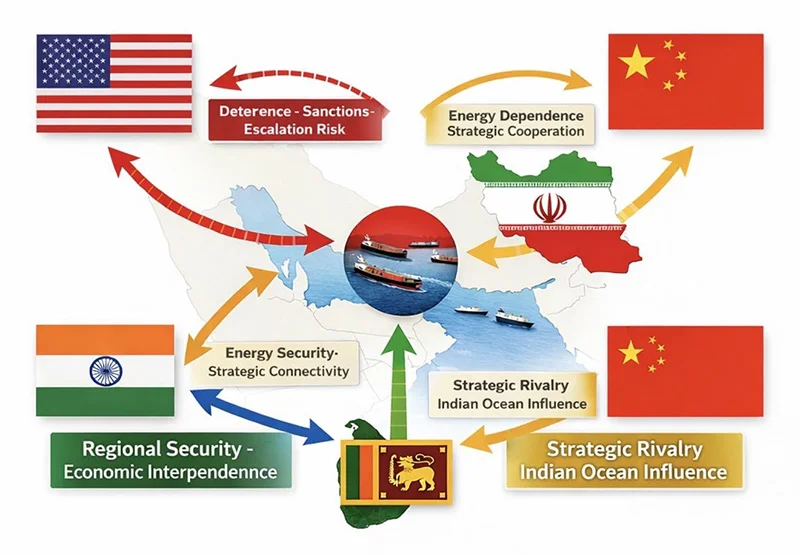
The unfolding tensions and diplomatic manoeuvres around the Strait of Hormuz offer more than a snapshot of regional instability. They reveal a deeper transformation in global statecraft, one where influence is exercised through calibrated engagement rather than outright confrontation. This is strategic diplomacy in its modern form: restrained, calculated, and layered with competing interests.
At first glance, the current developments may appear as routine diplomatic exchanges aimed at preventing escalation. However, beneath the surface lies a complex web of signalling among major and middle powers. The United States seeks to maintain deterrence without triggering an open conflict. Iran aims to resist pressure while avoiding isolation. Meanwhile, China and India, two rising powers with expanding global interests are navigating the situation with careful precision.
China’s position is anchored in economic pragmatism. As a major importer of Gulf energy, Beijing has a direct stake in ensuring that the Strait of Hormuz remains open and stable. Any disruption would reverberate through its industrial base and global supply chains. Consequently, China advocates de-escalation and diplomatic resolution. Yet, this is not purely altruistic. Stability serves China’s long-term strategic ambitions, including the protection of its Belt and Road investments and maritime routes. At the same time, Beijing remains alert to India’s growing diplomatic footprint in the region. Should India deepen its engagement with Iran and other Gulf actors, it could gradually reshape the strategic balance in areas traditionally influenced by China.
India’s approach, in contrast, reflects a confident and increasingly sophisticated foreign policy. By engaging Iran directly, while maintaining working relationships with Western powers, New Delhi is positioning itself as a credible intermediary. This is not merely about energy security, though that remains a key driver. It is also about strategic autonomy the ability to act independently in a multipolar world. India’s diplomacy signals that it is no longer a passive player but an active shaper of regional outcomes. Its engagement with Iran, particularly in the context of connectivity and trade routes, underscores its intent to secure long-term strategic access while countering potential encirclement.
Iran, for its part, views the situation through the lens of survival and strategic resilience. Years of sanctions and pressure have shaped a cautious but pragmatic diplomatic posture. Engagement with external actors, including India and China, provides Tehran with avenues to ease isolation and assert relevance. However, Iran’s trust deficit remains significant. Its diplomacy is transactional, focused on immediate gains rather than long-term alignment. The current environment offers opportunities for tactical advantage, but Iran is unlikely to make concessions that could compromise its core strategic objectives.
Even actors on the periphery, such as North Korea, are closely observing these developments. Pyongyang interprets global events through a narrow but consistent framework: regime survival through deterrence. The situation around Iran reinforces its belief that leverage, particularly military capability, is a prerequisite for meaningful negotiation. While North Korea is not directly involved, it draws lessons that may shape its own strategic calculations.
What emerges from these varied perspectives is a clear departure from traditional bloc-based geopolitics. The world is moving towards a more fluid and fragmented order, where alignments are temporary and issue-specific. States cooperate on certain matters while competing with others. This creates a dynamic but unpredictable environment, where misinterpretation and miscalculation remain constant risks.
It is within this evolving context that Sri Lanka’s strategic relevance becomes increasingly visible. The recent visit by the US Special Envoy for South and Central Asia, Sergio Gor, to the Colombo Port; is not a routine diplomatic courtesy call. It is a signal. Ports are no longer just commercial gateways; they are strategic assets embedded in global power competition. A visit of this nature underscores how Sri Lanka’s maritime infrastructure is being viewed through a geopolitical lens particularly in relation to sea lane security, logistics, and regional influence.
Such engagements reflect a broader reality: global powers are not only watching the Strait of Hormuz but are also positioning themselves along the wider Indian Ocean network that connects it. Colombo, situated along one of the busiest east–west shipping routes, becomes part of this extended strategic theatre. The presence and interest of external actors in Sri Lanka’s ports highlight an emerging pattern of influence without overt control a hallmark of modern strategic diplomacy.
For Sri Lanka, these developments are far from abstract. The island’s strategic location along major Indian Ocean shipping routes places it at the intersection of these global currents. The Strait of Hormuz is a vital artery for global energy flows, and any disruption would have immediate consequences for Sri Lanka’s economy, particularly in terms of fuel prices and supply stability.
Moreover, Sri Lanka must manage the competing interests of larger powers operating within its vicinity. India’s expanding regional role, China’s entrenched economic presence, and the growing attention from the United States all converge in the Indian Ocean. This requires a careful balancing act. Aligning too closely with any one power risks alienating others, while inaction could leave Sri Lanka vulnerable to external pressures.
The appropriate response lies in adopting a robust foreign policy that engages all major stakeholders while preserving national autonomy. This involves strengthening diplomatic channels, enhancing maritime security capabilities, and investing in strategic foresight. Sri Lanka must also recognise the growing importance of non-traditional security domains, including cyber threats and information warfare, which increasingly accompany geopolitical competition.
Equally important is the need for internal coherence. Effective diplomacy abroad must be supported by institutional strength at home. Policy consistency, professional expertise, and strategic clarity are essential if Sri Lanka is to navigate an increasingly complex international environment.
The situation in the Strait of Hormuz thus serves as both a warning and an opportunity. It highlights the fragility of global systems, but also underscores the potential for skilled diplomacy to manage tensions. For Sri Lanka, the challenge is not merely to observe these developments, but to position itself wisely within them.
In a world where power is no longer exercised solely through force, but through influence and presence, strategic diplomacy becomes not just an option, but a necessity. The nations that succeed will be those that understand this shift now and act with clarity, balance, and foresight.
Mahil Dole is a senior Sri Lankan police officer with over four decades of experience in law enforcement and intelligence. He previously served as Head of the Counter-Terrorism Division of the State Intelligence Service and has conducted extensive interviews with more than 100 suicide cadres linked to terrorist organisations. He is a graduate of the Asia-Pacific Centre for Security Studies (Hawaii).
By Mahil Dole
Senior Police Officer (Retd.), Former Head of Counter-Terrorism Division, State Intelligence Service, Sri Lanka

IPL captains’ meeting: What’s on the agenda?

Russia launches 948 drones at Ukraine in largest attack over 24-hour period

Oil at $150 will trigger global recession, says boss of financial giant BlackRock

Showers will occur at several places in the Western and Sabaragamuwa provinces and in Galle and Matara districts after 2.00 pm

Senior citizens above 70 years to receive March allowances on Thursday (26)

CEB Engineers warn public to be prepared for power cuts after New Year

‘Dates have the highest sugar content to fight Coronavirus’

Sunday Island 27 December – Headlines

#SundayIsland 17th December – Headlines

Sunday Island – 28th March

Sunday Island Headlines – 21 March

Sunday Island – 21st February – Headlines
-

 Features2 days ago
Trincomalee oil tank farm: An engineering marvel
-

 News6 days ago
Bailey Bridge inaugurated at Chilaw
-

 News5 days ago
CIABOC tells court Kapila gave Rs 60 mn to MR and Rs. 20 mn to Priyankara
-

 News6 days ago
Pay hike demand: CEB workers climb down from 40 % to 15–20%
-
 Features5 days ago
Science and diplomacy in a changing world
-

 News4 days ago
Colombo, Oslo steps up efforts to strengthen bilateral cooperation in key environmental priority areas
-

 Features2 days ago
The scientist who was finally heard
-

 News2 days ago
Substandard coal deepens energy crisis, warns former CEB Chief