
Midweek Review
Dr. Jaishankar drags H’tota port to reverberating IRIS Dena affair

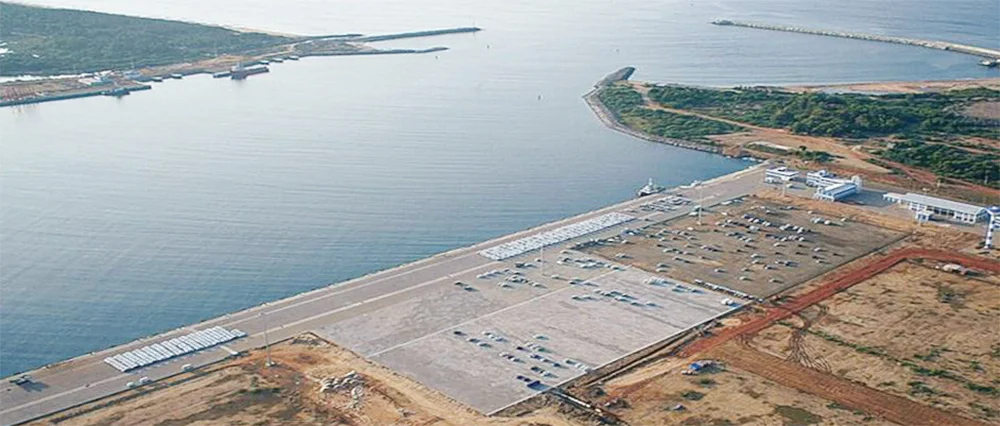
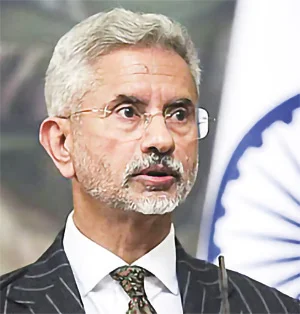
Indian Foreign Minister Dr. S. Jaishankar recognised Hambantota harbour as a Chinese military facility that underlined intimidating foreign military presence in the Indian Ocean. Jaishankar was responding to queries regarding India’s widely mentioned status as the region’s net security provider against the backdrop of a US submarine blowing up an Iranian frigate IRIS Dena, off Galle, within Sri Lanka’s Exclusive Economic Zone.
This happened at the Raisina Dialogue 2026 (March 5 to 7) in New Delhi. Raisina Dialogue was launched in 2016, three years after Narendra Modi became the Prime Minister.
The query obviously rattled the Indian Foreign Minister. Urging the moderator, Ms. Pakli Sharma Ipadhyay, to understand, what he called, the reality of the Indian Ocean, Dr. Jaishankar pointed out the joint US-British presence at Diego Garcia over the past five decades. Then he referred to the Chinese presence at Djibouti in East Africa, the first overseas Chinese military base, established in 2017, and Chinese takeover of Hambantota port, also during the same time. China secured the strategically located port on a 99-year lease for USD 1.2 bn, under controversial circumstances. China succeeded in spite of Indian efforts to halt Chinese projects here, including Colombo port city.
The submarine involved is widely believed to be Virginia-class USS Minnesota. The crew, included three Australian Navy personnel, according to international news agencies. However, others named the US Navy fast-attack submarine, involved in the incident, as USS Charlotte.
Diego Garcia is responsible for military operations in the Middle East, Africa and the Indo-Pacific. Dr. Jaishankar didn’t acknowledge that India, a key US ally and member of the Quad alliance, operated P8A maritime patrol and reconnaissance flights out of Diego Garcia last October. The US-India-Israel relationship is growing along with the US-Sri Lanka partnership.
The Indian Foreign Minister emphasised the deployment of the US Fifth Fleet in Bahrain, one of the countries that had been attacked by Iran, following the US-Israeli assassination of Iranian Supreme Leader, and key government functionaries, in a massive surprise attack, aiming at a regime change there. The Indian Minister briefly explained how they and Sri Lanka addressed the threat on three Indian navy vessels following the unprovoked US-Israeli attacks on Iran. Whatever the excuses, the undeniable truth is, as Sharma pointed out, that the US attack on the Iranian frigate took place in India’s backyard.
Sri Lankan Foreign Minister Vijitha Herath who faced Sharma before Dr. Jaishankar, struggled to explain the country’s position. Dr. Jaishankar made the audience laugh at Minister Herath’s expense who repeatedly said that Sri Lanka would deal with the situation in terms of the UN Convention on the Law of the Sea (UNCLOS) and international laws. Herath should have pointed out that Hambantota was not a military base and couldn’t be compared, under any circumstances, with the Chinese base in Djibouti.
Typical of the arrogant Western power dynamics, the US never cared for international laws and President Donald Trump quite clearly stated their position.
Israel is on record as having declared that the decision to launch attacks on Iran had been made months ago. Therefore, the sinking of the fully domestically built vessel that was launched in 2021 should be examined in the context of overall US-Israeli strategy meant to break the back of the incumbent Islamic revolutionary government and replace it with a pro-Western regime there as had been the case after the toppling of the democratically elected government there, led by Prime Minister Mossadegh, in August, 1953.
US Defence Secretary Pete Hegseth declared that IRIS Dena “thought it was safe in international waters’ but died a quiet death.” A US submarine torpedoed the vessel on the morning of March 4, off Galle, within Sri Lanka’s exclusive economic zone and that decision must have been made before the IRIS Dena joined International Fleet Review (IFR) and Exercise Milan 2026, at Visakhapatnam, from February 15 to 25.
The sinking of the Iranian vessel, a Moudge –class frigate attached to Iran’s southern fleet deployed in the Gulf of Oman and Strait of Hormuz, had been calculated to cause mayhem in the Indian Ocean. Obviously, and pathetically, Iran failed to comprehend the US-Israeli mindset after having already been fooled with devastating attacks, jointly launched by Washington and Tel Aviv against the country’s nuclear research facilities, while holding talks with it on the issue last June. Had they comprehended the situation they probably would have pulled out of the IFR and Milan 2026. Perhaps, Iran was lulled into a false sense of security because they felt the US wouldn’t hit ships invited by India. The US Navy did not participate though the US Air Force did.
The US action dramatically boosted Raisina Dialogue 2026, but at India’s expense. Prime Minister Modi’s two-day visit to Tel Aviv, just before the US-Israel launched the war to effect a regime change in Teheran, made the situation far worse. BJP seems to have decided on whose side India is on. But, the US action has, invariably, humiliated India. That cannot be denied. The Indian Navy posted a cheery message on X on February 17, the day before President Droupadi Murmu presided over IFR off the Visakhapatnam coast. “Welcome!” the Indian Navy wrote, greeting the Iranian warship IRIS Dena as it steamed into the port of Visakhapatnam to join an international naval gathering. Photographs showed Iranian sailors and a grey frigate gliding into the Indian harbour on a clear day. The hashtags spoke of “Bridges of Friendship” and “United Through Oceans.”
US alert
Dr. Jaishankar
Altogether, three Iranian vessels participated in IFR. In addition to the ill-fated IRIS Dena, the second frigate IRIS Lavan and auxiliary ships IRIS Bushehr comprised the group. Dr. Jaishankar disclosed at the Raisina Dialogue 2026 that Iran requested India to allow IRIS Lavan to enter Indian waters. India accommodated the vessel at Cochin Port (Kochi Port) on the Arabian Sea in Kerala.
At the time US torpedoed IRIS Dena, within Sri Lanka’s EEZ, IRIS Lavan was at Cochin port. Sri Lanka’s territorial waters extend 12 nautical miles (approximately 22 km) from the country’s coastline. The US hit the vessel 19 nautical miles off southern coastline.
Sri Lanka, too, participated in IFR and Milan 2026. SLN Sagara (formerly Varaha), a Vikram-class offshore patrol vessel of the Indian Coast Guard and SLN Nandimithra, A Fast Missile Vessel, acquired from Israel, participated and returned to Colombo on February 27, the day before IRIS Lavan sought protection in Indian waters.
Although many believed that Sri Lanka responded to the attack on IRIS Dena, following a distressed call from that ship, the truth is it was the Indo-Pacific Command (INDOPACOM) that alerted the Maritime Rescue Coordination centre (MRCC) after blowing it up with a single torpedo. The SLN’s Southern Command dispatched three Fast Attack Craft (FACs) while a tug from Sri Lanka Ports Authority (SLPA) joined later.
The INDOPACOM, while denying the Iranian claim that IRIS Dena had been unarmed at the time of the attack, emphasised: “US forces planned for and Sri Lanka provided life-saving support to survivors in accordance with the Law of Armed Conflict.” In the post shared on X (formerly Twitter) the US has, in no uncertain terms, said that they planned for the rescuing of survivors and the action was carried out by the Sri Lanka Navy.
IRIS Lavan and IRIS Bushehr are most likely to be held in Cochin and in Trincomalee ports, respectively, for some time with the crews accommodated on land. With the US-Israel combine vowing to go the whole hog there is no likelihood of either India or Sri Lanka allowing the ships to leave.
Much to the embarrassment of the Modi administration, former Indian Foreign Secretary Kanwal Sibal has said that IRIS Dena would not have been targeted if Iran was not invited to take part in IFR and Milan naval exercise.
“We were the hosts. As per protocol for this exercise, ships cannot carry any ammunition. It was defenseless. The Iranian naval personnel had paraded before our president,” he said in a post on X.
Sibal argued that the attack was premeditated, pointing out that the US Navy had been invited to the exercise but withdrew at the last minute, “presumably with this operation in mind.”
Sibal added that the US ignored India’s sensitivities, as the Iranian ship was present in the waters due to India’s invitation.
He stressed that India was neither politically nor militarily responsible for the US attack, but carried a moral and humanitarian responsibility.
“A word of condolence by the Indian Navy (after political clearance) at the loss of lives of those who were our invitees and saluted our president would be in order,” Sibal said.
Iran and even India appeared to have ignored the significance of USN pullout from IFR and Milan exercise at the eleventh hour. India and Sri Lanka caught up in US-Israeli strategy are facing embarrassing questions from the political opposition. Both Congress and Samagi Jana Balwegaya (SJB), as well as Sri Lanka Podujana Peramuna (SLPP), exploited the situation to undermine respective governments over an unexpected situation created by the US. Both India and Sri Lanka ended up playing an unprecedented role in the post-Milan 2026 developments that may have a lasting impact on their relations with Iran.
The regional power India and Sri Lanka also conveniently failed to condemn the February 28 assassination of Iranian Supreme Leader Ayatollah Ali Khamenei, while that country was holding talks with the US, with Oman serving as the mediator.
Condemning the unilateral attack on Iran, as well as the retaliatory strikes by Iran, Leader of the Opposition in the Lok Sabha and Congress leader Rahul Gandhi on Tuesday (March 3, 2026) questioned India’s silence on the Middle East developments.
In a post on social media platform X, Gandhi said Prime Minister Narendra Modi must speak up. “Does he support the assassination of a Head of State as a way to define the world order? Silence now diminishes India’s standing in the world,” he said.
Under heavy Opposition fire, India condoled the Iranian leader’s assassination on March 5, almost a week after the killing. Foreign Secretary Vikram Misri met the Iran Ambassador in Delhi and signed the condolence book, though much belatedly.
SL-US relations
The Opposition questioned the NPP government’s handling of the IRIS Dena affair. They quite conveniently forgot that any other government wouldn’t have been able to do anything differently than bow to the will of the US. Under President Trump, Washington has been behaving recklessly, even towards its longtime friends, demanding that Canada become its 51st state and that Denmark handover Greenland pronto.
SJB and Opposition leader Sajith Premadasa cut a sorry figure demanding in Parliament whether Sri Lanka had the capacity to detect submarines or other underwater systems. Sri Lanka should be happy that the Southern Command could swiftly deploy three FACs and call in SLPA tug, thereby saving the lives of 32 Iranians and recovering 84 bodies of their unfortunate colleagues. Therefore, of the 180-member crew of IRIS Dena, 116 had been accounted for. The number of personnel categorised as missing but presumably dead is 64.
There is no doubt that Sri Lanka couldn’t have intervened if not for the US signal to go ahead with the humanitarian operation to pick up survivors. India, too, must have informed the US about the Iranian request for IRIS Lavan to re-enter Indian waters. Sri Lanka, too, couldn’t have brought the Iranian auxiliary vessel without US consent. President Trump is not interested in diplomatic niceties and the way he had dealt with European countries repeatedly proved his reckless approach. The irrefutable truth is that the US could have torpedoed the entire Iranian group even if they were in Sri Lankan or Indian Exclusive Economic Zone (EEZ) that extends to 200 nautical miles from its coastline.
In spite of constantly repeating Sri Lanka’s neutrality, successive governments succumbed to US pressure. In March 2007, Mahinda Rajapaksa’s government entered into Acquisition and Cross- Servicing Agreement (ACSA) with the US, a high profile bilateral legal mechanism to ensure uninterrupted support/supplies. The Rajapaksas went ahead with ACSA, in spite of strong opposition from some of its partners. In fact, they did not even bother to ask or take up the issue at Cabinet level before the then Defence Secretary Gotabaya Rajapaksa, a US citizen at the time, and US Ambassador here Robert O. Blake signed it. Close on the heels of the ACSA signing, the US provided specific intelligence that allowed the Sri Lanka Navy to hunt down four floating LTTE arsenals. Whatever critics say, that US intervention ensured the total disruption of the LTTE supply line and the collapse of their conventional fighting capacity by March 2009. The US favourably responded to the then Vice Admiral Wasantha Karannagoda’s request for help and the passing of intelligence was not in any way in line with ACSA.
That agreement covered the 2007 to 2017 period. The Yahapalana government extended it. Yahapalana partners, the SLFP and UNP, never formally discussed the decision to extend the agreement though President Maithripala Sirisena made a desperate attempt to distance himself from ACSA.
It would be pertinent to mention that the US had been pushing for ACSA during Rail Wickremesinghe’s tenure as the Premier, in the 2001-2003 period. But, he lacked the strength to finalise that agreement due to strong opposition from the then Opposition. During the time the Yahapalana government extended ACSA, the US also wanted the Status of Forces Agreement (SOFA) signed. SOFA, unlike ACSA, is a legally binding agreement that dealt with the deployment of US forces here. However, SOFA did not materialise but the possibility of the superpower taking it up cannot be ruled out.
Gotabaya Rajapaksa, who won the 2019 presidential election, earned the wrath of the US for declining to finalise MCC (Millennium Challenge Corporation) Compact on the basis of Prof. Gunaruwan Committee report that warned that the agreement contained provisions detrimental to national security, sovereignty, and the legal system. In the run up to the presidential election, UNP leader Ranil Wickremesinghe declared that he would enter into the agreement in case Sajith Premadasa won the contest.
Post-Aragalaya setup
Since the last presidential election held in September 2024, Admiral Steve Koehler, a four-star US Navy Admiral and Commander of the US Pacific Fleet visited Colombo twice in early October 2024 and February this year. Koehler’s visits marked the highest-level U.S. military engagement with Sri Lanka since 2021.
Between Koehler’s visits, the United States and Sri Lanka signed a Memorandum of Understanding (MoU) formalising the defence partnership between the Montana National Guard, the US Coast Guard District 13, and the Sri Lanka Armed Forces under the Department of War’s State Partnership Programme (SPP). The JVP-led NPP government seems sure of its policy as it delayed taking a decision on one-year moratorium on all foreign research vessels entering Sri Lankan waters though it was designed to block Chinese vessels. The government is yet to announce its decision though the ban lapsed on December 31, 2024.
The then President Ranil Wickremesinghe was compelled to announce the ban due to intense US-Indian pressure.
The incumbent dispensation’s relationship with US and India should be examined against allegations that they facilitated ‘Aragalaya’ that forced President Gotabaya Rajapaksa out of office. The Trump administration underscored the importance of its relationship with Sri Lanka by handing over ex-US Coast Guard Cutter ‘Decisive ‘to the Sri Lanka Navy. The vessel, commanded by Captain Gayan Wickramasooriya, left Baltimore US Coast Guard Yard East Wall Jetty on February 23 and is expected to reach Trincomalee in the second week of May.
Last year Sri Lanka signed seven MoUs, including one on defence and then sold controlling shares of the Colombo Dockyard Limited (CDL) to a company affiliated to the Defence Ministry as New Delhi tightened its grip.
Sri Lanka-US relations seemed on track and the IRIS Dena incident is unlikely to distract the two countries. The US continues to take extraordinary measures to facilitate war on Iran. In a bid to overcome the Iranian blockade on crude carriers the US temporarily eased sanctions to allow India to buy Russian oil.
Treasury Secretary Scott Bessent declared a 30-day waiver was a “deliberate short-term measure” to allow oil to keep flowing in the global market. The US sanctioned Russian oil following Moscow’s invasion of Ukraine, forcing buyers to seek alternatives.
The US doesn’t care about the Ukraine government that must be really upset about the unexpected development. India was forced to halt buying Russian oil and now finds itself in a position to turn towards Russia again. But that would be definitely at the expense of Iran facing unprecedented military onslaught.
By Shamindra Ferdinando

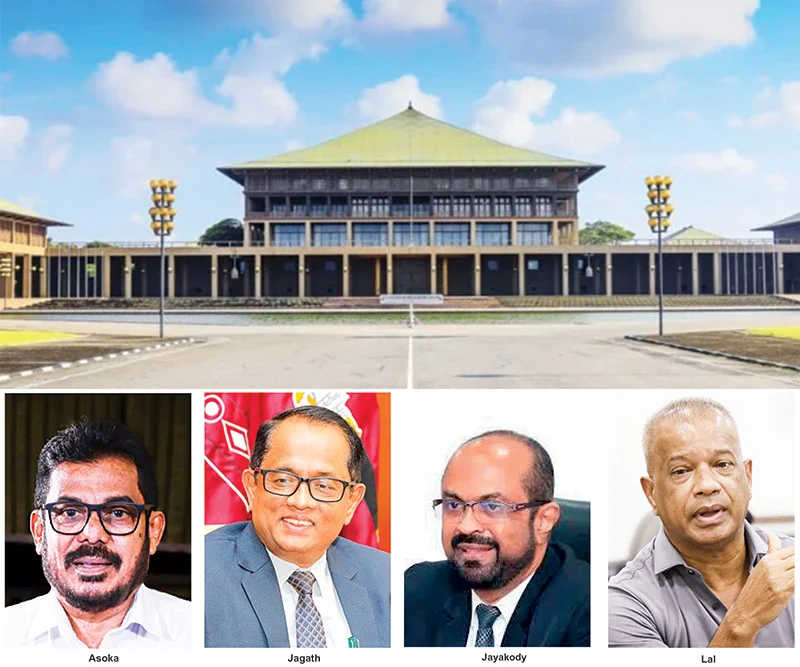
During the recent debate on the No-Confidence Motion (NCM) against Energy Minister Kumara Jayakody, Illankai Thamil Arasu Kadchi (ITAK) Batticaloa District lawmaker, Shanakiyan Rajaputhiran Rasamanickam, warned that the next NCM would be moved against Fisheries Minister Ramalingham Chandrasekaran. Rasamanickam accused the National List member of corruption, a charge vehemently denied by the NPPer. The NPP/JVP needs to initiate an internal inquiry before corruption allegations overwhelm the party that received the full advantage of Aragalaya to transform the outfit from just a three-member parliamentary group, in 2024, to a staggering 159, a year later. The UNP and SLFP led alliances were dealt harshly by the electorates for want of action to curb corruption. Today, the UNP and SLFP are not represented in Parliament, while the SLPP, that secured 145 seats at the 2020 general election, was reduced to just three with its parliamentary group leader Namal Rajapaksa entering Parliament through the National List. Rajapaksa junior obviously feared to face the Hambantota electorate at the last general election. That is the undeniable truth.
By Shamindra Ferdinando
The ongoing controversy over Agriculture, Lands, Irrigation and Livestock Minister K.D. Lal Kantha’s three-storeyed luxury house has intensified pressure on the Janatha Vimukthi Peramuna (JVP)-led National People’s Power (NPP) government struggling to cope-up with the devastating coal scam, blamed on Energy Minister Kumara Jayakody forcing him to resign.
Jayakody, one of those who financed the NPP/JVP campaign in the run-up to the 2024 national polls ,resigned on 17 April, along with Prof. Udayanga Hemapala, Secretary to the Energy Ministry. Their resignations happened eight months after the Frontline Socialist Party (FSP), a breakaway faction of the JVP, revealed the alleged coal scam. The Lal Kantha affair received significant public attention though the primary issue at hand is the massive coal scam that ripped through the government.
Jayakody will continue as a National List member of the ruling party. The NPP/JVP won an unprecedented 159 seats, including 18 National List slots at the November 2024 parliamentary elections.
The Opposition dismissed government claims that the resignations were meant to facilitate the Presidential Commission of Inquiry into the procurement of coal, since the commissioning of the country’s only coal-fired power plant during the onset of Mahinda Rajapaksa’s second term. In the wake of the much delayed resignations, NPP/JVP heavyweight Foreign Minister Vijitha Herath, addressing the media at the Information Department, pathetically vouched for Jayakody’s integrity.
Let us discuss the accusations directed at Lal Kantha who had served the SLFP-led Cabinet for a short period, years ago, in terms of an agreement between the SLFP and the JVP. Lal Kantha had never been accused of corruption and was, in fact, one of those lawmakers who raised the issue both in and outside Parliament. Political parties may have forgotten that the UNP got rid of Lacille de Silva, Director General of Administration, Parliament, during Ranil Wickremesinghe’s premiership, in the 2001-2003 period, alleging he passed on information to Lal Kantha to attack the government.
The NPP Executive Committee member, as well as JVP politburo and Central Committee heavyweight, has publicly defended his right to own a luxury house amidst a section of the social media pushing for police investigation into the lawmaker’s wealth.
Unlike the owner/owners of the mysterious Malwana mansion, built on a 16-acre land overlooking the Kelani river, Lal Kantha didn’t try to disclaim the house ownership at Jusse Road, Welivita, in the Kaduwela area. The Malwana house was built towards the end of Mahinda Rajapaksa’s second term as the President. The hullabaloo over the ownership of the Malwana mansion, and construction costs, dominated the 2015 presidential election campaign. On the basis of the Malwana mansion, the UNP and the JVP built a strong case against the Rajapaksas, accusing the family of corruption.
It would be of pivotal importance that the JVP backed Maithripala Sirisena’s 2015 presidential polls candidature. The campaign was built on an anti-corruption platform that earned the appreciation of the public who disregarded the unprecedented development work successfully carried out by the Rajapaksas, while also fighting a war to defeat the most ruthless terrorist organisation that was out to break up the country.
During a US-India backed violent protest campaign, in March-July 2022, an organised gang set the stately Malwana mansion ablaze. The general consensus was that the Malwana mansion belonged to Basil Rajapakasa, though he vehemently denied having anything to do with it.
Yahapalana Justice Minister Dr. Wijeyadasa Rajapakshe, PC, is on record as having declared that the Malwana mansion would be renovated and used to accommodate a state institution. Lal Kantha’s newly acquired wealth has to be examined and discussed, taking into consideration his long standing claim that as a fulltime member of the JVP he entirely depended on his wife’s monthly salary and help provided by friends and associates. If that was the case, Lal Kantha couldn’t have ended up among the richest group of politicians, within less than two years after the last presidential election, held in September 2024.
Lal Kantha couldn’t have been unaware of the possibility of the Opposition, particularly the Sri Lanka Podujana Peramuna (SLPP), attacking him and the NPP/JVP over his Kaduwela house. Responding to critics, the Anuradhapura District lawmaker has claimed, on YouTube, that he sold a property he owned in Anuradhapura and used that money to acquire the Jusse Road land.
The outspoken Minister is also on record as having said that the existence of his new house, to which he moved in late 2024, was disclosed by him. However, incisive Youtuber Dharma Sri Kariyawasam has claimed that he made the revelation on 01 October, 2025, while another You-Tuber, Abeetha Edirisinghe, rammed up pressure on the NPP by lodging a complaint with the police, via the special number 1818. Edirisinghe’s SL Leaders YouTube posted a video of him lodging the complaint.
What made the complaint really interesting was Edirisinghe’s declaration based on ‘Dark Room’ YouTube allegations that wealthy businessman Nissanka Senadhipathi, who had been one of the closest associates of the Rajapaksas, provided the wherewithal required to acquire land, build and then furnish the Jusse Road mansion. Defending his position, Lal Kantha claimed that he acquired a piano for his daughter, about 15 years ago, while declaring he enjoyed the capacity to raise large sums of funds if necessary. A smiling Lal Kantha explained how he could effortlessly collect Rs 500,000 each from 100 associates/friends. Programmes posted by Dharma Sri Kariyawasam and Abeetha Edirisinghe are must-watch for those genuinely interested in knowing the explosive story, from different angles.
Close on the heels of debates on Lal Kantha’s mansion, the media reported the Minister’s last available asset declaration, sent to the Commission to Investigate Allegations of Bribery or Corruption (CIABOC), dealt with over Rs 80 mn worth of property, vehicles and gold, etc. The JVP heavyweight’s annual income has stunned even the staunchest supporters of the ruling party. Lal Kantha, through his lawyer, demanded Rs 10 bn in damages from ‘Hiru’ for wrongly estimating his properties, etc., at Rs 460 mn.
Both Dharma Sri Kariyawasam and Abeetha Edirisinghe propagated that police wanted the public to complain to special the number 1818, created to accept such complaints in case they felt suspicious about newly acquired property, regardless of who owned them.
Unexpected disclosure of Lal Kantha’s unprecedented wealth obviously stunned the public who genuinely believed in the unshakable NPP/JVP stand on corruption. Lal Kantha, who had joined the JVP in 1982, before becoming a full time member, in 1987, had no qualms in defending his new lifestyle, having repeatedly and bitterly complained about the difficulties experienced by him and his family.
In his defence, Lal Kantha emphasised that he hadn’t been accused of robbing the taxpayer or public sector corruption. However, the NPP/JVP all-out attack on all previous governments, over waste, corruption, irregularities and mismanagement, and branding all their MPs corrupt, cannot adopt such a stance. The Kaduwela mansion has sent shockwaves through the electorate. Dharma Sri Kariyawasam, in his response to Lal Kantha, repeatedly stressed that his wealth was being questioned by those who exercised their franchise in support of the NPP/JVP at the national elections and Local Government polls, in 2025.
Growing public resentment over what various interested parties, including the NPP/JVP called ill-gotten wealth of members and henchmen of previous governments fuelled Aragalaya (31 March-14 July 2022). Those who set houses and other property, belonging to various then government politicians and their associates ablaze, operated on the presumption that they were beneficiaries of ill-gotten wealth. The NPP/JVP powered the campaign, alongside the breakaway JVP faction, styled as Peratugami Pakshaya (Frontline Socialist Party) as well as the UNP.
Ranwala and others
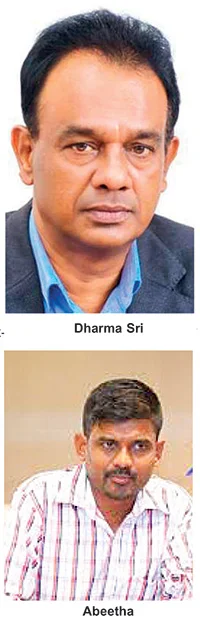 Against the backdrop of Auditor General Samudrika Jayarathne’s devastating report on coal procurement for the 2025/2026 period and Lal Kantha’s declaration that he owned a three-storeyed house, the resignation of Asoka Ranwala, as the Speaker of Parliament, over his failure to prove his declared academic qualifications seemed uncalled for. Jayarathne signed that report on behalf of the National Audit Office (NAO).
The Gampaha District MP resigned on 13 December, 2024, just 22 days after being appointed the Speaker. The main Opposition Samagi Jana Balawegaya (SJB) relentlessly attacked Ranwala over his fabricated or unverified educational qualifications, specifically a Ph.D. from a Japanese university and a degree from the University of Moratuwa.
The NPP/JVP tried to defend Ranwala but quickly succumbed to SJB pressure. We never managed to establish whether Ranwala resigned on his own accord or the NPP/JVP asked him to resign to save the party. Similarly, the resignations of Energy Minister Jayakody and Prof. Hemapala, who cut a sorry figure before the Committee on Public Enterprises (COPE) recently, must have been demanded by the ruling party. Had the NPP bosses acted prudently, much earlier, after he was indicted before the Colombo High Court on a previous corruption case, they could have easily asked Jayakody to resign his ministerial portfolio before the Parliament debated the no-confidence motion against him.
Another case that really embarrassed the ruling party was accusations directed at Dr. Jagath Wickremeratne, who succeeded Ranwala as House Speaker. The Polonnaruwa District MP was the next to face fire, following a dispute with the Deputy Secretary General of Parliament Chaminda Kularatne who is also the Chief of Staff of the House. Kularatne hit back hard after Parliament sacked him over alleged irregularities. In a petition, dated 2 February, 2026, sent to CIABOC, Kularatne disclosed the circumstances the Speaker reacted angrily after he brought to the NPPer’s notice illegal actions and corruption, as well as his (Kularatne) recommendation in his capacity as the Right to Information (RTI) officer, to release certain information sought by civil society activists. Kularatne further claimed that the situation deteriorated further over an incident that happened on 18 June, 2025, or a date closer to that date, in the room where Speaker Wickremeratne had his lunch. Kularatne refrained from revealing the incident.
There hadn’t been a previous instance of a senior parliamentary official moving the CIABOC against the Speaker. The allegations directed at the Speaker, in respect of abuse of vehicles, taking two fuel allowances, misuse of equipment belonging to the Media Unit of Parliament, inadequate payment for lunch obtained for Chameera Gallage, Speaker’s private secretary, who had lunch with him, illegal payments made to retired Ministry Additional Secretary S.K. Liyanage, who was appointed to inquire into Kularatne’s conduct, suppression of release of information in terms of RTI, and uncalled for interventions in administration.
Kularatne’s complaint to the CIABOC failed to result in an expeditious inquiry, though a complaint lodged against a sacked parliamentary official appeared to have received much more attention. The NPP has responded cautiously to Kularatne vs Wickremeratne battle as pressure mounted on the ruling party over the coal scam that threatened to cause further increase in already unbearable electricity tariffs. The Auditor General’s report, in no uncertain terms, has implicated the Energy Ministry and Lanka Coal Company in the sordid operation that resulted in low-grade coal ending up at the Lakvijaya coal-fired power plant that earlier met about 30 to 40% percent of the country’s power requirements at essentially low cost, barring hydroelectricity.
The report declared that the term tender for the supply of coal was awarded to Trident Champhar, an Indian company that hadn’t been registered at the time it bid for Sri Lanka’s largest tender and procedures in respect of loading and unloading the cargo. To make matters worse, Minister Jayakody, who had been implicated in the coal scam, was recently indicted on corruption charges in the High Court of Colombo. There hadn’t been a previous instance of a sitting member of the Cabinet being indicted for corruption. Therefore, the NPP government cannot be happy over its steamroller majority in Parliament having defeated the no-confidence motion moved against Jayakody who remained confident in the parliamentary group’s support at the behest of the top party leadership.
The NPP/JVP finds itself in an extremely embarrassing and pitiful situation over the coal scam. The damning report issued by the Auditor General pertaining to the coal scam has to be examined taking into consideration the failure on the part of the government and the Constitutional Council to reach a consensus on filling the vacant Auditor General’s post in 2025. The post of Auditor General remained vacant from early April 2025 to early February 2026.
Role of NAO
The NAO functions as an independent body answerable to Parliament. The recent NAO report that dealt with coal procurement exposed the utterly corrupt system in place, regardless of assurances given by the government. The report proved that irregularities can be perpetrated and corrupt practices continued, regardless of assurances given by the current dispensation.
Over the past several years, tangible measures were taken to strengthen the NAO. Parliament certified the National Audit (Amendment) Act, No. 19 of 2025 on 22 September, 2025. That act introduced reforms meant to enhance public sector accountability, enforce audit findings, and streamline the surcharge process. The no nonsense report proved that in spite of interference and undue influence exerted on the NAO, those responsible did their job without fear or favour.
SJB lawmaker Mujibur Rahman, during the debate on the no-confidence motion against Minister Jayakody, alleged in Parliament that COPE (Committee on Public Enterprises) Chairman Dr. Nishantha Samaraweera directly intervened when the NAO was in the process of finalising the report. The former UNPer called for an investigation to establish whether the Galle District NPP MP visited the NAO on several days to meet those handling the investigation.
We are not aware whether the COPE Chief, who called for the NAO to inquire into allegations in respect of coal procurement, visited the NAO.
However, the NAO report on the coal scam, now available online for all to study, underscores the pivotal importance of the anti-corruption fight.
In September 2025, the SJB asked the CIABOC to probe how some NPP/JVP Ministers amassed so much property. The SJB raised the issue with the focus on Trade, Commerce, Food Security and Cooperative Development Minister Wasantha Samarasinghe (like Lal Kantha, he, too, represents the Anuradhapura District) amassed Rs 275 mn. The SJB’s complaint to CIABOC sought investigations on Ministers Sunil Handunetti, Bimal Rathnayake, Dr. Nalinda Jayathissa and Kumara Jayakody, and Deputy Minister Sunil Watagala.
Lal Kantha, who has now acknowledged having as much as Rs 80 mn worth property, was not among the lawmakers targeted by the SJB. Having falsely propagated an anti-corruption campaign to deceive the public, the NPP/JVP stand literally exposed before the public. The coal scam and Lal Kantha fiasco have caused irreparable damage to such an extent, their anti-corruption campaigns may not carry any weight with the public at future elections.
‘… where the world has not been broken up into fragments by narrow domestic walls; ….
Where the clear stream of reason has not lost its way into the dreary desert sand of dead habit;
Where the mind is led forward….into ever-widening thought and action…’
With wide apologies, I am going to put snatches of that poem into more dreary uses, though not quite desert sand.
What are those narrow domestic walls which break up the world into fragments? Languages.
Amiya reads the Gitanjali but does not read the Tirukkural. Hong Li reads Kong Fut Ze’s Analects but not Plato’s Republic. Paul reads Miton’s Paradise Lost but not Njal Saga. Sarath Kumara reads Wickremasinghe’s satva santatitya but not Darwin’s Origin of the Species. Ngidi does not read Thomas Picketty’s Capital in the 20th Century or Anthony Atkinson’s Inequality at all. Hirono uses Large Language Models to do homework but Rasolomanana has not seen a computer. And so on and so forth. The world is broken into fragments by languages, but not by languages alone. The daughter of a rich black man living in Howard County in Maryland goes to Stanford but a brown dweller in Dharavi cannot enter Jawaharlal Nehru University. The lesson is that it is not only languages or orthodoxies that break up the world into ‘fragments’ but also many other barriers, about one of which Tagore sang.
Language is a marvellous ‘invention’ of nature well cultivated by humans. No other species has the faculty to use language to know. Ludwig Wittgenstein expressed it epigrammatically, ‘whereof one cannot speak, thereof one must be silent.’ It is language that carries forth knowledge. It is not only language that carries forth knowledge: mathematics, in its own right, is a powerful carrier of knowledge. One can write something simple like if x-y=0, then x=y, as well as whole pages of complex and complicated arguments using mathematical notations. Mathematics may and often does write nature and about nature; it also writes about things that exist only in the mind. That is not different from languages: heaven and Vishnu exist in some minds but not in others or elsewhere. Galileo Galilei learnt ‘Nature is an open book but it is written in mathematics’. Much of nature is a closed book to those to whom mathematics is alien territory. But today, I am interested in how some languages ‘break the world into fragments by domestic walls’, while a few others fly about regardless. When a team from India played cricket with a team from Pakistan a few weeks back, the commentary was broadcast in India in 14 languages and in Nigeria national news is read in several languages. That same game of cricket also was broadcast to the rest of the world in one language: English.
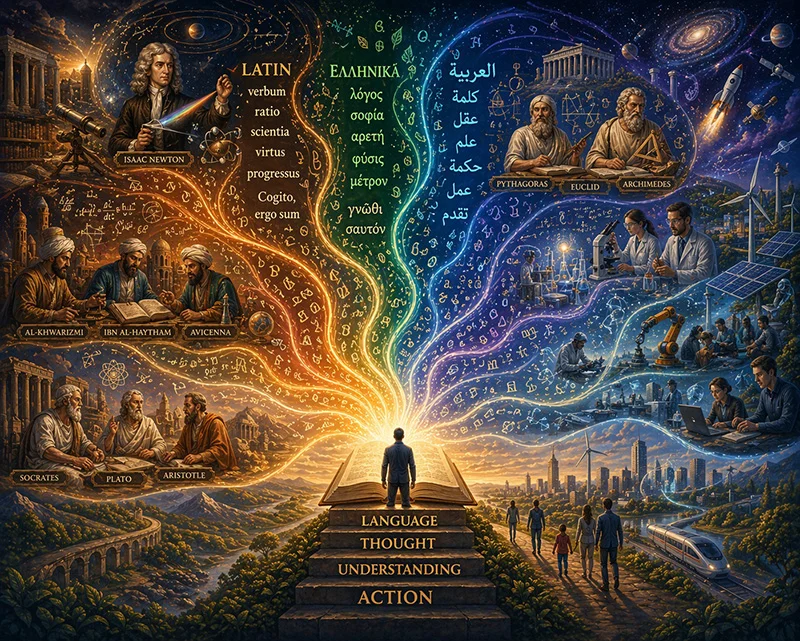
When and how do some languages come to ‘lead the mind forward into ever widening thought and action’? The transformation occurs when users of one language become conquerors and rulers of peoples using other languages and when the users of a language become generators of new knowledge which are eagerly sought after by users of other languages. Greek, Latin and Arabic contributed mightily to the vocabulary of modern Western European languages. When new ideas in law, government, philosophy, medicine and science had to be expressed, they went to Greek, Latin or Arabic. Consequently, you will bump into Greek terms the moment you begin thinking about those disciplines. The serious study of Greek was introduced to England by Erasmus (of Rotterdam) about 1500 AC. The use of Latin began with the Roman Empire but took on new functions when Latin became the vehicle carrying Christianity east and north (of Europe) and elsewhere later. Until about the 18th century AC Latin was the language of learning in most of Europe. At its inception, Manchester Grammar School was a Latin school and the Boston Latin School which started in 1635 still thrives in that name. The two medieval universities in England were mostly seminaries teaching in Latin well into the 19th century. A wide swathe of languages is written with the Latin alphabet: European languages from the Black Sea to the Atlantic and from the North Sea to the Mediterranean, America from Canada to Chile, sub-Saharan Africa including Togo, and Indonesian, Malaysian and several others. The exodus of Jewish, Arabic and other scholars, after the fall of Constantinople (1453) to the Ottomans, brought Greek and Arabic to Western Europe including England. From about the 14 to the 18th century, European indigenous vernaculars grew to be carriers of new knowledge, especially in sciences. Luther’s reformation and the development of German had much in common. Gutenberg’s new printing press (1450 AC) helped the growth of European vernaculars and the spread of reformed Christianity.
Four western European languages stood out as both conquerors and carriers of new knowledge: Portuguese, Spanish, French and English. Arabic performed the same function from about 800 AC to the 13 AC when that language carried a new religion and new knowledge in mathematics, astronomy and medicine. Arabic replaced the indigenous languages in the entire Maghreb. The language of governance and learning from Mexico south to Chile is Spanish with Brazil using Portuguese and are collectively called Latin America, because Portuguese, Spanish, French, Italian and Romanian are Romance or Latin Languages. French is the language of governance and learning in several parts of West Africa. English was a phenomenon in itself. It destroyed the use of hundreds of languages in North America. It conquered almost half the world and English is the language of governance and higher education in a good part of the land it once ruled. As a language carrying new knowledge, English excels all others. As the collapse of four European empires, including the Ottoman, went on from about 1915 to about 1960, English, which produced new knowledge faster than any other, began to break ‘domestic walls’, the world over. China, which had little love for the English-speaking world, had millions of its citizens schooled in the US, the UK, Canada and Australia during the last 30 years and continues to do so, to date. In contrast, during that time how many rushed to Niger to learn Fulfulde or to Lanka to study Sinhala? The prominence of English was promoted by two other processes: one was translation into English of major works in other languages and the other the growth of a class of indigenous writers and readers in the conqueror’s language. One reads Oblomov, Gilgamesh and, indeed, Gitanjali translated into English. India now probably has more readers in English than any other single country. Persons in Western African countries have crafted in French and English, masterpieces in fiction, poetry and drama. Modern European languages have been both conquerors’ languages and carriers of new knowledge.
Several people recently have written in The Island and in Lankadeepa about the importance of using the ‘mother tongue’. They have stressed the importance of the ‘mother tongue’ in creative writing. As with observations regarding empirical phenomena, it is necessary to test those generalisations against reality. Samskrt is a language not entirely unfamiliar to many in this land. Samskrt was nobody’s mother tongue. (After all, it is deva bhaashitam.) There is not a shred of evidence that Kalidasa’s mother talked to him in Samskrt. But Kalidasa wrote rtusmahara and shakuntalam.. The vedas and upanishads were first spoken and later written in samskrt. Pali is nobody’s mother tongue but Theravada writings are almost entirely in that language. Isaac Newton wrote Principia Mathematica in Latin; we have no evidence that baby Isaac babbled in Latin. Paul Dirac wrote about particle physics in mathematics rather than in his father’s beloved French. Leopold Senghor’s mother tongue was not French nor Chinua Achebe’s English. More casually, check your own libraries. I had a collection of about 2,300 books until last year. There weren’t even 200 written in Sinhala and that 200 included editions of works from the 13th century. Check how many books written in Sinhala and English you bought in the last two years. There were far too many writers and scientists who brought forth highly acclaimed work in languages other than their mother tongue, contradicting the argument that the mother tongue was essential or even desirable for original work, in science or in literature.
Most languages ‘break the world into narrow fragments’. A few coagulate them into large masses: 900 million people speak Mandarin and 325 million, Bengali. A half dozen bind themselves together speaking a conqueror’s language. Four languages stand out as having ‘led the ‘mind forward into ever-widening thought and action’: Greek, Latin, Arabic and English. English, so far, is unrivalled.
by Usvatte-aratchi
There was this elevating sight,
Of a young woman and man,
Tying the reverential ‘knot’,
With the registrar and retinue in tow,
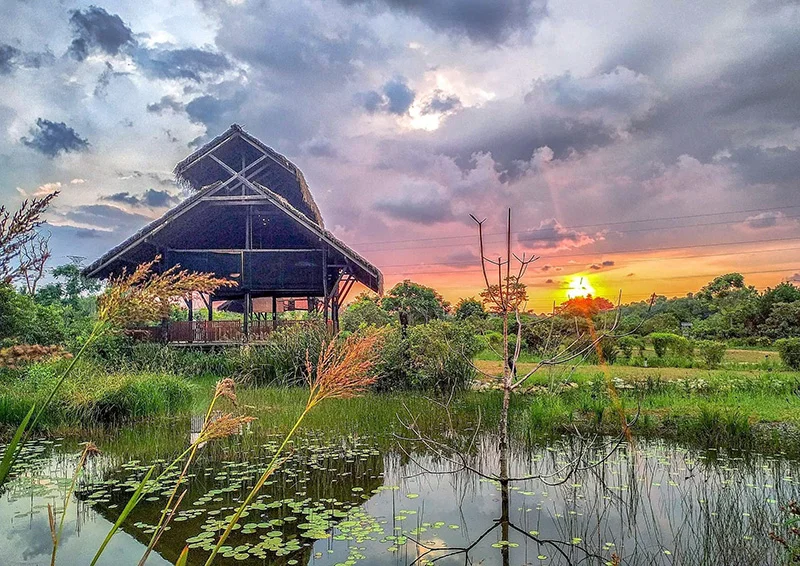
Amid the silently pulsating beauty,
Of the suburban ‘Diyasaru Park’,
Famous as the Concrete Jungle’s lung,
Where microbes take the long journey,
To jousting, snarling animal life,
And they kept it small, simple and smart,
With a practical sense on saving rupees,
Combining with the drive to unite as one.
By Lynn Ockersz

Opposition holds NPP Cabinet responsible for coal scam, three times bigger than bond fraud

Case against Yoshitha and Daisy Forrest postponed

Three-judge bench rejects request by ex-IGP Pujith

Johnston gets bail after four months

Thousands of pets affected by Avurudu firecrackers; over 10,000 cases of trauma reported

Inadequate LPG price hike compels the vulnerable to subsidize the wealthy: Advocata Institute

‘Dates have the highest sugar content to fight Coronavirus’

Sunday Island 27 December – Headlines

#SundayIsland 17th December – Headlines

Sunday Island – 28th March

Sunday Island Headlines – 21 March

Sunday Island – 21st February – Headlines
-
 News4 days ago
Rs 13 bn NDB fraud: Int’l forensic audit ordered
-

 Opinion5 days ago
Shutting roof top solar panels – a crime
-

 News6 days ago
From Nuwara Eliya to Dubai: Isha Holdings markets Agri products abroad
-

 News1 day ago
No cyber hack: Fintech expert exposes shocking legacy flaws that led to $2.5 million theft
-

 News2 days ago
Lanka faces crisis of conscience over fate of animals: Call for compassion, law reform, and ethical responsibility
-
 News1 day ago
Whistleblowers ask Treasury Chief to resign over theft of USD 2.5 mn
-
 News5 days ago
Church calls for Deputy Defence Minister’s removal, establishment of Independent Prosecutor’s Office
-
 Life style6 days ago
After dark in Sri Lanka: Tiny wild cats step into the spotlight